Author: Denis Avetisyan
New results from the ALICE experiment reveal how short-lived particles can illuminate the final moments of heavy-ion collisions and probe the structure of exotic hadrons.
Analysis of hadronic resonances in both proton-proton and heavy-ion collisions provides insights into the late-stage dynamics of the Quark-Gluon Plasma and the non-perturbative regime of Quantum Chromodynamics.
Understanding the dynamics of strongly coupled matter created in relativistic heavy-ion collisions requires detailed investigation of the late stages of the collision. This is addressed in ‘Exploring the hadronic phase with momentum and azimuthal distribution of short-lived resonances and understanding the internal structure of exotic resonances with ALICE’, which presents new measurements of short-lived hadronic resonances and exotic states produced in Pb-Pb collisions at 5.36 TeV. By analyzing the production yields, spectra, and flow harmonics of these resonances, the ALICE collaboration reveals sensitivities to the properties of the late-hadronic phase and provides insight into the internal structure of potentially multi-quark states. What further constraints on the equation of state and non-perturbative QCD can be gleaned from a comprehensive multi-resonance analysis?
Unveiling the Primordial State: Recreating the Early Universe
At the Large Hadron Collider, physicists recreate the conditions thought to have existed mere microseconds after the Big Bang through ultra-relativistic heavy-ion collisions. By smashing ions like lead at energies of 5.36 TeV – trillions of electron volts – they generate temperatures exceeding those found in the sun’s core, effectively melting protons and neutrons into a state of matter known as the Quark-Gluon Plasma. This incredibly hot and dense environment allows quarks and gluons, normally confined within hadrons, to roam freely, offering a unique window into the strong force that governs their interactions. The fleeting existence of this plasma, lasting only a tiny fraction of a second, presents a formidable experimental challenge, requiring precise measurements of the particles produced in these collisions to unravel its fundamental properties and confirm predictions from the theory of Quantum Chromodynamics.
Theoretical predictions from Quantum Chromodynamics (QCD) suggest that under extreme temperatures and densities, matter transitions into a state where quarks and gluons are no longer confined within hadrons, but exist as a deconfined plasma – the Quark-Gluon Plasma (QGP). However, directly observing and characterizing this state presents a significant challenge. Because the QGP is inherently unstable, it exists only for fleeting moments – on the order of 10-23 seconds – and at extraordinarily high temperatures, exceeding trillions of degrees Celsius. This necessitates indirect investigation through the analysis of the numerous particles produced when heavy ions collide, demanding sophisticated experimental techniques and theoretical modeling to reconstruct the QGP’s properties from these decay products and infer its behavior under such extreme conditions.
Characterizing the quark-gluon plasma necessitates a meticulous examination of the particles produced in ultra-relativistic heavy-ion collisions, with a particular focus on short-lived resonances. These resonances, such as the K*(892)^0 meson which exists for a mere 4.16 femtometers per unit of the speed of light, act as sensitive probes of the QGP’s fleeting existence. Because of their incredibly short lifetimes, the production and decay of these particles are significantly influenced by the dense medium of the plasma, providing insights into its temperature, density, and transport properties. Any suppression or modification of these resonances relative to expectations from proton-proton collisions signals interactions within the QGP, allowing physicists to map its characteristics and test the predictions of quantum chromodynamics in an extreme environment.
Resonances as Messengers: Deciphering the Hadronic Phase
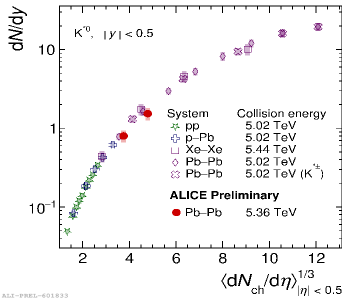
Hadronic resonances, including the K*(892)^0, \Phi(1020), and \rho(770)^0, are produced in abundance during the final stages of heavy-ion collisions. These short-lived particles serve as probes of the quark-gluon plasma (QGP) formed in these collisions, as their interactions with the dense hadronic medium provide information about its properties. Specifically, the yields and spectral distributions of these resonances are modified due to in-medium effects like absorption and re-scattering. Analyzing these modifications allows researchers to characterize the temperature, density, and collective flow of the QGP, offering insights into the nature of strongly coupled matter.
The production and characteristics of hadronic resonances in heavy-ion collisions are modified by interactions with the created medium. Rescattering, where a resonance interacts with other particles and loses information about its initial state, and regeneration, where resonances are created from other particles, both influence the observed yields and spectra. The extent of these effects is strongly dependent on the resonance’s lifetime; resonances with shorter lifetimes, such as the \rho(770) meson (mean lifetime of 1.3 fm/c), are more susceptible to these in-medium modifications and thus provide a more direct probe of the conditions present in the very early stages of the collision. Longer-lived resonances, conversely, are more likely to be affected by the later, cooler stages and may not accurately reflect the initial conditions.
Identification of short-lived hadronic resonances relies heavily on the invariant-mass technique and analysis of transverse momentum (p_T) spectra. The invariant-mass technique reconstructs the mass of a decaying particle from its daughter products, allowing for the separation of the resonance signal from the underlying background. This is particularly important for resonances with narrow widths. Analysis of p_T spectra provides information about the resonance’s production mechanism and allows for the determination of its flow coefficients, which are sensitive to the interaction of the resonance with the surrounding medium. Accurate reconstruction and characterization require high-statistics data and careful consideration of detector effects and background contributions; statistical significance is often determined by calculating a signal-to-background ratio and assessing the probability of observing the peak due to chance fluctuations.
Modeling the Hadronic Environment: Theoretical Tools for Interpretation
Hydrodynamic models and hadronic transport models represent complementary approaches to simulating the quark-gluon plasma (QGP) created in heavy-ion collisions. Hydrodynamic models, treating the QGP as a fluid, effectively describe the collective behavior and rapid thermalization observed in experiments, utilizing equations of viscous hydrodynamics to evolve the system from initial conditions to hadronization. These models typically focus on the early, strongly-coupled phase. Conversely, hadronic transport models, such as Boltzmann transport equation solvers, simulate the interactions of hadrons and resonances after the QGP has cooled and hadronized. They excel at describing the late stages of the collision, including particle rescattering and the formation of the final state particles. Combining these approaches – often through hybrid models – allows researchers to capture the complete evolution from the initial high-energy density state to the observed hadronic spectrum, providing a more comprehensive understanding of the QGP’s properties and dynamics.
Lattice Quantum Chromodynamics (Lattice QCD) calculations offer first-principles determinations of the Quark-Gluon Plasma (QGP) equation of state, including parameters such as temperature and baryon chemical potential. These calculations discretize spacetime into a four-dimensional lattice, allowing for non-perturbative solutions to QCD. Specifically, they provide insights into thermal quantities like pressure and energy density as a function of temperature, crucial for understanding the QGP’s phase transition. Furthermore, Lattice QCD informs the properties of hadronic resonances formed within the QGP, including their masses and decay widths, which are essential inputs for models describing hadronization. These calculations are typically performed on large-scale computing facilities due to the significant computational demands, and ongoing efforts focus on reducing systematic uncertainties and extending the calculations to include dynamical quarks with lighter masses.
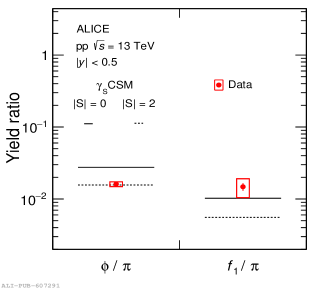
The γs-Canonical Statistical Model predicts the yields of hadronic resonances produced in heavy-ion collisions by applying the principles of statistical mechanics to a grand canonical ensemble. This approach assumes that at the time of freeze-out, interactions are frequent enough to establish a thermal and chemical equilibrium, allowing for the calculation of particle multiplicities based on conserved charges and the freeze-out temperature. Refinement of the model’s parameters, including the temperature and strangeness fugacity, relies heavily on data from collisions at specific energies; recent studies at 13.6 TeV proton-proton and 5.36 TeV lead-lead collisions are particularly important for constraining these parameters and improving the model’s predictive power, especially for resonance production which provides sensitivity to the late stages of the collision.
Beyond the Conventional: Exotic Hadrons and the Strong Force
The conventional understanding of hadrons – particles composed of quarks bound by the strong force – posits them as either baryons (three quarks) or mesons (a quark-antiquark pair). However, the persistent search for exotic hadrons – tetraquarks (four quarks), glueballs (bound states of gluons), and meson-meson molecular states – indicates that this picture may be incomplete. These newly observed particles don’t fit neatly into the established framework, suggesting that the strong force allows for more complex arrangements than previously thought. Investigating their properties – mass, spin, decay modes – forces physicists to refine existing models of quantum chromodynamics (QCD) and explore the possibility of multi-quark states and novel binding mechanisms within the nucleus, potentially revealing entirely new aspects of matter at its most fundamental level.
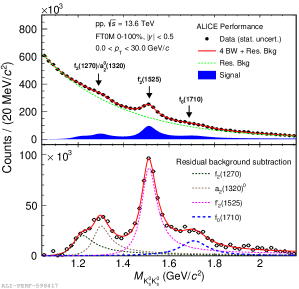
Certain observed resonances – notably f0(980), f2(1270), f2′(1525), and f0(1710) – have consistently appeared as strong candidates for being pure glueballs, particles composed entirely of gluons rather than the usual quarks. Identifying these states is exceptionally difficult, as their predicted decay patterns often overlap with those of conventional mesons. Physicists analyze their production rates in various collisions and meticulously examine their decay channels, hoping to discern unique signatures that would confirm their glueball nature. The challenge lies in differentiating a true glueball from a tightly bound quark-antiquark state with exotic quantum numbers, or even a four-quark state mimicking a glueball’s properties. Ongoing research, including precise measurements of their masses, spins, and decay modes, continues to refine the understanding of these enigmatic particles and their potential role in the fundamental structure of matter.
A comprehensive understanding of the strong interaction, the force binding quarks and gluons within hadrons, requires investigation beyond the well-established particles like the Ks0 and Phi(1020). These conventional resonances serve as crucial benchmarks when exploring the properties of newly discovered exotic hadrons – tetraquarks, glueballs, and molecular states. By meticulously comparing the characteristics of these exotic states to those of their more familiar counterparts, physicists can begin to map the complex landscape of the strong force and refine theoretical models. This comparative approach allows for a more nuanced determination of how quarks and gluons combine to form observable particles, potentially revealing previously unknown aspects of quantum chromodynamics and the fundamental nature of matter.
Charting the Future: Precision and Modeling in Quark-Gluon Plasma Research
Refining the characterization of the quark-gluon plasma (QGP) demands increasingly precise measurements of the particles produced in heavy-ion collisions, particularly short-lived resonances. These resonances, created and decaying within the QGP, act as sensitive probes of its temperature, density, and collective flow. Analyzing the yields and spectra of these particles – how many are created and their energy distribution – using models like the Blast-Wave Model and the Scalar Product Method allows physicists to reconstruct the conditions present during the QGP’s fleeting existence. The Blast-Wave Model, for instance, simulates the expansion of the QGP as a collective ‘blast’ of particles, while the Scalar Product Method extracts information about the flow velocity. Combining these analytical tools with high-precision data enables a more detailed understanding of the QGP’s properties and evolution, pushing the boundaries of knowledge about this exotic state of matter and the strong force that governs it.
Advancing our comprehension of the quark-gluon plasma (QGP) necessitates ongoing refinement of theoretical frameworks like Lattice Quantum Chromodynamics (Lattice QCD) and hydrodynamic models. Current simulations often simplify the transition from the QGP to the hadronic phase – the realm of protons, neutrons, and other composite particles – which limits the accuracy of predictions. Future progress hinges on incorporating more realistic descriptions of this crucial phase, accounting for the complex interactions and decay dynamics of numerous hadronic species. These advancements will not only improve the fidelity of model calculations but also enable researchers to extract more meaningful insights from experimental data, ultimately painting a more complete picture of the strong force and the fundamental constituents of matter at extreme temperatures and densities.
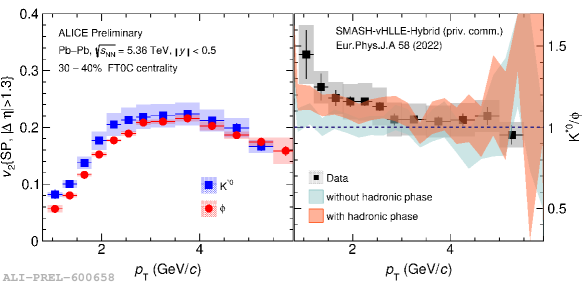
Recent investigations into the collective behavior of the quark-gluon plasma (QGP) reveal that the flow patterns of different resonances – subatomic particles created in the aftermath of heavy-ion collisions – are not uniform. Specifically, the differing elliptic flow, denoted as v_2, observed between the short-lived K*(892)0 (with a lifetime of 4.16 fm/c) and the comparatively long-lived ϕ(1020) (lifetime 46 fm/c) indicates that the QGP’s influence is sensitive to a particle’s decay time. This disparity suggests that the strong force, which governs interactions within the QGP, affects particles differently based on how quickly they cease to exist. Further exploration of this interplay between well-established resonances and potentially exotic ones promises to unveil a more nuanced understanding of the strong force’s properties and, ultimately, the fundamental building blocks of matter that comprise all visible reality.
The study of hadronic resonances, as detailed in this paper, reveals a complex interplay between initial conditions and late-time dynamics within the quark-gluon plasma. This echoes Thomas Kuhn’s observation that “the more novel and revolutionary an idea, the more closely it will be scrutinized and resisted.” The ALICE collaboration’s meticulous reconstruction of these short-lived particles, and their subsequent analysis of momentum and azimuthal distributions, represents a challenge to established understandings of particle behavior in extreme conditions. The subtle signals extracted from heavy-ion collisions require a shift in perspective, much like Kuhn’s paradigm shifts, to fully appreciate the non-perturbative nature of QCD and the internal structure of exotic hadrons. Good architecture is invisible until it breaks, and only then is the true cost of decisions visible.
The Road Ahead
The exploration of hadronic resonances, as presented, reveals a curious truth: the late stages of heavy-ion collisions are not merely a chaotic dispersal, but a subtle arena where even short-lived particles retain a memory of the initial conditions. However, the reliance on resonance reconstruction – a process inherently susceptible to systematic uncertainties – necessitates a parallel development of complementary probes. A deeper understanding requires disentangling final-state effects from genuine modifications to the resonance properties, a task demanding both experimental precision and theoretical ingenuity.
The quest to illuminate the internal structure of exotic hadrons – glueballs, hybrids, and beyond – highlights a persistent tension. Observing these states is only the first step; establishing their quantum numbers remains a formidable challenge. Future progress hinges on combining resonance studies with other sensitive observables, such as radiative decays and angular correlations, to map the complex landscape of non-perturbative Quantum Chromodynamics. The pursuit of these exotic states is not simply about discovering new particles, but about refining the very foundations of strong interaction theory.
Ultimately, this work serves as a reminder that simplicity is often elusive. Modifying one aspect of the collision system – the energy, the centrality, the observed particle – triggers a cascade of effects throughout the entire system. The challenge now lies in building a coherent framework that can account for this intricate interplay, moving beyond isolated observations towards a holistic understanding of the quark-gluon plasma and the strong force itself.
Original article: https://arxiv.org/pdf/2601.09777.pdf
Contact the author: https://www.linkedin.com/in/avetisyan/
See also:
- Elon Musk’s Mom Maye Musk Shares Her Parenting Philosophy
- GBP CNY PREDICTION
- Mark Zuckerberg & Wife Priscilla Chan Make Surprise Debut at Met Gala
- Forza Horizon 6 Car List So Far: Confirmed Highlights, Cover Cars, DLC, and Rewards
- 10 Greatest Manga Endings of All Time
- Elon Musk’s Ex Ashley St. Clair Reveals When Romance Became “Weird”
- 38 Years Later, Murder, She Wrote’s Most Overlooked Episode Still Pulls Off TV’s Greatest Crossover
- 10 Best Free Games on Steam in 2026, Ranked
- Hollow Knight: Silksong Guide – All 30 Lost Flea Locations
- 20 K-Dramas That Nailed the Perfect Ending
2026-01-16 13:16