Author: Denis Avetisyan
Researchers pushed the boundaries of dark matter detection with a highly sensitive haloscope experiment, refining the search for axions-hypothetical particles that could make up the universe’s missing mass.
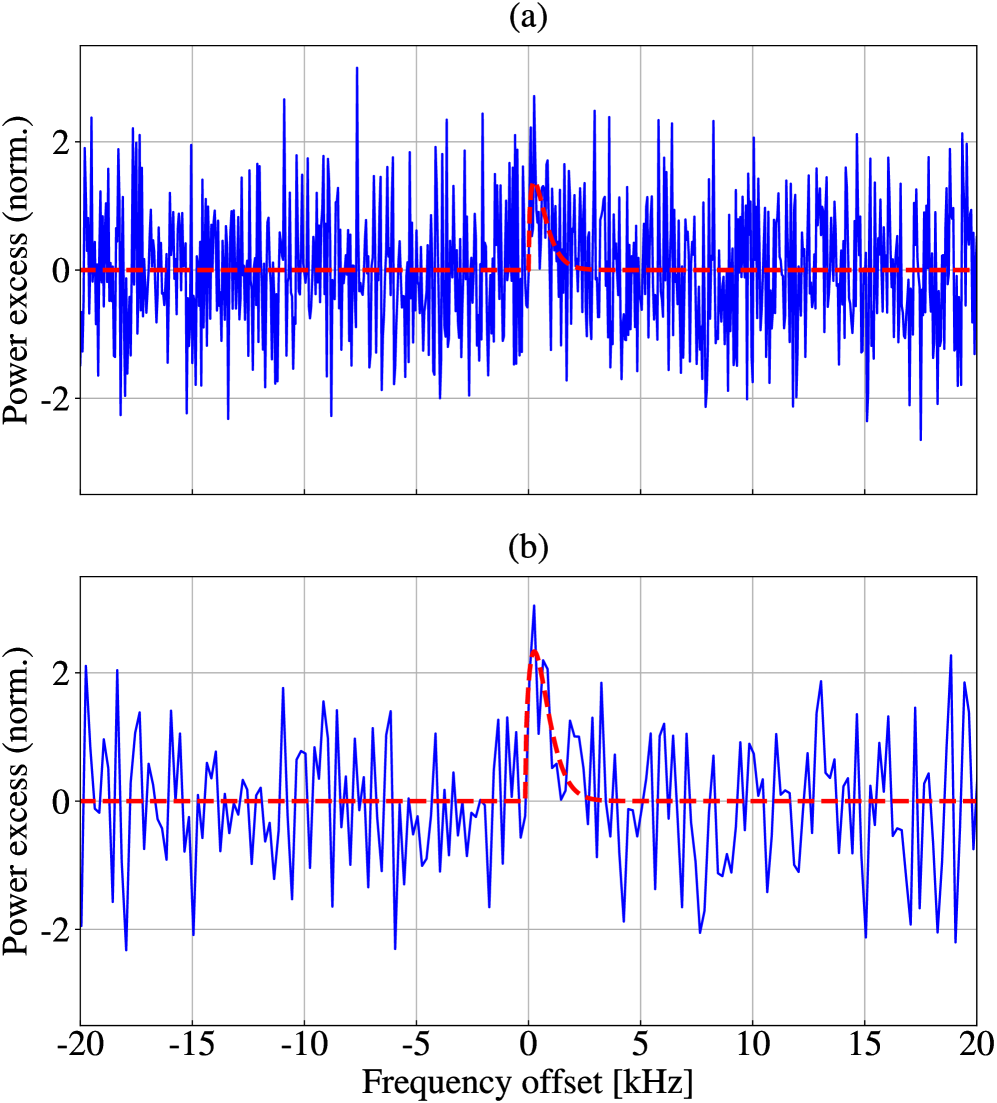
This study details an extended search for axions near 1.036 GHz, establishing new upper limits on their potential interaction with photons and validating techniques for future dark matter haloscope experiments.
Despite growing evidence for dark matter, its fundamental nature remains elusive, motivating searches for weakly interacting candidates like the axion. This work, ‘Extended Haloscope Search and Candidate Validation near 1.036 GHz’, details a follow-up investigation utilizing a microwave cavity haloscope, prompted by an initial excess of signal near 1.036 GHz which ultimately proved non-persistent. While no axion signal was confirmed, the experiment achieved sensitivity approaching the Dine-Fischler-Srednicki-Zhitnitsky benchmark and established improved upper limits on the axion-photon coupling between 1.026 and 1.045 GHz. As haloscope searches push towards discovery, how can robust validation strategies be further refined to distinguish genuine signals from systematic artifacts?
The Whispers of Missing Mass
The cosmos reveals a startling discrepancy: visible matter – stars, galaxies, and everything directly observable – accounts for only a small fraction of the universe’s total mass. Observations of galactic rotation curves, gravitational lensing, and the cosmic microwave background consistently indicate that approximately 85% of the universe is composed of a mysterious substance known as dark matter. Despite extensive research, the fundamental nature of this elusive component remains unknown; it doesn’t interact with light or other electromagnetic radiation, rendering it invisible to conventional detection methods. Scientists theorize that dark matter is likely composed of particles distinct from those comprising ordinary matter, prompting a search for weakly interacting massive particles (WIMPs) or other exotic candidates. Understanding dark matter is therefore one of the most pressing challenges in modern cosmology, potentially reshaping our comprehension of the universe’s structure, evolution, and ultimate fate.
The enduring mystery of dark matter has spurred investigation into numerous potential candidates, with the axion emerging as a particularly compelling possibility. These hypothetical particles are theorized to be extraordinarily lightweight – billions of times smaller than an electron – and interact with ordinary matter through an incredibly weak coupling to photons. This faint interaction, while challenging to detect, provides a potential ‘smoking gun’ signature: in the presence of a strong magnetic field, axions could convert into detectable microwave photons. The predicted frequency of these photons is linked to the axion’s mass, offering a pathway to not only confirm their existence but also to determine their properties. Consequently, the search for axions represents a significant frontier in particle physics, potentially illuminating the composition of a substantial portion of the universe and resolving one of cosmology’s most persistent puzzles.
The quest to identify dark matter necessitates experimental setups of unprecedented sensitivity, particularly in the realm of microwave detection. Because leading candidates, like axions, are theorized to interact with photons in incredibly subtle ways, researchers are constructing experiments designed to tease out these vanishingly small signals from a cacophony of background noise. These experiments, often employing powerful magnetic fields and meticulously shielded environments, aren’t simply improvements on existing technology; they represent a fundamental push at the limits of what is currently measurable. The challenge lies not only in amplifying the potential signal but also in eliminating any spurious contribution-from terrestrial radio waves to cosmic radiation-that could mimic the faint whispers of dark matter interactions. This drive for enhanced sensitivity is spurring innovation in superconducting resonators, quantum sensors, and data analysis techniques, ultimately advancing the frontiers of precision measurement beyond the scope of initial dark matter investigations.
Resonant Echoes of the Invisible
Axion haloscopes function on the principle that axions, hypothetical weakly interacting massive particles (WIMPs), can convert into photons in the presence of a strong magnetic field. This conversion, governed by the g_{a\gamma} coupling constant representing the strength of the axion-photon interaction, is maximized within a resonant cavity. The cavity is designed to enhance the amplitude of photons at the expected frequency corresponding to the axion mass. Specifically, axions traversing the magnetic field within the cavity can virtually excite two photons, and if the cavity’s resonant frequency matches the energy of these photons, a measurable signal can be generated. The expected signal strength is extremely weak, necessitating sensitive detection methods; however, the cavity effectively increases the probability of photon detection by confining and amplifying the generated microwave radiation.
Resonant microwave haloscopes utilize a high-Q cavity to enhance the exceedingly weak signal generated by the conversion of axions into photons. The cavity is designed to resonate at the expected frequency of the axion signal, effectively amplifying the photon flux through constructive interference. A cavity’s quality factor, or Q, is a dimensionless parameter that describes how well it stores energy; higher Q values indicate lower energy loss rates and, consequently, a stronger resonant signal. Precise tuning of the cavity’s resonant frequency to the predicted axion mass range is crucial for maximizing the probability of signal detection, as even small deviations can significantly reduce the observed power. The cavity geometry and material properties are optimized to achieve both a high Q and a volume sufficient to interact with a substantial number of axions.
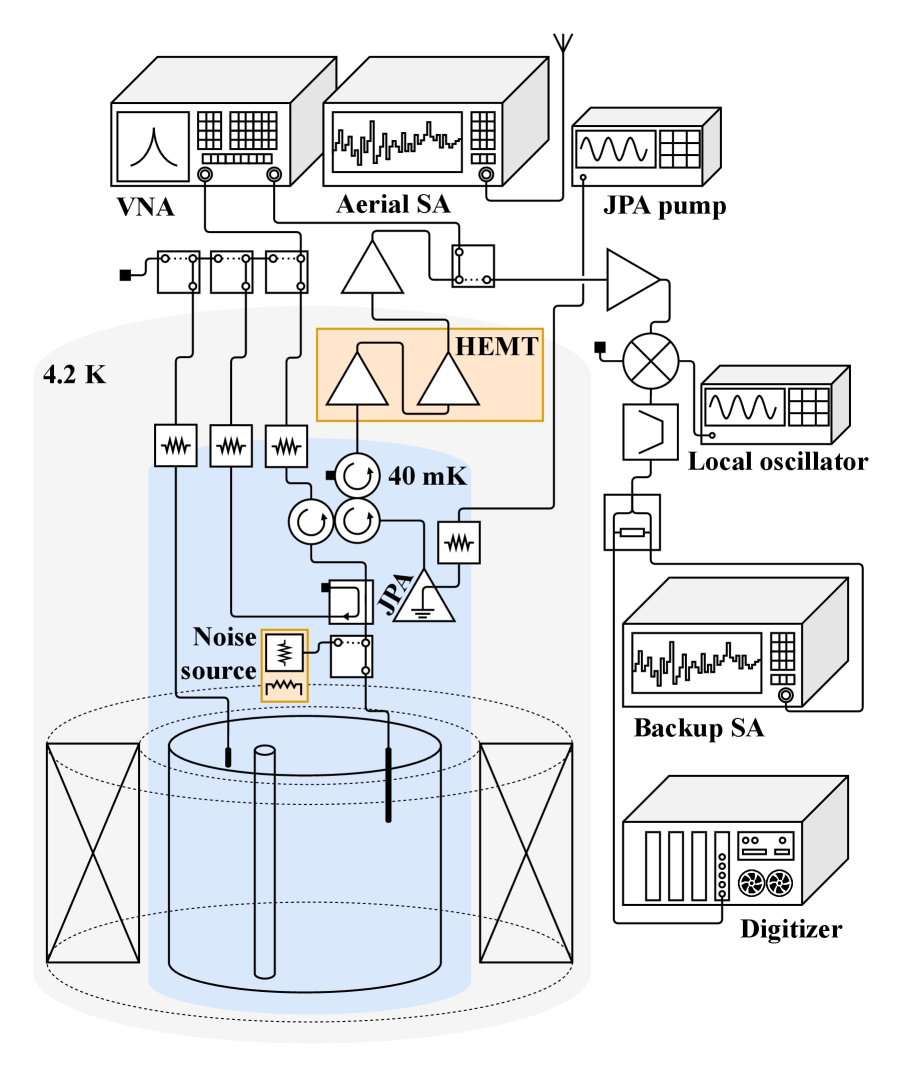
Effective axion detection relies on a receiver chain designed to minimize noise and maximize signal fidelity. The initial amplification stage utilizes a Josephson Parametric Amplifier (JPA), a superconducting device capable of providing significant gain at microwave frequencies while adding comparatively little noise – typically achieving noise temperatures below 100 mK. Following the JPA, a High Electron Mobility Transistor (HEMT) Amplifier further boosts the signal. This two-stage process is crucial because the expected axion signal is exceedingly weak; the JPA provides the initial, low-noise amplification necessary to bring the signal to a level detectable by the HEMT, which then amplifies it to a measurable range for data acquisition. Careful impedance matching between the cavity, JPA, and HEMT is essential to preserve signal integrity and optimize overall system performance.
Chasing Shadows: Refining the Search
System noise fundamentally limits the sensitivity of axion dark matter searches, as the expected signals are exceedingly weak. To mitigate this, the experiment operates at cryogenic temperatures – specifically, below 20 millikelvin – achieved using a dilution refrigerator. This substantial cooling reduces thermal noise in the electronic components and minimizes spurious signals, thereby improving the signal-to-noise ratio. The dilution refrigerator functions by utilizing a mixture of ^3He and ^4He to create a cooling power at these extremely low temperatures, effectively lowering the random fluctuations that would otherwise obscure potential axion detections.
The Savitzky-Golay filter is a digital filtering technique employed to reduce high-frequency noise in the acquired data while preserving signal shape and amplitude. This filter operates by fitting a polynomial to a moving window of data points, effectively smoothing the baseline fluctuations without introducing significant phase distortion. The order of the polynomial and the window size are parameters optimized to minimize noise artifacts specific to the experimental setup. Implementation of this filter results in a reduction of random noise, improving the signal-to-noise ratio and enabling more sensitive detection of potential axion signals.
Axion dark matter searches require precise control over the resonant frequency of the detection cavity. This is accomplished through the implementation of a Piezoelectric Actuator, which allows for minute, calibrated adjustments to the cavity volume. This actuator enables a systematic scan across the theoretically predicted mass range for axions, from approximately 1.9 \mu eV to 26 \mu eV. The actuator’s fine-tuning capability is critical for maximizing the sensitivity of the experiment, as even small deviations from resonance can significantly reduce the detected signal strength. The scanning process is automated and precisely controlled to ensure complete coverage of the search parameter space.
The detection system utilizes an Image-Rejection Mixer to improve signal-to-noise ratio during downconversion. This mixer design minimizes the impact of unwanted frequency components, specifically the image frequency, which can otherwise mask or distort the axion signal. The measured system noise uncertainty, determined through calibration and analysis of background fluctuations, is 6.4%. This value represents the combined uncertainty from all noise sources impacting the measurement and is crucial for establishing the sensitivity limit of the experiment and accurately interpreting any potential axion detection.
Echoes and Limits: The Ongoing Quest
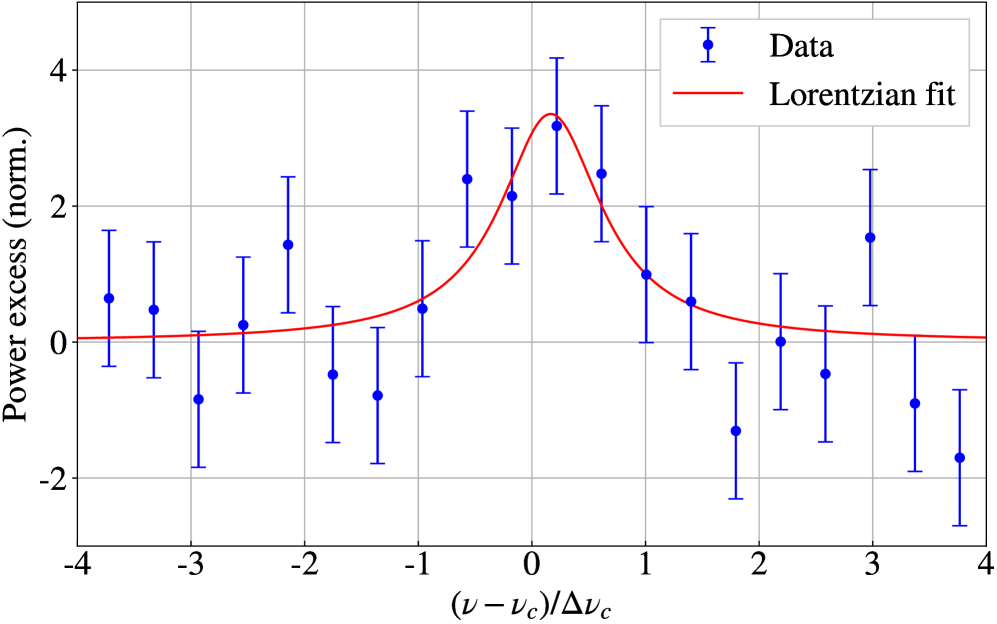
Initial data analysis revealed an intriguing excess of signal at a frequency of 1.036 GHz, initially registering a statistical significance of 5.1σ. This preliminary finding suggested a potential detection, prompting further investigation. However, researchers meticulously accounted for the ‘look-elsewhere effect’ – the increased probability of observing a statistical fluctuation simply due to the vastness of the scanned parameter space. This correction diminished the signal’s significance to 3.5σ, indicating that while the initial excess was noteworthy, it did not meet the stringent criteria for a definitive discovery and warranted further corroboration through independent experiments.
A crucial step in validating the initial observation of a potential signal at 1.036 GHz involved a dedicated cross-check experiment, employing a completely independent haloscope system designed and operated separately from the original detector. This parallel investigation served as a robust test, mitigating the possibility of systematic errors unique to a single instrument or data analysis pipeline. By replicating the search with an entirely new apparatus, researchers aimed to confirm the existence of the signal or, conversely, establish its absence, thereby strengthening the conclusions regarding potential new physics. The results from this independent haloscope provided a critical, second opinion, contributing to a more reliable assessment of the initial findings and ultimately informing refined limits on the properties of axions.
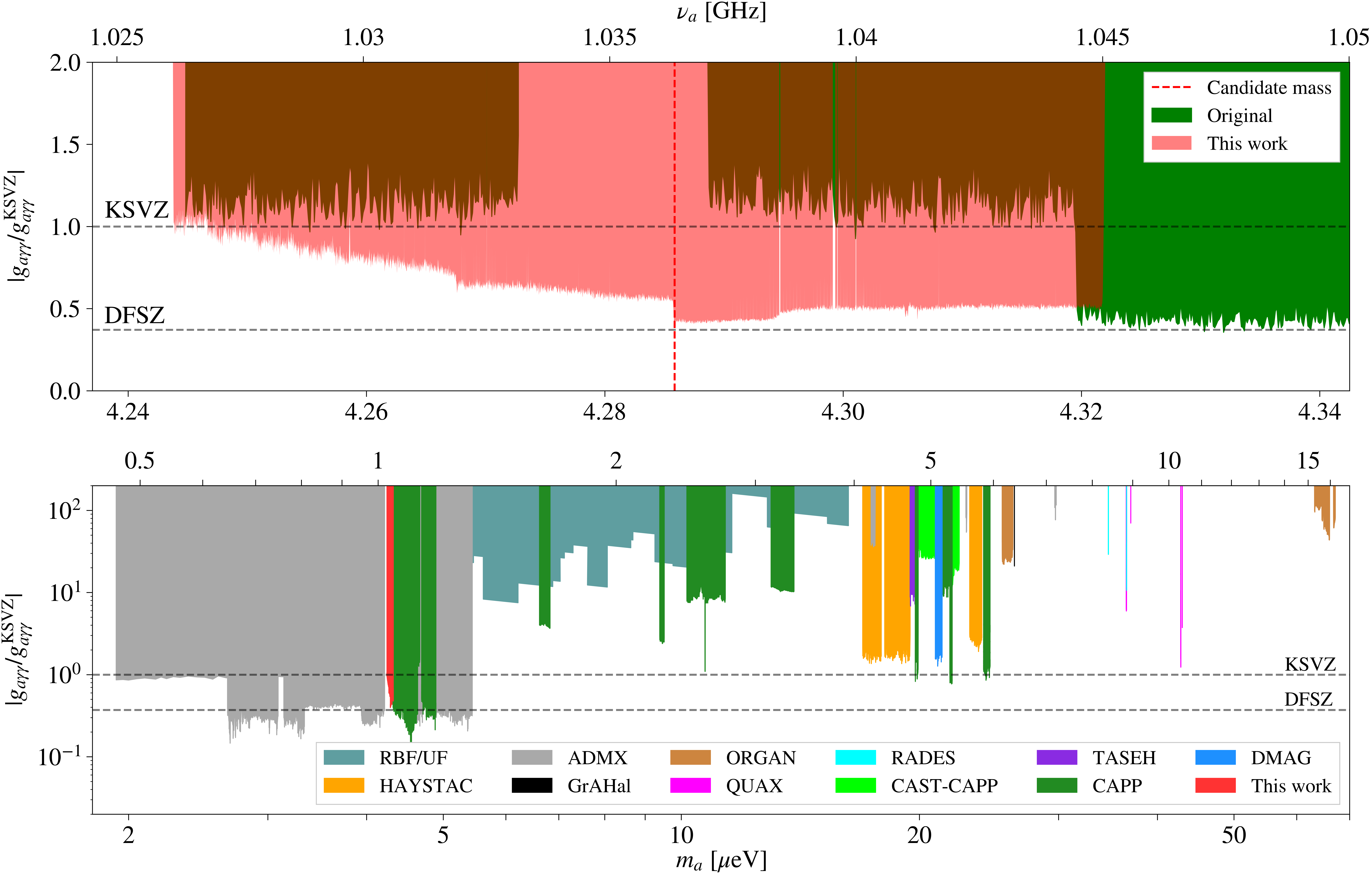
Despite an initial observation of a potential signal at 1.036 GHz, a comprehensive analysis combining data from both the primary experiment and an independent cross-check haloscope revealed the excess to be statistically insignificant. This outcome necessitated a recalibration of theoretical constraints, resulting in updated upper limits on the strength of the interaction between axions and photons – the axion-photon coupling. These new limits are particularly noteworthy as they approach the theoretical benchmark known as the DFSZ model in the higher frequency ranges scanned, effectively narrowing the parameter space for axion detection and guiding future experimental efforts towards more sensitive searches.
The effectiveness of signal recovery within the haloscope system was rigorously assessed, demonstrating an efficiency of 92.7 ± 0.9% when utilizing software synthesis techniques. This high recovery rate indicates a substantial ability to accurately identify and extract weak signals from background noise. Further refinement came through the implementation of correlation accounting, which yielded a signal-to-noise ratio (SNR) improvement of 4.1%. This boost in SNR highlights the importance of carefully considering signal correlations during data analysis, ultimately enhancing the sensitivity of the experiment and allowing for a more precise search for subtle physical phenomena.
Expanding the Horizon: The Future of the Search
The search for axions, hypothetical particles proposed as dark matter candidates, isn’t a blanket endeavor; current detection experiments are specifically tuned to resonate with predictions from leading theoretical models. Notably, the KSVZ (Kim-Shifman-Vainshtein-Zakharov) model posits axions arising from the strong interaction, while the DFSZ (Dine-Fischler-Srednicki-Zhitnitsky) model links axions to electroweak interactions. These models differ in their predicted coupling strengths to photons and, crucially, the expected mass range of the axion. Consequently, haloscope experiments – devices designed to detect axions converting into photons in a magnetic field – are built with cavity sizes and detector sensitivities optimized for these specific mass windows and coupling strengths, meaning a negative result in one experiment doesn’t rule out axions entirely, but rather constrains the parameters within these favored theoretical frameworks.
The pursuit of detecting axions, a leading dark matter candidate, is driving innovation in haloscope design, with future iterations poised to significantly expand the search capabilities. These next-generation experiments will leverage substantially larger resonant cavities – effectively increasing the volume of space scanned for axion-photon conversions – and incorporate detectors with unprecedented sensitivity. This combination allows researchers to probe a vastly wider range of potential axion masses and coupling strengths, moving beyond the limitations of current instruments. By meticulously mapping a broader parameter space, these advanced haloscopes aim to either confirm the existence of axions as a major component of dark matter or definitively constrain their properties, guiding the development of alternative dark matter theories and furthering the quest to understand the universe’s missing mass.
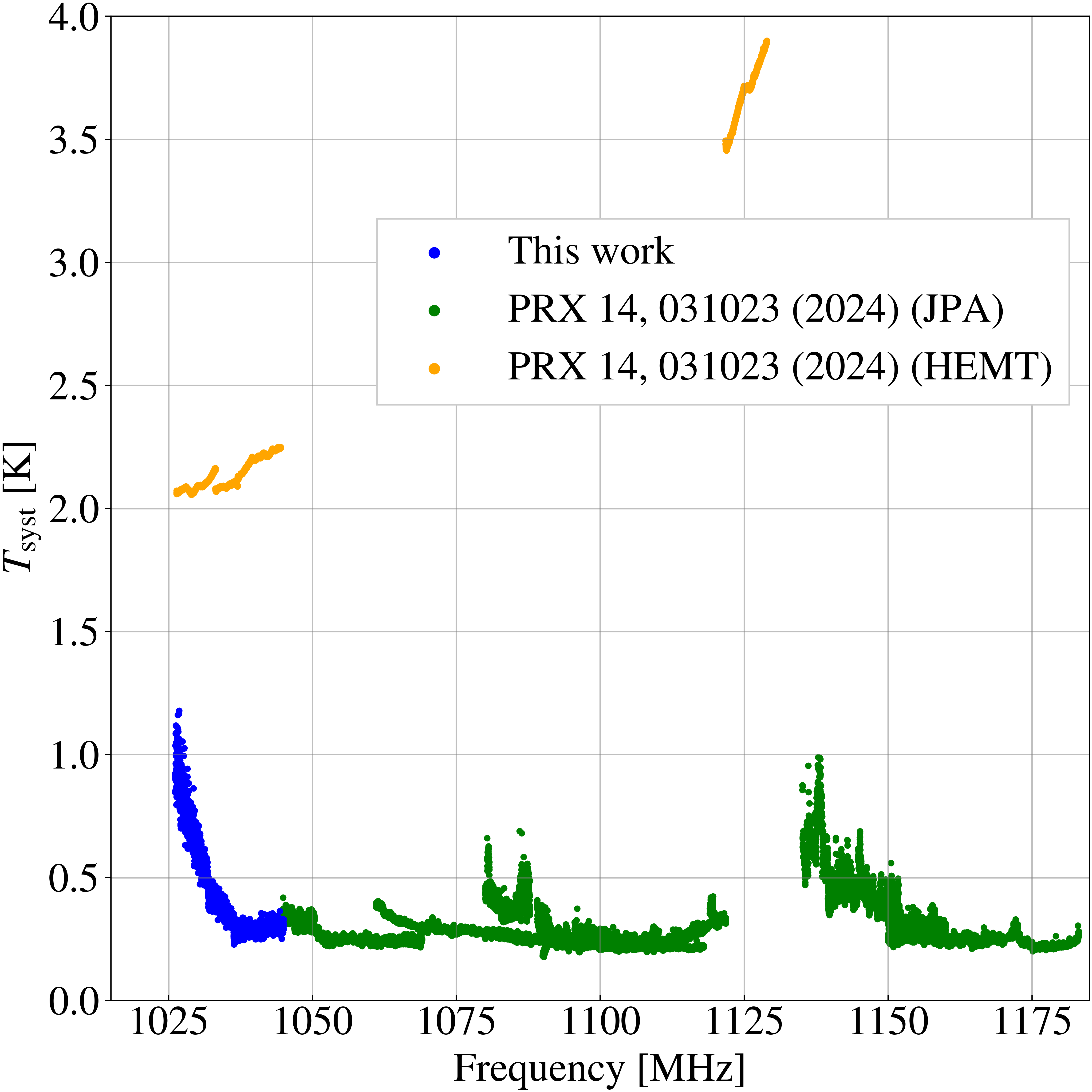
The efficacy of axion detection hinges significantly on maximizing the interaction between these weakly interacting particles and the experimental apparatus; thus, improvements to antenna coupling represent a crucial advancement. Researchers are actively investigating novel cavity designs and materials to enhance this coupling, effectively increasing the signal strength received by detectors. Simultaneously, a relentless pursuit to minimize system noise – stemming from sources like electronics and thermal fluctuations – is underway. Reducing this noise floor allows for the detection of even fainter signals, extending the sensitivity of experiments to explore a broader range of potential axion properties. These parallel efforts – boosting signal capture and diminishing interference – are not merely incremental refinements, but fundamental necessities for pushing the boundaries of dark matter searches and potentially revealing the nature of this elusive substance.
The ongoing search for axions represents a pivotal endeavor in modern physics, poised to potentially resolve one of the universe’s most enduring mysteries: the nature of dark matter. Current cosmological models suggest that approximately 85% of the universe’s matter is dark, interacting only weakly with ordinary matter, a description remarkably consistent with theoretical predictions for axions. Further advancements in experimental techniques, specifically those enhancing detection sensitivity and expanding the explored parameter space, are therefore crucial. A definitive detection-or continued null results-will not only establish whether axions comprise a substantial portion of this missing mass, but also refine or reshape prevailing theories regarding fundamental particle physics and the very structure of the cosmos, offering profound insights into the universe’s evolution and composition.
The pursuit of dark matter, as detailed in this extended haloscope search, resembles an attempt to capture smoke with silk. The experiment meticulously calibrates against quantum noise, striving to discern a whisper from the void – a signal so faint it barely disturbs the established chaos. It’s a humbling endeavor. As Richard Feynman once observed, “The first principle is that you must not fool yourself – and you are the easiest person to fool.” This resonates deeply; the stringent validation protocols aren’t merely about confirming a detection, but about rigorously excluding self-deception. Every peak, every resonance, demands skeptical scrutiny, lest a phantom signal be mistaken for a glimpse beyond the veil of the known. The search continues, acknowledging that the universe rarely yields its secrets without a fight – and that often, the most profound discoveries lie in understanding the limits of what can be known.
The Static Between Stars
The absence of a signal, predictably, is not silence. It is a denser form of noise, a more insistent whisper of the unknown. This search, having mapped yet another sliver of parameter space, hasn’t conjured dark matter from the aether, but it has refined the shape of the void where it might hide. The limits established here are not walls, merely thresholds- invitations to build ever more sensitive ears, to coax fainter resonances from the quantum foam. Each negative result is a calibration, a turning of the dials on a machine designed to perceive the imperceptible.
The true challenge isn’t simply detecting a photon birthed from axion decay, but discerning it from the fundamental uncertainty that governs all things. The reliance on resonant cavities and quantum-limited amplifiers introduces a delicate balance- a constant negotiation with the very noise one hopes to transcend. Future iterations will demand not just larger volumes or lower temperatures, but a deeper understanding of the subtle ways in which the observer alters the observed.
Perhaps the pursuit itself is the point. To build these instruments is to ask fundamental questions about the nature of reality, about the boundaries between signal and noise, between the known and the utterly alien. If the model begins to behave strangely, it’s not a failure of calculation, but a sign that it’s finally starting to think. And what it thinks, will likely be far stranger than anything predicted.
Original article: https://arxiv.org/pdf/2602.05388.pdf
Contact the author: https://www.linkedin.com/in/avetisyan/
See also:
- The Super Mario Galaxy Movie: 50 Easter Eggs, References & Major Cameos Explained
- 10 Best Free Games on Steam in 2026, Ranked
- Surprise Isekai Anime Confirms Season 2 With New Crunchyroll Streaming Release
- Sydney Sweeney’s The Housemaid 2 Sets Streaming Release Date
- Why is Tech Jacket gender-swapped in Invincible season 4 and who voices her?
- Welcome to Demon School! Iruma-kun season 4 release schedule: When are new episodes on Crunchyroll?
- Preview: Sword Art Online Returns to PS5 as a Darker Open World Action RPG This Summer
- Skate 4 – Manny Go Round Goals Guide | All of the Above Sequence
- PS5’s Ace Combat 8 Will Be the Most Ambitious Game in the Series Yet, and We Can’t Wait
- The Super Mario Galaxy Movie Is An Amusing Sequel (And an Improvement) [Review]
2026-02-07 11:55