Author: Denis Avetisyan
A comprehensive review explores the experimental efforts to detect processes that break fundamental conservation laws, with profound implications for particle physics and cosmology.
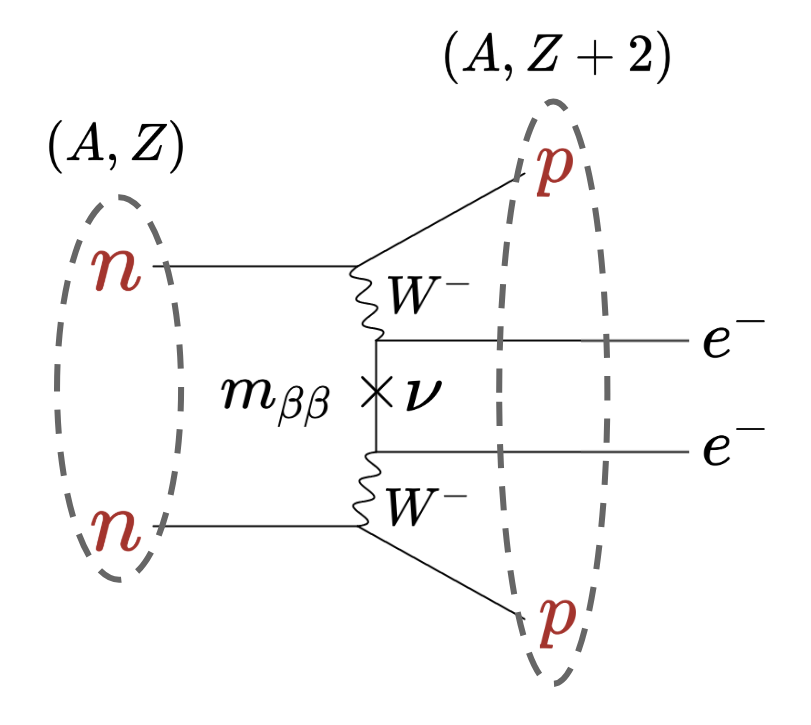
This article details the theoretical underpinnings and current status of searches for baryon and lepton number violation, including tests of neutrino mass, nucleon decay, and Majorana particle existence.
The apparent stability of matter and the structure of lepton interactions rely on the conservation of baryon and lepton numbers, symmetries which, despite their fundamental role, are not strictly required by the Standard Model. This review, ‘Experimental Tests of Baryon and Lepton Number Conservation’, summarizes the status of searches for violations of these conservation laws, motivated by theoretical frameworks beyond the Standard Model-including grand unification and mechanisms for generating neutrino mass. A unified assessment of historical experiments and current searches-spanning nucleon decay, neutrinoless double beta decay, and other processes-reveals the sensitivity and complementarity of different approaches. What new insights into the fundamental symmetries of nature and the origin of matter will be uncovered by the next generation of experiments?
The Standard Model’s Cracks: Prophecies of Failure
Despite its remarkable predictive power and consistent validation through decades of experimentation, the Standard Model of particle physics remains incomplete. This foundational theory, which describes the fundamental forces and particles of the universe, fails to incorporate gravity, provide a compelling explanation for the observed abundance of dark matter and dark energy, or account for the mass of neutrinos. Furthermore, it offers no insight into the matter-antimatter asymmetry of the universe – why there is so much more matter than antimatter. These unresolved puzzles, alongside theoretical inconsistencies at very high energies, strongly suggest the existence of new particles, forces, and symmetries beyond the current framework, driving ongoing research into areas like supersymmetry, extra dimensions, and other exotic phenomena that could reshape our understanding of the cosmos.
The discovery of neutrino oscillations represents a fundamental challenge to the Standard Model of particle physics, demanding a re-evaluation of established symmetries. Initially conceived as massless particles, neutrinos are now known to possess a tiny, yet non-zero, mass, a property incompatible with the original Standard Model framework. This mass necessitates the introduction of new physics, potentially through right-handed neutrinos or other extended mechanisms. The oscillation phenomenon itself-the spontaneous change of neutrino flavor during propagation-requires mixing between neutrino types, implying that the symmetries governing neutrino interactions are not what they initially appeared to be. These observations suggest that lepton number, a quantity previously thought to be conserved, may in fact be violated, opening avenues for exploring even more exotic physics and potentially linking neutrino behavior to the matter-antimatter asymmetry observed in the universe.
The persistent anomalies challenging the Standard Model of particle physics have driven extensive searches for violations of fundamental conservation laws, specifically lepton and baryon number. These quantities, typically held constant in particle interactions, may not be strictly preserved if new particles or forces are at play. Experiments meticulously examine decay processes and high-energy collisions, looking for rare events where these numbers appear to be violated – a signal that would definitively indicate physics beyond the Standard Model. For instance, observing a muon decay into an electron and a photon alongside the disappearance of a tau lepton would constitute a clear breach of lepton number conservation. Similarly, the detection of proton decay – though never observed – would signal baryon number violation and open a window onto grand unified theories. The absence of such events places increasingly stringent limits on the properties of potential new interactions, but continues to motivate ever more sensitive searches for these elusive signatures.
Majorana Ghosts: A Hint of Lepton Number’s Demise
The Standard Model typically treats neutrinos as Dirac particles, distinct from their antiparticles. However, the Majorana hypothesis posits that the neutrino is its own antiparticle, meaning \nu = \bar{\nu} . This characteristic fundamentally violates lepton number conservation, as the creation or annihilation of a Majorana neutrino changes lepton number by two units. Lepton number violation is not predicted within the Standard Model, making the Majorana nature of neutrinos a clear signal of physics beyond it. Establishing the existence of Majorana neutrinos would necessitate a modification of the Standard Model to accommodate this property and the associated lepton number non-conservation.
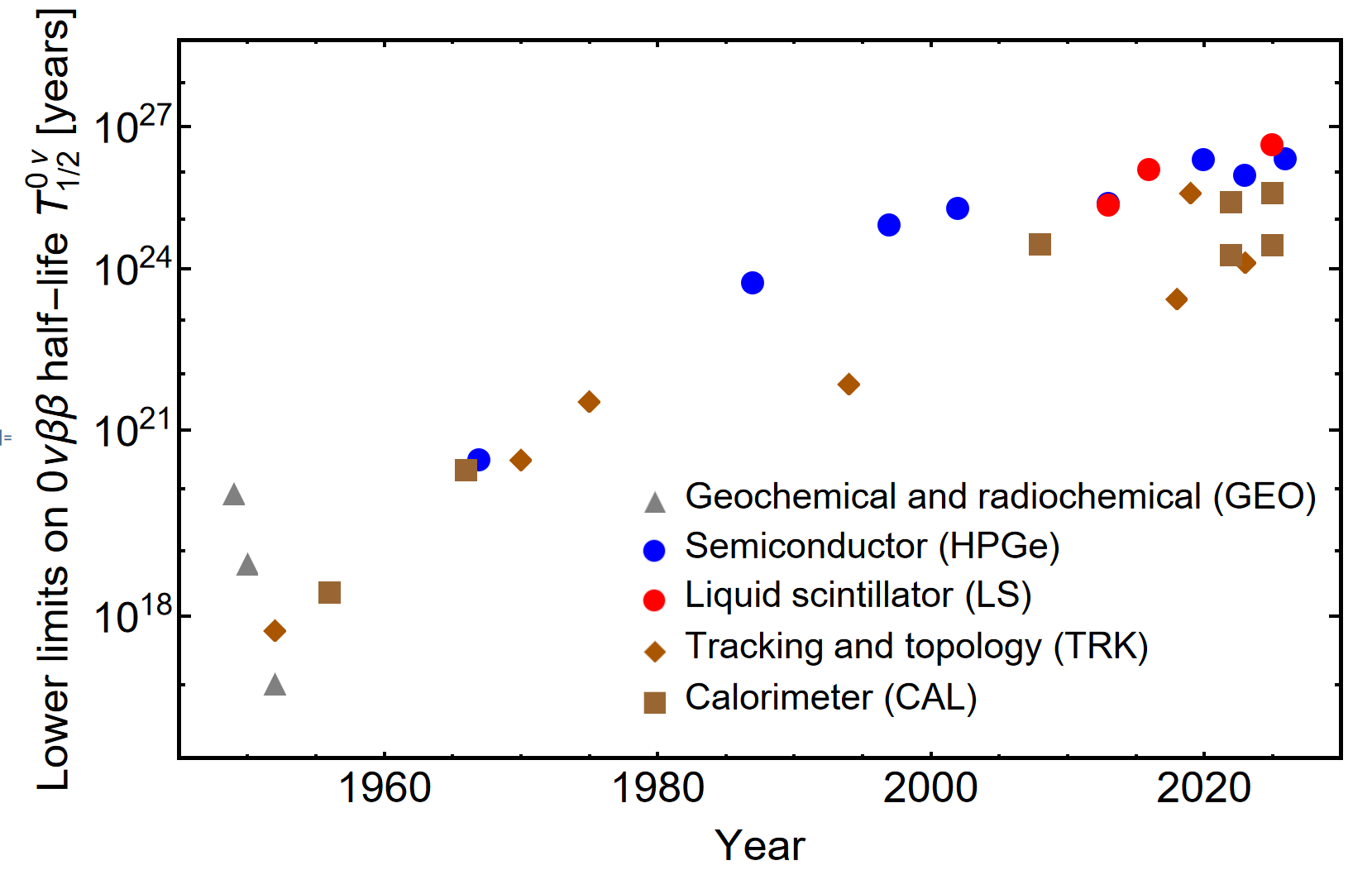
The experimental search for neutrinoless double beta decay represents a key approach to verifying the Majorana nature of neutrinos and confirming lepton number violation. This rare process, if observed, would demonstrate that neutrinos are their own antiparticles and that lepton number, a conserved quantity in the Standard Model, is not strictly conserved in nature. Current experiments, notably GERDA and LEGEND, utilize highly sensitive detectors to search for this decay mode in various isotopes; these experiments have not yet observed the decay but have established lower limits on the half-life exceeding 1.07 \times 10^{26} years, constraining theoretical models and guiding the development of future experiments with increased sensitivity and exposure.
Lepton number violation is not exclusive to Majorana neutrinos; hypothetical particles such as leptoquarks also provide potential mechanisms. Leptoquarks are bosons that couple leptons and quarks, and their existence would allow processes that change total lepton number by one unit. Experimental searches for leptoquarks typically focus on either direct production in high-energy colliders or indirect effects in low-energy processes. Current experimental limits, established by the CMS and ATLAS collaborations at the LHC, place lower bounds on leptoquark masses, generally exceeding 1 TeV, depending on the specific leptoquark model and coupling assumptions. These searches, alongside neutrinoless double beta decay experiments, provide complementary avenues for investigating physics beyond the Standard Model and probing potential violations of lepton number conservation.
Cosmic Asymmetry: The Seeds of Our Existence
The observed prevalence of matter over antimatter in the universe necessitates mechanisms that violate fundamental conservation laws. Standard Model physics, while highly successful, predicts equal production of matter and antimatter in the early universe, leading to complete annihilation and a resultant absence of matter – a clear contradiction of observation. Therefore, any viable cosmological model must incorporate sources of Charge-Parity (CP) violation and processes that violate baryon and lepton number conservation. These violations are required to create an asymmetry – a slight excess of matter over antimatter – that survived annihilation and ultimately formed the structures we observe today. The magnitude of this asymmetry is quantified by the baryon-to-photon ratio, approximately 6 \times 10^{-{10}}, indicating a very small, but significant, imbalance requiring novel physics beyond the Standard Model.
Baryogenesis, the hypothetical process that created an asymmetry between baryons and antibaryons in the early universe, necessitates a departure from strict conservation of baryon number. While baryon number violation is a primary requirement, the establishment of this asymmetry also often involves lepton number violation. Mechanisms that connect these two violations – known as leptobaryogenesis – are particularly efficient at generating the observed matter-antimatter imbalance. These processes typically involve the decay of heavy particles that simultaneously violate both baryon and lepton numbers, creating an excess of baryons over antibaryons and establishing the conditions for the formation of the universe as we observe it today.
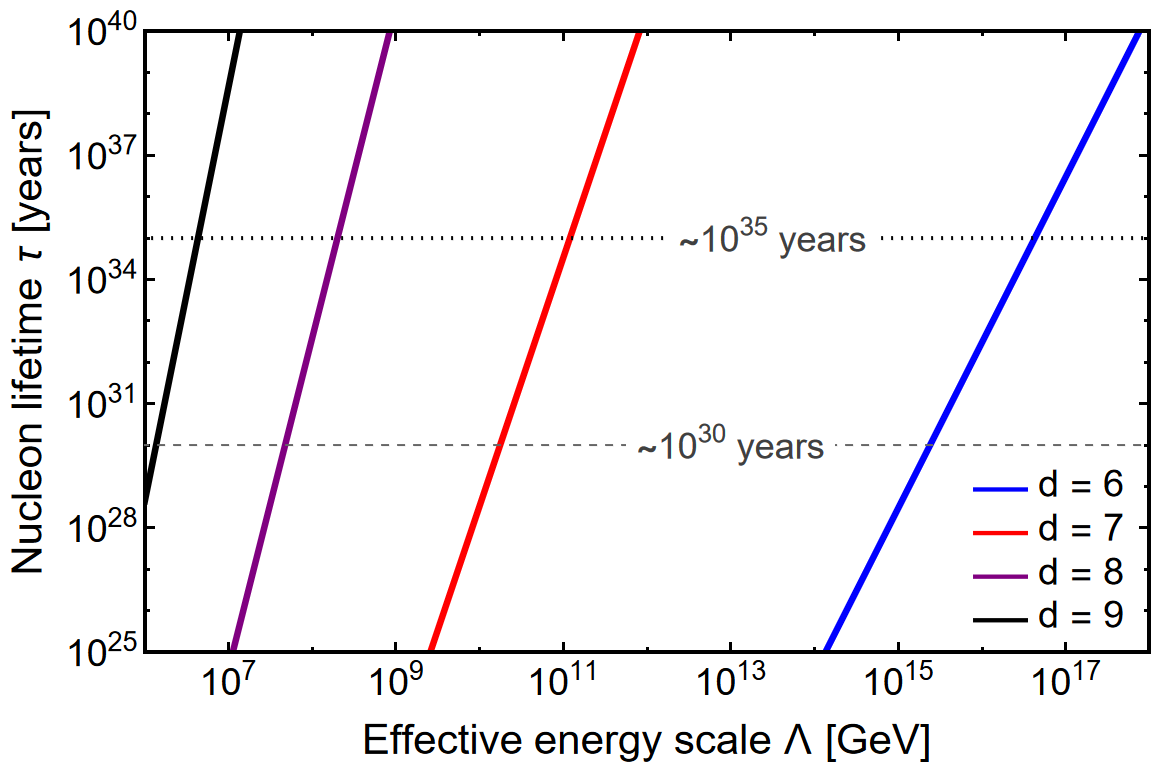
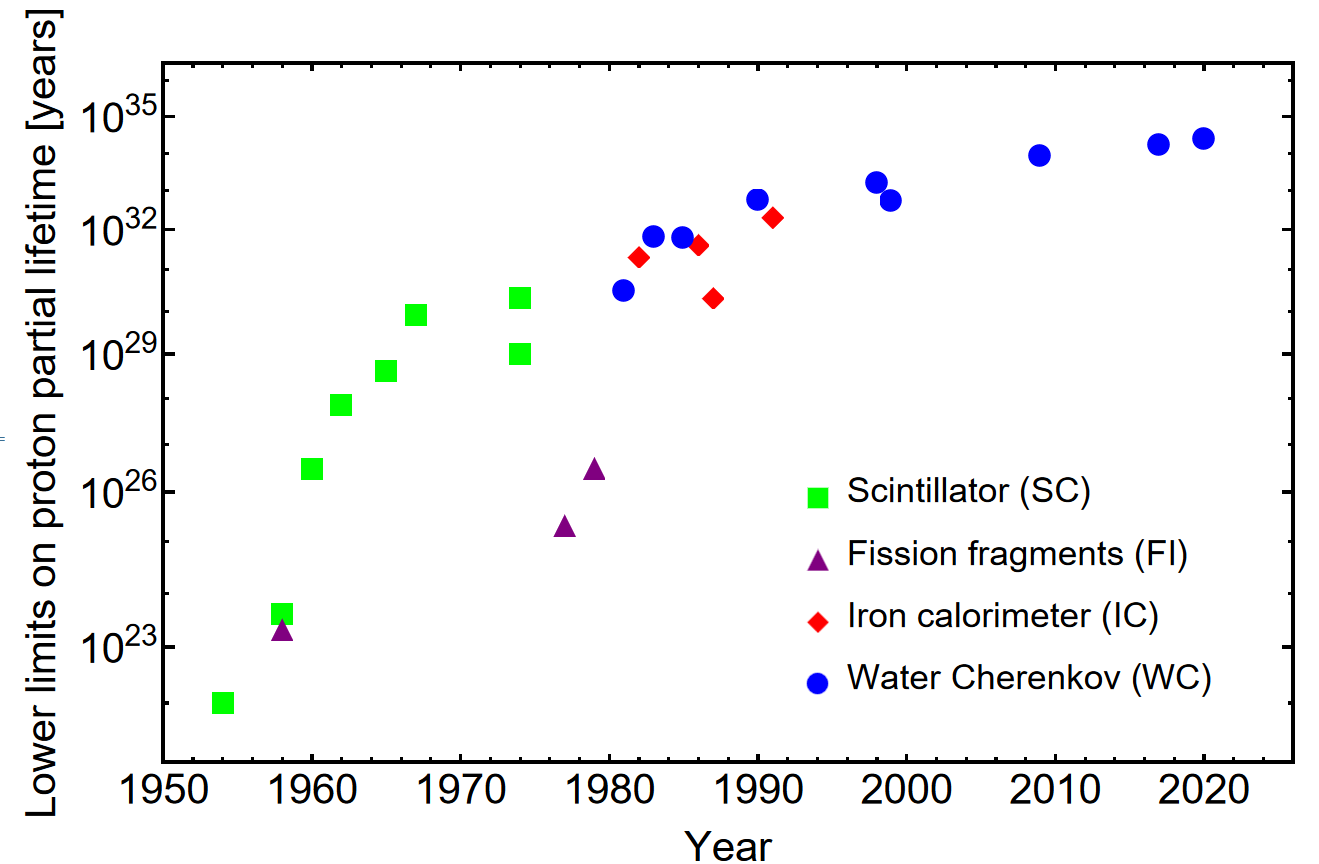
Grand Unified Theories (GUTs) posit that at sufficiently high energies, the strong, weak, and electromagnetic forces unify, and this unification predicts that baryon number, normally conserved in the Standard Model, is not. A key consequence of baryon number violation is proton decay, where a proton is not stable but can decay into lighter particles such as positrons and pions. Current experimental searches, notably those conducted by Super-Kamiokande and other large-scale detectors, have not observed proton decay, establishing a lower limit on the proton lifetime exceeding > 1.25 x 1034 years. This limit constrains the parameters of many GUT models, excluding those predicting significantly shorter lifetimes and providing valuable input for model building.

Beyond the Search: Mapping the Landscape of New Physics
The search for rare events like nucleon decay and neutrinoless double beta decay doesn’t require pinpointing the exact physics at incredibly high energy scales; instead, researchers utilize effective field theory. This powerful approach allows scientists to analyze experimental data by focusing on the low-energy manifestations of potentially complex, unknown high-energy processes. Essentially, it provides a systematic way to extract meaningful information from these searches, irrespective of the specific details of the underlying physics – whether it involves supersymmetry, extra dimensions, or other theoretical constructs. By treating the high-energy physics as contributing to a series of effective interactions at lower energies, experiments can place constraints on the parameters governing these interactions, offering valuable insights into physics beyond the Standard Model even without directly observing the new particles or phenomena responsible.
Current cosmological models, built upon observations of the cosmic microwave background and large-scale structure, provide a unique avenue for investigating the nature of neutrinos, specifically whether they are Majorana particles – their own antiparticles. These studies don’t rely on direct detection experiments, but instead examine how the presence of Majorana neutrinos would affect the early universe’s evolution, influencing processes like the formation of light elements and the distribution of matter. Analysis of these cosmological datasets currently constrains the effective Majorana neutrino mass – a parameter reflecting the overall scale of neutrino self-interactions – to be below 0.1 to 0.2 electron volts. This upper limit, derived from the cosmos itself, complements the ongoing searches in terrestrial laboratories and offers crucial independent verification of theoretical predictions regarding these elusive particles.
The convergence of searches for proton decay and neutrinoless double beta decay with cosmological observations represents a powerful strategy to investigate fundamental symmetries governing matter. These rare processes, if observed, would signal violations of baryon and lepton number conservation – principles crucial to the Standard Model of particle physics. Experiments designed to detect these decays, such as large underground detectors, are actively pushing the limits of sensitivity, while cosmological data from observations of the cosmic microwave background and large-scale structure provide complementary constraints on the underlying parameters. By combining these distinct approaches, physicists aim to not only confirm or refute the existence of these violations, but also to map the landscape of physics beyond the Standard Model, potentially revealing the origin of matter-antimatter asymmetry in the universe and the nature of dark matter.
The pursuit of baryon and lepton number violation, as detailed in this exploration of experimental tests, feels less like construction and more like tending a garden. One cultivates conditions, proposes symmetries, and then observes what flourishes – or fails to. The very act of searching for these violations acknowledges an inherent fragility within the established order, a prophecy of future failure embedded within the Standard Model. As the article suggests, the implications extend to understanding the matter-antimatter asymmetry, a foundational question. It recalls Carl Sagan’s observation: “Somewhere, something incredible is waiting to be known.” The search isn’t about finding answers, but about creating the conditions for discovery, accepting that even the most elegant theoretical architecture will, eventually, reveal its limitations.
What’s Next?
The pursuit of baryon and lepton number violation isn’t a search for new particles, but a mapping of the fault lines in the edifice of predictability. Each null result, each tightened constraint on nucleon decay or neutrinoless double beta decay, merely refines the landscape of permissible failures. It is a process of discovering where the universe will inevitably break its symmetries, not if. Architecture is, after all, how one postpones chaos.
The theoretical motivations – Grand Unified Theories, the need to explain matter-antimatter asymmetry – remain stubbornly divorced from experimental reach. The ever-increasing scales required to directly observe these phenomena suggest a fundamental miscalculation in approach. Perhaps the relevant processes occur not at higher energies, but in regimes of extreme density or complexity, hiding within the emergent properties of many-body systems. There are no best practices-only survivors.
The future lies not in building larger detectors, but in cultivating more sensitive probes of the subtle, unexpected. Neutrinos, with their ghostly nature and demonstrated mass, will continue to be central, but the focus must broaden. Order is just cache between two outages. The true signal may not be a violation of a known law, but the emergence of entirely new principles, rewriting the rules as the universe attempts to resolve its internal contradictions.
Original article: https://arxiv.org/pdf/2602.09097.pdf
Contact the author: https://www.linkedin.com/in/avetisyan/
See also:
- Trails in the Sky 2nd Chapter launches September 17
- Paradox codes (April 2026): Full list of codes and how to redeem them
- Pragmata Shows Off Even More Gorgeous RTX Path Tracing Ahead of Launch
- PRAGMATA ‘Eight’ trailer
- Crimson Desert’s Momentum Continues With 10 Incredible New Changes
- How Could We Forget About SOL Shogunate, the PS5 Action RPG About Samurai on the Moon?
- Xbox Game Pass Users “Blown Away” by New Exclusive Game
- Hulu Just Added One of the Most Quotable Movies Ever Made (But It’s Sequel Is Impossible To Stream)
- Why is Tech Jacket gender-swapped in Invincible season 4 and who voices her?
- Dragon Quest Smash/Grow launches April 21
2026-02-11 17:09