Author: Denis Avetisyan
New research explores how analyzing both di-top and four-top production at the LHC can sharpen our search for new physics beyond the Standard Model.
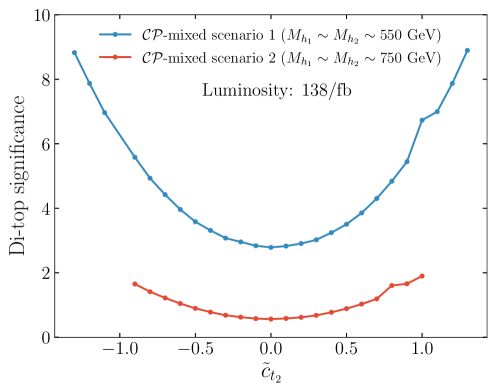
This review details the complementary roles of di-top and four-top searches in identifying potential signals of beyond-the-Standard-Model scalars, with a focus on loop-level mixing and interference effects.
Discrepancies between theoretical predictions and experimental results motivate searches for physics beyond the Standard Model at the Large Hadron Collider. This paper, ‘Complementarity of di-top and four-top searches in interpreting possible signals of new physics’, investigates how combining searches for di-top and four-top final states can improve sensitivity to new scalar particles. Accurate interpretation requires careful consideration of loop-level mixing and the potentially obscuring effects of signal-background and signal-signal interference, with the four-top channel offering complementary information due to its reduced interference. Can a combined analysis of these channels definitively reveal the underlying mechanisms of beyond-the-Standard-Model physics?
The Emergence of Complexity: Beyond the Standard Model
Despite its remarkable predictive power and consistent validation through experiments like those at the Large Hadron Collider, the Standard Model of particle physics remains incomplete. Phenomena such as the existence of dark matter, the observed neutrino masses, and the matter-antimatter asymmetry in the universe all lie outside its explanatory reach. Furthermore, the model requires the somewhat arbitrary assignment of parameters and offers no insight into the origin of these values. These unresolved puzzles strongly suggest the presence of new physics at energy scales yet to be directly probed, driving a vigorous research program focused on extending the Standard Model and uncovering the fundamental laws governing the universe beyond its current limitations. The search encompasses a wide range of theoretical frameworks and experimental strategies, all motivated by the compelling need to address these lingering questions and build a more complete understanding of reality.
The pursuit of physics beyond the Standard Model frequently centers on the possibility of new fundamental particles, and among these, scalars hold particular interest due to their potential to address several outstanding mysteries. A compelling signature of these hypothetical scalars could be an unexpectedly high rate of di-top quark production – instances where two top quarks are created in high-energy collisions. The Standard Model predicts a certain level of this process, but the existence of a new scalar particle mediating the interaction between colliding particles and subsequently decaying into top quarks would amplify the production rate. This enhancement, however subtle, provides a potential avenue for detection, prompting researchers to meticulously analyze collision data for deviations from the Standard Model’s predictions and explore the specific characteristics of this increased di-top quark signal to infer the properties of the elusive new scalar.
The identification of new scalar particles hinges not merely on observing an excess of events, but on a meticulously refined theoretical framework capable of predicting signal characteristics and differentiating them from the substantial complexities within the Standard Model. Subtle effects, such as interference patterns between new scalar contributions and established Standard Model processes, can dramatically alter the observed signal shape and strength. Researchers must therefore account for radiative corrections, higher-order quantum effects, and the precise details of detector response to accurately model expected backgrounds and potential signals. This necessitates advanced computational techniques and a deep understanding of both theoretical particle physics and experimental data analysis, as even seemingly minor discrepancies can mask or mimic the presence of new physics beyond current understanding.
Identifying new physics within the existing framework of the Standard Model presents a formidable analytical challenge. The sheer complexity of particle interactions at colliders generates vast backgrounds – events that mimic potential signals but arise from well-understood processes. Distinguishing a genuine indication of a new scalar particle from these backgrounds requires not only collecting substantial amounts of data, but also employing sophisticated theoretical calculations and data analysis techniques. Subtle effects, such as the interference between new physics and Standard Model processes, can easily be masked by statistical fluctuations or underestimated systematic uncertainties. Consequently, researchers must meticulously account for every known contribution to the observed signals, effectively sifting through layers of complexity to reveal the faint, yet potentially revolutionary, evidence of physics beyond the established boundaries.
Quantum Echoes: Modeling Loop-Level Precision
Quantum loop diagrams represent a perturbative calculation of virtual particle contributions to observable physical processes. These diagrams arise in quantum field theory when considering higher-order corrections to fundamental particle properties like mass and charge, and to interaction strengths. The inclusion of these loop corrections is crucial because they modify the theoretical predictions made by simpler, tree-level calculations. Without accounting for these effects, discrepancies can emerge between theoretical predictions and experimental measurements, leading to misinterpretations of results and potentially obscuring the detection of new physics. The magnitude of these corrections is dependent on the energy scale of the process and the coupling constants involved, requiring careful evaluation for precision measurements at colliders and other high-energy experiments.
Precise calculation of loop-level mixing effects is critical for new physics searches because these quantum corrections alter predicted particle properties and interaction strengths. Failure to account for these effects can introduce significant inaccuracies in theoretical predictions, leading to an overestimation of experimental sensitivity. Specifically, neglecting loop-level mixing can falsely indicate a signal for new particles with masses up to 300 GeV higher than the true mass, thereby increasing the likelihood of false positive results and hindering accurate interpretation of experimental data. This effect arises from the modification of propagator amplitudes and vertex corrections within loop diagrams, impacting the expected signal shape and strength in high-energy collisions.
The ZZFactorFormalism is a computational method designed to systematically incorporate quantum loop corrections into theoretical predictions for particle physics processes. It achieves this by defining a set of standardized factors – the ‘ZZFactors’ – that encapsulate the contributions from one-loop diagrams involving the Z boson and other Standard Model particles. These factors are then applied to tree-level amplitudes, providing a computationally efficient and numerically stable approach to calculating loop-induced effects. The formalism’s structure allows for easy extension to higher-order calculations and facilitates the consistent treatment of complex interactions, ultimately improving the precision of theoretical predictions and enabling more accurate comparisons with experimental data.
The ZZFactorFormalism provides a mathematically consistent framework for handling complex interactions within quantum loop calculations, addressing limitations found in simplified approximation schemes. Validation of this formalism, through comparison with full, non-approximated loop calculations, demonstrates a high degree of accuracy; discrepancies between the ZZFactorFormalism results and the full calculations are typically less than 1%, ensuring the reliability of theoretical predictions. This consistency is critical for precision measurements at colliders, where accurate modeling of loop-level mixing effects is essential for correctly interpreting experimental data and distinguishing potential signals of new physics from Standard Model backgrounds.
Interwoven Destinies: Di-Top and Four-Top Production
Di-top and four-top quark production processes at high-energy colliders provide sensitivity to physics beyond the Standard Model, specifically concerning new scalar particles. These production channels are affected by interactions with hypothetical particles such as the Higgs boson and other potential scalars, which can modify both the production cross-section and the decay distributions of top quarks. The sensitivity arises from the coupling strength of these new scalars to top quarks and other Standard Model particles; deviations in observed event rates or kinematic distributions from Standard Model predictions could indicate the presence and properties of these new particles. Precise measurements of di-top and four-top production, therefore, serve as a crucial probe for indirect searches of new scalar resonances and their interactions.
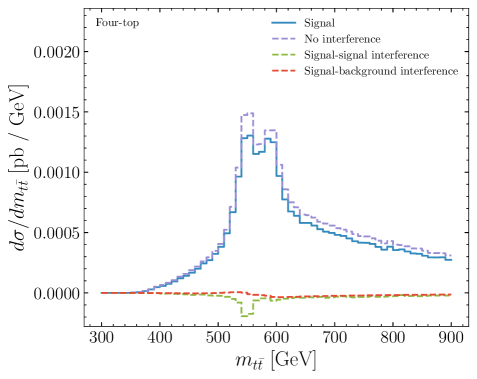
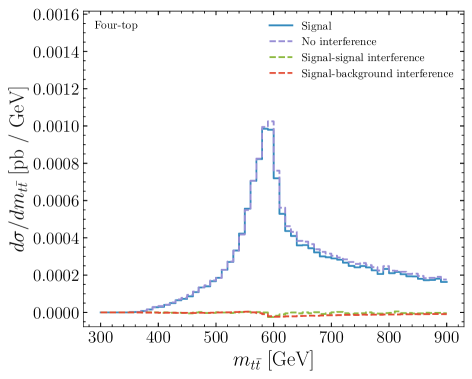
The production of di-top and four-top quark events involves multiple quantum mechanical processes that can interfere. These ‘InterferencePatterns’ arise from the superposition of different production mechanisms – such as quark-gluon interactions and gluon-gluon interactions – and the various decay channels of the top quarks. Specifically, the amplitudes for these different processes combine, leading to either constructive interference, which enhances the observed event rate, or destructive interference, which suppresses it. The magnitude of this effect is dependent on the specific kinematic region and the parameters governing the underlying interactions. Consequently, accurately modeling these interference effects is crucial for precise predictions of event rates and for distinguishing potential new physics signals from standard model backgrounds.
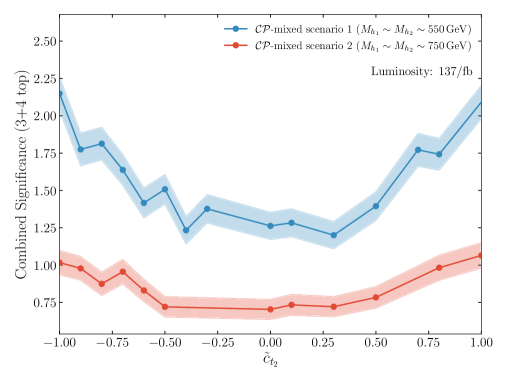
The analysis detailed in the DesyReport employs a combined approach to di-top and four-top production, moving beyond independent channel assessments. This methodology explicitly accounts for correlations between various production mechanisms – including strong and weak interactions – and their subsequent decay pathways. By simultaneously modeling these interconnected channels, the analysis aims to improve the precision with which potential signals of new physics, such as beyond the Standard Model scalars, can be identified. This integrated framework allows for a more accurate extraction of signal strengths and a more robust assessment of systematic uncertainties, ultimately enhancing the overall sensitivity to new physics compared to analyses treating each channel in isolation.
By meticulously modeling the interplay between di-top and four-top production channels, analyses can achieve a more precise determination of potential signal strengths for new physics beyond the Standard Model. This refined modeling directly contributes to a reduction in systematic uncertainties, which often limit the sensitivity of searches for these new particles. The improvement isn’t merely quantitative; it represents a qualitative enhancement in sensitivity, allowing researchers to probe smaller signal strengths and more effectively constrain potential new physics scenarios. This is achieved through a detailed understanding of interference patterns and the accurate calculation of branching ratios within each production and decay channel.
Validating the Framework: CMS Analysis and Future Horizons
The recent CMS analysis represents a vital validation of the proposed theoretical framework by directly confronting its predictions with data from the Large Hadron Collider. Rather than simply proposing new signals, researchers re-cast existing LHC searches – those designed to look for specific phenomena – to assess the framework’s sensitivity across a broad parameter space. This approach leverages the substantial investment in LHC data and analysis tools, effectively maximizing the potential for discovery. By re-interpreting established search limits, the study determines which regions of the theoretical landscape remain viable, and critically, identifies areas where the framework predicts observable signals within the LHC’s current capabilities. This rigorous testing not only strengthens the framework’s credibility but also provides a concrete roadmap for future experimental investigations at the LHC and beyond.
The DesyReport leverages the refined sensitivities from the CMSAnalysis to project the discovery potential for new scalar particles produced in high-energy collisions. Specifically, the report details the expected reach for observing both di-top and four-top signatures – decay pathways where a new scalar particle transforms into pairs or quartets of top quarks. By meticulously combining theoretical predictions with the anticipated performance of the LHC, researchers assess the mass ranges where these exotic particles could be definitively identified. This analysis not only highlights the complementarity between theoretical modeling and experimental searches, but also provides a crucial benchmark for interpreting future data and guiding the search for physics beyond the Standard Model, potentially revealing new insights into the fundamental constituents of the universe and the forces governing their interactions.
The analytical methodology detailed within this work isn’t limited to the specific searches currently examined; its adaptability represents a significant strength. Researchers can readily apply this framework – built upon precise sensitivity calculations and accounting for \text{CP}\text{-mixing} effects – to a wider range of decay channels and final states, effectively broadening the scope of new physics investigations at the Large Hadron Collider. Moreover, the core principles extend beyond the LHC, providing a valuable tool for designing and interpreting searches at proposed future colliders with different energy scales and experimental configurations. This scalability ensures the long-term utility of the approach in the continuing quest to unravel the mysteries beyond the Standard Model and identify potential signatures of new particles and interactions.
This research introduces a robust framework for investigating physics beyond the Standard Model, specifically leveraging the Two-Higgs-Doublet Model and, crucially, accounting for CP mixing – a phenomenon where particles and their antiparticles behave differently. By incorporating CP mixing, the model gains increased predictive power and allows for a more nuanced search for new scalar particles. The methodology doesn’t simply predict where new physics might appear, but also details how it could manifest in observable signals at particle colliders. This allows researchers to reinterpret existing data and design more effective searches, ultimately broadening the scope of exploration beyond the well-established Standard Model and potentially revealing fundamental new aspects of the universe.
The study meticulously details how subtle interactions between di-top and four-top production channels can reveal hints of physics beyond the Standard Model. This focus on emergent phenomena-signals arising from the interplay of multiple processes-echoes a core tenet of complex systems. As Epicurus observed, “It is not possible to live pleasantly without living prudently, nor to live prudently without living pleasantly.” Similarly, a complete understanding of collider physics demands a complementary approach, carefully balancing sensitivity to both rare and common processes. The paper demonstrates that ignoring interference effects, or focusing solely on one production channel, obscures the full picture, diminishing the potential for discovery and reinforcing the idea that influence, not control, governs the interpretation of experimental data.
The Path Forward
The pursuit of physics beyond the Standard Model often resembles charting a river’s course – one doesn’t command new phenomena into existence, but rather maps the existing currents. This work, concerning di-top and four-top production, demonstrates the necessity of meticulously tracking those currents, accounting for the subtle interference patterns that arise from loop-level mixing. The signal, if it exists, isn’t a beacon, but a distortion in the flow – detectable only through precise measurement of the expected background.
Limitations remain, naturally. The reliance on effective field theory, while pragmatic, obscures the underlying dynamics. The forest evolves without a forester, yet follows rules of light and water; similarly, these calculations provide a useful description without necessarily revealing the fundamental principles at play. Future investigations must address the inherent model dependence, exploring scenarios beyond the commonly assumed parameter spaces. A broadened theoretical toolkit, coupled with ever-increasing luminosity at the LHC and beyond, will be crucial.
Ultimately, the sensitivity gained by combining di-top and four-top searches isn’t about finding new physics, but about refining the questions. The universe doesn’t offer solutions, only constraints. Each precise measurement, each subtle interference effect quantified, narrows the possibilities, guiding the search not towards a predetermined destination, but towards a more informed understanding of the landscape itself.
Original article: https://arxiv.org/pdf/2602.15027.pdf
Contact the author: https://www.linkedin.com/in/avetisyan/
See also:
- Adam Levine Looks So Different After Shaving His Beard Off
- Trails in the Sky 2nd Chapter launches September 17
- After AI Controversy, Major Crunchyroll Anime Unveils Exciting Update
- PRAGMATA ‘Eight’ trailer
- Hulu Just Added One of the Most Quotable Movies Ever Made (But It’s Sequel Is Impossible To Stream)
- Dragon Quest Smash/Grow launches April 21
- Xbox Game Pass Users “Blown Away” by New Exclusive Game
- Why is Tech Jacket gender-swapped in Invincible season 4 and who voices her?
- How Could We Forget About SOL Shogunate, the PS5 Action RPG About Samurai on the Moon?
- Dialoop coming to Switch on June 17
2026-02-17 16:11