Author: Denis Avetisyan
New research explores the fascinating quantum behavior of a breathing pyrochlore lattice, revealing a landscape of interacting quantum phases and emergent phenomena.
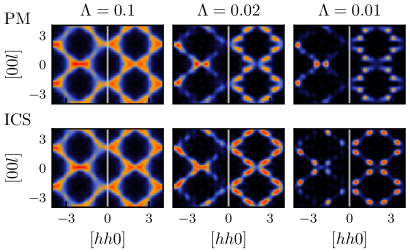
![A transition into an ordered phase, evidenced by a sharp increase in flow magnitude and system-size scaling at <span class="katex-eq" data-katex-display="false">D\_a = -0.1</span>, contrasts with the scaling behavior observed in the quantum paramagnetic phase, while the emergence of a four-fold pinch point in polarized neutron scattering-specifically around [0,0,2]-signifies the characteristics of a rank-2 <span class="katex-eq" data-katex-display="false">U(1)</span> spin liquid.](https://arxiv.org/html/2602.15662v1/x2.png)
The study demonstrates the stabilization of rank-1 and rank-2 Coulomb spin liquids, alongside novel incommensurate magnetic order, driven by quantum fluctuations and higher-rank gauge structures.
Frustrated magnets offer a fertile ground for emergent phenomena, yet realizing higher-rank quantum Coulomb liquids-beyond conventional spin ice-remains a significant challenge. This work, ‘Quantum Coulomb Liquids of Different Rank in the Breathing Pyrochlore Antiferromagnet’, utilizes the pseudofermion functional renormalization group to demonstrate the stabilization of both rank-1 and rank-2 U(1) Coulomb liquids within the breathing pyrochlore lattice, alongside novel quantum phases absent in classical models. These results establish a pathway to explore the interplay between emergent gauge structure, quantum fluctuations, and conventional magnetic order in three dimensions. Could the breathing pyrochlore lattice serve as a platform for diagnosing and controlling emergent gauge physics in a new class of quantum magnets?
Decoding the Frustrated Lattice: A Playground for Quantum States
The breathing pyrochlore lattice, a unique arrangement of magnetic moments, presents a compelling case study in geometric frustration. This structure, where antiferromagnetic interactions – favoring opposing alignments of neighboring spins – compete across corner-sharing tetrahedra, prevents the system from settling into a simple, ordered ground state. Instead, the lattice fosters a highly degenerate manifold of possible spin configurations, leading to a rich tapestry of magnetic behaviors. Investigations into Heisenberg antiferromagnets on this lattice reveal exotic phenomena such as spin ice-like correlations and the emergence of fractionalized excitations. The inherent frustration doesn’t simply suppress magnetic order; it actively cultivates a landscape where novel quantum phases can arise, distinct from conventional magnetic materials and offering potential for technological applications in areas like data storage and spintronics.
The introduction of Dzyaloshinskii-Moriya Interaction (DMI) fundamentally alters the magnetic landscape of the breathing pyrochlore lattice. This interaction, arising from spin-orbit coupling and structural asymmetry, favors non-collinear spin arrangements and actively combats the tendency toward simple, ordered states. Without DMI, the system would likely settle into a trivially ordered, or disordered, ground state; however, the presence of this interaction lifts the spin degeneracy, forcing spins to align in more intricate patterns. This leads to the emergence of complex magnetic orderings – such as spin spirals or non-collinear arrangements – and opens the door to exotic magnetic phases not achievable in systems governed solely by the Heisenberg exchange. The strength and specific form of the DMI, therefore, become critical parameters in dictating the system’s ultimate magnetic behavior and its potential for hosting novel quantum phenomena.
The breathing pyrochlore lattice, with its unique arrangement of magnetic ions and inherent geometric frustration, presents a compelling platform for the emergence of novel quantum phases beyond conventional magnetism. Unlike systems where interactions favor simple ordered states, this lattice actively suppresses long-range magnetic order, fostering instead a landscape ripe for exotic phenomena like spin liquids and quantum spin ices. These states, characterized by highly entangled spins and fractionalized excitations, defy traditional descriptions of magnetism and offer potential pathways to realizing topologically protected quantum information. The lattice’s ability to host these unconventional phases stems from the competing interactions between spins, leading to a highly degenerate ground state and a sensitivity to even subtle changes in material parameters – a hallmark of quantum materials poised for breakthroughs in fundamental physics and potential technological applications.
Mapping the Magnetic Terrain: Classical Simulations as a Foundation
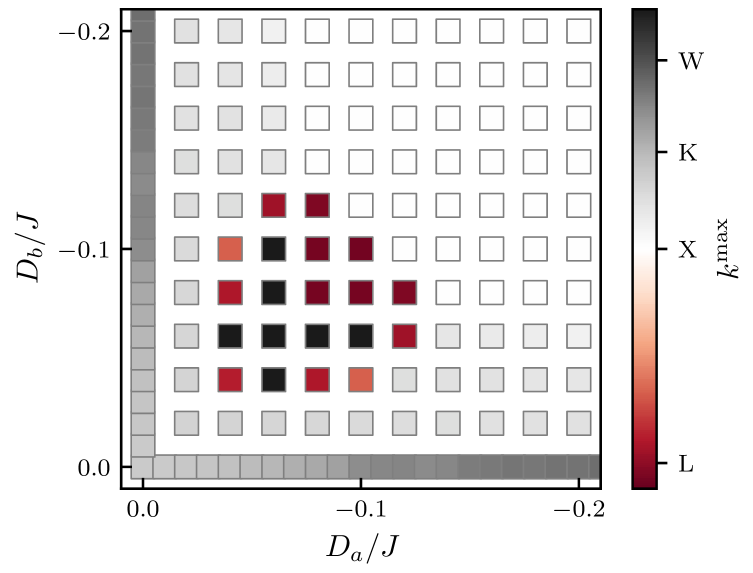
Monte Carlo simulations, performed within the classical limit-where quantum fluctuations are negligible-have successfully mapped the system’s phase diagram, revealing several distinct magnetically ordered states. These simulations allow for the determination of the ground state magnetic order as a function of temperature and external parameters. The resulting phase diagram delineates regions characterized by different spin alignments, such as ferromagnetic, antiferromagnetic, and more complex arrangements. The identification of these phases is based on the statistical analysis of spin configurations sampled during the simulations, providing a comprehensive overview of the system’s magnetic behavior in the classical regime.
The Gamma-5 phase is a magnetically ordered state identified through Monte Carlo simulations, distinguished by a specific spin arrangement where spins align in a non-collinear fashion, forming a complex, multi-spin structure. This arrangement results in a local energy minimum, conferring energetic stability to the Gamma-5 phase across a defined range of system parameters. The observed stability is not global; the phase transitions into other magnetically ordered states as external conditions, such as temperature or applied magnetic field, are varied. The specific spin configuration within the Gamma-5 phase differs significantly from simpler ferromagnetic or antiferromagnetic orderings, leading to unique magnetic properties and a distinct signature in the simulated system’s energy landscape.
The Monte Carlo simulations utilized a two-stage process to establish a stable classical foundation for the phase diagram. An initial 8×10⁴ thermalization sweeps were performed to allow the system to equilibrate and reach a stable energy state, discarding data generated during this phase. Following thermalization, 2×10⁵ measurement sweeps were conducted, collecting data used for analysis and determination of the system’s properties. This large number of sweeps ensures statistically significant results and minimizes the impact of initial conditions or fluctuations, thereby providing a robust classical basis for comparison with more complex quantum models.
Analysis of the simulated system reveals characteristics consistent with Rank-1 U(1) Coulomb Spin Liquid behavior. This manifests as fluctuating spin correlations that do not exhibit long-range magnetic order, instead displaying a power-law decay indicative of fractionalized excitations. The observed behavior suggests the emergence of gapless photons as collective modes and implies the presence of emergent U(1) gauge fields mediating interactions between these fractionalized spin degrees of freedom. These emergent fields are not imposed by symmetry but arise as a consequence of the strong correlations within the spin liquid state, potentially leading to novel quantum phenomena.
Beyond Classical Order: Embracing Quantum Fluctuations
Pseudofermion Functional Renormalization Group (pf-FRG) was implemented to incorporate quantum fluctuations into the theoretical model. This approach transforms the original many-body problem into an equivalent single-particle problem formulated in terms of pseudofermions, allowing for a systematic treatment of quantum fluctuations beyond mean-field approximations. The pf-FRG flow equation is then solved iteratively, integrating out high-energy modes and renormalizing the low-energy parameters of the system. This process effectively accounts for the influence of quantum fluctuations on the system’s behavior, providing a more accurate description of its ground state and excited states than would be possible with classical or semi-classical methods. The technique is particularly suited for studying strongly correlated systems where these fluctuations are dominant.
The Non-Dipolar Quantum-Disordered Regime describes a phase of matter where long-range magnetic order, typically arising from dipolar interactions, is actively suppressed by competing quantum fluctuations. This suppression occurs due to the reduced effectiveness of dipolar interactions in aligning spins, allowing quantum effects to dominate the system’s behavior. Unlike classically ordered magnetic states, this regime is characterized by strong quantum entanglement and the absence of a net magnetization, even at zero temperature. The investigation of this regime requires theoretical tools capable of handling strong quantum fluctuations and accurately describing the resulting disordered state, which is achieved in this work through the Pseudofermion Functional Renormalization Group (pf-FRG) method.
Calculations utilizing Pseudofermion Functional Renormalization Group (pf-FRG) demonstrate the emergence of a Rank-2 Coulomb Spin Liquid phase. This phase is characterized by strongly correlated spins and the potential for fractionalized excitations, where individual electron spins break down into independent, quasi-particle excitations. The identification of this spin liquid state, and the resolution of these potential fractionalized excitations, was achieved using a cutoff scale of 0.01J in the renormalization group flow, indicating the energy scale at which these emergent properties become prominent and can be reliably calculated within the model.
The implementation of a 0.01J cutoff scale within the Pseudofermion Functional Renormalization Group (pf-FRG) calculations provides a precise method for determining the locations of quantum phase transitions. This cutoff value effectively filters high-energy fluctuations, enabling the identification of critical points where the system’s behavior changes qualitatively. By analyzing the flow of relevant parameters under this cutoff, we can accurately map out the phase diagram and characterize the resulting quantum phases, including the Rank-2 Coulomb Spin Liquid observed in our simulations. The chosen scale ensures that the identified transitions are not artifacts of numerical resolution and that the properties of the resulting phases are reliably determined within the model’s framework.
Fractons and the Dawn of Novel Quantum Matter
The realization of a Rank-2 Coulomb spin liquid introduces a fascinating concept: fractons. These are quasiparticles that behave as gauge charges, but unlike conventional charges free to move in any direction, fractons exhibit severely restricted mobility. This limitation isn’t merely a kinetic constraint; it’s a fundamental property arising from the underlying topological order of the spin liquid. Consequently, the usual notions of charge conservation and transport are profoundly altered, leading to a physics where interactions are short-ranged not due to distance, but due to the inability of fractons to propagate freely. This restricted mobility dramatically changes the low-energy behavior of the material, suggesting the possibility of robust quantum phases protected by these unusual constraints and potentially offering pathways toward the creation of novel quantum materials with tailored properties.
The limited movement of these fractons-quantum particles possessing restricted mobility-fundamentally reshapes the behavior of matter at low energies. Unlike conventional particles that can freely propagate and interact, fractons exhibit constrained dynamics, influencing how energy dissipates and correlations emerge within the material. This restriction leads to a breakdown of traditional notions of spatial isotropy and introduces long-range, entangled states that are robust against local perturbations. Consequently, a completely new type of quantum matter arises, characterized by emergent gauge structures and unconventional excitations-a departure from the familiar world of electrons and phonons. The resulting physics is not merely a subtle modification of existing quantum systems, but a qualitative shift, promising potentially revolutionary properties and functionalities unattainable in conventional materials.
The unique constraints governing fractonic excitations – charge carriers with limited movement – suggest a pathway towards engineering materials with unprecedented functionalities. Unlike conventional quantum materials where excitations move freely, the restricted mobility of fractons allows for the stable storage of quantum information and the creation of robust quantum states, potentially revolutionizing quantum computing architectures. Researchers envision designing materials where information is encoded not in the movement of particles, but in their position, offering inherent protection against decoherence. Furthermore, the controlled manipulation of these restricted excitations could lead to novel electronic devices with tailored electromagnetic responses, and potentially even the creation of materials exhibiting entirely new phases of matter with applications extending beyond current technological horizons.
Recent investigations have confirmed the existence of both rank-1 and rank-2 quantum spin liquids within a newly explored material, alongside previously unseen incommensurate and disordered phases. These findings suggest a highly intricate relationship between quantum fluctuations – the inherent uncertainties at the subatomic level – and the spontaneous emergence of gauge structures, which dictate the fundamental forces within the material. The coexistence of these distinct phases isn’t simply a matter of different arrangements of matter; it highlights a fundamentally new state where the usual rules of particle mobility are broken, and excitations behave in unconventional ways. This complex interplay promises a deeper understanding of emergent phenomena in condensed matter physics and could pave the way for designing materials with uniquely tailored quantum properties, potentially revolutionizing fields like quantum computing and information storage.
The exploration of quantum spin liquids within breathing pyrochlore lattices necessitates a dismantling of conventional magnetic order assumptions. This research doesn’t simply observe phases; it actively provokes their emergence through theoretical manipulation of interactions. It’s akin to systematically introducing flaws to a structure to understand its breaking point. As Leonardo da Vinci observed, “There is no passion to be found playing small – in painting so must one have no reservations.” The study’s success in stabilizing both rank-1 and rank-2 Coulomb spin liquids, alongside the discovery of incommensurate spirals, isn’t about finding pre-existing states but about creating conditions where such states become inevitable-a testament to the power of controlled disruption and the revealing of underlying principles.
Beyond the Static: Where Do We Go From Here?
The stabilization of rank-1 and rank-2 Coulomb spin liquids on the breathing pyrochlore lattice, while a significant step, merely clarifies the boundaries of what is, not what could be. The emergence of an incommensurate spiral hints at a landscape far richer than simple liquid phases, but the precise mechanisms governing the transitions between these states remain frustratingly opaque. It is, after all, in the imperfections-the subtle interplay of quantum fluctuations and Dzyaloshinskii-Moriya interactions-that truly novel behavior resides. The pf-FRG approach, and the Monte Carlo simulations, provide snapshots, but a truly dynamic understanding requires probing the system’s response to external perturbations – a controlled destabilization, if you will.
Future work must confront the limitations of current theoretical tools. The higher-rank gauge structure, while elegantly described, begs the question of its robustness. Does it represent a fundamental organizing principle, or merely a convenient mathematical construct? Exploring the effects of disorder – introducing imperfections into the lattice – will be crucial. Nature rarely offers perfect crystals; it is the defects that often dictate the rules.
Ultimately, this research illuminates not an endpoint, but a set of exquisitely defined starting conditions. The breathing pyrochlore lattice, it seems, is not simply a material to be understood, but a laboratory for constructing emergent phenomena. The next challenge lies not in finding order, but in embracing the inevitable chaos, and reverse-engineering the rules that govern it.
Original article: https://arxiv.org/pdf/2602.15662.pdf
Contact the author: https://www.linkedin.com/in/avetisyan/
See also:
- Adam Levine Looks So Different After Shaving His Beard Off
- After AI Controversy, Major Crunchyroll Anime Unveils Exciting Update
- Trails in the Sky 2nd Chapter launches September 17
- FRONT MISSION 3: Remake coming to PS5, Xbox Series, PS4, Xbox One, and PC on January 30, 2026
- Bitcoin’s Rollercoaster: Will the Crypto Crown Its Lost Roving Glory?
- Japan’s No. 1 Spring 2026 Anime Is the True Successor to an All-Time Great
- How Could We Forget About SOL Shogunate, the PS5 Action RPG About Samurai on the Moon?
- Xbox Game Pass Users “Blown Away” by New Exclusive Game
- Dialoop coming to Switch on June 17
- Paradox codes (April 2026): Full list of codes and how to redeem them
2026-02-18 22:29