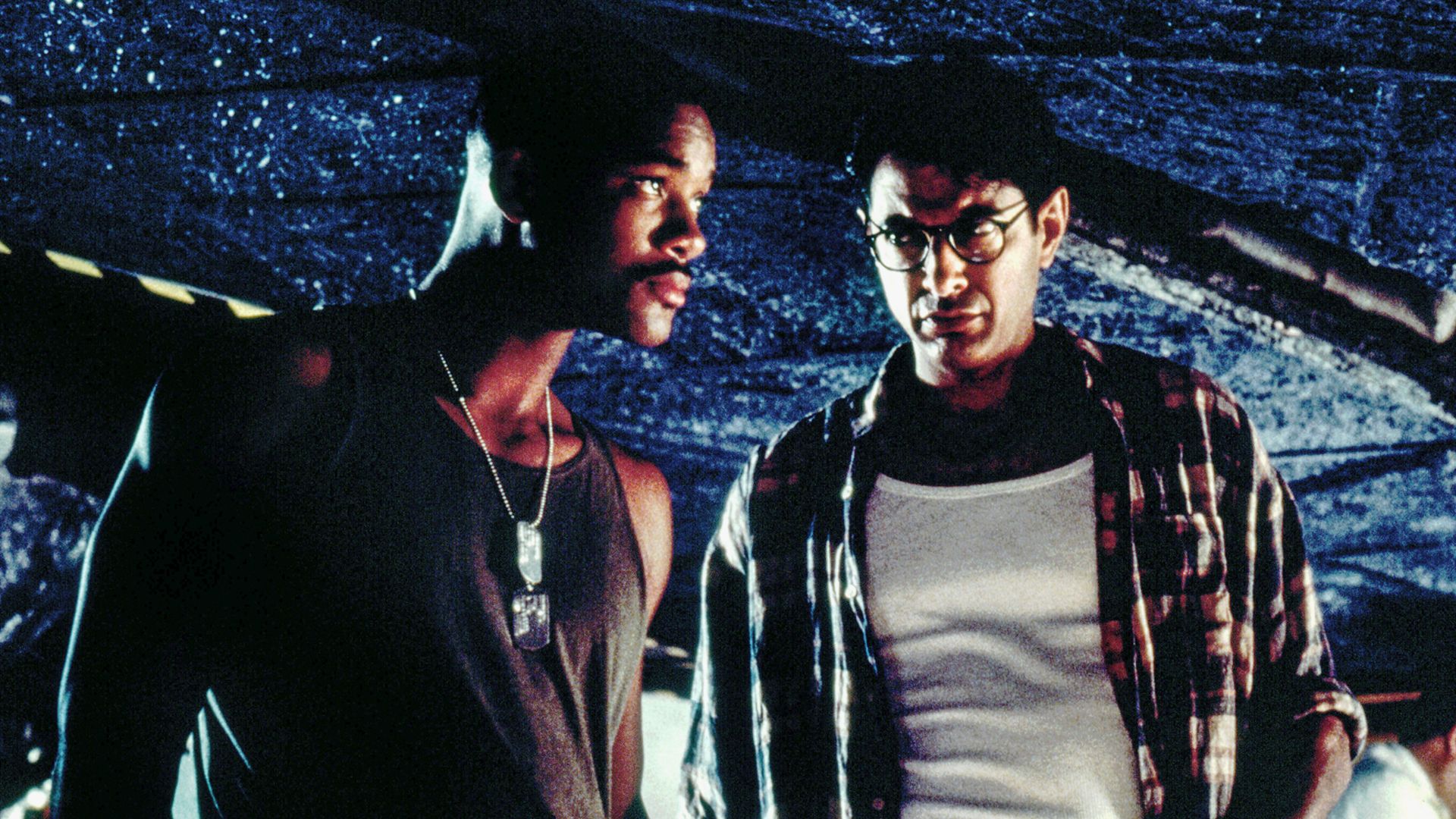
It’s become popular to examine past decades of film, looking back at how they shaped what came after. Each decade has a unique style that’s reflected in its movies, and specific filmmaking methods also come to define each era. This is particularly noticeable in the science fiction genre, where changes in technology are clearly visible over time.
The 1990s were a time of significant change, and 1996 offered a particularly interesting collection of science fiction films. While many movies from the ’90s clearly show their age, sci-fi has a unique ability to create films that feel timeless. They can be enjoyed with a sense of nostalgia that isn’t limited to a specific decade, although they may still bring back happy memories of 1996 for some viewers.
Mystery Science Theater 3000: The Movie Never Gets Old
You know, it’s funny – one of my favorite sci-fi movies from ’96 actually comments on older sci-fi flicks! It’s called Mystery Science Theater 3000: The Movie, and it was based on this really popular TV show. The premise is just brilliant: these mad scientists are trying to drive a janitor crazy by forcing him to watch terrible, old-school sci-fi B-movies, and thankfully, he’s got a couple of robot buddies to riff on the films with him. It’s a total blast if you’re a fan of cheesy sci-fi and clever commentary.
The movie felt very similar to the show, with a bit more polish, but it still kept the fun, low-budget vibe we love. Mike, Tom Servo, and Crow T. Robot are stuck watching the 1955 film This Island Earth, but luckily, the audience gets to enjoy their hilarious commentary along the way.
While Mystery Science Theater 3000: The Movie doesn’t quite reach the heights of the original TV show—and some fans might overlook it now that the series has returned—it’s still a fun watch. The humor of poking fun at cheesy special effects and dramatic acting hasn’t aged, especially when enjoyed with friends as the satellite crew.
Tremors 2: Aftershocks Still Stands Well in the Larger Franchise
If you’re feeling nostalgic for the ’90s, check out Tremors II: Aftershocks. Though it went straight to video, it’s a sequel to the popular 1990 monster movie Tremors, and continues the adventures of the memorable characters Val and Earl.
Though Kevin Bacon didn’t reprise his role, Fred Ward returned as Earl in the sequel. Down on his luck, Earl gets pulled into a lucrative job with a new, younger partner: hunting the same underground creatures – nicknamed Graboids – that are now attacking a factory in Mexico. Luckily, Earl teams up again with Michael Gross’s Burt Gummer, who gets a chance to shine as the main monster hunter.
Although the first Tremors movie and TV show gained a dedicated following, Tremors 2: Aftershocks is often considered the best in the series, which would go on to include five more direct-to-video releases. The sequel introduced a new and important type of monster that influenced the rest of the films, and it cleverly avoided typical ’90s horror clichés by focusing on strong characters and themes of regret and redemption.
Mars Attacks! is a Star-Studded Dark Comedy Cult Classic
In 1996, Tim Burton directed Mars Attacks!, a funny movie based on the popular Topps trading cards from the 1960s. These cards originally depicted a gruesome Martian invasion of Earth, with the aliens being both doomed and incredibly cruel. The cards were revived in the early 1990s, and their renewed popularity led to the creation of the film.
Tim Burton’s film featured a star-studded cast led by Jack Nicholson, who played two characters. Glenn Close, Martin Short, Natalie Portman, Danny DeVito, Annette Bening, Pierce Brosnan, Michael J. Fox, Sarah Jessica Parker, Matthew Broderick, Jack Black, Jim Brown, and Pam Grier also appeared as Earth’s residents comically and unsuccessfully battled a Martian invasion.
While the special effects might not seem as impressive today compared to newer movies, they actually suit the playfully quirky style Tim Burton was aiming for. Combining flying saucers, giant robots, and all sorts of death rays with silly humor and a surprisingly sweet tone, Mars Attacks! has become a beloved cult classic.
Multiplicity’s Humor is Dated but The Premise is Still Relevant
Although other animals had been cloned before, 1996 was the year Dolly the Sheep became famous. Cloning had been a topic in science fiction and the news for some time, but it really came to life in the 1990s, even starting to appear in movies. Director Harold Ramis explored this new scientific possibility in his 1996 film, Multiplicity.
The story follows a stressed-out father and husband who finds an unconventional solution to his busy life: he volunteers for a cloning experiment. He hopes a clone, imbued with his memories and personality, will handle his workload. But a mishap during the process causes the clone to develop some differences, and things quickly spiral out of control when the clone starts making copies of himself. The result is a funny and chaotic take on the cloning technology that was in the news at the time.
While not as widely celebrated as some of the other films mentioned, Multiplicity has remained popular enough to appear on many lists of essential comedies and science fiction movies. Considering advancements in areas like cloning and genetic engineering – including the development of lab-grown meat and food alternatives – the film still feels surprisingly relevant, even if its science isn’t entirely accurate.
Independence Day is Even More Timeless Than the Sequel
The 1990s were a time of widespread fascination with space and the possibility of alien life, and it’s easy to see why. NASA was actively exploring with high-profile missions like the Mars rover landings, and international cooperation in space increased. While movies in the 1980s often portrayed aliens with optimism and a sense of discovery, Roland Emmerich’s Independence Day took a more dramatic and destructive approach.
Jeff Goldblum and Bill Pullman star in a film about the aftermath of a devastating alien attack on Earth, where major cities have been destroyed. The story follows humanity’s struggle to fight back from the edge of total defeat. While the film features technology from before the age of smartphones, which might feel a little dated, it doesn’t detract from the overall experience.
The special effects in the movie Independence Day were groundbreaking for their time, and remarkably, they still look good today. While the original film remains relatable, its sequel explored a different path – a world where humanity had adapted to alien technology. This departure from reality unfortunately diminished some of the charm that made the first movie so impactful.
Star Trek: First Contact is Peak Sci-Fi That Keeps Aging Well
This is particularly appealing to fans of Star Trek and its many shows and films, but anyone who enjoys a good science fiction story beyond just spaceships and political intrigue will appreciate it. While Star Trek often explores those themes, the 1996 film Star Trek: First Contact offers something a little different.
Okay, so as a huge Star Trek fan, I really enjoyed First Contact. It definitely leans into the backstory from The Next Generation, but honestly, you don’t need to be a Trek expert to get into it. It’s a fantastic action movie at its heart, focused on the characters, and it tells the story of the Enterprise crew racing against time. They’re trying to prevent the Borg from taking over a planet before the first encounter with the aliens that gives the movie its name. It’s a really gripping story!
Even though it’s set in the past of the Star Trek universe, the show still focuses on humanity’s drive to explore, endure, and conquer seemingly impossible challenges, especially when facing emotionless robots. Patrick Stewart and the rest of the TNG cast had the opportunity to develop their characters for the big screen, guided by the dedicated and enthusiastic direction of their colleague, Jonathan Frakes.
Found an error? Send it so it can be corrected.
Read More
- Adam Levine Looks So Different After Shaving His Beard Off
- After AI Controversy, Major Crunchyroll Anime Unveils Exciting Update
- Trails in the Sky 2nd Chapter launches September 17
- FRONT MISSION 3: Remake coming to PS5, Xbox Series, PS4, Xbox One, and PC on January 30, 2026
- Japan’s No. 1 Spring 2026 Anime Is the True Successor to an All-Time Great
- Bitcoin’s Rollercoaster: Will the Crypto Crown Its Lost Roving Glory?
- Xbox Game Pass Users “Blown Away” by New Exclusive Game
- How Could We Forget About SOL Shogunate, the PS5 Action RPG About Samurai on the Moon?
- Dialoop coming to Switch on June 17
- New Reveal Proves Windrose Isn’t The Only Promising Pirate Game Coming Out In 2026
2026-02-19 01:39