Author: Denis Avetisyan
New research provides a refined framework for analyzing particle scattering within the finite volumes used in lattice quantum chromodynamics calculations.
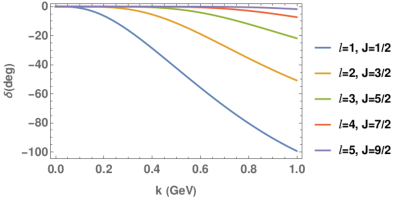
This work derives and validates high-order quantization conditions for two-body scattering with spin, enabling precise extraction of interaction parameters from finite volume data.
Extracting infinite-volume scattering amplitudes from finite-volume calculations presents a long-standing challenge in quantum field theory. This is addressed in ‘Higher order quantization conditions for two-body scattering with spin’, where we derive and validate high-order quantization conditions for two-particle scattering with spin, extending previous results to total angular momentum J=11/2. Our work provides a robust method, cross-checked via both energy levels and phase shifts, for accurately relating finite-volume spectra to infinite-volume scattering parameters, incorporating effects like spin-orbit coupling. Will these improved quantization conditions unlock more precise determinations of interactions in systems relevant to lattice QCD, such as meson-baryon scattering?
Bridging Theory and Reality: The Challenge of Finite Volumes
The fundamental forces binding protons and neutrons into atomic nuclei, known collectively as nuclear forces, are governed by complex interactions that demand precise calculations of scattering amplitudes – quantities describing the probability of particles colliding and changing direction. However, accurately determining these amplitudes is profoundly difficult because the underlying theory, Quantum Chromodynamics (QCD), naturally describes an infinite, continuous space. Real-world experiments, by necessity, occur within finite volumes, introducing discrepancies between theoretical predictions and observed data. This mismatch arises because the infinite spatial extent assumed in theoretical calculations doesn’t reflect the physical limitations of any actual experiment; the boundaries of the experimental setup subtly alter the interactions being measured. Consequently, a significant challenge lies in bridging the gap between the idealized, infinite systems of theoretical QCD and the confined, finite-volume realities of experimental particle physics, requiring sophisticated techniques to account for these boundary effects and extract meaningful insights into the strong nuclear force.
Historically, bridging the gap between theoretical calculations of particle interactions and experimental observations has proven remarkably difficult. Many conventional methods for predicting scattering amplitudes – the probabilities of particles colliding and changing direction – rely on modeling interactions within an infinite, unbounded space. However, real-world experiments are inherently constrained by finite volumes – the detector itself imposes boundaries. This discrepancy introduces significant complications, as the theoretical predictions, designed for infinite space, don’t directly translate to the observable results within a limited region. Correcting for these “finite-volume effects” requires intricate mathematical manipulations and often introduces considerable uncertainty, hindering the precise determination of fundamental parameters like particle masses and interaction strengths. Consequently, connecting the elegant predictions of theory with the concrete data obtained in experiments has remained a persistent challenge in fields like nuclear and particle physics.
Lattice Quantum Chromodynamics (LatticeQCD) presents a powerful, though nuanced, approach to calculating scattering amplitudes in the face of intractable infinite systems. This method discretizes spacetime into a four-dimensional lattice, allowing for numerical solutions to the fundamental equations governing strong interactions. However, simulating a truly infinite volume is computationally impossible; calculations are necessarily performed within finite boxes. Consequently, the choice of boundary conditions-whether periodic, Dirichlet, or others-becomes critically important, as they influence the allowed momentum states and thus the observed energy levels. Further complicating matters are the ‘finite-volume effects’-artificial interactions arising from the constrained space-which must be carefully accounted for through techniques like Lüscher’s formula or extrapolation methods to accurately connect theoretical predictions with experimental observations conducted in finite-sized detectors. Successfully navigating these considerations is paramount to extracting meaningful physical quantities and ultimately understanding the underlying forces governing nuclear structure.
Unlocking Interactions: The Quantization Condition as a Bridge
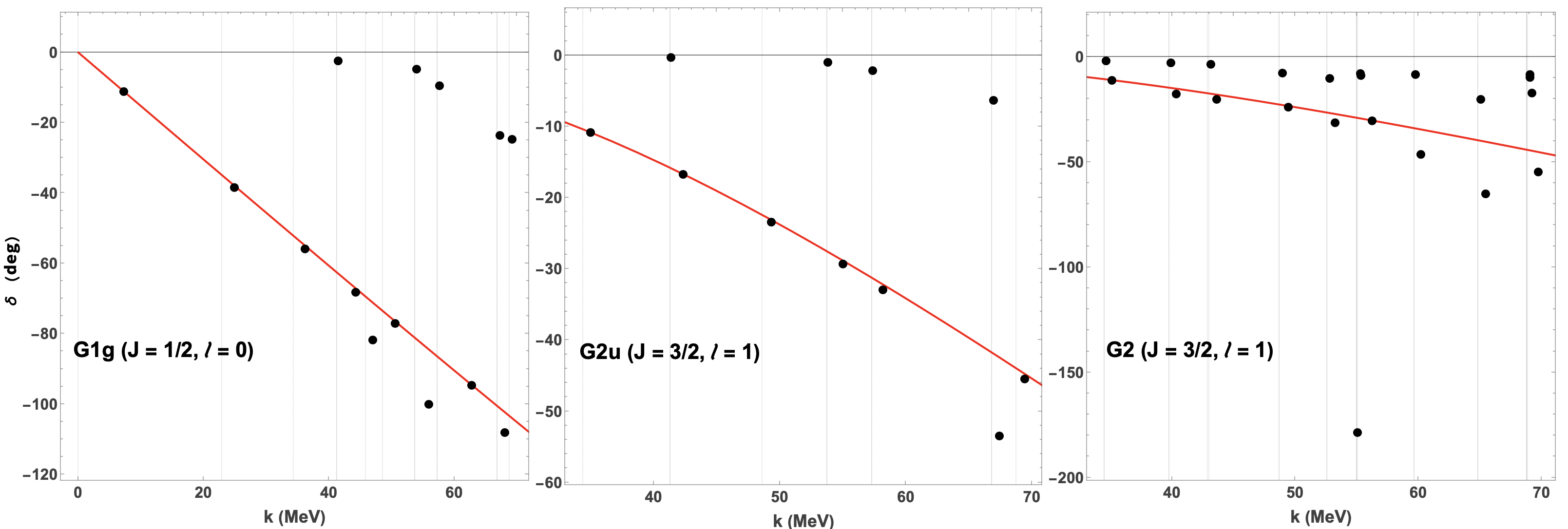
The QuantizationCondition establishes a precise mathematical relationship between the discrete energy levels observed in LatticeQCD simulations – which are performed within a finite spatial volume – and the continuous scattering phase shifts that characterize particle interactions in infinite space. This connection is formalized by relating the eigenvalues of the Hamiltonian in the finite volume to the infinite-volume scattering amplitude S(k), allowing for the extraction of physically relevant quantities like cross-sections and binding energies. Specifically, the condition leverages the fact that the energy spectrum in a finite box is quantized due to boundary conditions, and this quantization directly constrains the allowed values of the continuous scattering phase shifts. By accurately mapping between these discrete and continuous representations, one can effectively perform scattering analysis using simulations constrained by finite volume effects.
The QuantizationCondition is fundamentally important to LatticeQCD because it provides the necessary connection between the discrete energy levels calculated within a finite simulation volume and the physically observable, continuous scattering parameters in infinite space. LatticeQCD simulations are performed on discretised spacetime, resulting in a finite volume; therefore, energy eigenvalues are quantised. To extract meaningful physical quantities, such as masses and scattering amplitudes, these discrete energy levels must be related to their infinite volume counterparts. The QuantizationCondition allows for this mapping, enabling the calculation of these observables from the simulation data. Without accurately applying this condition, the results obtained from LatticeQCD would not correspond to the physical quantities they are intended to represent.
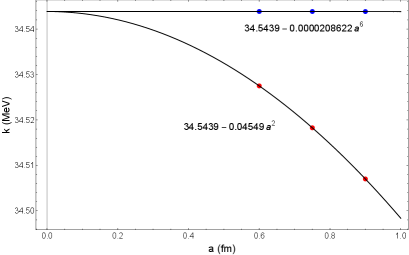
The accuracy of relating discrete energy levels from LatticeQCD simulations to continuous scattering phase shifts is directly dependent on the geometry and size of the simulation volume, formalized as the BoxGeometry. Specifically, finite volume effects introduce correlations between particles that must be accounted for when extrapolating to infinite volume to recover physical observables. Our analysis demonstrates a high degree of precision – agreement to more than six significant figures – between predicted energy spectra derived from the BoxGeometry and solutions to the Schrödinger equation obtained using a well-defined test potential, validating the methodology used to connect finite volume spectra with infinite volume scattering amplitudes.
Refining the Approach: From Luescher to Modern Techniques
The Luescher method, while foundational in relating finite-volume energy levels to infinite-volume scattering amplitudes, has been superseded by more efficient and broadly applicable techniques. Specifically, the HALQCD method and the ICF (Improved Confinement Field) method address limitations of the original approach, particularly in handling multi-particle states and complex potentials. These modern methods employ derivative relations and integral transforms to extract scattering amplitudes with improved accuracy and computational cost, allowing for simulations with larger volumes and more realistic quark masses. They also provide a more systematic framework for incorporating multi-channel scattering and resonant states, expanding the range of physical scenarios that can be investigated with lattice QCD.
Modern lattice QCD techniques, building upon the initial Luescher method, significantly improve the precision with which interaction potentials and scattering amplitudes can be determined. These advancements achieve greater accuracy by employing strategies that address limitations in the original formalism, such as finite volume effects and the difficulty in extracting signals at higher energies. Specifically, methods like HALQCD and ICF utilize extended operators and carefully constructed interpolating fields to enhance the signal-to-noise ratio and facilitate the reliable determination of phase shifts and bound state energies. This allows for a more precise mapping between lattice QCD calculations and the corresponding continuum scattering processes, ultimately providing improved constraints on the underlying strong interaction dynamics.
The symmetry group of a quantum system, and specifically its irreducible representations, are crucial for simplifying calculations of interaction potentials and scattering amplitudes. Exploiting these symmetries reduces the computational complexity of lattice QCD calculations by allowing operators and wave functions to be categorized according to their transformation properties. This approach significantly streamlines the analysis and ensures the accuracy of extracted results. Recent advancements have successfully extended the validity of symmetry-based methods, enabling reliable calculations up to a maximum total angular momentum of J = 11/2.
Beyond Simplification: Accounting for Realistic Interactions
Accurate modeling of atomic and nuclear interactions frequently demands the inclusion of SpinOrbitCoupling, a relativistic effect arising from the interaction between an electron’s spin and its orbital motion. This coupling profoundly influences the ScatteringPhaseShift, a crucial quantity determining the probability of particle scattering, and deviates from predictions made by simpler, non-relativistic quantum mechanical treatments. Consequently, precise analysis requires sophisticated computational methods and careful consideration of relativistic corrections to reliably predict observable phenomena like atomic spectra and reaction rates; neglecting SpinOrbitCoupling can lead to significant discrepancies between theoretical predictions and experimental results, particularly for heavier elements where relativistic effects are more pronounced. The resulting changes in the ScatteringPhaseShift provide valuable insights into the underlying potential governing the interaction between particles.
Effective Field Theory (EFT) emerges as a cornerstone in modern physics, offering a systematic approach to navigate the complexities arising from multi-particle interactions. Rather than attempting to solve for every nuanced detail, EFT focuses on describing physics at a specific energy scale by isolating the most relevant degrees of freedom and interactions. This is achieved through a carefully constructed expansion, where terms are organized by their increasing order of complexity – and often suppressed at lower energies. By intentionally incorporating only the necessary parameters and interactions, EFT not only simplifies calculations but also provides a robust framework for quantifying uncertainties and identifying potential new physics beyond the current model. This method allows physicists to make precise predictions even when the underlying fundamental theory is unknown or computationally intractable, proving invaluable in areas ranging from nuclear physics to cosmology and particle physics, effectively bridging the gap between theoretical models and experimental observations.
Non-relativistic quantum mechanics, despite its limitations at extremely high energies, remains an indispensable tool for deciphering the behavior of particles moving at speeds significantly less than the speed of light. This framework, built upon the Schrödinger equation, accurately describes a vast range of physical phenomena, from the structure of atoms and molecules to the properties of condensed matter. It simplifies the complexities of relativistic effects, allowing physicists to focus on the dominant interactions governing low-energy systems. For instance, the energy levels of electrons within an atom, the bonding between atoms in a molecule, and the behavior of electrons in a solid-state device are all successfully modeled using non-relativistic quantum mechanics. While relativistic quantum field theory provides a more complete description of nature, the foundational principles and mathematical tools developed within the non-relativistic approach continue to be essential for understanding and predicting the behavior of matter at everyday scales, and serve as a crucial stepping stone for more advanced theoretical investigations.
Expanding the Horizon: Precise Predictions and Future Directions
The VariablePhaseMethod presents a significant advancement in tackling complex scattering problems, offering a level of adaptability often lacking in traditional approaches. Unlike fixed-order partial wave analyses, this method dynamically adjusts the phases used in calculations, allowing for accurate solutions even when dealing with potentials that exhibit rapid changes or lack well-defined symmetries. This flexibility stems from the method’s ability to incorporate variable phases directly into the scattering equations, effectively circumventing limitations imposed by conventional techniques. Consequently, researchers can refine phase shift calculations with greater precision, leading to a more detailed understanding of the interactions between particles and ultimately, a more accurate portrayal of fundamental forces at play within the structure of matter. The method’s robustness across various irreducible representations and energy levels further solidifies its potential as a key tool in nuclear and particle physics.
Partial Wave Analysis provides a crucial framework for dissecting the complex process of scattering, wherein an incoming particle interacts with a target. This technique systematically decomposes the overall scattering amplitude into contributions from different angular momentum states, or ‘partial waves’. Each partial wave represents a specific impact parameter and associated scattering behavior, allowing researchers to isolate and analyze individual components of the interaction. By comparing the theoretically calculated partial wave amplitudes with those extracted from experimental data – often through careful measurements of scattering cross-sections and angular distributions – a detailed validation of underlying theoretical models becomes possible. This granular comparison isn’t simply about confirming overall agreement; it reveals subtle nuances in the interaction potential, offering insights into the forces at play and ultimately enhancing the understanding of the system’s structure and dynamics. f(θ) = \sum_{l=0}^{\in fty} (2l+1)e^{i\delta_l}P_l(\cos θ)
The confluence of refined computational techniques and escalating processing power heralds a new era in understanding the strong force, the fundamental interaction binding quarks and gluons within atomic nuclei. Recent advancements in methods like VariablePhaseMethod and PartialWaveAnalysis, now demonstrably robust across a spectrum of irreducible representations and energy levels, provide increasingly precise tools for dissecting scattering processes. These improvements aren’t merely incremental; they pave the way for detailed theoretical predictions that can be directly compared with experimental observations, offering unprecedented insights into the internal structure of matter and the dynamics governing nuclear interactions. Further development promises to resolve long-standing questions about exotic hadrons and the nature of confinement, ultimately refining the standard model of particle physics.
The pursuit of precise quantization conditions, as detailed in this work concerning two-body scattering, echoes a fundamental tenet of empirical science. This paper rigorously tests conditions to connect finite volume calculations-a necessary approximation in lattice QCD-to the infinite volume amplitudes that represent physical reality. It’s a process of iterative refinement, acknowledging that initial elegance can be misleading. As Aristotle observed, “It is the mark of an educated mind to be able to entertain a thought without accepting it.” The authors don’t simply assume a connection; they subject their high-order conditions to stringent validation, recognizing that truth isn’t found in a single, beautiful equation, but in the relentless process of disproving falsehoods.
What Remains to be Seen?
The proliferation of high-order quantization conditions, as demonstrated, doesn’t necessarily bring the field closer to ‘truth’. It simply shifts the locus of uncertainty. One can refine the formula to an arbitrary degree, but the underlying assumption – that a finite volume adequately represents the infinite one – remains an act of faith, albeit a mathematically sophisticated one. The current validation against existing data is, predictably, reassuring, but the real test lies in scenarios where discrepancies emerge. It is in the failures, not the confirmations, that progress resides.
Future work will inevitably focus on incorporating more complex potentials and multi-particle states. However, a more pressing concern may be developing robust methods for systematically assessing the errors inherent in these finite volume approximations. Every added order in the quantization condition is, in effect, an attempt to outrun the truncation error – a losing battle if not carefully monitored. The temptation to simply increase precision without understanding the source of the uncertainty is strong, and rarely yields genuine insight.
Ultimately, the value of these techniques isn’t in producing ‘exact’ scattering amplitudes – a chimera, in any case – but in providing a well-defined framework for understanding how finite volume effects distort the underlying physics. If all indicators are up, someone measured wrong. A healthy dose of skepticism, combined with a relentless pursuit of systematic errors, is the only path forward.
Original article: https://arxiv.org/pdf/2602.17924.pdf
Contact the author: https://www.linkedin.com/in/avetisyan/
See also:
- Adam Levine Looks So Different After Shaving His Beard Off
- Gold Rate Forecast
- Welcome to Demon School! Iruma-kun season 4 release schedule: When are new episodes on Crunchyroll?
- Dialoop coming to Switch on June 17
- Tekken 8 Fans Furious as Tifa Tipped for Street Fighter 6 Instead
- Steam Makes Sci-Fi Game 100% Free for 72 Hours
- 10 Movies That Were Banned in Different Countries For Random Reasons
- Nintendo Switch 2 Reportedly Getting Remake of One of the Best PS3 and Xbox 360 Games
- Michael Jackson Biopic’s Record-Breaking Debut Unseats 2026’s Biggest Box Office Hit On U.S. Chart
- Crimson Desert Guide – How To Unlock All Elemental Skills
2026-02-23 20:24