Author: Denis Avetisyan
A new theoretical model details how superconducting islands can induce and stabilize non-abelian anyons within two-dimensional fractional quantum Hall liquids.
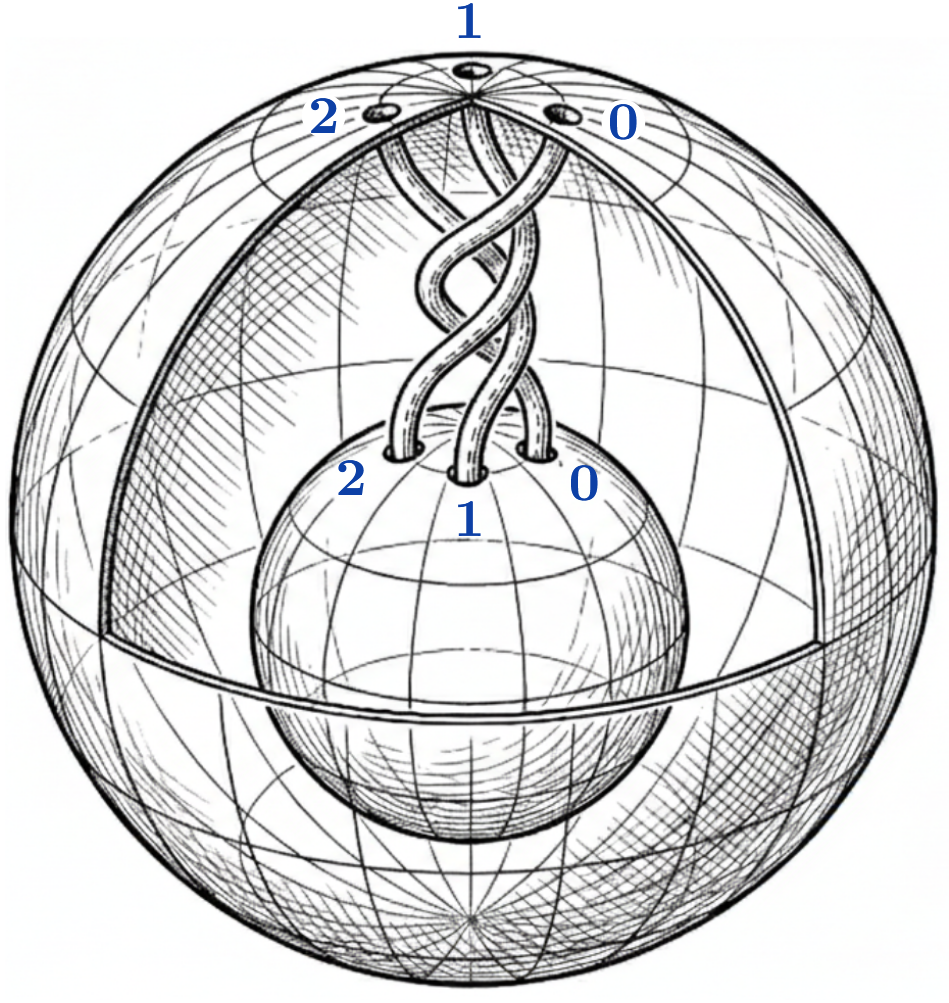
The research utilizes 5D Maxwell-Chern-Simons theory and cohomotopy to describe the emergence of these topologically protected quantum states.
The pursuit of topologically protected quantum states remains a central challenge in condensed matter physics, with experimental realization proving elusive in many systems. Here, in ‘Nonabelian Anyons attached to Superconducting Islands in FQH Liquids’, we revisit the theoretical underpinnings of non-abelian anyons within fractional quantum Hall liquids, proposing a framework based on 5D Maxwell-Chern-Simons theory and concepts from \mathbb{C}P^1-model/cohomotopy to demonstrate how superconducting islands can induce robust, non-abelian anyonic states. This approach predicts specific signatures arising from the interplay of topological order and induced superconductivity, offering a novel route toward realizing and characterizing these exotic states of matter. Could this framework pave the way for designing and verifying platforms for topological quantum computation?
The Illusion of Order: Electrons Dancing to a Different Tune
The Fractional Quantum Hall Effect (FQHE) reveals a remarkable state of matter where electrons in two-dimensional systems exhibit collective behavior that transcends simple, independent particle descriptions. When subjected to strong magnetic fields and low temperatures, these electrons don’t merely follow predictable trajectories; instead, they self-organize into correlated states characterized by quantized Hall conductance values – but crucially, these values are fractional multiples of the fundamental unit of conductance. This isn’t a consequence of imperfections or disorder; it’s an intrinsic property arising from the strong electron-electron interactions and the geometric constraints of the two-dimensional environment. The system effectively behaves as if it contains quasiparticles with fractional charges – like e/3 or e/5 – fundamentally challenging the conventional understanding of charge quantization and demonstrating a new form of emergent order where the whole is demonstrably more than the sum of its parts.
The Fractional Quantum Hall Effect reveals a world where the fundamental rules of particle behavior are rewritten, manifesting in the form of fractionalized excitations. Unlike conventional physics where particles carry integer charges – like the electron’s -1 – these quasiparticles exhibit charges that are fractions of the elementary charge, such as \frac{e}{3} or \frac{e}{5}. Even more startling is their exotic exchange statistics; swapping two of these quasiparticles doesn’t simply change the wavefunction’s sign (as with fermions) or leave it unchanged (as with bosons), but can result in a more complex phase change. This ‘anyonic’ behavior, stemming from the collective quantum entanglement within the two-dimensional electron gas, defies categorization by traditional particle types and hints at a deeper, more nuanced understanding of quantum mechanics, potentially unlocking pathways to robust quantum computation where information is encoded in these topologically protected states.
The pursuit of understanding the Fractional Quantum Hall Effect (FQHE) extends far beyond condensed matter physics, representing a pivotal step toward discovering entirely new states of matter with properties not found in conventional materials. These exotic states, arising from strong electron correlations, offer a unique platform to investigate fundamental concepts in quantum mechanics and potentially unlock revolutionary technologies. Critically, the FQHE hosts quasiparticles with unusual exchange statistics – neither bosons nor fermions – leading to topologically protected quantum states. This inherent robustness against local perturbations makes these states exceptionally promising for building fault-tolerant quantum computers, where maintaining the delicate quantum information is a major hurdle. While current quantum computing approaches are susceptible to noise, the topological protection offered by FQHE-based qubits could dramatically improve stability and scalability, paving the way for practical quantum computation.
A Topological Toolkit: Describing the Indescribable
Chern-Simons theory offers a field-theoretic description of fractional quantum Hall effect (FQHE) systems by focusing on the low-energy degrees of freedom and their associated topological properties. The theory utilizes a U(1) Chern-Simons action, S = \frac{k}{4\pi} \in t d^2x \epsilon^{\mu\nu} A_\mu \partial_\nu A_\nu, where A_\mu is the electromagnetic gauge field and k is an integer representing the filling fraction. This action naturally leads to the emergence of long-range correlations and the quantization of Hall conductance in units of e^2/h, consistent with experimental observations. Importantly, the topological nature of the FQHE states-characterized by the presence of quasiparticles with fractional charge and anyonic statistics-is directly encoded within the Chern-Simons term and its associated topological invariants, providing a powerful tool for analyzing these exotic phases of matter.
The emergence of fractional charge and anyonic statistics within the fractional quantum Hall effect (FQHE) is a direct consequence of the topological order described by Chern-Simons theory. Specifically, the theory predicts that quasiparticles in FQHE states exhibit charge that is a fraction of the elementary charge, such as e/3 or e/5, due to the underlying topological degrees of freedom. Furthermore, the exchange of these quasiparticles does not result in a simple \pm 1 phase factor as with bosons or fermions, but rather a more general phase factor dependent on the exchange path – a characteristic defining anyonic behavior. This arises from the topological nature of the Chern-Simons action, where the relevant degrees of freedom are not local but are defined by the global topology of the system, leading to these exotic statistical properties independent of specific details of the microscopic interactions.
Standard Chern-Simons theory, while effective for describing basic fractional quantum Hall effect (FQHE) states, exhibits limitations when applied to more complex systems. Specifically, modeling states beyond the simplest Laughlin or Moore read-me sequences requires extensions to the theory, as the standard formalism struggles to accurately capture the correlated many-body effects present in these states. Furthermore, incorporating external perturbations, such as disorder or electromagnetic fields, necessitates additional terms and approximations that can compromise the theory’s predictive power and introduce complexities in calculations. These limitations motivate the development of modified Chern-Simons theories and alternative approaches to address the full range of FQHE phenomena.
Beyond the Basics: Refining the Topological Description
Maxwell-Chern-Simons theory represents an extension of the foundational Chern-Simons theory, offering enhanced capabilities for modeling fractional quantum Hall effect (FQHE) systems. While Chern-Simons theory provides a description of topological phases through the use of Chern-Simons action S = \frac{k}{4\pi} \in t_{\mathcal{M}} \text{Tr}(A \wedge dA), the Maxwell-Chern-Simons theory incorporates a Maxwell term, allowing for a more complete description of systems with both topological order and conventional electromagnetic behavior. This extension is crucial for accurately representing the edge states and collective excitations observed in FQHE systems, as it permits the inclusion of long-range electromagnetic interactions and the treatment of systems with non-zero particle density. The added versatility allows for the investigation of a wider range of FQHE states and provides a framework for understanding their behavior under external fields and varying conditions.
Standard 2-cohomology, while useful in characterizing topological phases, fails to accurately account for the proper quantization of magnetic flux in fractional quantum Hall effect (FQHE) systems, particularly when considering more complex geometries or boundary conditions. 2-Cohomotopy addresses this limitation by providing a more sophisticated mathematical framework for describing the relevant topological invariants. Unlike 2-cohomology, 2-Cohomotopy incorporates information about the precise manner in which fluxes are quantized, allowing for a more physically realistic representation of FQHE states. This is achieved through the inclusion of additional data – specifically, a choice of a stable bundle class – which captures details lost in the coarser resolution of standard cohomology. Consequently, calculations using 2-Cohomotopy yield more accurate predictions regarding the topological properties and behavior of these systems, especially in scenarios where flux quantization is a critical factor.
The five-dimensional Maxwell-Chern-Simons theory, when combined with the mathematical framework of 2-Cohomotopy, provides a means of analyzing the topological characteristics of fractional quantum Hall effect (FQHE) states. This approach predicts the existence of non-abelian anyons localized at the boundaries of superconducting islands in these systems. These anyons, unlike bosons or fermions, exhibit exchange statistics where particle exchange results in a non-trivial phase transformation, potentially enabling topological quantum computation. The use of 2-Cohomotopy is crucial, as it refines the standard 2-cohomology approach by accurately accounting for the global topological constraints inherent in the FQHE, thereby enabling a more precise description of these exotic quasiparticles and their associated properties.
Engineering the Exotic: Islands of Superconductivity
The creation of non-Abelian anyons, exotic quasiparticles with the potential to revolutionize quantum computation, is significantly advanced through the strategic embedding of superconducting islands within a fractional quantum Hall effect (FQHE) liquid. These anyons arise not from the material itself, but from the carefully orchestrated interactions at the boundaries between the superconductor and the FQHE system. The superconducting islands act as “traps” for these anyons, localizing them and enabling precise control over their quantum state. This approach leverages the unique properties of both materials – the dissipationless current of superconductivity and the topologically protected states within the FQHE – to create a platform where anyons can be braided, or exchanged, manipulating their quantum information. The resulting system offers a pathway to realize topologically protected qubits, potentially overcoming the decoherence challenges inherent in conventional quantum computing architectures, as the information is encoded in the topology of the anyon configuration rather than in a specific physical state.
The topological properties arising within superconducting island systems are intrinsically linked to the geometry of their arrangement, demanding a sophisticated understanding beyond simple spatial considerations. Researchers model these systems using concepts borrowed from topology, specifically ‘punctured surfaces’ – imagine a surface with holes representing the superconducting islands within the fractional quantum Hall effect (FQHE) liquid. The number and arrangement of these ‘holes’ – and how they connect – directly dictate the types of anyons that emerge and their braiding statistics. This isn’t merely about physical distance; it’s about how these islands alter the global topology of the electron wavefunction, creating protected states robust against local perturbations. By carefully designing the geometry – the connectivity and number of these ‘punctured’ regions – scientists can engineer systems exhibiting specific, desired topological phases and, crucially, control the emergence of non-Abelian anyons necessary for fault-tolerant quantum computation.
The convergence of superconductivity and the fractional quantum Hall effect (FQHE) offers a compelling route towards realizing topologically protected quantum states essential for robust quantum computation. Specifically, engineered systems combining these phenomena can host anyons – quasiparticles exhibiting exotic exchange statistics – whose quantum information is encoded not in individual particles, but in the way they are braided around each other. These anyons fall into specific mathematical representations, known as irreducible representations (irreps), of the framed symmetric group – a mathematical structure dictating how braiding operations transform the quantum state. By carefully controlling the system’s parameters and geometry, researchers aim to manipulate these anyons, performing computations through braiding operations that are inherently resistant to local disturbances and decoherence, paving the way for fault-tolerant quantum technologies. The potential lies in leveraging the robust nature of these topological states to overcome the limitations of conventional quantum bits.
Mapping the Dance: The Mathematics of Braiding
Anyons, exotic particles exhibiting neither purely bosonic nor fermionic behavior, owe their unique properties to how they are exchanged – a process described by braiding statistics. The Framed Symmetric Group provides a powerful mathematical language to precisely capture these statistics. Unlike ordinary particles, where exchange is inconsequential, anyons acquire a phase factor upon braiding- circling each other-dependent not just on which particles are exchanged, but how the exchange occurs on a surface. This group elegantly accounts for the topology of these exchanges, considering not simply the order of braiding, but also the ambient space in which it happens. Specifically, the “framing” of the braid – how the strands pass over or under each other – profoundly affects the resulting phase. Understanding this mathematical structure is crucial because these braiding operations form the basis for topologically protected quantum computation; the robustness of quantum information hinges on the inherent stability encoded within these complex, yet precisely describable, exchanges.
The Mapping Class Group provides a crucial lens through which to examine the subtle behavior of anyons and their potential for quantum computation. This mathematical group doesn’t describe the anyons themselves, but rather the different ways a surface on which they move can be deformed without altering their fundamental topological properties – essentially, how the ‘fabric’ of space around them can be stretched and twisted. Each deformation corresponds to a unique element within the group, and understanding the relationships between these elements reveals how topological observables – quantities that remain unchanged under continuous deformations – are affected by the anyons’ movements. By classifying these deformations, physicists gain insight into the possible braiding patterns of anyons, which are central to encoding and manipulating quantum information in a robust manner, as the information is protected by the topology of the system rather than relying on the precise location of individual particles. This framework allows for the prediction and control of anyonic systems, paving the way for potentially fault-tolerant quantum technologies.
Theoretical models, such as the CP1 model and the Hopfion model, serve as crucial analytical tools in the exploration of anyonic systems. These frameworks allow researchers to move beyond abstract mathematical descriptions and begin predicting the physical behavior of these exotic particles – particularly their braiding statistics and resulting quantum states. The CP1 model, for example, provides insights into the low-energy properties of certain anyonic systems, while the Hopfion model focuses on understanding more complex, knotted configurations of anyons. Importantly, the ability to accurately model and predict anyonic behavior is fundamental to the development of topological quantum computation, where these particles could be harnessed to create exceptionally stable and robust quantum bits – qubits – less susceptible to the decoherence that plagues traditional quantum computing approaches. Through these models, scientists are edging closer to realizing the potential of anyons as building blocks for a revolutionary new form of computation.
The pursuit of topological quantum states, as detailed in this framework concerning non-abelian anyons, feels predictably ambitious. It’s a carefully constructed theory, leveraging 5D Maxwell-Chern-Simons theory and Cohomotopy – a beautiful edifice of mathematical rigor. Yet, one anticipates the inevitable friction with reality. As David Hume observed, “The mind has a great propensity to discover causes and effects.” This theoretical elegance, while compelling, will ultimately be tested by the messy unpredictability of experimental realization. The emergence of these anyons, induced by superconducting islands, offers a tantalizing prospect, but production environments rarely adhere to idealized models. Every abstraction dies in production, and this one, however beautifully constructed, will likely meet the same fate – at least it dies beautifully.
What’s Next?
The construction of a five-dimensional Chern-Simons theory to describe emergent anyons isn’t, strictly speaking, solving a problem. It’s relocating the inconvenience. The inherent difficulty lies not in the mathematics – elegant as it may be – but in the eventual confrontation with material reality. Every carefully crafted topological state will, inevitably, discover a ground state it prefers. The promise of robust quantum computation rests on isolation, and isolation is merely a temporary reprieve from entropy.
Future work will likely focus on refining the parameters of these superconducting islands, chasing increasingly improbable regimes of coherence. The search for Hopfions, while theoretically compelling, should be tempered by the understanding that what survives in simulation rarely survives deployment. The framework presented offers a sophisticated language for describing these states, but a language is not a blueprint.
It’s worth remembering that everything optimized will one day be optimized back. The field doesn’t build solutions; it postpones failures. The true measure of this work won’t be the beauty of the theory, but the ingenuity with which its inevitable decay is managed. Architecture isn’t a diagram; it’s a compromise that survived deployment-for a while.
Original article: https://arxiv.org/pdf/2602.18748.pdf
Contact the author: https://www.linkedin.com/in/avetisyan/
See also:
- Adam Levine Looks So Different After Shaving His Beard Off
- Gold Rate Forecast
- Dialoop coming to Switch on June 17
- Nintendo Switch 2 Reportedly Getting Remake of One of the Best PS3 and Xbox 360 Games
- Tekken 8 Fans Furious as Tifa Tipped for Street Fighter 6 Instead
- Steam Makes Sci-Fi Game 100% Free for 72 Hours
- Welcome to Demon School! Iruma-kun season 4 release schedule: When are new episodes on Crunchyroll?
- 10 Movies That Were Banned in Different Countries For Random Reasons
- When Things Fall Apart: A New View of Phase Transitions
- Michael Jackson Biopic’s Record-Breaking Debut Unseats 2026’s Biggest Box Office Hit On U.S. Chart
2026-02-25 04:21