Key Takeaways:
- ADA dropped below $0.19, hitting its lowest price in six years.
- JPG.Store and TapTools both shut down within the same six-week window.
- Cardano’s DeFi TVL sits at $123M, ranking 28th globally – behind newer chains.
- The community voted down its own Summit funding and is blocking IOG’s research budget.
As of June 4th, the token was trading at $0.1862, a drop of over 20% in just one week. This puts it at a six-year low, significantly down from its peak of $3.09 in September 2021. While this price decrease is concerning, it’s not the biggest issue Cardano has faced recently. The past two months have brought even more damaging developments.
Two pillars gone in six weeks
JPG.Store, a popular NFT marketplace that helped many people start using Cardano’s blockchain in 2021, officially closed down on May 23rd. Shortly after, TapTools—an analytics tool used by almost all Cardano traders to monitor blockchain activity and financial data—also stopped working, due to high operating costs. These weren’t minor projects; JPG.Store was the main way people entered the Cardano world, and TapTools provided essential data. With both gone within six weeks, Cardano’s services for everyday users have been significantly weakened, and there aren’t any similar replacements available yet.
After recent market developments, Cardano’s Charles Hoskinson warned on X (formerly Twitter) that struggling projects and teams with limited funding could face difficulties, potentially leading to wider failures. Shortly after, he announced he was taking a break, clearly expressing his frustration with the ongoing challenges in securing funding for Cardano’s treasury.
I’m taking a break. TTYL
— Charles Hoskinson (@IOHK_Charles) June 3, 2026
The liquidity numbers don’t lie
Cardano currently has around $109 million locked in its decentralized finance (DeFi) applications, according to DefiLlama. This ranks it 28th globally, trailing behind newer networks like Aptos and Mantle, and significantly below Ethereum. SundaeSwap V2, Cardano’s main decentralized exchange, sees about $1.86 million in daily trading volume, while similar exchanges on Solana process over 400 times that amount. The entire Cardano network generates only around $2,153 in fees per day, suggesting very little activity. ADA, Cardano’s token, has a market value of $6.75 billion, which is 93.8% lower than its peak, and there’s currently no evidence that people are buying it at this price.
The weekly chart confirms the damage
Looking at the weekly chart for ADA/USDT, the price has been consistently falling. Strong resistance levels are present above the current price. The 50, 100, and 200-week simple moving averages – currently at $0.4892, $0.5717, and $0.4873 – are acting as major barriers to further price increases.
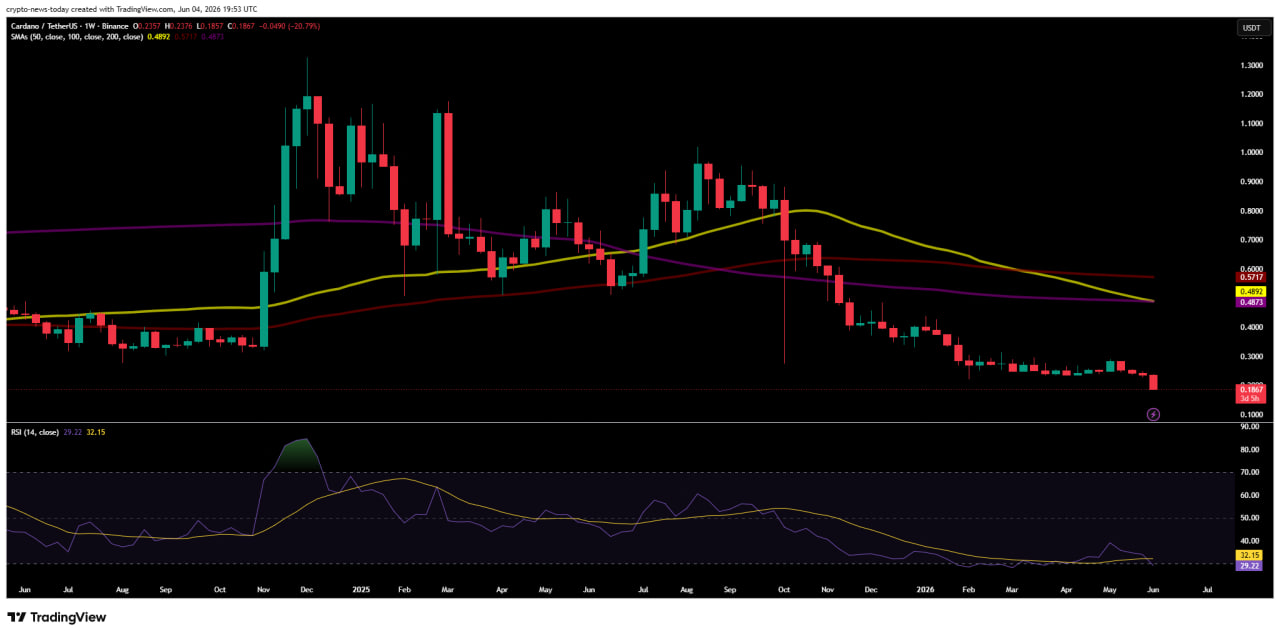
The Relative Strength Index (RSI) on the weekly chart is at 29.22, which usually indicates an oversold condition. However, it’s been at this level for a while now, so it doesn’t reliably suggest a price bounce is coming. We’re not seeing any signs that selling pressure is weakening – no clear support level is forming, and prices aren’t stabilizing. Until we see increased buying activity – both in trading volume and on the blockchain – the price is likely to continue falling.
Governance is choking the project’s own infrastructure
-
- Cardano Summit 2026 Cancellation: DReps rejected a 7.8 million ADA treasury proposal to fund the flagship Cardano Summit in Singapore, resulting in the event’s cancellation. Public voting documentation indicates the proposal secured a 65.21% approval rate, narrowly missing the required 66.67% two-thirds majority. Community financial reviews show that DReps exercised caution due to a projected budget imbalance, as the forecasted event revenue covered only $450,000 of the requested $2.26 million USD gross operating costs.
- Research & Development Rejection: A separate 32.9 million ADA research and development budget requested by Input Output Global (IOG)—the primary engineering firm behind Cardano’s core infrastructure—is facing an approximate 80% rejection rate from the active DRep body. Hoskinson has publicly stated that a prolonged funding halt risks the retention of core scientific and engineering staff.
What remains
Despite claims that Cardano is failing, its technical development remains strong. Data from GitHub shows it has the third-highest number of code updates globally – over 17,000 in the last year, behind only Ethereum and Internet Computer. The network is also actively used, with over 17,000 smart contracts running and these contracts making up over 35% of all daily transactions. Furthermore, the German bank DZ Bank recently added Cardano’s ADA to its regulated trading platform, indicating continued interest from institutional investors despite a decrease in retail investment.
Midnight, a privacy-focused blockchain supported by IOG and used by companies like Google and Vodafone, is currently the most important project for the network. It aims to bring business applications to the blockchain, something the main public chain hasn’t been able to achieve. While technologies like Hydra and Mithril are ready to handle increased activity, they aren’t being used much yet because there isn’t enough demand.
Even though Cardano’s core technology remains strong, this hasn’t attracted new investors or prevented existing ones from selling. The platform is now at a critical point – its long-term success depends on whether its community-based governance system can quickly provide funding for essential tools that users need, before its remaining public-facing services are forced to shut down.
This article is for informational purposes only and shouldn’t be considered financial, investment, or trading advice. Coindoo.com doesn’t support or suggest any particular investment or cryptocurrency. Always do your own research and talk to a qualified financial advisor before investing.
Read More
- Green Game Jam returns with 70 games teaming up to tackle the climate crisis
- PI PREDICTION. PI cryptocurrency
- USD THB PREDICTION
- USD CHF PREDICTION
- USD MYR PREDICTION
- USD HKD PREDICTION
- Brent Oil Forecast
- USD MXN PREDICTION
- USD JPY PREDICTION
- EUR HKD PREDICTION
2026-06-05 00:15