Author: Denis Avetisyan
New analyses of existing and future long-baseline neutrino experiments are tightening the constraints on exotic interactions that could reveal physics beyond the Standard Model.
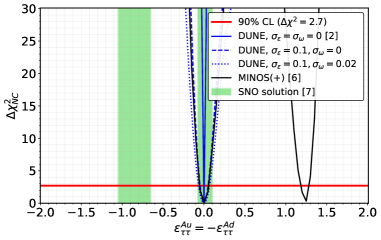
This review details how experiments like MINOS and the upcoming DUNE are probing axial non-standard interactions in neutrino propagation and scattering.
Despite growing evidence for neutrino oscillations, the potential for non-standard interactions (NSI) beyond the Standard Model remains largely unexplored, particularly in the axial sector. This paper, ‘Constraining axial non-standard interactions of neutrinos with long baseline experiments’, investigates the sensitivity of current and future long baseline neutrino experiments – including MINOS, MINOS$+$ and the Deep Underground Neutrino Experiment (DUNE) – to axial NSI couplings through neutral current scattering. Our analysis reveals that existing data already constrains some previously viable axial NSI scenarios, and that DUNE possesses the potential to significantly refine these limits. Could a detailed understanding of these interactions unlock new physics beyond the Standard Model and illuminate the role of neutrinos in the universe?
Unveiling the Neutrino Anomaly: A Window Beyond the Standard Model
The Standard Model of particle physics, a remarkably successful framework for describing the fundamental constituents of the universe and their interactions, nevertheless exhibits a significant limitation when it comes to neutrinos. While the model accurately predicts the behavior of particles like quarks, leptons, and bosons-and the forces governing them-it originally posited that neutrinos are massless. However, decades of experimental evidence, beginning with observations of the solar neutrino problem, have demonstrated that neutrinos do possess a small, but non-zero, mass. This discovery necessitates an extension of the Standard Model, as the original formulation lacks the necessary mechanisms to accommodate massive neutrinos. The discrepancy isn’t merely a matter of adding a single parameter; it implies the existence of new physics, potentially involving additional particles or interactions, that remain to be fully understood. Consequently, the study of neutrino properties has become a crucial avenue for probing beyond the established boundaries of particle physics and uncovering the deeper mysteries of the cosmos.
Early theoretical predictions posited neutrinos as massless particles, a cornerstone of the original Standard Model of particle physics. However, experiments such as the Sudbury Neutrino Observatory (SNO) fundamentally challenged this assumption. SNO, designed to detect neutrinos produced by nuclear reactions in the sun, observed a significant deficit in the number of electron neutrinos reaching the detector. This wasn’t due to a flaw in the experiment, but rather evidence that neutrinos were changing “flavor” – oscillating between electron, muon, and tau neutrinos – a process impossible for massless particles. The observation of neutrino oscillation unequivocally demonstrated that neutrinos possess mass, albeit incredibly small, necessitating an extension of the Standard Model to accommodate this previously unknown property and opening new avenues for exploring the fundamental nature of these elusive particles.
The established Standard Model of particle physics, while remarkably successful, presents a fundamental challenge when confronted with observed neutrino behavior. The confirmed existence of neutrino mass and oscillation-a quantum mechanical phenomenon where neutrinos change ‘flavor’ as they travel-directly contradicts the original model’s prediction of massless neutrinos. This discrepancy isn’t merely a refinement needed within the existing framework; it strongly indicates the presence of physics beyond the Standard Model. One compelling avenue of exploration lies in the concept of Non-Standard Interactions (NSIs), hypothetical interactions between neutrinos and matter that deviate from the model’s established weak interaction. These NSIs could manifest as altered neutrino production or detection rates, or even influence the oscillation patterns themselves, providing a crucial pathway to resolve the observed anomalies and potentially revealing new fundamental particles and forces governing the universe.
The persistent anomalies observed in neutrino behavior-discrepancies between predicted and measured neutrino counts-hint at physics beyond the established Standard Model. Researchers theorize that Non-Standard Interactions (NSIs), hypothetical interactions between neutrinos and matter differing from the weak force, could resolve these puzzles. These NSIs aren’t merely adjustments to existing theory; they propose fundamentally new ways neutrinos propagate and interact, potentially revealing previously unknown forces or particles. Investigating these interactions offers a unique window into the very fabric of reality, potentially explaining not only the observed neutrino anomalies, but also providing critical clues regarding the matter-antimatter asymmetry in the universe and the ultimate composition of dark matter. The exploration of NSIs, therefore, represents a crucial frontier in particle physics, promising a deeper understanding of the fundamental building blocks of existence.
Beyond the Standard Model: Charting New Theoretical Territory
Extending the Standard Model, certain theoretical frameworks propose the addition of a new U(1) gauge symmetry to the existing electroweak interactions described by the SU(2)xU(1) group. This expansion introduces an additional gauge boson and associated coupling constants. The resulting gauge group becomes SU(2)xU(1)xU(1), necessitating the introduction of new parameters to define the interactions. These models often arise from attempts to address shortcomings within the Standard Model, such as the hierarchy problem or the existence of dark matter, and predict modifications to processes governed by the electroweak force. The precise form of the new U(1) symmetry, and thus the properties of the associated gauge boson, is model-dependent and determined by the specific charge assignments given to Standard Model particles.
The introduction of a new U(1) gauge symmetry predicts the existence of the Z’ boson, a force carrier not present in the Standard Model. This boson mediates interactions specifically with particles possessing a new quantum number associated with this symmetry. Within the neutrino sector, these interactions constitute Non-Standard Interactions (NSIs) because they deviate from the predicted weak interactions. The Z’ boson can couple to both neutrinos and quarks, leading to effective NSI couplings that manifest as modified neutrino scattering cross-sections and altered oscillation probabilities. Detection of these NSIs would provide evidence for physics beyond the Standard Model and constrain the properties of the Z’ boson, including its mass and coupling strengths.
Non-Standard Interactions (NSIs) in the neutrino sector, arising from physics beyond the Standard Model, directly impact neutrino interaction cross-sections with matter. Specifically, these interactions modify the contributions to the Axial Interaction channel, altering the expected rates and final state distributions of neutrino scattering events. This deviation from Standard Model predictions manifests through altered weak mixing angles and the introduction of new couplings involving the neutrino field and quarks/leptons. Consequently, measurements of neutral and charged current interactions, particularly in neutrino oscillation experiments and deep inelastic scattering, become sensitive probes for these NSI effects, potentially revealing new physics through discrepancies between observed and predicted event rates and kinematic distributions.
The Hadronic Current, representing the collective effect of quark interactions within hadrons, is fundamentally altered by the introduction of new gauge bosons, such as the Z’ boson postulated in extensions to the Standard Model. These bosons couple to quarks, modifying their contributions to the current and influencing neutrino-nucleus scattering cross-sections. Specifically, the Z’ boson introduces an additional component to the Hadronic Current, which interferes with the Standard Model contribution and becomes particularly relevant in channels sensitive to axial vector interactions. The strength of this interference is determined by the coupling constants between the Z’ boson, quarks, and potentially other fundamental particles, impacting predictions for neutrino oscillation experiments and searches for Non-Standard Interactions.
Simulating the Invisible: A Computational Approach to Neutrino Interactions
Monte Carlo event generators, such as NuWro, are essential for modeling neutrino interactions due to the inherent complexity of these processes. These generators do not calculate interactions analytically; instead, they utilize random number generation to produce a large number of simulated events, statistically representing the probability distribution of possible outcomes. NuWro specifically focuses on simulating neutrino interactions with nucleons within the few-GeV energy range, relevant to many current and future neutrino experiments. The simulation process involves sampling initial state parameters, randomly selecting interaction vertices based on cross-sections, and propagating the resulting particles through a detector material, accounting for energy loss and particle decay. The output of these generators is a set of event records, detailing the kinematics of the interaction and the resulting particles, which can then be used for detector design, signal and background estimation, and ultimately, parameter extraction.
Accurate simulation of neutrino interactions necessitates a detailed understanding of the hadronic current, which describes the strong force interactions within the nucleus. This current is fundamentally composed of two components: the vector current and the axial vector current. The vector current arises from the interaction of the neutrino with the intrinsic spin of the quarks, while the axial vector current is related to the quark spin transitions. These currents are mathematically represented as four-vectors and contribute differently to the overall interaction cross-section; the axial current typically dominates due to its stronger coupling at low energies. Precisely modeling the contributions of both the vector and axial currents, including their form factors which account for the finite size and internal structure of hadrons, is crucial for accurately predicting neutrino interaction rates and final-state particle distributions.
Implementation of Non-Standard Interactions (NSI) within neutrino event generators necessitates the addition of new terms to the Lagrangian describing neutrino interactions. These terms introduce modifications to the Standard Model interaction basis, typically through the inclusion of operators involving non-standard vector and axial-vector couplings. Specifically, NSI are parameterized by introducing new couplings related to single and multiple exchanges of neutral and charged currents, which affect both charged-current and neutral-current neutrino scattering cross-sections. The extended generators then require evaluation of Feynman diagrams incorporating these new couplings, and their associated momentum transfer dependencies, to accurately model the altered interaction probabilities. These new terms are often characterized by complex phase factors and require careful consideration of their impact on CP violation and lepton flavor universality.
Analysis of neutrino interaction simulations necessitates statistical methods to determine the values of underlying parameters that best describe the observed data. Markov Chain Monte Carlo (MCMC) techniques are commonly employed for this purpose, allowing for the exploration of the parameter space and the quantification of uncertainties. Frameworks like Cobaya provide a flexible and efficient platform for implementing MCMC algorithms, facilitating the sampling of posterior probability distributions and the calculation of credible intervals for extracted parameters. This process enables researchers to not only estimate the most likely values of these parameters but also to assess the statistical significance of their findings and constrain potential new physics contributions beyond the Standard Model.
Towards Precision Neutrino Physics: Experimental Verification and Future Prospects
Early investigations into neutrino interactions, notably those conducted by the MINOS experiment, established crucial initial limitations on the strength of potential Non-Standard Interactions (NSIs). These experiments didn’t simply search for deviations from the Standard Model; they actively quantified the allowable range for couplings that would indicate physics beyond our current understanding. By meticulously analyzing neutrino oscillation patterns and interaction rates, MINOS provided the first experimental constraints on various NSI parameters, effectively narrowing the scope of theoretical models. This data served as a foundational dataset, guiding subsequent theoretical refinements and informing the design sensitivities of future, more powerful experiments dedicated to probing these subtle deviations from established physics. The initial bounds established by MINOS were not definitive, but they were instrumental in shaping the landscape of NSI research and setting the stage for the precision measurements now pursued by leading neutrino facilities.
Contemporary neutrino physics relies heavily on techniques like Deep Inelastic Scattering (DIS) to unravel the complex internal structure of hadrons-protons and neutrons-which serve as the targets in neutrino interaction experiments. By bombarding these targets with high-energy neutrinos and analyzing the resulting scattered particles, physicists can map the distribution of quarks and gluons within hadrons with increasing precision. This refined understanding is crucial because neutrino interactions are not simply collisions with point-like particles; rather, they involve complex processes influenced by the hadron’s internal composition. Improved models of hadron structure, informed by DIS and other techniques, directly translate into more accurate predictions for neutrino interaction rates and energy distributions, ultimately enhancing the sensitivity of experiments searching for new physics beyond the Standard Model, including Non-Standard Interactions.
A recent re-evaluation of data collected by the MINOS(++) experiment has yielded a significant result for the study of neutrino interactions. Analysis demonstrates that previously proposed ‘disconnected’ solutions within models of axial Non-Standard Interactions (NSI) are now excluded. These disconnected solutions represented theoretical possibilities where certain NSI parameters could take on values without conflicting with existing experimental constraints, effectively creating alternative scenarios for neutrino behavior. The MINOS(++) data, through improved analysis techniques and a larger data set, now firmly rules out these previously viable options, narrowing the range of possible parameters for axial NSI and providing a more constrained landscape for theoretical model building. This finding is crucial for refining the search for physics beyond the Standard Model and guides future experimental efforts focused on precisely characterizing neutrino interactions.
The next generation of long-baseline neutrino experiments, prominently featuring the Deep Underground Neutrino Experiment (DUNE), promises a revolutionary leap in the search for Non-Standard Interactions (NSI). These forthcoming studies are designed with sensitivities far exceeding current capabilities, enabling researchers to probe NSI couplings with unprecedented precision. Forecasts indicate that DUNE will be particularly adept at constraining the \tau\tau component of NSI, a channel proving difficult to examine with existing datasets. This enhanced capability arises from DUNE’s innovative detector technology and intensified neutrino beam, allowing for a more detailed understanding of neutrino oscillation patterns and, consequently, a refined ability to detect subtle deviations indicative of physics beyond the Standard Model. By substantially improving the bounds on these interactions, DUNE aims to either confirm or rule out many of the theoretical models proposing new physics at play in the neutrino sector.
The Deep Underground Neutrino Experiment (DUNE) promises a substantial refinement of current constraints on Non-Standard Interactions, even when accounting for potential systematic uncertainties. Projections indicate that DUNE could improve bounds on these interactions to a degree where background misidentification-the incorrect categorization of events-could introduce up to a 2% impact on the final results. This anticipated level of precision highlights the experiment’s sensitivity and the importance of meticulous control over systematic effects; even seemingly minor uncertainties could influence the interpretation of DUNE’s findings regarding physics beyond the Standard Model. Such precision underscores DUNE’s potential to not only detect, but also characterize, subtle deviations from established particle physics.
The pursuit of understanding neutrino interactions, as detailed in this study of Non-Standard Interactions (NSI), echoes a sentiment expressed long ago by Isaac Newton: “I do not know what I may seem to the world, but to myself I seem to be a boy playing on the seashore.” Just as Newton meticulously observed the patterns of the natural world, this research carefully examines the subtle deviations within neutrino oscillations, seeking to constrain axial couplings beyond the Standard Model. The methodical approach, employing long baseline experiments like MINOS and the future DUNE, reflects a similar dedication to patient observation and rigorous testing of hypotheses, recognizing that quick conclusions can mask structural errors in our understanding of these fundamental particles.
Where Do We Go From Here?
The exploration of neutrino Non-Standard Interactions, as demonstrated by this work, continually refines the boundaries of accepted parameters. It is a process of subtraction, eliminating possibilities rather than confirming truths. Current data, while narrowing the scope of axial couplings, doesn’t offer a definitive ‘signal’ – merely a shrinking space where potential deviations could reside. The sensitivity gains promised by DUNE are, naturally, presented as a pathway to discovery, yet one must consider the inherent limitations of even the most ambitious experiment. A null result, while disappointing to those invested in the ‘new physics’ narrative, would be equally valuable – a necessary step in solidifying the Standard Model, however incomplete it may be.
Future investigations should focus not solely on increasing statistical power, but on innovative approaches to systematic uncertainties. The challenge isn’t simply to see a deviation, but to confidently attribute it to physics beyond the Standard Model, rather than an unaccounted-for effect within it. Furthermore, a synergistic approach, combining long baseline data with complementary searches – such as those involving reactor neutrinos or atmospheric neutrinos – may offer a more holistic view, breaking the potential degeneracies inherent in single-experiment analyses.
The pursuit of neutrino NSI is, at its core, an exercise in pattern recognition. The identification of a statistically significant anomaly, however, is only the first step. If a pattern cannot be reproduced or explained, it doesn’t exist.
Original article: https://arxiv.org/pdf/2601.18888.pdf
Contact the author: https://www.linkedin.com/in/avetisyan/
See also:
- Pluribus Star Rhea Seehorn Weighs In On That First Kiss
- Gold Rate Forecast
- Kelly Osbourne Slams “Disgusting” Comments on Her Appearance
- Arknights: Endfield – Everything You Need to Know Before You Jump In
- Looks Like SEGA Is Reheating PS5, PS4 Fan Favourite Sonic Frontiers in Definitive Edition
- ’90s Cartoon Reboot & TMNT Connection!
- Goat 2 Release Date Estimate, News & Updates
- Hideo Kojima Says He Was Never Told About The Matrix Creators Wanting Him to Make a Game
- ‘Marty Supreme’ Ending, Explained
- Dune 3 Gets the Huge Update Fans Have Been Waiting For
2026-01-29 04:14