As a researcher following the meme coin space, 币安人生 (Binance Life) really struck me as a prime example of how hype can overshadow actual value. It also seems to be presenting a centralized structure as if it were a community-driven success, which is a bit misleading.
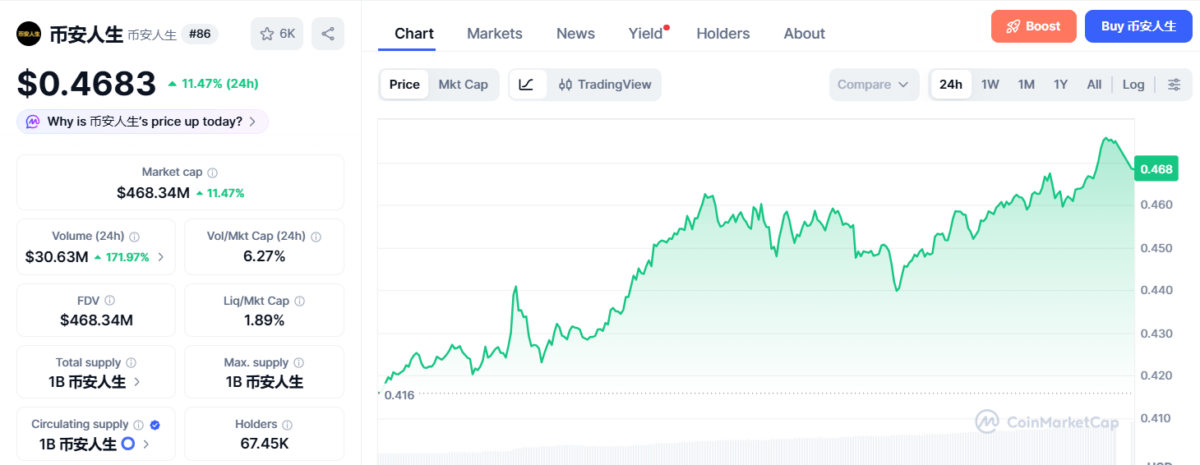
This token, which started on the BNB Chain in October 2025, quickly became popular thanks to viral memes circulating online in China and perceived connections to Binance leaders. It briefly reached a market value of almost $470 million.
The token promised an appealing lifestyle – the “Binance Life” – with perks like exclusive cars and a strong community. However, examining the token’s actual distribution reveals a stark contrast. The vast majority of tokens are held by the exchange itself, undermining the concept of a decentralized system.
As of today, the token’s price has jumped 11.5% to $0.4685, and trading volume has increased by 170% over the last 24 hours. Most of this trading activity is happening on Binance and PancakeSwap, the biggest decentralized exchange on the BNB Chain, which is believed to be connected to the Binance team.
Custodial Dominance on Steroids
Data from BscScan reveals a surprising concentration of ownership in this meme coin. A single Binance hot wallet holds a massive 667.19 million tokens, representing over 66% of the total 1 billion tokens in circulation.
A wallet identified as belonging to Binance holds the fourth-largest amount of these tokens, with 25.52 million (2.55%). Together with another Binance-controlled wallet, they manage almost 70% of the total tokens currently available.
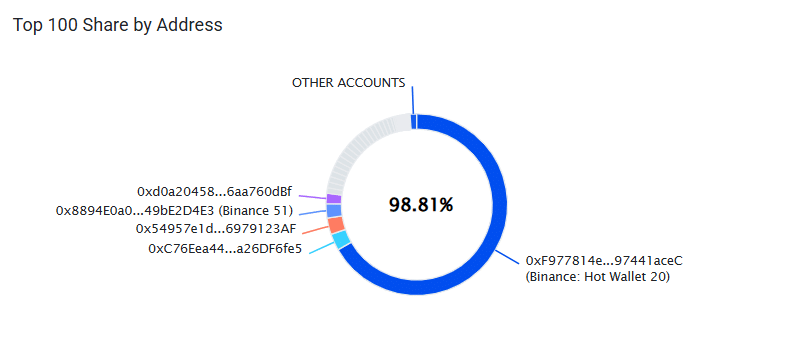
After the largest holders, a few other significant entities each control around 3% of the total. The remaining 30% is spread across a large number of smaller holders – over 67,700, in fact. This indicates that a small number of custodians control a vast majority of the asset, rather than it being widely owned by individual investors.
Those defending the situation often note that large amounts of tokens held in exchange wallets are typical for cryptocurrencies listed on centralized exchanges, as they represent customer deposits. However, this doesn’t address the real issue: Binance’s control over such a significant portion of the available tokens gives them considerable operational power.
If the exchange experiences a large number of withdrawals, shifts its internal holdings, or changes how it manages funds, the price of the coin could suddenly and dramatically drop. Regular investors would likely bear the full brunt of these losses. For a coin that’s purely based on hype and has no real-world use, this reliance on a single exchange isn’t just dangerous, it’s extremely irresponsible.
Murky Origins and Convenient Anonymity
The project’s unclear beginnings are raising red flags. It’s impossible to identify who created it – there are no known founders or publicly revealed developers. Instead, its story relies on a simple comment from Binance’s He Yi and unclear support from CZ, framed as a ‘community takeover.’
The new token was released on Four.Meme with a total supply of one billion tokens, no transaction fees, and all tokens were immediately available. Interestingly, it’s unclear who initially provided the funds to enable trading or acquired the first tokens.
Many teams in this field operate anonymously, quickly launching projects and then disappearing. This lack of transparency isn’t a good thing – it’s a major warning sign.
币安人生 has essentially built its entire project around the Binance brand and holds most of its tokens within Binance wallets. This creates a risky situation where the project’s success is heavily reliant on Binance continuing to attract users and maintain a positive reputation.
When most digital tokens are held on a single exchange, it becomes difficult to distinguish between genuine community interest and the exchange manipulating the market.
The biggest question is how a completely unknown cryptocurrency, created anonymously and with no real reputation – not even a website – ended up being officially listed on Binance. What requirements did Binance ignore to make that happen?
Some observers question if this system mainly benefits Binance by increasing its trading activity and fees. They wonder if it encourages individual investors to pursue a risky lifestyle centered around Binance, while the majority of the available assets remain controlled by the company.
From High to Low to Another High
The token’s price has followed a typical pattern for meme coins: big, quick increases followed by sharp drops. It experienced several surges in value, even briefly reaching a market value of $550 million earlier this year, but these were always followed by significant price declines.
As a researcher, I’m observing the recent price increase around $0.46, and frankly, it feels like we’re seeing another wave of excitement rather than a real, lasting shift in belief. There’s no clear plan for the future, no actual product to show for it, and the token’s value isn’t based on any solid foundations – it’s driven entirely by how people *feel* about it at any given moment.
This situation makes the limited supply even riskier. If the story driving investment weakens, people could rush to sell, and available funds could disappear quickly, particularly if large institutions start selling at the same time as regular investors lose interest.
It’s not unusual for a meme coin to gain popularity because of its listing on an exchange, but this one is unique due to how much of it is held by a small group of people. This situation essentially makes Binance the main source of buying and selling power, and helps keep the price stable – even if that wasn’t the intention.
This has resulted in favorable trading conditions with narrow price gaps and lots of activity. However, those passionate about decentralized finance see it as a step backward – a project that claims to be community-driven, yet operates with a centrally controlled supply of tokens.
Looking back at the meme coin craze on BNB Chain around 2025-2026, 币安人生 is a really interesting case study. Some people made a *lot* of money getting in early, and it was fun to watch. But it also highlighted something important: a lot of these tokens that claim to be all about the community are actually heavily reliant on centralized exchanges. It makes you think about how much control is *really* in the hands of the community versus the exchange itself.
Investors jumping into this recent price increase should be cautious and not get caught up in the hype. While “Binance Life” sounds appealing, the benefits seem limited to those who actually control the tokens – namely, the platform itself – and not the typical investor.
In a market that rewards skepticism as much as FOMO, this one deserves far more scrutiny than hype.
Read More
- Best Controller Settings for ARC Raiders
- Meet the cast of Good Omens season 3: All the actors and characters
- Mark Zuckerberg & Wife Priscilla Chan Make Surprise Debut at Met Gala
- Review: Final Fantasy Tactics: The Ivalice Chronicles (PS5) – Still the Benchmark for Turn-Based Tactics
- Nippon Sangoku Is The Best New Post-Apocalyptic Anime of Spring 2026
- The Witcher 3 Officially Reveals Stunning New Ciri Figure Coming 2026
- The WONDERfools ending explained: What happened to the Child of Eternity?
- 7 Great Marvel Villains Who Are Currently Dead
- FRONT MISSION 3: Remake coming to PS5, Xbox Series, PS4, Xbox One, and PC on January 30, 2026
- Welcome to Demon School! Iruma-kun season 4 release schedule: When are new episodes on Crunchyroll?
2026-05-19 15:35