Beyond Smooth Averages: Unveiling Hidden Structure in Complex Systems
![The study demonstrates that in a linear sigma model, the ratio [latex]GL[/latex] exhibits a temperature dependence affected by explicit breaking, with the interval defining the limits of reliability for mean-field theory and illustrating a pseudo-critical temperature’s relationship to this breaking parameter.](https://arxiv.org/html/2602.21095v1/x2.png)
A new theoretical framework moves past traditional mean-field approximations to reveal how spatial variations and interaction ranges shape the behavior of physical systems.
A new theoretical framework moves past traditional mean-field approximations to reveal how spatial variations and interaction ranges shape the behavior of physical systems.
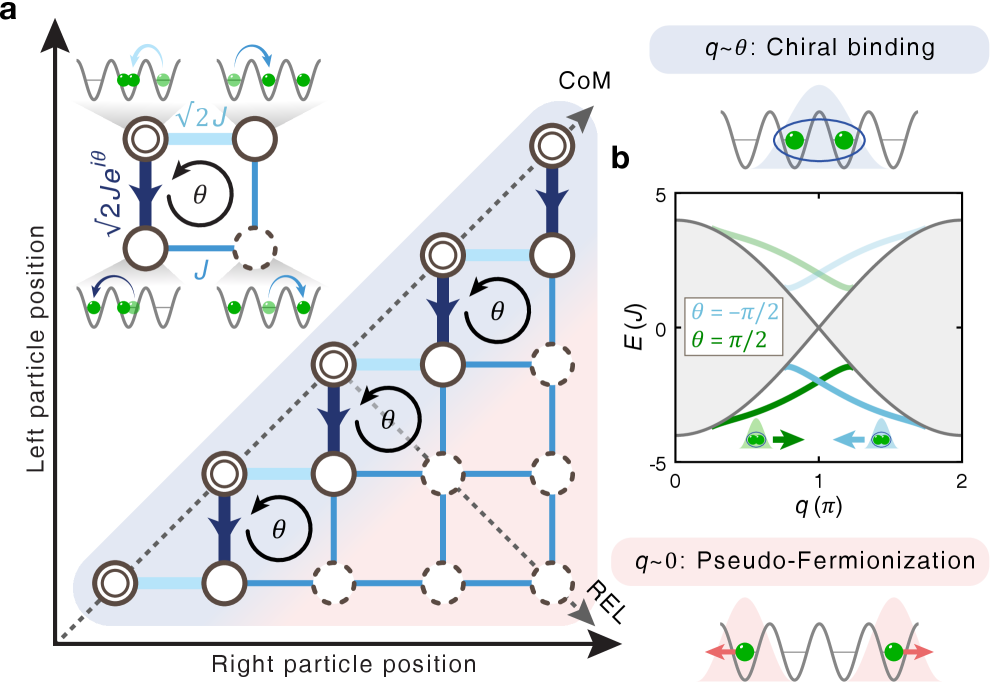
Researchers have successfully created and observed one-dimensional anyons, providing compelling evidence for their exotic quantum behavior.
![The analysis of quantum wells reveals that beyond a critical threshold [latex]h_c[/latex], the energy gap’s prefactor and the cubic well’s imaginary component exhibit oscillatory behavior, suppressing tunneling at specific points and demonstrating the inherent limitations of any theoretical construct when approaching a singularity.](https://arxiv.org/html/2602.20576v1/x33.png)
A new analysis reveals how quantum tunneling can be suppressed in deformed quantum mechanical systems, uncovering connections to fundamental mathematical structures.
A new theoretical framework explores how particles with internal structure behave in gravitational fields, revealing subtle effects on their quantum states.
![The analysis of hyperon decay processes-specifically, measurements of weak and strong phase differences in [latex]\Xi^{-}[/latex] decays-reveals subtle discrepancies between experimental results and Standard Model predictions, with observed values consistently diverging from theoretical expectations and exhibiting confidence intervals-spanning 68.2%, 95.4%, and 99.7%-that suggest a potential breakdown in established physics beyond the precision of current models.](https://arxiv.org/html/2602.20524v1/x6.png)
New, highly precise measurements of hyperon decay are refining our understanding of why the universe is dominated by matter over antimatter.
New observations reveal sequential mini-oscillations in the Dirac semiconductor ZrTe5, hinting at unexpected quantum behavior beyond established theory.
![The Earth’s dense matter fundamentally alters the behavior of hypothetical axion dark matter particles through quadratic coupling with fermions, creating a localized gradient in the axion field-analogous to light refraction-that is maximized at the surface and detectable via a specialized comagnetometer configured to exploit this effect; this configuration leverages the differing responses of alkali-metal and noble-gas spins to external noise and the axion gradient to achieve ultrahigh sensitivity, with predicted enhancements scaling approximately as [latex] 1/(kR_{\mathrm{E}}) \times ((f_{\mathrm{a}}^{c}/f_{\mathrm{a}})^{2} [/latex] for a Compton frequency of 1 Hz and a decay constant of [latex] 10^{13.5} [/latex] GeV, demonstrating a spatially-confined, measurable signal concentrated near the Earth’s surface.](https://arxiv.org/html/2602.20260v1/x1.png)
A new experiment leverages the planet’s own magnetic field to boost the search for weakly interacting axions, a leading dark matter candidate.
![The study demonstrates that as [latex] \lambda k(s) [/latex] approaches 0.5 - specifically transitioning from 0.1, 0.3 to 0.49 and 0.499 - the uncertainty product [latex] \Delta q \Delta_{q} [/latex] exhibits a critical behavior, suggesting a fundamental limit to precision even before accounting for slow-roll corrections.](https://arxiv.org/html/2602.20734v1/x2.png)
A novel theoretical framework suggests that quantum entanglement between hidden gravitational sectors could amplify primordial gravitational waves, offering a potential solution to longstanding constraints on early universe cosmology.
![Altermagnetic textures give rise to emergent spin-orbit coupling and odd-parity magnetism, demonstrated by the vanishing of an emergent Zeeman field [latex]V\_z \propto \cos 2\varphi[/latex] at specific points within circular Néel domain walls-where energy splitting stems solely from a metric-induced term [latex]\boldsymbol{\mathtt{g}}\_{\boldsymbol{p}}\propto\boldsymbol{p}\cdot\nabla\phi[/latex]-and, conversely, by the elimination of nodes in the energy contours of skyrmion textures due to contributions from both [latex]\nabla\theta[/latex] and [latex]\sin\theta\nabla\phi[/latex].](https://arxiv.org/html/2602.20236v1/x5.png)
A new understanding of altermagnetic textures is revealing unexpected links between spin arrangements, emergent electromagnetic fields, and the quantum behavior of electrons.
![Precision spectroscopy, applied across diverse atomic, molecular, and exotic systems-including hydrogenic atoms, molecular ions, and muonium-establishes a complementary sensitivity to new physics, with the reach dependent on specific combinations of effective couplings to fundamental particles and modulated by the characteristic interaction range, as evidenced by the distinct sectors delineating sensitivity for electrons, muons, protons, and neutrons [latex] [/latex].](https://arxiv.org/html/2602.20750v1/x2.png)
Atomic and molecular spectroscopy are emerging as powerful tools to explore phenomena beyond our current understanding of the universe.