Hunting Dark Matter with a Magnetic Grid
![This work projects the sensitivity of a proposed ferromagnet lattice magnetometer to ultralight dark matter couplings, demonstrating constraints-shown as a solid red curve-that improve upon existing limitations derived from both the literature [15,16] and single ferromagnet magnetometers [8], based on calculations utilizing a [latex]1\ \mathrm{m}[/latex] shield size and established parameter configurations.](https://arxiv.org/html/2602.17291v1/x4.png)
A novel magnetometer design leveraging a ferromagnet lattice promises enhanced sensitivity in the search for ultralight dark matter particles.
A novel magnetometer design leveraging a ferromagnet lattice promises enhanced sensitivity in the search for ultralight dark matter particles.
New research reveals a powerful method for calculating how particles scatter in the presence of exotic quantum fields known as instantons.
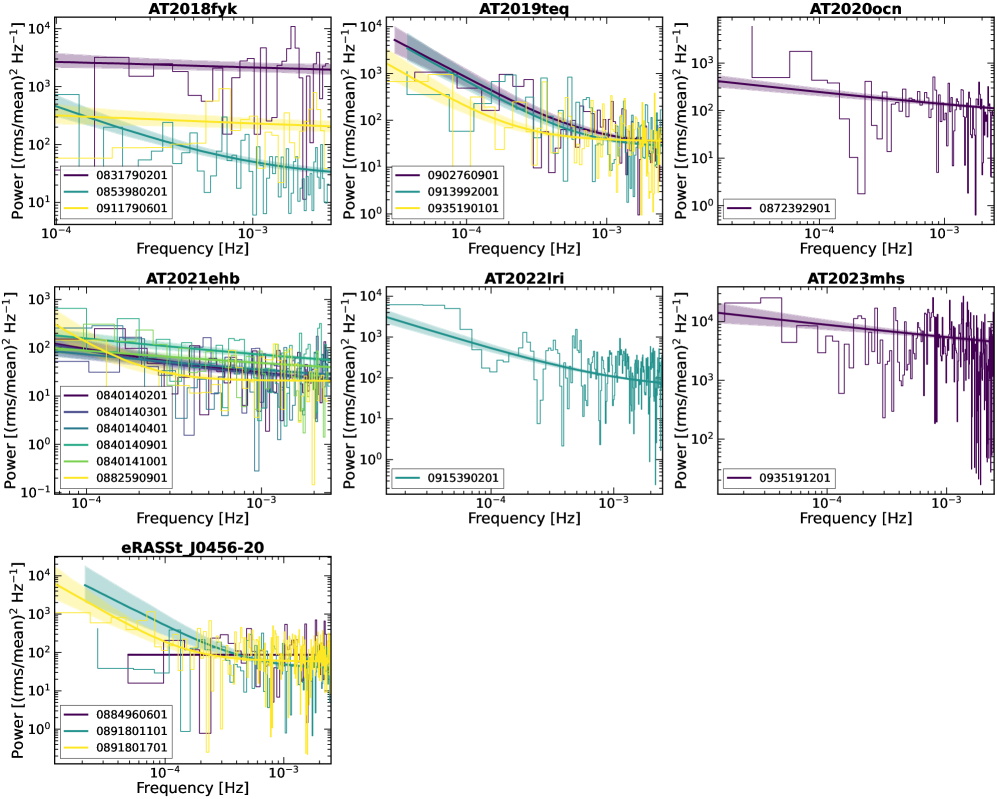
A new study provides the first detailed look at how X-ray emissions change over time in the aftermath of a star being torn apart by a black hole.
![The phase space of a Kerr-de Sitter black hole, depicted with [latex]\ell = 1[/latex], demonstrates how ensemble choices-visualized as directional arrows, with the red arrow specifically detailing the selection used in Section 7.1-influence the system’s trajectory and potential states.](https://arxiv.org/html/2602.16767v1/x1.png)
New research reveals a consistent logarithmic correction to the entropy of near-extremal black holes, stemming from subtle quantum effects.
![Dilepton transverse momentum distributions-analyzed at collision energies of 13 TeV and 38.8 GeV using the Pdf2Is approach with a fixed gluon mass of 2.0 GeV-demonstrate the capacity to model experimental measurements [19, 21] and quantify theoretical uncertainties across a range of invariant masses.](https://arxiv.org/html/2602.17533v1/x23.png)
New research sheds light on the complex interplay of quantum effects that govern particle production in high-energy collisions.
New research reveals a fundamental link between the complex entanglement of many particles and the underlying topological order governing their long-range behavior.
![The study of fermionic gravity, as demonstrated through gravitational path integrals on a solid torus, reveals a spectrum of states-including bosonic and fermionic black holes denoted by energy thresholds [latex]E \geq |j|[/latex] where [latex]j \in \mathbb{Z}[/latex]-and further distinguishes these states through the presence of both positive and negative energy contributions, each characterized by an edge proportional to [latex]1/\sqrt{E-|j|}[/latex].](https://arxiv.org/html/2602.17618v1/x4.png)
New research reveals a surprising link between three-dimensional gravity, fermionic particles, and the hallmarks of quantum chaos in their two-dimensional counterparts.
Researchers have developed a novel transform that redefines scale in NMR spectroscopy, potentially reducing data acquisition requirements and improving signal processing accuracy.
![The critical temperature [latex]T_c[/latex] exhibits a discernible relationship with the strength of second-neighbor antiferromagnetic exchange coupling [latex]J_b'[/latex], suggesting a tunable pathway for manipulating the material’s magnetic phase transition.](https://arxiv.org/html/2602.17057v1/x2.png)
New research reveals that atomic vacancies and subtle interactions between nanoparticle atoms dramatically influence their magnetic stability and tendency to flip polarization.
New research confirms the existence of multimodal superfluidity, a complex phase where neutrons pair up in multiple ways, challenging conventional understandings of matter at extreme densities.