Hidden Symmetry: Unlocking New Material Properties
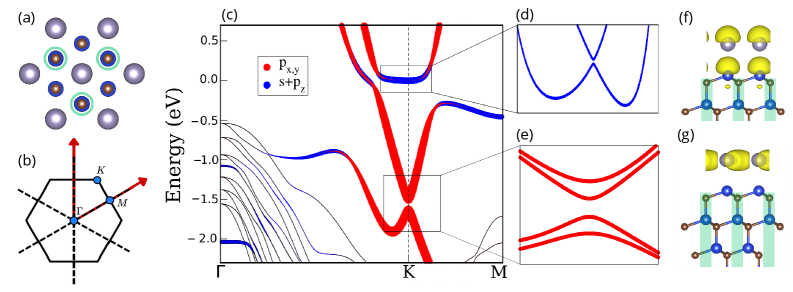
A new framework reveals how subtle arrangements within crystalline structures can give rise to unexpected symmetries and influence a material’s electronic behavior.
A new framework reveals how subtle arrangements within crystalline structures can give rise to unexpected symmetries and influence a material’s electronic behavior.
![The spectra of quantum field theory and spin systems-examined with parameters [latex]L=128[/latex], [latex]\ell=\pi[/latex], and [latex]m=1[/latex]-demonstrate a divergence attributable to the doubler mass scale, specifically at [latex]2p/\varepsilon - m[/latex], indicating a fundamental distinction in their spectral properties as the parameter <i>p</i> varies from 1 to 0.1.](https://arxiv.org/html/2602.17935v1/x1.png)
Researchers have developed a new method for modeling quantum field theories with boundaries in curved spacetime using open spin systems, offering a path to understanding physics in extreme environments.

Researchers have developed a comprehensive finite element analysis approach to accurately simulate the behavior of interconnected systems undergoing large deformations.
![The interplay of parameters [latex]\mu/t = -0.1[/latex] and [latex]\Delta/t[/latex] sculpts the electronic landscape, manifesting as distinct distributions of Berry curvature and orbital magnetic moment within the Brillouin zone, ultimately influencing the quasiparticle band structure and revealing a tunable relationship between topological properties and low-energy excitations-a relationship further modulated by shifting [latex]\Delta/t[/latex] from 0.09 to 0.225.](https://arxiv.org/html/2602.17376v1/x3.png)
New theoretical work reveals a unique orbital magnetic moment arising from superconducting quasiparticles, diverging from conventional electron behavior and impacting material properties.
![On a kagome lattice superconductor, the interplay of sublattice degrees of freedom gives rise to a phase boundary-separating [latex]\Delta+\Delta^{+}[/latex] and [latex]\Delta^{-}\Delta^{-}[/latex] phases-that manifests as a hexagonal structure of fractionalized vortices and suppressed order parameters, each exhibiting individual current loops around the three sublattices.](https://arxiv.org/html/2602.17399v1/x1.png)
New theoretical work predicts the emergence of fractional quantum vortices, tied to individual sublattices, within chiral d+id superconductors on the kagome lattice.
New research reveals that Coulomb interactions within generalized Weyl semimetals create direction-dependent electronic behavior, challenging traditional Fermi liquid theory.
![The magnetoelectric Raman force response function [latex]\chi^{\alpha l}_{2}(\omega_{1},\omega_{2})[/latex]-where α denotes longitudinal or transverse components and [latex]l[/latex] represents the x or y direction-is determined by the interplay of four Green’s functions [latex]G_{1,..4}(\boldsymbol{k},i\omega_{n})[/latex] and symmetrized Bogoliubov transformations of 4x4 polarization matrices, establishing a framework for understanding complex material responses to external stimuli.](https://arxiv.org/html/2602.16785v1/x12.png)
Researchers have theoretically shown how electric fields can be used to manipulate magnetic states in a specific class of layered materials through a novel coupling between light and atomic vibrations.
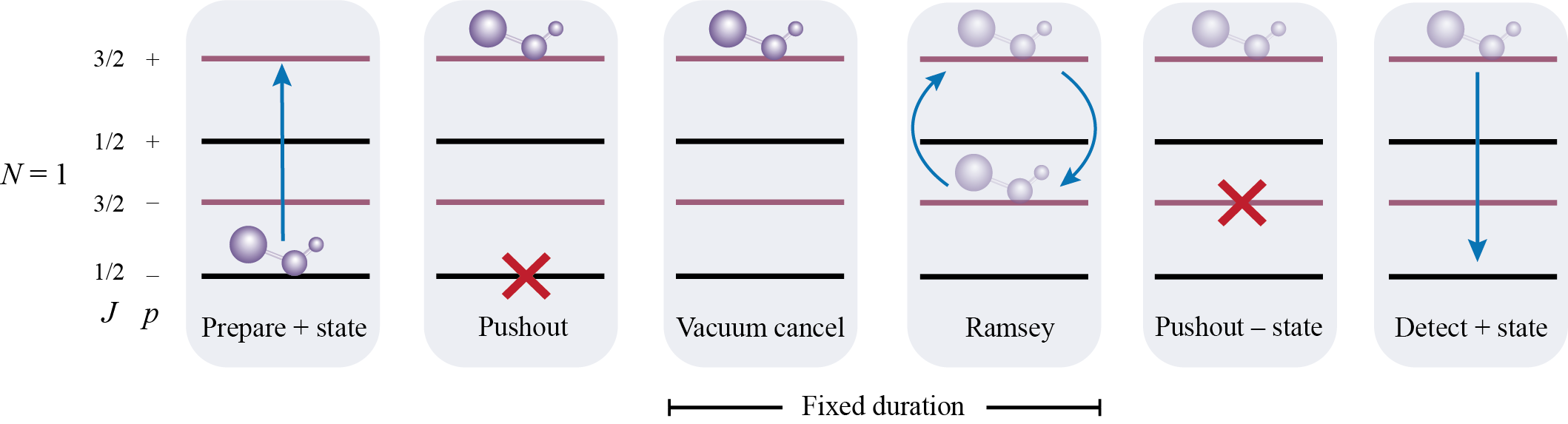
Researchers have achieved remarkably long coherence times in complex molecular states, opening new possibilities for quantum simulations and precision measurements of fundamental physics.
![Rydberg atom arrays leverage local hole injection-induced by a combination of global microwave radiation and modulated light shifts at frequencies [latex]\omega\_{\rm MW}\pm\omega\_{\rm LS}[/latex]-to probe the many-body spectrum and access the local density of states, demonstrated by observing sideband coupling to both eigenstates in a two-atom system and a Rabi frequency that aligns with expected Bessel function [latex]J\_{1}(\kappa)[/latex] behavior.](https://arxiv.org/html/2602.17600v1/x1.png)
A new spectroscopic technique using precisely controlled Rydberg atoms allows researchers to map out the energy landscape of complex magnetic materials.
![This work projects the sensitivity of a proposed ferromagnet lattice magnetometer to ultralight dark matter couplings, demonstrating constraints-shown as a solid red curve-that improve upon existing limitations derived from both the literature [15,16] and single ferromagnet magnetometers [8], based on calculations utilizing a [latex]1\ \mathrm{m}[/latex] shield size and established parameter configurations.](https://arxiv.org/html/2602.17291v1/x4.png)
A novel magnetometer design leveraging a ferromagnet lattice promises enhanced sensitivity in the search for ultralight dark matter particles.