Beyond Einstein: Refining Gravity with Scalar Fields
![In Entangled Relativity, the relative variation of a constant, [latex]\frac{C\_{i}-C\_{0}}{C\_{0}}[/latex], is numerically integrated and demonstrably changes with radius, exhibiting a dependency linked to a central density of 100 MeV/fm[latex]^{3}[/latex].](https://arxiv.org/html/2602.11811v1/first_integral_constant.png)
New research delivers precise calculations of how alternative gravity theories diverge from General Relativity in extreme cosmic scenarios.
New research delivers precise calculations of how alternative gravity theories diverge from General Relativity in extreme cosmic scenarios.
New research demonstrates that enforcing constraints arising from multiple symmetries can guarantee gapless phases in physical systems, offering a novel pathway beyond traditional anomaly-driven mechanisms.
![Fine-tuning a structured semantic similarity learning (SSL) model-initially characterized by strong correlation at [latex]\rho=0.94[/latex]-destroys its inherent geometric organization, plummeting correlation to [latex]-0.03[/latex] and causing the resulting invasive probe to fail unpredictably on out-of-distribution tasks, a consequence avoided by a more robust, non-invasive probing method maintaining correlation above [latex]\rho=0.8[/latex].](https://arxiv.org/html/2602.12218v1/x8.png)
New research reveals that standard machine learning techniques can inadvertently corrupt a model’s underlying understanding of physical principles, impacting its ability to accurately simulate the world.
New research leverages ballistic fluctuation theory to map the behavior of charged particles and quantum entanglement in complex systems, even after a disruptive event.
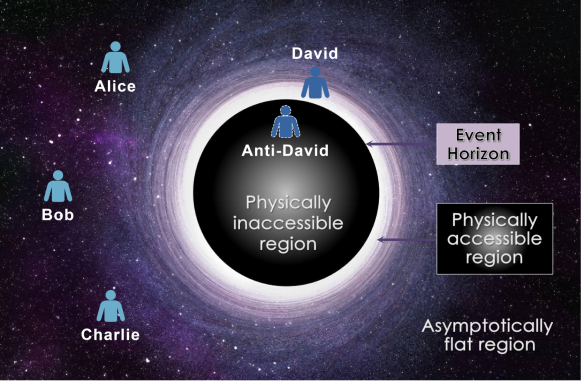
New research reveals a uniquely stable quantum state that maintains maximal entanglement even when exposed to the intense gravitational forces and Hawking radiation surrounding a black hole.
Researchers have developed a robust method for constructing the fundamental operator bases used to describe interactions in non-relativistic effective field theories.
![The dynamics of [latex] q^n(t) [/latex] are explored for values of <i>n</i> ranging from 1 to 8, demonstrating a range of behaviors despite the differing units inherent in these observables.](https://arxiv.org/html/2602.11335v1/x3.png)
New simulations reveal that initializing a cavity mode with a single photon unlocks observable light-matter entanglement and oscillating energy exchange in molecular polariton systems.
![The study of a QCD-like gauge-fermion theory-with three colors and three chiral flavors-reveals how a chiral order parameter [latex]\sigma_0(r)[/latex] evolves with spatial separation and temperature, transitioning from a symmetric phase at high temperatures to a precondensation regime-where the condensate exists only over finite length scales-and ultimately to a broken phase characterized by a macroscopic condensate at large distances, with the domain size ξ delineating the extent of precondensation and a UV length scale [latex]r_{UV}[/latex] marking its effective vanishing point.](https://arxiv.org/html/2602.11265v1/x1.png)
New research explores how thermal fluctuations drive the formation of short-range condensates in complex quantum systems.
New research connects the subtle world of quantum entanglement to the geometry of spacetime, revealing a deeper link between gravity and quantum information.
Researchers have successfully created and studied molecular rings assembled from triangulene units, opening new avenues for exploring the behavior of quantum spins.