Where Quantum Reality Takes Shape: A New Framework for Localization
Researchers have developed a mathematical approach to defining where quantum events occur, bridging the gap between quantum mechanics and the principles of relativity.
Researchers have developed a mathematical approach to defining where quantum events occur, bridging the gap between quantum mechanics and the principles of relativity.
![The study delineates the bounds of applicability for critical function space estimations-specifically, for [latex]L^{q}(\mathbb{R}^{n})[/latex] potentials, Strichartz pairs [latex](r,p)[/latex], and the Stein-Tomas extension [latex]L^{2}(\mathbb{S}^{n-1})\to L^{p}(\mathbb{R}^{n})[/latex]-demonstrating that the Kenig-Ruiz-Sogge estimate holds for [latex]p\in[q\_{2},\in fty)[/latex] in two dimensions and [latex]p\in[q\_{n},p\_{n}][/latex] for higher dimensions, thereby establishing a nuanced understanding of their dimensional dependence.](https://arxiv.org/html/2602.12122v1/x3.png)
New research demonstrates a powerful method for uniquely determining a quantum potential by analyzing how a system evolves between initial and final states.
![The study demonstrates that alterations in the Kondo lattice temperature [latex]T_{K}[/latex]-induced by applied strain-directly modulate electrical resistance, manifesting as a sign change in temperature dependence and a positive elastoresistance under a magnetic field, thereby revealing the interplay between material properties and externally applied forces.](https://arxiv.org/html/2602.12141v1/Fig1.jpg)
New research demonstrates a powerful connection between mechanical strain and the emergence of magnetic entropy in a heavy-fermion material, offering insights into its quantum critical behavior.
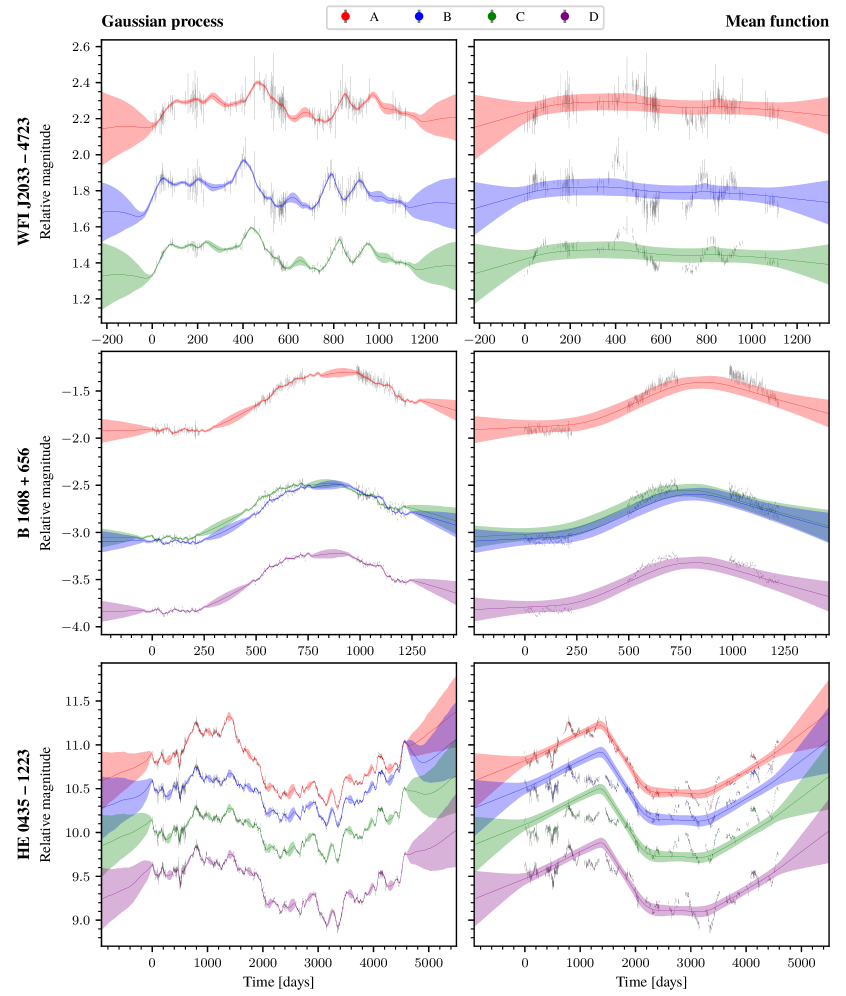
A new Bayesian framework leveraging Gaussian Processes is helping astronomers dissect the fluctuating light from quasars to refine our understanding of the universe’s expansion.
![The scaling dimension [latex]\Delta\phi[/latex] is calculated across different [latex]\mathrm{Sp}(10)[/latex] and [latex]\mathrm{Sp}(4)[/latex] models using conformal 2-pt correlators [latex]\mathscr{C}_T[/latex], revealing its dependence on both [latex]\gamma_{12}[/latex] and [latex]R[/latex], and consistently approaching the expected value of [latex]\Delta_J = 2[/latex] while aligning with the critical point previously identified through crossing symmetry.](https://arxiv.org/html/2602.11255v1/x8.png)
Researchers are using innovative simulations on a ‘fuzzy sphere’ to explore the behavior of quantum systems at the brink of phase transitions.
![The Sondheimer frequency exhibits a clear dependence on doping concentration, transitioning predictably across the overdoped to underdoped regime under a perpendicular magnetic field-a relationship governed by parameters including a perpendicular transfer integral of [latex]3 \times 10^{-3} \text{eV}[/latex], zero phase shift [latex]\eta = 0[/latex], and a layer thickness ratio of [latex]d/a = 40[/latex].](https://arxiv.org/html/2602.11252v1/x6.png)
New research demonstrates that subtle changes in electrical resistance under a magnetic field can be used to chart the complex electronic structure of high-temperature superconductors.
New research reveals that the fundamental nature of spacetime in loop quantum gravity allows for both fermionic and bosonic behavior in the excitations of the gravitational field.
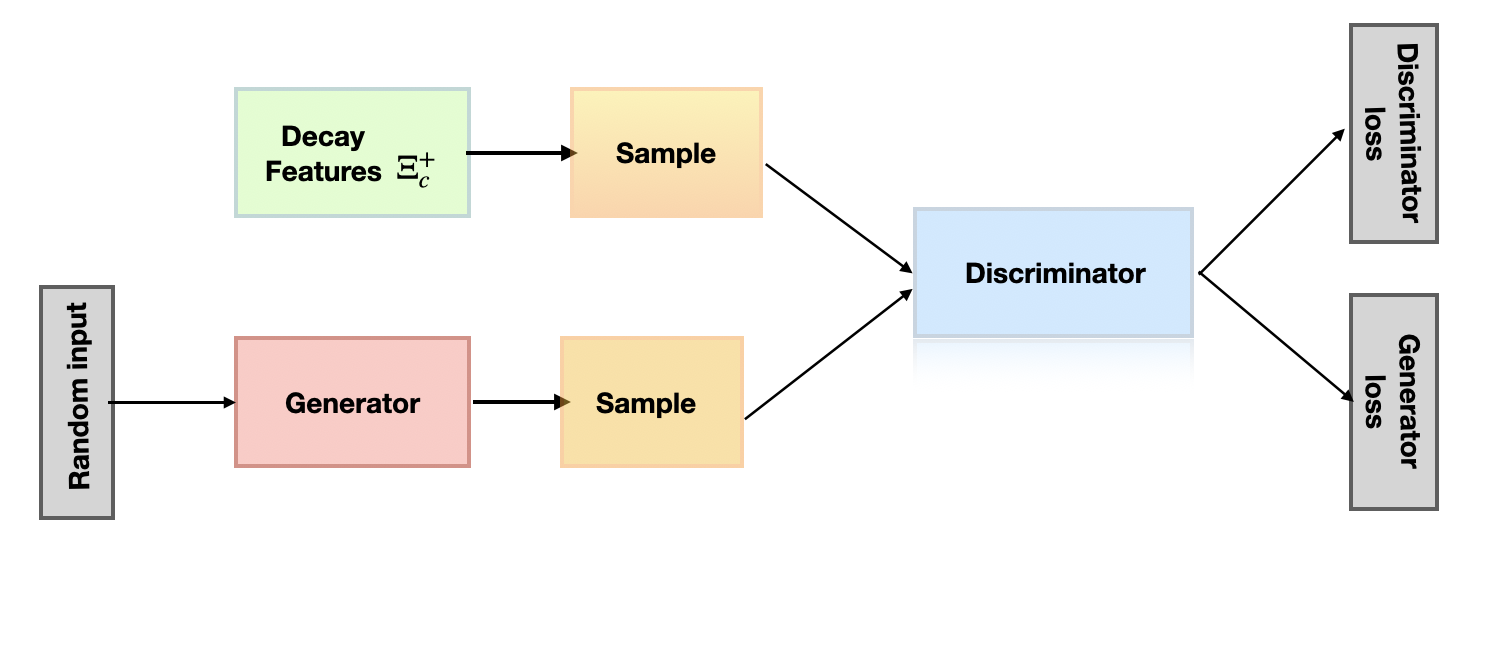
A new approach leveraging generative AI is enhancing the search for rare particles created in the extreme conditions of heavy-ion collisions.
![A search for minimal extensions to the Standard Model, constrained by parity violation limits and experimental data from NA64 and KLOE-2, reveals a landscape of viable neutron and proton couplings-specifically [latex]\epsilon_{n}^{V},\epsilon_{n}^{A},\epsilon_{p}^{V},\epsilon_{p}^{A}[/latex]-that simultaneously accommodate ATOMKI measurements at 99% confidence, potentially explaining the PADME excess through corresponding electron coupling values [latex]\epsilon_{e}^{V}[/latex].](https://arxiv.org/html/2602.11263v1/x5.png)
New research explores the potential role of a previously undetected vector boson, the X17, in explaining anomalies observed in nuclear decays.
^{2}[/latex].](https://arxiv.org/html/2602.11405v1/feynman_GammaD_To_chi_chi.png)
A new analysis tightens the constraints on dark axion interactions, leveraging both searches for invisible particles and precise measurements of fundamental asymmetries.