Squeezing Vacuum: A New Limit for Measuring Light’s Interaction with Nothing
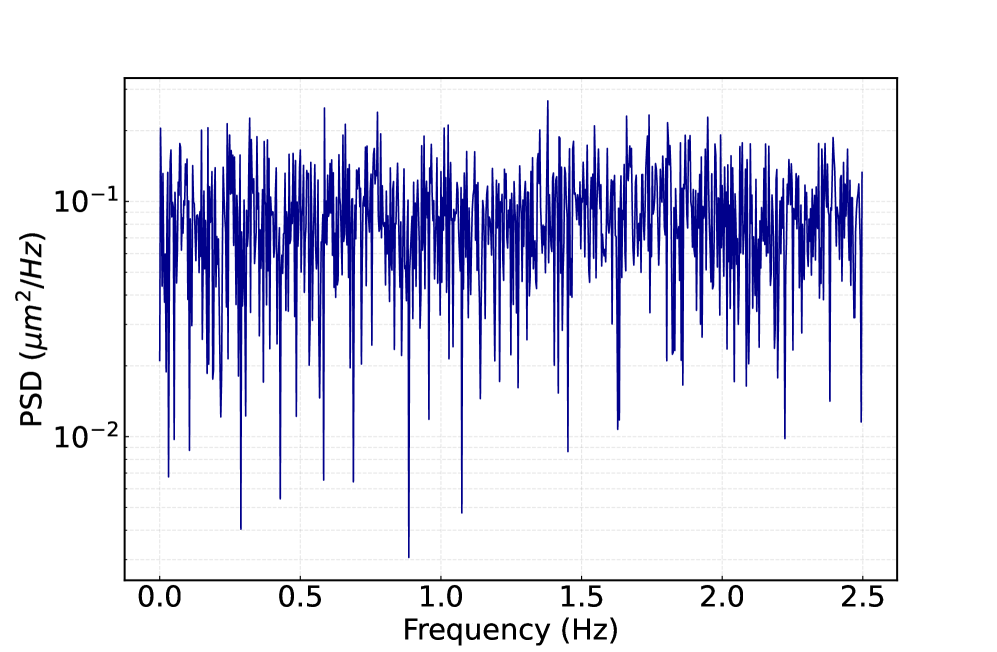
Researchers have demonstrated a novel technique to suppress noise in interferometric measurements, pushing the boundaries of our ability to detect the subtle nonlinear effects of the quantum vacuum.
![The study defines helicity angles for the decay process [latex]e^{+}e^{-}\to Y\bar{Y}[/latex], where Y subsequently decays into a Lambda baryon and a pion, establishing a consistent framework applicable to both the initial particle pair and the resulting anti-baryon-pion combination.](https://arxiv.org/html/2602.10398v1/diagram_new.png)
![Four-wave mixing (FWM) experiments demonstrate momentum state manipulation in atomic gases, utilizing sequential Bragg pulses at [latex]790.00\ \mathrm{nm}[/latex] to generate distinct momentum states [latex]\mathbf{p}\_{1}, \mathbf{p}\_{2}, \text{ and } \mathbf{p}\_{3}[/latex] from a single spin component, and, with a [latex]769.35\ \mathrm{nm}[/latex] lattice configuration and a bias magnetic field, to reveal symmetric momentum transitions [latex]\lvert\pm 2\hbar k\rangle[/latex] within a two-spin component system, evidenced by the formation of scattered wave packets visualized through absorption imaging.](https://arxiv.org/html/2602.10873v1/x1.png)
![The study demonstrates how a surrounding dark matter halo, modeled with a Hernquist density profile and anisotropic distribution, subtly alters the expected inertial frame dragging effect - specifically, the angular velocity [latex]\omega(r)[/latex] - deviating from the vacuum prediction and manifesting as a measurable shift in the spacetime geometry around a slowly rotating massive object.](https://arxiv.org/html/2602.10579v1/x2.png)
![The study demonstrates how dust density and mass distributions within an outer boundary-configured to achieve a minimum radius of [latex]L_0 = 0.2[/latex] for a mass of [latex]M = 1[/latex]-reveal the inherent limitations of any model attempting to define a boundary, much like peering into the abyss where even the most carefully constructed theories risk vanishing beyond reach.](https://arxiv.org/html/2602.10804v1/x2.png)
![The study demonstrates that deviations in the recombination coefficient [latex]\alpha_{21}[/latex] between first-principles calculations and scaled Standard Model results remain below 3% for [latex]\alpha_D \sim eq 0.3[/latex] when the matter-radiation ratio is [latex]\mathcal{R}_m = 0.1[/latex], even when exploring scenarios representing dark positronium-created by setting dark electron and proton masses equal to the Standard Model electron mass-across temperatures of [latex]T_\gamma = E_n[/latex], [latex]T_\gamma = 0.1E_n[/latex], and [latex]T_\gamma = 0.01E_n[/latex], where [latex]E_n = B_{H_D}/n^2[/latex] with [latex]n=2[/latex].](https://arxiv.org/html/2602.10197v1/x1.png)