Beyond Alignment: Exploring Exotic Magnetism on the Maple Leaf Lattice
![The study of the maple leaf lattice reveals three distinct antiferromagnetic orderings-canted-120°, q=0, and q=M-emerging from the interplay of nearest and second-neighbor exchange couplings [latex]J_r[/latex] along lattice vectors h, t, d, and d', demonstrating a nuanced relationship between geometric frustration and magnetic alignment.](https://arxiv.org/html/2601.16807v1/x1.png)
A new theoretical study delves into the fascinating world of altermagnetic materials, revealing unconventional spin arrangements and potential for novel quantum effects.
A new theoretical study delves into the fascinating world of altermagnetic materials, revealing unconventional spin arrangements and potential for novel quantum effects.
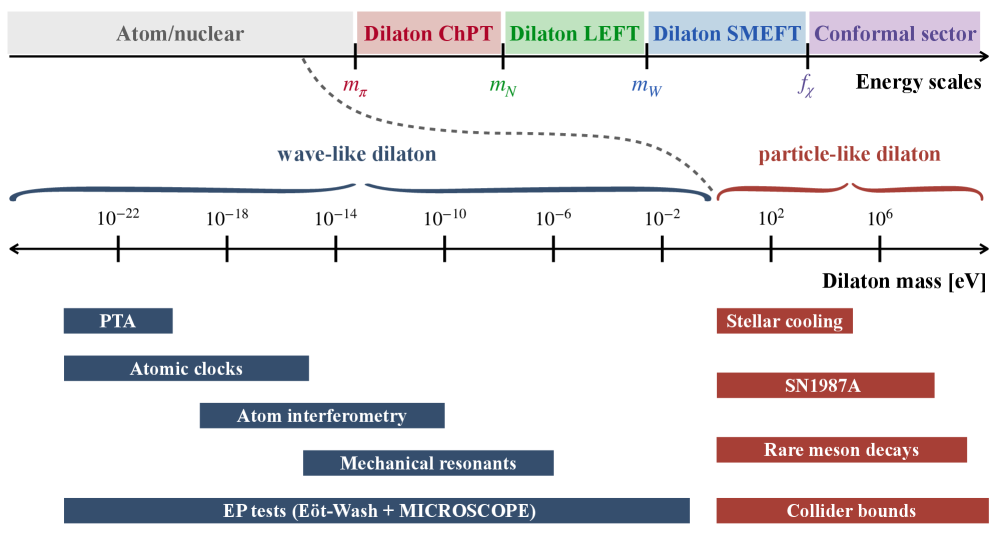
A new theoretical framework details the interactions of the dilaton, a potential particle arising from broken scale invariance, with known Standard Model particles.
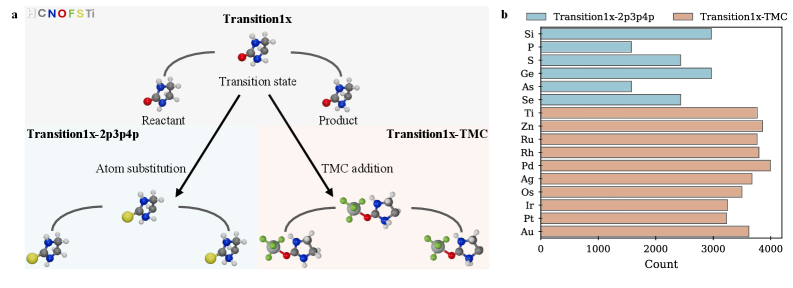
Researchers have developed a new approach to training artificial intelligence models to accurately predict the transition states of chemical reactions, even for previously unseen molecules and complex systems.
![A pronounced asymmetry in the decay of [latex]\Lambda_{b}^{0}[/latex] particles into [latex]pK^{-}\pi^{+}\pi^{-}[/latex] is observed, as evidenced by the distributions of invariant mass within this decay channel, and mirrored in the decay of its antiparticle, [latex]\overline{\Lambda}_{b}^{0}[/latex] into [latex]\overline{p}K^{+}\pi^{+}\pi^{-}[/latex].](https://arxiv.org/html/2601.16787v1/x11.png)
Recent experiments are refining our understanding of CP violation in both meson and baryon decays, revealing subtle differences in the behavior of matter and antimatter.
![Neutron star parameters-radius, tidal deformability, and compactness-exhibit quantifiable relationships with mass, as determined through a Bayesian framework incorporating astrophysical observations and expressed as 95% confidence intervals for [latex] \text{radius}_{RR} [/latex] (km), Λ, and [latex] M/R [/latex] as functions of mass [latex] M_{\odot} [/latex].](https://arxiv.org/html/2601.16227v1/x4.png)
New research utilizes observations of neutron stars to test alternative theories of gravity, specifically exploring the viability of f(Q) gravity.
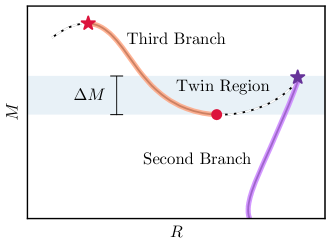
New research explores how observations of ‘twin stars’-pairs of neutron stars with similar masses but differing radii-are refining our understanding of the extreme matter within these cosmic objects.
![The measured cross section of electron-positron annihilation into pion pairs-a fundamental process in particle physics-demonstrates a consistent relationship to the reduced energy [latex]\sqrt{s^{\prime}}[/latex], and notably aligns with, yet refines, previous findings from the 2009 BABAR experiment, suggesting a robust understanding of this interaction.](https://arxiv.org/html/2601.16587v1/x6.png)
The BABAR experiment delivers a high-precision measurement of how electron-positron collisions create pion pairs, refining calculations crucial for understanding fundamental particle properties.
![The study positions four quantum harmonic oscillators - designated QHs11, 44, 22, and 33 - at precisely calculated distances from the origin: QHs11 and 44 initially reside at a distance of [latex]r = R/3[/latex], positioned at polar angles of 0 and π, while QHs22 and 33 are fixed at [latex]r = 2R/3[/latex], also at angles of 0 and π, where [latex]R = \sqrt{2N/\nu}[/latex] defines the scaling factor based on the system’s inherent parameters.](https://arxiv.org/html/2601.16819v1/x2.png)
New research demonstrates a powerful method for simulating and verifying non-Abelian anyon behavior in complex many-body systems, paving the way for advancements in topological quantum computation.
New research connects quantum entanglement, the axial anomaly, and polarization phenomena, offering a framework for understanding non-causal effects in extreme physical environments.
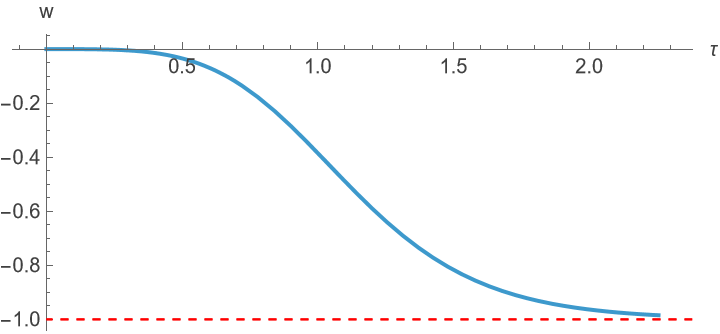
New research applies advanced quantization techniques to k-essence cosmology, offering insights into the universe’s earliest moments and its ultimate destiny.