On Thursday, the cryptocurrency market continued to struggle. Increased military conflict between the U.S. and Iran caused a new round of selling and investors pulled money out of exchange-traded funds (ETFs).
Summary
- Bitcoin fell under the $73,000 mark as U.S.-Iran tensions, rising oil prices, and liquidations pressured crypto markets.
- U.S. spot Bitcoin ETFs recorded $733 million in outflows on Wednesday, extending their losing streak to eight straight days.
- More than $900 million in leveraged crypto positions were liquidated after Bitcoin and Ethereum broke key support levels.
The overall value of the cryptocurrency market decreased by about 4% in the last day, falling to approximately $2.48 trillion, according to CoinGecko. Bitcoin, the leading cryptocurrency, dipped to a five-week low of under $73,000 after trading around $76,000, though it rebounded somewhat by the time this was reported.
Ethereum’s price dropped over 5%, falling below $2,000. Other major cryptocurrencies like Solana, XRP, BNB, Dogecoin, and Hyperliquid also lost value – between 6% and 14% – as investors became more cautious due to growing economic uncertainty.
Over the last 24 hours, crypto traders lost positions worth more than $900 million, according to data from CoinGlass. Most of these losses came from traders who bet that crypto prices would increase (known as ‘long’ positions).
The recent price drops got worse after Bitcoin fell below $75,000 and Ethereum dropped below $2,100. This caused a wave of automatic selling on trading platforms that use borrowed funds.
When trading platforms automatically closed out winning bets on rising prices for underwater assets, this caused further selling, which pushed prices down and accelerated the overall market decline.
Oil prices jump as U.S.-Iran tensions escalate
Investors became more cautious this week as conflicts between the United States and Iran increased.
Oil prices increased on Thursday, with West Texas Intermediate (WTI) crude rising 2.6% to over $91 a barrel and Brent crude approaching $96. This increase followed reports that U.S. forces had attacked Iranian military sites thought to be a threat to ships traveling near the Strait of Hormuz.
Iran’s Revolutionary Guard is said to have attacked a U.S. airbase, but authorities haven’t revealed where it happened.
As a researcher following the talks, it’s become clear that negotiations between the two countries have stalled. From what I understand, Iran is maintaining that any agreement must allow them to continue controlling the Strait of Hormuz and to keep their nuclear program intact.
Recent events have made it less likely that a quick agreement will be reached to reopen the important shipping route and restore normal oil supplies worldwide.
Increasing energy costs are fueling worries that inflation might stay high for an extended period. This could mean the Federal Reserve will be less likely to lower interest rates soon, and it could also make it harder to invest in risky assets like cryptocurrencies.
ETF outflows extend as institutions reduce exposure
Institutional demand also weakened considerably over the past two weeks.
U.S. Bitcoin ETFs experienced a significant outflow of around $733 million on Wednesday, marking the biggest single-day drop since February. This continues a trend of net withdrawals, now totaling eight days in a row.
Spot Ethereum ETFs continued to see money leave, marking 12 consecutive days of outflows. On Wednesday alone, these funds lost $67 million.
Over the last two weeks, U.S. Bitcoin ETFs have seen a total of $2.33 billion withdrawn, likely because institutional investors are moving their money out of crypto during the recent market fluctuations.
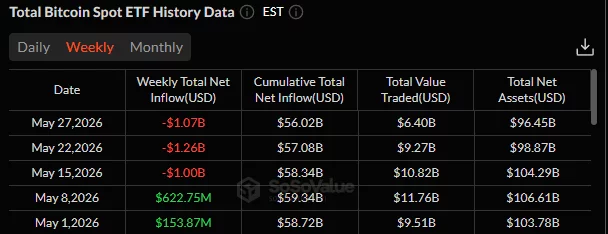
Bitfinex analysts shared a report with crypto.news explaining that Bitcoin’s market became more fragile after a recent $766 million sell-off. Unlike what usually happens after big market drops, this event didn’t cause a complete rebalancing of leveraged positions.
Following a 10% drop in Bitcoin’s price from over $82,000, trading activity in futures contracts decreased significantly. Interestingly, traders quickly began taking on leveraged positions again, with many individual (retail) investors reopening optimistic bets on cryptocurrency exchanges.
As I’ve been looking into this, it’s interesting to note that traditional exchanges like the CME haven’t seen the same kind of leveraged trading we’re observing elsewhere. And despite fairly high funding rates, the Coinbase Premium – the difference between prices on Coinbase and other exchanges – has stayed negative. This suggests a disconnect in the market.
The report indicated traders were still buying insurance against potential market drops before the release of the U.S. Personal Consumption Expenditures report, which is the Federal Reserve’s key measure of inflation.
According to Bitfinex analysts, stronger-than-expected inflation data (the PCE) released on May 28th could put pressure on traders who have borrowed money to bet on interest rate cuts. However, if the PCE data matches expectations, that pressure would ease, and price movements would then depend more on how traders are positioned rather than economic news.
Read More
- Gold Rate Forecast
- Forza Horizon 6 Car List So Far: Confirmed Highlights, Cover Cars, DLC, and Rewards
- 10 Greatest Manga Endings of All Time
- 10 Most Powerful Versions of Superman, Ranked
- 38 Years Later, Murder, She Wrote’s Most Overlooked Episode Still Pulls Off TV’s Greatest Crossover
- Mark Zuckerberg & Wife Priscilla Chan Make Surprise Debut at Met Gala
- Elon Musk’s Ex Ashley St. Clair Reveals When Romance Became “Weird”
- Forza Horizon 6 PC Issues: Fix Crashes, Stuttering, Steam Errors, and Game Pass Problems
- Why There’s No New Episode Of From S4 This Weekend (May 24) & When The Show Returns
- GBP CNY PREDICTION
2026-05-28 11:29