Global markets, ever the nervous debutant, retreated into risk-off mode Tuesday as US Treasury Secretary Scott Bessent, with the charm of a man ordering the last bottle of champagne at a sinking ship, reaffirmed the Trump administration’s fondness for tariffs as geopolitical weaponry. His remarks, delivered with the subtlety of a sledgehammer at a porcelain sale, resurrected the specter of trade-war inflation just as crypto markets were beginning to whisper of a ceasefire.
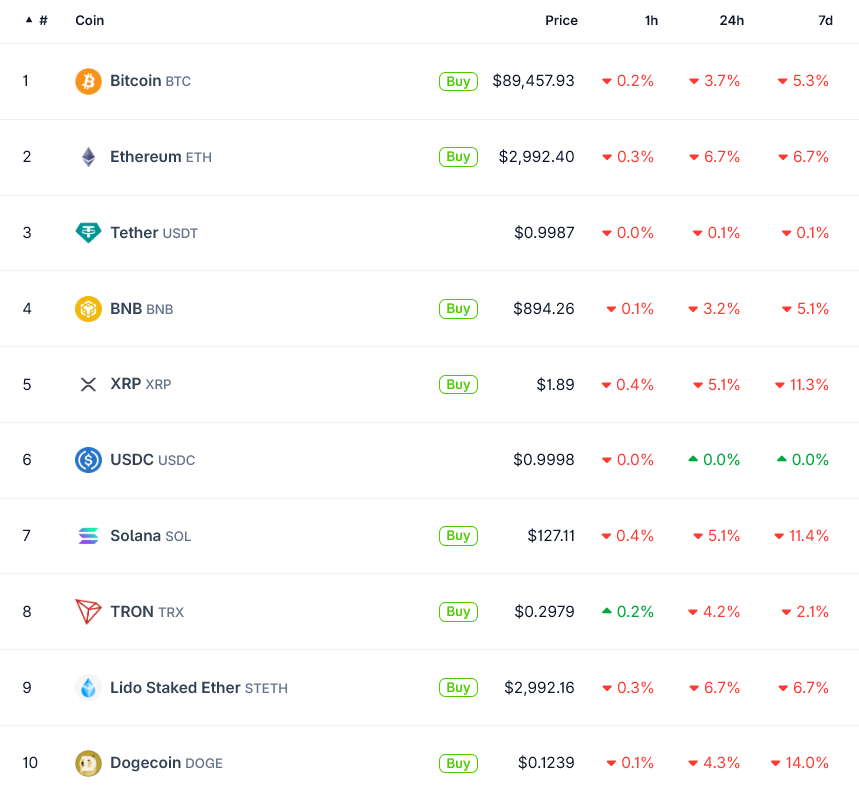
Bitcoin, that fickle lover of stability, dipped below $90,000, while Ethereum, perhaps nursing a hangover from its own speculative excesses, slumped under $3,000. Investors, now sporting fresh sunburns from their macroeconomic tanning sessions, reassessed the menu of global chaos.
Tariffs: A Dance of Diplomatic Discomfort
At Davos, Bessent, with the poise of a man who’d just won a bet on a nuclear winter, declared tariffs not a Plan B but the main event in US foreign policy. One might say he framed them as the life of the party-assuming the party is a tense negotiation over Greenland’s mineral rights.
“Sit back, take a deep breath, do not retaliate,” he advised Europe, as if suggesting they ignore a burning house while he dangled a lit match. “The president will be here tomorrow and he will get his message across.” One wonders if the message included a subscription to a Danish pastry service.
The White House, it seems, has mastered the art of the diplomatic double entendre. Markets, however, interpreted this as a return to the days of economic Jenga-where every tariff is a new block precariously stacked atop the US-EU relationship.
Bessent, ever the optimist, hinted at a 10% tariff on February 1 if Denmark and allies failed to “cooperate” on Greenland. One imagines a memo titled “Greenland: Strategic Asset or Scandinavian Hobby Farm?” being circulated in the Treasury’s breakroom.
At Davos today, U.S. Treasury Secretary Scott Bessent warned it would be “very unwise” for Europe to retaliate over U.S. ambitions to take Greenland.
He added that European leaders should take President Trump at his word, arguing the U.S. needs Greenland for strategic leverage…
– BeInCrypto (@beincrypto) January 20, 2026
Inflation’s Comeback Tour
Bessent, with the confidence of a man who’s never owned a suit off the rack, dismissed tariff fears as mere background noise. “The Supreme Court won’t strike down a president’s signature policy,” he declared, perhaps forgetting they once ruled against a certain “emoluments clause” enthusiast.
“Tariffs have generated ‘hundreds of millions’ in revenue,” he insisted, as if fiscal alchemy were a family tradition. One wonders if the Treasury plans to monetize the next asteroid strike.
Meanwhile, economists, that most reliable of soothsayers, reminded us that tariffs are less a tool of prosperity and more a tax on consumer wallets. A revelation, to be sure, though one suspects it’s news to the average Joe currently paying $12 for a loaf of bread and a side of existential dread.
This, of course, sends shivers through crypto’s fragile spine. After all, what’s a digital asset but a modern-day tulip bulb for the algorithmic age? Reduced discretionary spending and inflation’s return are the economic equivalent of telling a ballerina to dance in clogs.
What is President Trump’s Greenland ambition really about? 🇬🇱🇺🇸 Is it a true national security priority for the US, or a behind-the-scenes push from tech billionaires? @c_grigera reports.
– BeInCrypto (@beincrypto) January 20, 2026
Bond Markets: The Uninvited Guest
Bessent, ever the deft host, blamed Japan’s bond market chaos for crypto’s woes. “Six standard deviations!” he exclaimed, as if volatility were a party favor. One might say he’s mastered the art of the strategic deflection-though his guests (markets) are politely declining to RSVP.
“Japan’s bond market turmoil has nothing to do with Greenland,” he insisted, as if the two were estranged cousins at a family reunion. Markets, meanwhile, were busy passing around the salt to season their skepticism.
Traders, however, remain fixated on the trifecta of tariffs, geopolitical saber-rattling, and rate volatility-a cocktail that turns crypto from a party trick into a cautionary tale. Bitcoin’s $90,000 stumble and Ethereum’s $3,000 retreat are the financial equivalent of a fashion faux pas: everyone notices, no one forgives.
BESSENT: Markets are going down because Japan’s bond market just suffered a six-standard-deviation move in ten-year bonds over the past two days.
This has nothing to do with Greenland; it’s all about the Japanese bond blowout.
– Bitcoin News (@BitcoinNewsCom) January 20, 2026
Crypto’s Requiem in Minor Key
The sell-off, one might say, is a tragic opera in four acts: tariffs, liquidity droughts, institutional whispers, and now, the ghost of October’s liquidation shock. Davos, that glittering theater of global power, has once again proven it’s a front-row seat to chaos.
Bitcoin holders realizing losses, for a 30-day period since, late December for the first time since October 2023.
– Julio Moreno (@jjcmoreno) January 20, 2026
While Bessent waxed poetic about private-sector growth, markets tuned out the overture and fast-forwarded to the denouement. After all, what’s economic strength without a bit of policy-driven uncertainty to spice things up?
For now, the message from Davos is clear: trade-war inflation is back on the menu, and crypto, that beleaguered diner, is left picking at the crumbs of a once-promising feast.
Read More
- Surprise Isekai Anime Confirms Season 2 With New Crunchyroll Streaming Release
- The Super Mario Galaxy Movie: 50 Easter Eggs, References & Major Cameos Explained
- 10 Best Free Games on Steam in 2026, Ranked
- Starfield (PS5) Review – A Successful Cross-Console Voyage
- Preview: Sword Art Online Returns to PS5 as a Darker Open World Action RPG This Summer
- ‘Project Hail Mary’: The Biggest Differences From the Book, Explained
- All 7 New Supes In The Boys Season 5 & Their Powers Explained
- Frieren: Beyond Journey’s End Gets a New Release After Season 2 Finale
- Sydney Sweeney’s The Housemaid 2 Sets Streaming Release Date
- Silver Rate Forecast
2026-01-21 02:32