Author: Denis Avetisyan
A new study details how relatively simple upgrades to the SPS at CERN could dramatically expand the search for feebly interacting particles beyond the Standard Model.
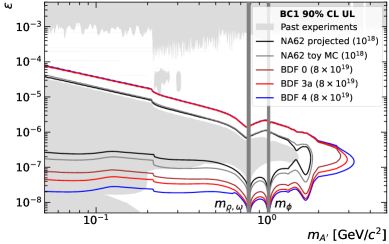
Researchers explore detector configurations at CERN’s ECN3 hall to maximize the potential for discovering dark matter candidates and other exotic physics with beam-dump experiments.
The search for physics beyond the Standard Model increasingly relies on exploring the potential of feebly interacting particles, yet current experimental avenues require optimization to maximize discovery potential. This paper, ‘NO LESS: Novel Opportunities for Light Exotic Searches at the SPS’, investigates the sensitivity of beam-dump experiments at CERN’s ECN3 facility, comparing projected performance with that of the existing NA62 setup. Our analysis demonstrates that even minimal reconfiguration of existing detectors can yield competitive results in the search for these new particles, offering an immediate path toward exploring a broader range of models. Could these readily achievable improvements unlock new insights into the nature of dark matter and other exotic phenomena?
Beyond the Standard Model: Unveiling the Invisible Universe
Despite its remarkable predictive power and consistent validation through experiments like those at the Large Hadron Collider, the Standard Model of particle physics remains incomplete. Several fundamental observations defy explanation within its framework, including the existence of dark matter and dark energy, the observed mass of neutrinos, and the matter-antimatter asymmetry of the universe. These anomalies suggest the presence of undiscovered particles and forces operating beyond the currently known interactions. Furthermore, the Standard Model necessitates fine-tuning of certain parameters to achieve observed values, a circumstance considered unnatural by many physicists and serving as further motivation for exploring theoretical extensions. This pursuit of ‘new physics’ drives ongoing research and innovative experimental designs aimed at unveiling the universe’s hidden complexities and refining ΛCDM model.
The universe, as described by the Standard Model of particle physics, accounts for only about 5% of its total energy density, leaving the vast majority attributed to dark matter and dark energy. Feebly Interacting Particles (FIPs) offer a tantalizing bridge to understanding this ‘dark sector’ – hypothetical particles that interact with Standard Model particles, and thus with each other, but with a weakness that has so far evaded direct detection. Unlike the particles responsible for strong and electromagnetic forces, FIPs would participate in interactions significantly rarer, potentially explaining why dark matter remains elusive. These particles aren’t necessarily a single entity; rather, FIPs encompass a broad class of candidates, ranging from sterile neutrinos to axion-like particles, each with unique properties and potential roles in mediating forces within the dark sector and perhaps even providing a portal for interactions between visible and dark matter. The exploration of FIPs, therefore, represents a crucial frontier in particle physics, promising to illuminate the composition of the universe and resolve one of its most profound mysteries.
The pursuit of feebly interacting particles (FIPs) necessitates a radical departure from conventional detection strategies employed in high-energy physics. Traditional methods, reliant on strong interactions within massive colliders, prove ineffective against particles that barely engage with known forces. Consequently, researchers are pioneering innovative experimental designs – from highly sensitive detectors placed near nuclear reactors to explore potential neutrino-FIP couplings, to ‘light shining through walls’ experiments searching for FIPs that can traverse opaque barriers. These approaches often prioritize extreme precision and background reduction, demanding advancements in detector technology, data acquisition, and analysis techniques. Furthermore, the search extends beyond dedicated facilities, leveraging existing infrastructure like beam dumps and even astronomical observations to indirectly infer the presence of these elusive particles, effectively redefining the frontiers of particle physics investigation.

Harnessing the Power of Beam Dumps: A Novel Detection Strategy
Beam-dump experiments generate potential First Invisible Particles (FIPs) by directing a high-energy proton beam onto a target material. This method relies on the principle that when high-energy protons collide with the target nuclei, they undergo Bremsstrahlung radiation – the emission of electromagnetic radiation due to deceleration of charged particles. This process produces a broad spectrum of secondary particles, including those potentially constituting FIPs, which are then directed towards downstream detectors. The intensity of the proton beam is a critical parameter, with facilities like the Beam Dump Facility (BDF) capable of delivering up to 4 \times 10^{19} protons per year to maximize FIP production rates.
Bremsstrahlung radiation, produced when high-energy protons collide with a target material, is the primary mechanism for generating a flux of potential FIPs in beam-dump experiments. This process converts the kinetic energy of the protons into electromagnetic radiation – specifically, photons across a broad spectrum. These photons can then interact with the target material or with other materials within the detector, creating secondary particles, including FIPs. The intensity of the generated FIP flux is directly proportional to the proton beam’s energy and current, as well as the target’s atomic number Z. Detector placement and shielding are crucial to maximize the collection of these FIPs while minimizing background noise from other particles produced in the Bremsstrahlung process.
Successful FIP detection in beam-dump experiments relies on detector configurations specifically designed to identify FIP signatures amidst significant background noise. These detectors must be capable of handling a high proton flux, with the Beam Dump Facility (BDF) projected to deliver up to 4 \times 10^{19} protons per year. Optimization involves precise calibration of detection thresholds, shielding to minimize irrelevant particle interactions, and data acquisition systems capable of processing the large volume of data generated by such high-intensity beams. Detector materials and geometries are chosen to maximize the probability of FIP interaction while suppressing background events, thereby increasing the signal-to-noise ratio and enabling statistically significant observations.

Pioneering the Search: NA62 and SHiP at the Forefront
The NA62 experiment, originally designed to study kaon decays at CERN, was successfully repurposed as a dedicated facility for searching for Feebly Interacting Particles (FIPs). This transition involved implementing a beam-dump configuration where a high-intensity proton beam is directed onto a target, producing a substantial flux of mesons that subsequently decay, potentially producing FIPs. The resulting particles are then directed through a fiducial volume instrumented with a highly sensitive detector system. This approach leverages the existing infrastructure and data acquisition systems of NA62, providing a cost-effective and efficient platform for FIP searches complementary to other dedicated experiments. The beam-dump configuration maximizes the production and decay volume available for observing these elusive particles, enhancing the experiment’s sensitivity.
The SHiP (Search for Hidden Particles) experiment is a proposed, fixed-target endeavor designed to systematically probe the parameter space for Feebly Interacting Particles (FIPs). Its primary focus is the detection of Heavy Neutral Leptons (HNLs) – hypothetical particles predicted by extensions to the Standard Model – and Dark Photons, potential mediators of interactions within the dark sector. The experiment utilizes a beam-dump configuration, directing a high-intensity proton beam onto a heavy target to produce FIPs, which then decay within a dedicated detector system. By varying the beam momentum and detector acceptance, SHiP aims to cover a broad range of FIP masses and coupling strengths, providing a comprehensive search for these beyond-the-Standard-Model particles.
Variations in the experimental configuration of FIP search experiments, specifically configurations 1a, 2a, and 3a, demonstrate significant improvements in detection capabilities. Configuration 3a is designed to increase the decay volume by up to 28.303 cubic meters, allowing for a greater probability of observing rare FIP decays. Configurations 1a and 2a, while not focused on volume increase, provide up to a 2x gain in acceptance compared to a minimal baseline configuration, effectively increasing the probability of detecting FIPs within the instrumented volume. These gains are achieved through modifications to the beamline and detector arrangement, optimizing the experiment for FIP signal identification.
The identification of FIP signals in both the NA62 and SHiP experiments necessitates a suite of advanced detector technologies. Ring Imaging Cherenkov (RICH) detectors are employed to provide precise velocity measurements, enabling particle identification and separation of signal events from background. Electromagnetic Calorimeters measure the energy of photons and electrons, crucial for reconstructing FIP decay products and rejecting hadronic backgrounds. Straw Spectrometers are utilized for tracking charged particles, providing momentum measurements and vertex reconstruction capabilities. Finally, Muon Veto systems are implemented to suppress muon backgrounds, improving the signal-to-noise ratio and enhancing the sensitivity of the searches.

Simulating the Invisible: Tools for Data Interpretation
Monte Carlo simulation is a computational technique used extensively in experimental physics to model the production and subsequent decay of fragile intermediate particles (FIPs). These simulations generate numerous randomized events, mimicking the physical processes occurring within a detector. By varying input parameters according to probability distributions representing known or estimated physical characteristics-such as particle energies, emission angles, and decay lengths-a statistically significant dataset is created. This synthetic data allows researchers to predict detector responses to FIP signals, accounting for factors like detector efficiency, resolution, and background noise. The resulting simulated distributions are then directly comparable to experimental data, facilitating signal identification and precise measurements of FIP properties.
Alpinist is a software package designed to model the production and decay of Fast Interaction Primaries (FIPs) within experimental high-energy physics setups. The framework utilizes Geant4 as its underlying simulation engine, allowing for detailed tracking of particle interactions and energy deposition. Specifically, Alpinist enables users to define detector geometries, material compositions, and beam characteristics to generate Monte Carlo simulations. These simulations produce synthetic detector signals, including hit patterns and energy depositions, which are crucial for evaluating detector performance, calibrating analysis algorithms, and ultimately, predicting expected signal rates for FIP detection.
Accurate identification of faint signals indicative of FIP events requires effective discrimination from inherent background noise. Simulations, based on modeled FIP production and decay, generate expected noise profiles and signal characteristics. By comparing experimental data to these simulated distributions, researchers can establish statistically significant thresholds for event selection, minimizing false positives and maximizing the sensitivity of the analysis. Furthermore, simulation results inform the development of optimized data analysis pipelines, including appropriate weighting schemes and filtering techniques, thereby enhancing the extraction of meaningful data from complex experimental results and improving the overall efficiency of the data processing workflow.
Implications for Beyond-Standard-Model Physics
The confirmation of feebly interacting particles (FIPs) represents a paradigm shift in particle physics, directly challenging the completeness of the Standard Model. This theoretical framework, while remarkably successful, leaves several fundamental questions unanswered – from the nature of dark matter to the origin of neutrino masses. FIPs, by definition, participate in interactions beyond those described by the Standard Model, offering a tangible window into a broader, more comprehensive understanding of the universe’s building blocks. Their detection wouldn’t simply add to the existing model; it would necessitate a fundamental revision, prompting the development of new theories and experimental approaches to explore the hidden sectors of reality and redefine the boundaries of known physics. The implications extend beyond theoretical advancements, potentially revealing connections between seemingly disparate phenomena and unlocking a deeper understanding of the cosmos itself.
The concept of dark photons arises from the intriguing possibility that the visible universe interacts with a hidden ‘dark sector’ through a force carrier analogous to the photon. These hypothetical particles, a specific type of feebly interacting particle (FIP), could act as a bridge, mediating interactions between standard model particles and dark matter candidates. Detecting dark photons wouldn’t just confirm new physics; it would open a window into the composition and dynamics of dark matter, currently understood only through its gravitational effects. The strength of this interaction dictates the observability of dark photons, and ongoing research focuses on refining detection strategies to capture these faint signals, potentially revealing the fundamental nature of the universe’s missing mass and offering clues to its elusive composition.
Current experimental designs offer substantial potential for enhancing the detection of feebly interacting particles through strategic optimization. Researchers demonstrate that refined detector configurations – encompassing advancements in target materials, detector geometry, and data acquisition techniques – can yield a signal improvement of up to 4.5 times for direct production processes. This projected amplification stems from maximizing the interaction probability within the detector volume and minimizing background noise, effectively increasing the sensitivity to these elusive particles. Such improvements are not merely incremental; they represent a pathway toward transforming a null result into a statistically significant discovery, bringing the search for physics beyond the Standard Model closer to fruition and potentially revealing the nature of dark matter interactions.
The pursuit of feebly interacting particles (FIPs) demands a sustained, interwoven approach of both experimental innovation and theoretical refinement. While current experiments offer tantalizing possibilities, fully characterizing these elusive entities-and understanding their potential role in phenomena like dark matter-requires pushing detector technology to its limits and simultaneously developing more sophisticated theoretical models. Future experiments must prioritize increased sensitivity and novel detection strategies, while theorists are tasked with predicting the properties of FIPs with greater precision and exploring the broader implications of their existence for cosmology and particle physics. This synergistic progression – informed by data and guided by theoretical insight – represents the most promising pathway toward unveiling the secrets hidden within the universe’s fundamental building blocks and resolving some of the most enduring mysteries in modern physics.

The study meticulously details how even subtle alterations to existing detector configurations can significantly amplify the potential for discovering feebly interacting particles. This approach echoes a philosophy of refined efficiency, prioritizing impactful results through thoughtful design rather than sheer complexity. As Epicurus observed, “It is not the pursuit of pleasure itself that is wrong, but the failure to calculate the pains that come with it.” Similarly, this research calculates the gains achievable with minimal infrastructural investment, demonstrating a harmonic balance between ambition and pragmatic execution within the realm of particle physics. The emphasis on maximizing reach with modest means reveals an elegant solution, a testament to the power of focused ingenuity.
Beyond the Shadow
The pursuit of feebly interacting particles, as detailed within this work, reveals a subtle truth: often, the most profound discoveries require not radical reinvention, but a keen eye for optimization. The demonstrated potential of modestly upgraded infrastructure at facilities like CERN’s ECN3 hall suggests that the low-hanging fruit in the search for physics beyond the Standard Model may be surprisingly accessible. This is not merely a pragmatic observation; it hints at an underlying elegance – a principle that simplicity, honed with precision, can rival the complexity of bespoke solutions.
However, the simulations presented, while encouraging, are but a first step. The true challenge lies in rigorously accounting for systematic uncertainties, particularly those related to detector calibration and background estimation. A more nuanced understanding of the interplay between these effects, and the development of robust techniques to mitigate them, will be crucial to transforming statistical potential into definitive discovery. The current framework offers a compelling foundation, but it demands expansion to incorporate a broader range of signal models and decay topologies.
Ultimately, the search for dark matter and heavy neutral leptons is a quest for harmony. Every detector element, every algorithmic choice, is part of a symphony intended to reveal the faint whispers of new physics. The continued refinement of these tools, guided by a commitment to both theoretical rigor and experimental ingenuity, promises to bring that harmony ever closer.
Original article: https://arxiv.org/pdf/2601.17119.pdf
Contact the author: https://www.linkedin.com/in/avetisyan/
See also:
- Looks Like SEGA Is Reheating PS5, PS4 Fan Favourite Sonic Frontiers in Definitive Edition
- Pluribus Star Rhea Seehorn Weighs In On That First Kiss
- Dune 3 Gets the Huge Update Fans Have Been Waiting For
- Gold Rate Forecast
- Kelly Osbourne Slams “Disgusting” Comments on Her Appearance
- Tomodachi Life: Living the Dream ‘Welcome Version’ demo now available
- Arknights: Endfield – Everything You Need to Know Before You Jump In
- ’90s Cartoon Reboot & TMNT Connection!
- The Smiling Friends’ Creators Have Bad News For Fans
- Dungeon Stalkers to end service on June 9
2026-01-27 10:08