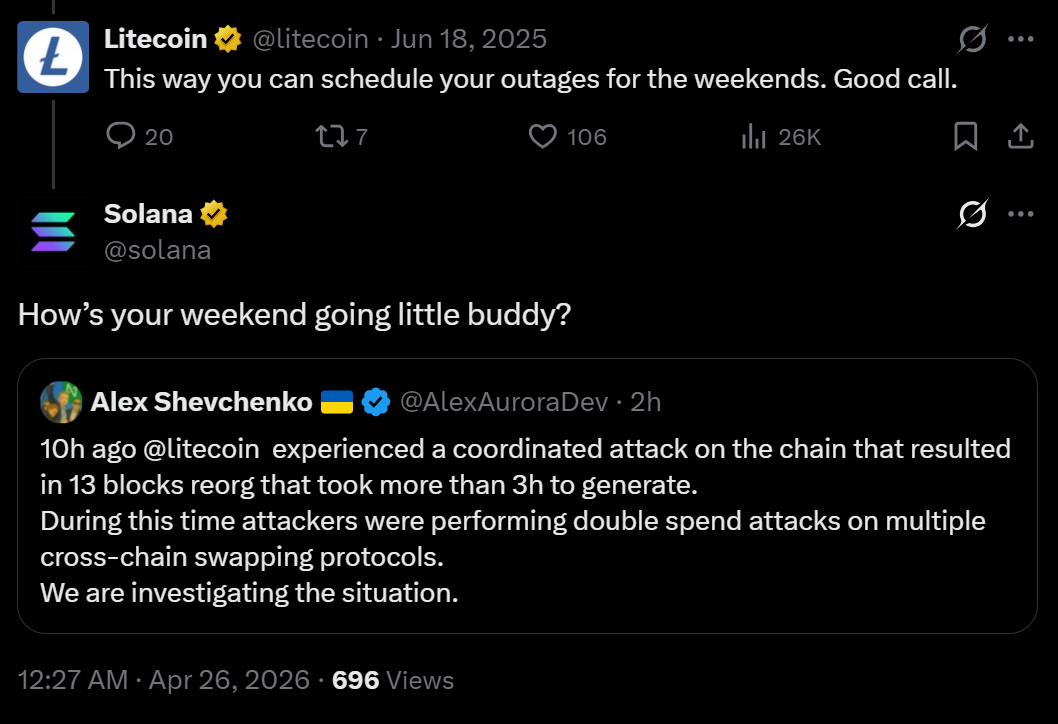
Oh, the indignity! Litecoin’s emergency 13-block reorganization to reverse a zero-day attack has stirred quite the commotion, casting doubt on the sanctity of transaction finality and the network’s so-called security.
One might wonder, is blockchain immutability but a fleeting illusion, subject to the whims of malcontented nodes and unpatched software?
The Peril of Unsecured Transactions
For years, crypto enthusiasts have extolled blockchains as immutable ledgers, where transactions are as permanent as a well-arranged marriage. Yet Litecoin’s recent antics reveal a most inconvenient truth: even the most steadfast systems may be rewritten by a cunning adversary and a few wayward nodes.
Though developers hailed the reorg as a necessary correction, the question lingers: how many confirmations are sufficient when a single bug may erase 13 blocks of history, as if they were but a passing dream?
LTC Update:
• A zero-day bug caused a DoS attack, leaving mining pools in disarray.
• Unpatched nodes allowed invalid MWEB transactions, enabling coins to be pegged to third-party DEXs.
• A 13-block reorg reversed these transactions – they will not…– Litecoin (@litecoin) April 25, 2026
The Peril of Unpatched Nodes
The zero-day attack thrived because many Litecoin nodes clung to antiquated software, improperly validating MWEB transactions. This created a two-tier network, where some danced to one set of rules and others to another.
Bitcoin and Litecoin, with their lack of mandatory updates, afford nodes the freedom to linger in the past. While this may be philosophically noble, it proved a most unfortunate vulnerability.
Miners and exchanges, alas, became unwitting accomplices in this exploit.
The zero-day targeted MWEB, Litecoin’s privacy feature. Privacy, that most delicate of pursuits, adds complexity, and complexity, as we now see, invites peril. MWEB, still in its infancy, requires further refinement before users dare entrust it with their fortunes.
The Investor’s Dilemma
Litecoin’s smaller hash rate and meager security budget render it more vulnerable to both bugs and future assaults. A 13-block reorg, equivalent to 2.5 hours of history, is but a trifle for Bitcoin, where reversing such a depth would cost billions and demand a 51% majority.
Users must now ponder: how many confirmations suffice when a buggy client may unmake 13 blocks with a mere flick of the wrist?
Can Trust Be Restored?
Technically, the issue is resolved. Yet the incident lays bare the fragility of decentralized networks, which depend as much on coordinated updates as on the good graces of their participants. The network recovered, but not without a scar or two.
For casual transactions, Litecoin may yet serve. For storing wealth, however, the incident raises most pertinent questions: can one trust a ledger that may, with the right bug, rewrite its own history?
Read More
- FRONT MISSION 3: Remake coming to PS5, Xbox Series, PS4, Xbox One, and PC on January 30, 2026
- Best Controller Settings for ARC Raiders
- Mark Zuckerberg & Wife Priscilla Chan Make Surprise Debut at Met Gala
- Meet the cast of Good Omens season 3: All the actors and characters
- 7 Great Marvel Villains Who Are Currently Dead
- Welcome to Demon School! Iruma-kun season 4 release schedule: When are new episodes on Crunchyroll?
- The Boys Season 5 Officially Ends An Era For Jensen Ackles’ Soldier Boy
- Gold Rate Forecast
- Netflix Confirms One Surprising Anime Beat Pokemon & Tied With One Piece for Viewership
- The MCU’s 2026 Release Slate Updated With 4 New Updates
2026-04-26 16:26