Author: Denis Avetisyan
New research suggests quantum effects may have played a larger role in the early universe than previously thought, potentially leaving detectable signatures in the cosmic microwave background.
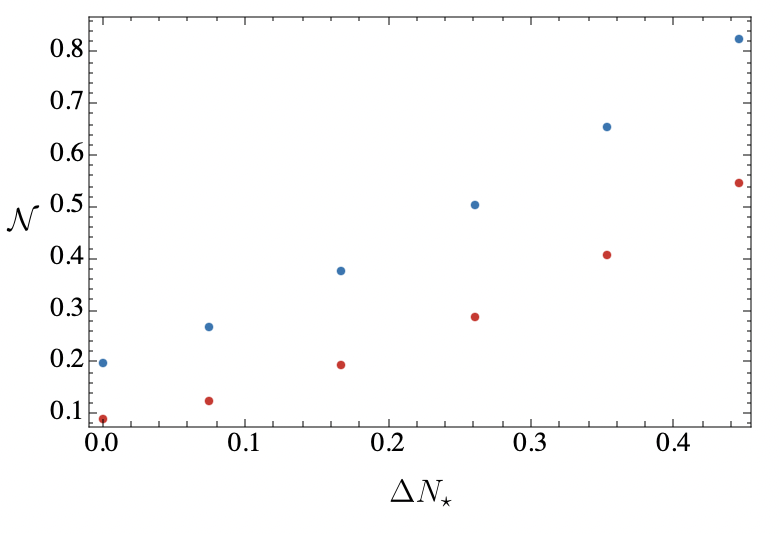
This review examines how non-Gaussianity in primordial fluctuations leads to Wigner function negativity, challenging the classical description of inflationary cosmology.
Despite the common assumption that quantum fluctuations generated during inflation rapidly transition to classical stochastic fields, their genuinely quantum nature remains an open question. This paper, ‘When inflationary perturbations refuse to classicalise: the role of non-Gaussianity in Wigner negativity’, investigates this by examining the Wigner function of curvature perturbations, a diagnostic of quantum interference, and its sensitivity to primordial non-Gaussianities. We find that deviations from Gaussianity induce a measurable negativity in the Wigner function on super-Hubble scales, growing as a^2 in ultra-slow-roll scenarios, challenging the notion that squeezing alone guarantees classicality. Could these persistent quantum effects offer a pathway to detect primordial quantum signatures in cosmological observations, reshaping our understanding of the universe’s earliest moments?
The Echo of Quantum Beginnings
The universe’s large-scale structures – galaxies, clusters, and vast cosmic voids – didn’t emerge from a smooth, uniform beginning, but rather arose from incredibly tiny quantum fluctuations present during the inflationary epoch, a period of exponential expansion in the universe’s earliest moments. These weren’t simply random disturbances; inflation stretched microscopic quantum jitters – inherent uncertainties in the fabric of spacetime itself – to cosmic scales. Effectively, the seeds of all subsequent structure were imprinted during this fleeting period, acting as slight variations in the density of the early universe. Regions that were even infinitesimally denser, due to these quantum fluctuations, eventually drew in more matter through gravity, growing into the structures observed billions of years later. The scale of these initial fluctuations is remarkably small – on the order of 10^{-5} – yet their amplified effect defines the distribution of matter throughout the cosmos.
The universe’s large-scale structure – the cosmic web of galaxies and voids – began not with grand events, but with extraordinarily tiny quantum fluctuations occurring in the universe’s earliest moments. These weren’t merely random jitters; during the period of inflation, these quantum ripples were stretched to cosmic scales, becoming the seeds for all subsequent structure formation. While originating as probabilistic quantum events, these fluctuations rapidly transitioned into classical density perturbations – regions of slightly higher or lower density. These initial density contrasts, amplified by gravity over billions of years, ultimately coalesced into the galaxies and galaxy clusters observed today, demonstrating a remarkable link between the quantum realm and the macroscopic universe. The magnitude and statistical properties of these primordial perturbations, imprinted in the cosmic microwave background, provide a crucial test for models of inflation and the very origins of cosmic structure.
The ultimate test of inflationary cosmology hinges on demonstrating how the universe transitioned from a quantum realm, governed by uncertainty and probability, to the classical cosmos observed today. Inflation predicts that the seeds of all cosmic structure – galaxies, clusters, and vast voids – originated from quantum fluctuations magnified to cosmic scales. However, these initial fluctuations were inherently quantum; their evolution to the classical density perturbations detected in the cosmic microwave background and galaxy distributions requires a robust theoretical framework. Validating inflationary models, therefore, necessitates a detailed understanding of this quantum-to-classical transition, verifying that the observed large-scale structure genuinely arose from the predicted quantum origins and that the theoretical mechanisms accurately describe this pivotal moment in cosmic history. A mismatch between predicted and observed characteristics would necessitate a reevaluation of inflationary theory or exploration of alternative cosmological models.
Phase Space: A Bridge Between Realms
The Wigner function, denoted as W(x, p), is a quasiprobability distribution that represents a quantum state in terms of position x and momentum p. Unlike true probability distributions, the Wigner function can take on negative values, reflecting the non-classical nature of quantum mechanics and violating the constraints of classical probability theory. However, any marginal distribution of W(x, p) – integrating over either position or momentum – yields the correct probability density for the corresponding variable. This allows for the application of classical concepts and mathematical tools to analyze quantum systems, albeit with careful consideration of the function’s non-classical properties. The Wigner function is particularly useful for examining the time evolution of quantum states and for understanding the relationship between quantum and classical mechanics.
The representation of quantum states within phase space – typically position q and momentum p – allows for the visualization of quantum fluctuations as distributions analogous to classical probability distributions. While not true probabilities due to the possibility of negative values in the Wigner function, these distributions provide a direct connection between quantum mechanical descriptions and classical quantities. Specifically, expectation values of operators that are functions of position and momentum can be calculated via integration over phase space, mirroring classical statistical mechanics. This approach enables the identification of classical limits and the examination of quantum corrections to classical behavior, providing a framework for understanding the interplay between quantum and classical physics.
Canonical transformations are coordinate changes in phase space – defined by pairs of conjugate variables q and p – that preserve the form of Hamilton’s equations of motion. Specifically, these transformations maintain the symplectic structure of phase space, meaning they preserve the commutation relations between the coordinate and momentum variables. This preservation is crucial because it ensures that physical quantities calculated before and after the transformation remain consistent. By employing canonical transformations, complex quantum systems can be simplified by identifying constants of motion and revealing underlying symmetries, such as translational or rotational invariance. The identification of these symmetries then allows for the separation of variables in the Schrödinger equation and a more tractable solution of the quantum system.
The Signature of Non-Classicality: Wigner Negativity
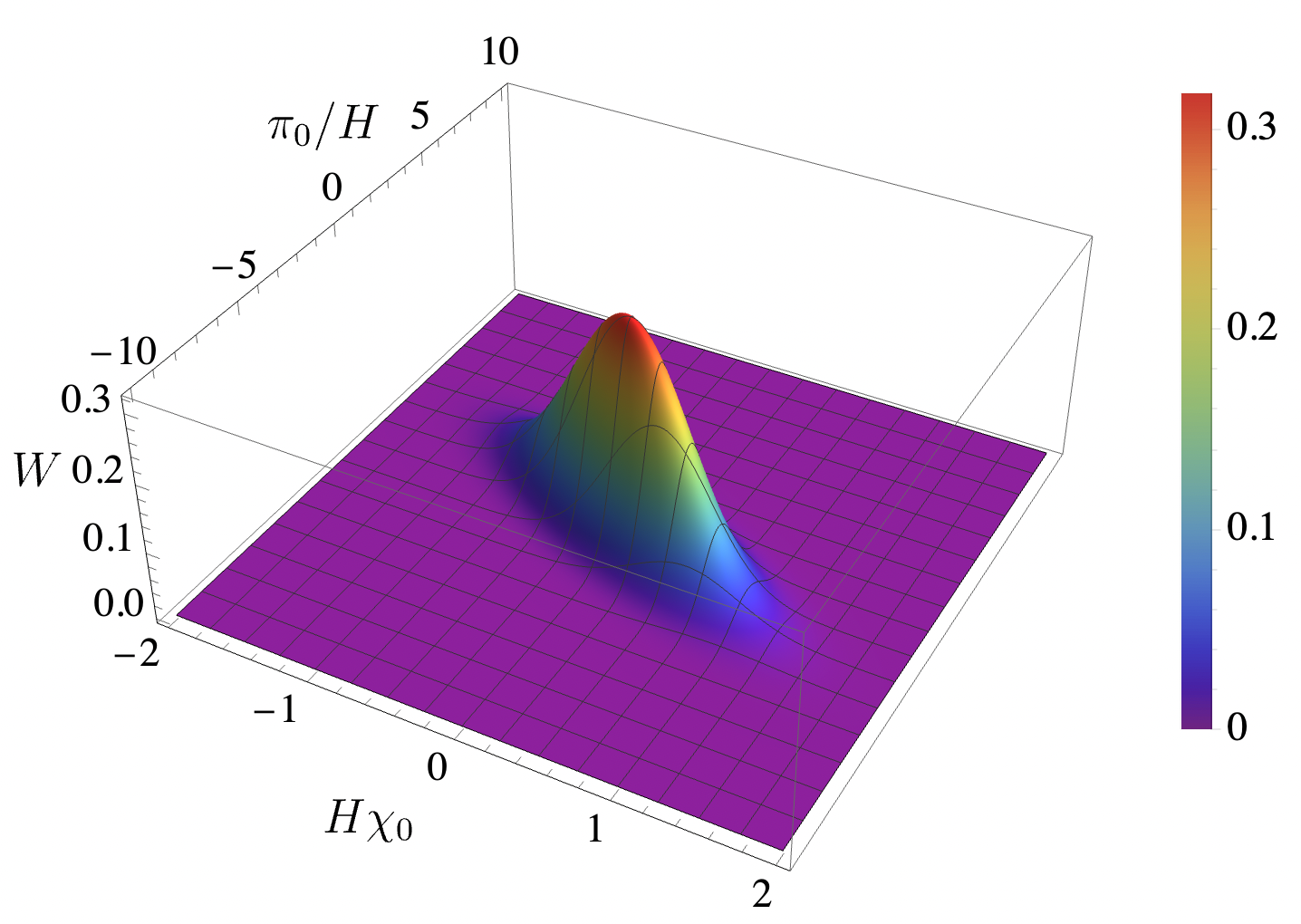
Wigner negativity, a key indicator of non-classical behavior in quantum systems, manifests when quantum interference effects surpass classical expectations. The Wigner function, a quasi-probability distribution representing a quantum state in phase space, can yield negative values in regions where these interference effects are prominent. Classical probability distributions are always non-negative; therefore, the presence of negativity in the Wigner function signals a deviation from classical descriptions of the system. This negativity isn’t a measurement artifact but rather a fundamental property indicating that the state cannot be accurately represented by classical variables and requires a full quantum mechanical treatment to properly describe its behavior. The degree of Wigner negativity is directly proportional to the strength of quantum interference within the system.
During the inflationary epoch, conditions described by ultra-slow-roll, specifically where the second inflationary parameter \epsilon_2 equals -6, significantly enhance regions of negative Wigner function values. This amplification is crucial because Wigner negativity directly correlates with quantum interference, and its presence indicates a departure from classical behavior in the primordial fluctuations. The increased magnitude of Wigner negativity in these scenarios suggests the potential for observable non-Gaussianity in the Cosmic Microwave Background (CMB). Non-Gaussianity, representing deviations from a purely Gaussian probability distribution of primordial density perturbations, provides a key signature for probing the physics of inflation and testing models beyond single-field slow-roll inflation.
The quantifiable measure of non-classicality, Wigner negativity, exhibits a time-dependent volumetric increase. This growth is monotonic, meaning it consistently increases without bound. Initially, the volume of negativity expands exponentially, characterized by a rate proportional to 2\Delta N, where \Delta N represents the number of e-folds during inflation and c_1 is a constant coefficient. Furthermore, the magnitude of this negativity is directly correlated with the average scalar amplitude \overline{P_\mathcal{R}}; larger scalar amplitude values result in a greater overall volume of Wigner negativity, indicating a stronger departure from classical behavior during the inflationary epoch.
From the Quantum to the Classical: The Inevitable Dissipation
The transition from the bizarre, probabilistic world of quantum mechanics to the definite reality experienced daily relies heavily on a process called decoherence. This phenomenon isn’t a collapse of the wave function, but rather the gradual loss of quantum coherence – the superposition and entanglement that define quantum states – through constant interaction with the surrounding environment. Every interaction, however subtle – a collision with an air molecule, a stray photon – introduces a form of ‘measurement’ that entangles the quantum system with its surroundings, effectively spreading out the quantum information and suppressing the interference effects that are hallmarks of quantum behavior. As this entanglement grows, the system increasingly behaves like a classical object with well-defined properties, losing its ability to exist in multiple states simultaneously. Consequently, decoherence is considered a fundamental mechanism explaining why macroscopic objects don’t exhibit quantum phenomena, bridging the gap between the quantum and classical realms by dissolving the fragile quantum states into the robust, definite states of classical physics.
Beyond the deterministic equations of quantum mechanics, a stochastic approach offers valuable insight into the process of decoherence. This method acknowledges that quantum systems are rarely perfectly isolated; instead, they constantly interact with a complex and often unpredictable environment. Rather than attempting to model every single interaction, a stochastic description focuses on the cumulative effect of countless unresolved fluctuations within that environment. These fluctuations are treated as random variables, introducing an element of chance into the system’s evolution. By averaging over these random influences, researchers can effectively simulate decoherence without explicitly tracking the details of each individual interaction – a computationally advantageous approach. This framework reveals how seemingly subtle environmental noise can rapidly destroy quantum superposition and entanglement, driving the transition from quantum behavior to the classical world of definite outcomes, and provides a complementary perspective to traditional decoherence theory.
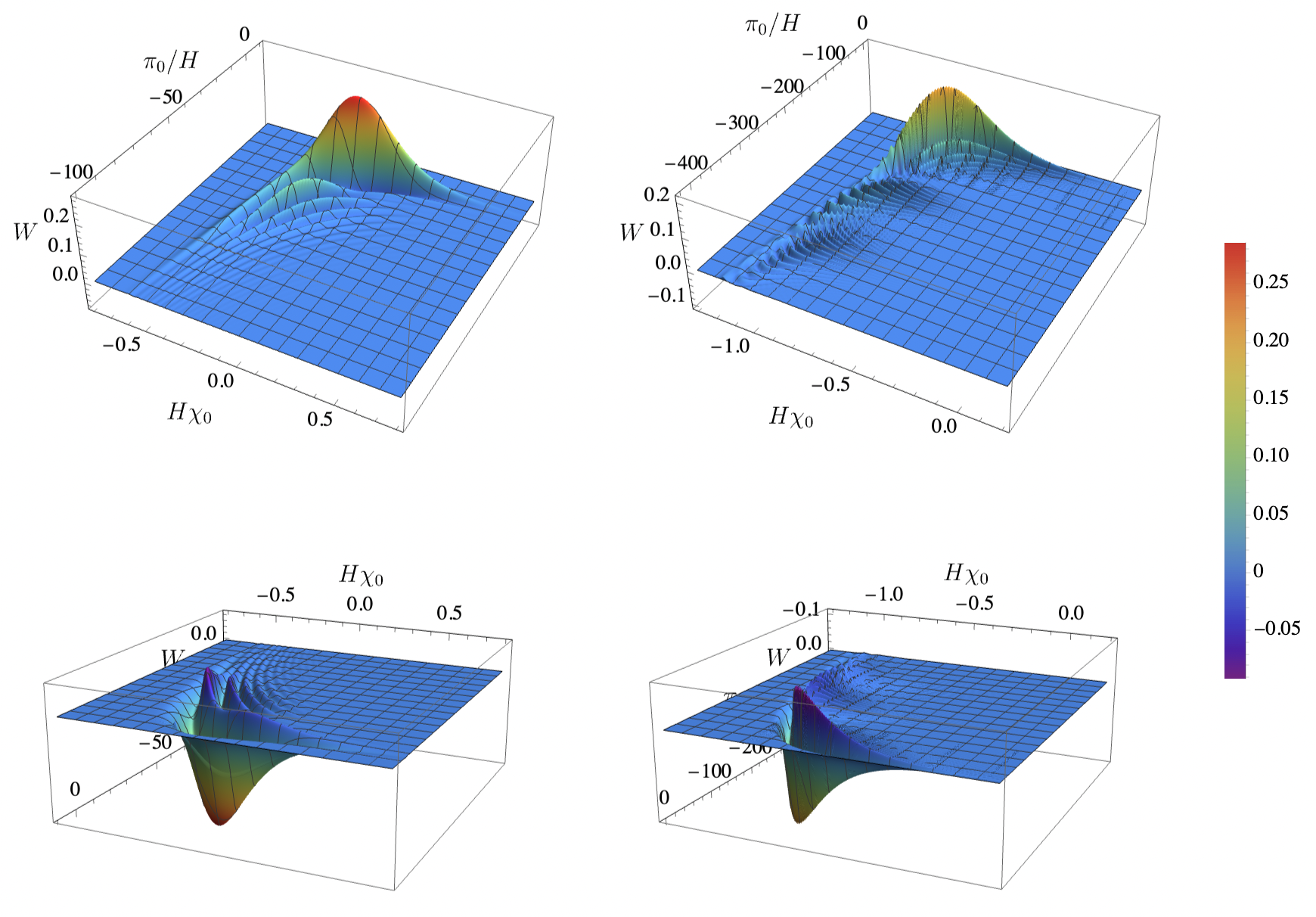
The evolution of a quantum system toward classical behavior is vividly illustrated by changes in its Wigner function, a quasi-probability distribution representing the system’s state in phase space. Initially, this function often resembles an ellipse, indicative of a well-defined quantum state. However, as time progresses due to environmental interactions, this elliptical profile dramatically distorts, morphing into a boomerang shape characterized by rapidly oscillating interference fringes. These fringes, particularly noticeable at negative values of π₀, signify a loss of quantum coherence and a departure from the smooth, Gaussian behavior typical of purely classical systems. This transition isn’t merely a smoothing out of quantum effects; it’s a fundamental reshaping of the system’s representation, showcasing how quantum interference gives way to the more familiar probabilistic descriptions of the classical world.
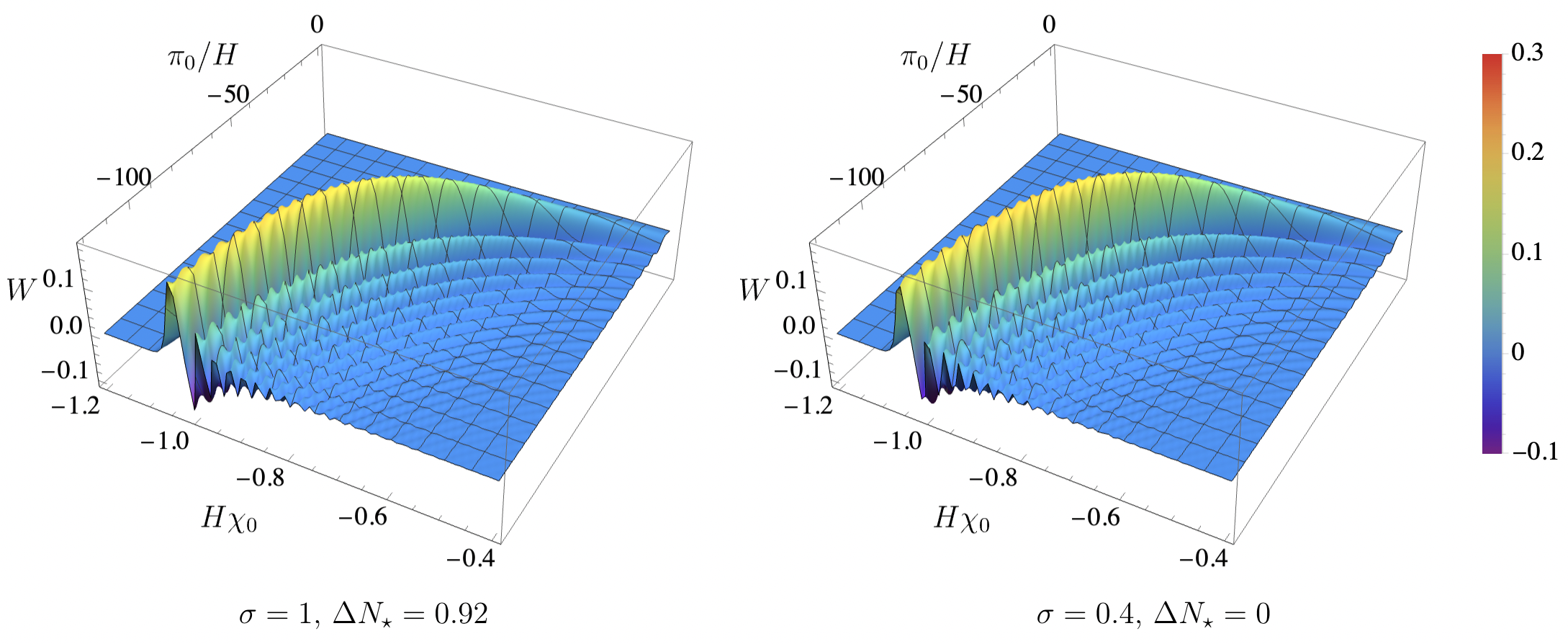
The study meticulously details how deviations from slow-roll inflation introduce quantum effects-specifically, negativity within the Wigner function-that resist classicalization. This echoes a fundamental principle of systemic evolution: any simplification, such as the classical approximation of quantum fields, carries a future cost. As Ralph Waldo Emerson observed, “The only way of really knowing a thing is to live it.” The researchers, in effect, ‘lived’ with the quantum perturbations, allowing the complexities of non-Gaussianity to emerge, demonstrating that dismissing these effects risks obscuring genuine signatures of the universe’s earliest moments. The persistence of Wigner negativity, even during inflationary epochs, suggests that the universe remembers its quantum past, a form of ‘system memory’ manifesting in observable cosmological parameters.
The Long Fade
The persistence of Wigner negativity in non-slow-roll inflationary models suggests that the transition to a classical description of primordial fluctuations is not as assured as conventional wisdom dictates. The study reveals that the architecture of this transition-or its failure-is intrinsically linked to the degree of non-Gaussianity present. Every delay in classicalization is, in effect, the price of understanding the precise mechanisms governing decoherence in these extreme conditions. It is not merely about whether quantum effects vanish, but how and when-a matter of temporal resilience, not simply the passage of time.
Future work must confront the limitations inherent in approximations used to model these quantum fields on cosmological scales. The interplay between quantum entanglement and the generation of observable non-Gaussianity requires particularly careful scrutiny. A fruitful avenue lies in exploring the sensitivity of cosmological parameters-specifically, those derived from the cosmic microwave background and large-scale structure-to these subtle quantum signatures.
Ultimately, the question is not whether inflation was ‘quantum’ or ‘classical,’ but whether the resulting cosmic structure retains a discernible echo of its quantum origins. An architecture without history-a complete erasure of initial quantum conditions-is fragile and ephemeral. The search for Wigner negativity, therefore, is not simply a technical exercise, but a quest to understand the enduring legacy of the universe’s earliest moments.
Original article: https://arxiv.org/pdf/2601.22219.pdf
Contact the author: https://www.linkedin.com/in/avetisyan/
See also:
- Gold Rate Forecast
- Dune 3 Gets the Huge Update Fans Have Been Waiting For
- Looks Like SEGA Is Reheating PS5, PS4 Fan Favourite Sonic Frontiers in Definitive Edition
- Pluribus Star Rhea Seehorn Weighs In On That First Kiss
- Kelly Osbourne Slams “Disgusting” Comments on Her Appearance
- Arknights: Endfield – Everything You Need to Know Before You Jump In
- Antiferromagnetic Oscillators: Unlocking Stable Spin Dynamics
- Tomodachi Life: Living the Dream ‘Welcome Version’ demo now available
- Disney Promotes Thomas Mazloum To Lead Parks and Experiences Division As Josh D’Amaro Prepares To Become CEO
- Xbox 360 and PS3 Series Not Seen Since 2013 Reportedly Returning With New Game
2026-02-02 21:04