Author: Denis Avetisyan
New research demonstrates control over quantum entanglement and Bell nonlocality in hyperon-antihyperon pairs created from polarized electron-positron annihilation.
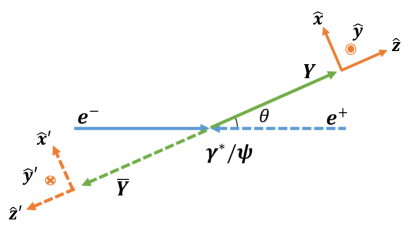
This study reveals enhanced quantum correlations through manipulation of beam polarization, opening avenues for exploring quantum information in high-energy physics.
While quantum entanglement is typically explored in controlled laboratory settings, understanding its manifestation in high-energy particle collisions remains a significant challenge. This is the focus of ‘Manipulating Bell nonlocality and entanglement in polarized electron-positron annihilation’, a theoretical study investigating how polarization of lepton beams influences quantum correlations within hyperon-antihyperon pairs produced in these collisions. The research demonstrates that both longitudinal and transverse polarization exhibit distinct effects on entanglement and Bell nonlocality, as quantified by metrics like concurrence and the CHSH parameter. Could exploiting these polarization-dependent quantum features offer new insights into the decay dynamics of charmonium and potentially pave the way for exploring quantum information processing in relativistic environments?
Beyond Classical Correlations: Entanglement’s Grip on Reality
Quantum entanglement represents a profound departure from classical physics’ ingrained notions of how objects relate to one another. In the classical world, correlated properties arise from shared history or a common cause – if two gloves are found separated, one left and one right, it’s understood they were a pair to begin with. Entanglement, however, posits a correlation that isn’t dependent on spatial proximity or pre-existing properties; two entangled particles become linked in such a way that their fates are intertwined, regardless of the distance separating them. Measuring a property of one instantly defines the corresponding property of the other, a phenomenon Einstein famously termed “spooky action at a distance.” This isn’t a transfer of information faster than light, but rather a demonstration that the particles, as a combined system, don’t possess definite properties until measured – challenging the classical assumption of local realism, where objects have definite properties independent of observation and are only influenced by their immediate surroundings. This interconnectedness, therefore, forces a reconsideration of fundamental concepts like individuality and locality, revealing a universe where relationships can be more intrinsic than spatial separation.
The successful implementation of quantum technologies hinges on the ability to both demonstrate and rigorously quantify quantum entanglement, a phenomenon where two or more particles become linked in such a way that they share the same fate, no matter how far apart they are. However, traditional methods for verifying entanglement face significant hurdles. Direct measurement collapses the delicate quantum state, potentially obscuring the very correlation being investigated. Furthermore, distinguishing genuine entanglement from classical correlations – where apparent links arise from shared history rather than quantum connection – requires increasingly sophisticated experimental designs and data analysis. These challenges necessitate the development of novel techniques, such as entanglement witnesses and quantum state tomography, to not only confirm the presence of entanglement but also to precisely characterize its strength and properties – a critical step towards building reliable quantum computers and secure communication networks.
The delicate and ephemeral nature of quantum entanglement necessitates a continual push for inventive methodologies in both its generation and characterization. Traditional approaches to creating entangled states often rely on precise control of interactions, but are frequently hampered by environmental noise and system imperfections. Similarly, verifying the presence and quality of entanglement demands measurements that go beyond classical correlations, requiring sophisticated techniques like Bell tests and entanglement witnesses. Recent research explores novel materials – such as specifically engineered photonic crystals and superconducting circuits – to enhance entanglement creation rates and coherence times. Furthermore, innovative measurement schemes, including continuous variable measurements and those leveraging machine learning algorithms, are being developed to more accurately quantify the intricate correlations that define this uniquely quantum phenomenon. This ongoing pursuit of refined techniques is not merely about improving experimental precision; it’s fundamental to unlocking the transformative potential of entanglement in quantum technologies.
The pursuit of quantum entanglement extends far beyond theoretical physics, serving as a foundational element for transformative technologies. Quantum computation, with its promise of solving presently intractable problems, relies on entangled qubits to perform calculations that are impossible for classical computers. Similarly, secure quantum communication networks, impervious to eavesdropping, hinge on the distribution of entangled particles to establish unbreakable encryption keys. Without a robust understanding and precise control of entanglement – including its creation, maintenance, and measurement – these advancements remain largely conceptual. The ability to harness this uniquely quantum phenomenon isn’t simply a matter of scientific curiosity; it’s the essential key to unlocking a future defined by unparalleled computational power and absolutely secure communication channels, demanding continued research and innovation in this critical field.
High-Energy Collisions: Forging Entangled Pairs
High-energy particle collisions, as routinely performed in facilities like the Large Hadron Collider and Relativistic Heavy Ion Collider, serve as a prolific source of entangled particles due to the fundamental principles of quantum mechanics governing particle interactions. These collisions provide the energy necessary to create particle pairs – such as photons, leptons, or mesons – in specific quantum states where their properties are correlated, regardless of the physical distance separating them. The short lifetimes of many produced particles necessitate in situ entanglement characterization, requiring detectors capable of reconstructing particle trajectories and measuring their quantum numbers immediately following the collision event. Furthermore, the high event rates characteristic of these colliders enable statistically significant studies of entanglement, allowing for precise measurements and the exploration of entanglement’s role in various physical processes.
Particle colliders are essential for generating the high-energy interactions required to produce entangled particles. Hadronic colliders, such as the Large Hadron Collider, utilize beams of protons or ions, while lepton colliders employ beams of electrons and positrons. Electron-ion colliders combine electron beams with heavy ion beams, offering complementary interaction dynamics. The collision process converts kinetic energy into mass, creating new particles, including entangled pairs, which are then detected and analyzed. The specific collider configuration influences the types of particles produced and the entanglement characteristics, necessitating a range of collider designs for comprehensive investigation.
Polarized particle beams are critical for controlling and maximizing entanglement production in high-energy physics experiments. Transverse polarization refers to the alignment of particle spins perpendicular to the beam axis, while longitudinal polarization describes alignment parallel to it. Precise control over both polarization states allows physicists to selectively produce entangled pairs with specific spin correlations. By manipulating the polarization of colliding beams, the entanglement properties of the resulting particles can be enhanced, increasing the signal strength and improving the precision of entanglement characterization. Furthermore, varying polarization states enables the study of different entanglement phenomena and tests of quantum mechanical predictions related to spin correlations, leveraging the ρ density matrix for analysis.
Quantifying entanglement necessitates the use of advanced analytical tools beyond simple observation. The spin density matrix provides a complete description of the quantum state, enabling the calculation of entanglement measures. Two prominent metrics are Wootters concurrence and negativity. Concurrence, ranging from 0 for unentangled states to 1 for maximally entangled states, is directly affected by the degree of polarization in the entangled particle pair. Negativity, another entanglement measure, assesses the violation of positivity under partial transposition. These metrics allow researchers to not only confirm the presence of entanglement but also to precisely characterize its strength and properties, providing crucial data for validating quantum mechanical predictions and developing quantum technologies.

Particle Systems as Entanglement Probes: Unveiling Quantum Connections
Elementary particles, including top quarks and neutrinos, are utilized as fundamental systems for observing quantum entanglement due to their inherent simplicity and well-defined properties. Unlike complex composite particles, these elementary constituents minimize extraneous factors that could obscure entanglement signatures. The short lifetimes of particles like top quarks necessitate reconstruction of their properties from decay products, presenting unique challenges but also opportunities to verify entanglement even in transient states. Neutrinos, due to their weak interaction, offer a distinct environment for entanglement studies, enabling investigations into the limits of quantum correlations and potential decoherence mechanisms. These particles provide a controlled environment for testing the foundations of quantum mechanics and validating theoretical predictions regarding entanglement.
The utilization of massless quark pairs, specifically those created in high-energy collisions, provides a streamlined experimental setup for investigating the foundational aspects of quantum entanglement. Unlike systems involving composite particles or massive fermions, massless quarks – such as those briefly existing during particle decay – minimize extraneous factors that can obscure entanglement signatures. This simplification arises from the reduced degrees of freedom and the absence of internal structure, allowing researchers to focus on the fundamental correlations arising from quantum mechanical principles. Analysis of these pairs, particularly their spin states and momentum correlations, facilitates the isolation and characterization of entanglement without the complexities introduced by strong or electromagnetic interactions within composite particles. This approach is valuable for benchmarking theoretical models and validating entanglement metrics in a controlled environment.
Hyperon-antihyperon pairs offer a unique system for entanglement studies due to their composite nature; unlike fundamental particles, hyperons are baryons comprised of three quarks, introducing internal degrees of freedom and strong interactions. Investigating entanglement within these pairs requires accounting for the complexities arising from the constituent quarks and their interactions, providing a more nuanced test of entanglement principles beyond simple two-particle systems. The decay channels of hyperons and antihyperons, particularly those involving spin correlations, serve as observable proxies for the entangled state, allowing researchers to probe entanglement in a context relevant to composite hadronic matter. Analysis focuses on measuring correlations in decay products to infer the initial entanglement present in the hyperon-antihyperon pair, and to distinguish entanglement from background correlations.
Bell states, representing the highest degree of entanglement achievable between two qubits, function as crucial reference points for evaluating experimental data. This research successfully demonstrates the generation of states capable of yielding a Clauser-Horne-Shimony-Holt (CHSH) parameter value of 2, the theoretical maximum. This result provides strong evidence for robust entanglement, as the CHSH inequality violation is directly proportional to the degree of entanglement. The attainment of this maximum value validates the experimental setup and methodology, confirming the ability to reliably produce and characterize maximally entangled states for use as a benchmark in further entanglement studies.
The degree of entanglement, and thus the separability of particle pairs, is demonstrably angle-dependent. Analysis reveals that the critical angle θ at which entanglement transitions to a separable state is not constant, but varies according to both the polarization degree of the particles involved and the specific quantum channel through which they are observed. This variation indicates a capacity for controlled manipulation of entanglement; by adjusting the measurement angle θ, researchers can intentionally induce a transition from an entangled to a separable state, and vice versa, providing a mechanism for actively controlling quantum correlations under defined experimental conditions.
Theoretical Foundations and Validation: Beyond Classical Intuition
Quantum Chromodynamics, the established theory describing the strong force, is fundamental to understanding the complex behavior of particles known as partons – quarks and gluons – contained within hadrons like protons and neutrons. These partons aren’t simply isolated entities; rather, they exist in a state of strong entanglement due to the nature of the strong force and the principles of QCD. This entanglement isn’t a mere correlation, but a quantum mechanical connection where the properties of one parton are intrinsically linked to others, regardless of the distance separating them within the hadron. Investigating this entanglement, therefore, provides crucial insights into the internal structure of matter and the dynamics governing the fundamental constituents of the universe, allowing physicists to probe the limits of our understanding of quantum field theory and potentially uncover new phenomena beyond the Standard Model.
The Clauser-Horne-Shimony-Holt (CHSH) inequality provides a rigorous mathematical framework for investigating Bell non-locality, a key characteristic of quantum entanglement. This inequality establishes a limit on the correlations that can arise from any local realistic theory – theories positing that objects have definite properties independent of measurement and that influences cannot travel faster than light. Experiments demonstrating a violation of the CHSH inequality, as repeatedly observed with entangled particles, definitively rule out local realism. Such violations don’t simply confirm quantum mechanics; they highlight its fundamentally non-classical nature, proving that entangled particles exhibit correlations stronger than any possible through classical means. The degree to which the inequality is violated quantitatively measures the strength of the entanglement, providing a powerful tool for characterizing and manipulating this uniquely quantum phenomenon.
The confirmation of quantum entanglement carries profound implications, directly challenging the principles of local realism – the intuitive notion that objects possess definite properties independent of measurement and that any influence cannot travel faster than light. Experiments demonstrating entanglement reveal correlations between particles that cannot be explained by any local realistic theory, effectively proving that these particles are interconnected in a way that transcends classical understanding. This isn’t merely a mathematical curiosity; it signifies that the very fabric of reality operates on principles fundamentally different from those governing everyday experience, demanding a shift in how properties are perceived and how interactions are modeled. The counterintuitive nature of this phenomenon highlights the departure of quantum mechanics from classical physics, underscoring its power to describe the universe at its most fundamental level and paving the way for potentially revolutionary technologies reliant on these uniquely quantum properties.
Rigorous theoretical validation, particularly through tests of quantum entanglement, isn’t merely an academic exercise; it’s foundational for both deepening the understanding of fundamental physics and enabling the development of emerging quantum technologies. Investigations consistently demonstrate that the degree of entanglement – quantified by measuring the negativity of quantum correlations – can be precisely controlled by manipulating the polarization of particles. This control is achieved by systematically assessing negativity across a range of polarization angles, providing a sensitive measure of entanglement strength and its responsiveness to external parameters. Such precise manipulation has significant implications, potentially paving the way for applications in quantum computing, quantum cryptography, and advanced quantum sensors, where controlled entanglement is a crucial resource.
![The CHSH parameter <span class="katex-eq" data-katex-display="false">\mathcal{B}[\rho^{P_{L}}_{Y\bar{Y}}] </span> varies with scattering angle <span class="katex-eq" data-katex-display="false">\cos\theta </span> and longitudinal beam polarization <span class="katex-eq" data-katex-display="false">P_L </span> in <span class="katex-eq" data-katex-display="false">J/\psi \to Y\bar{Y}</span> decays for <span class="katex-eq" data-katex-display="false">Y = \Lambda, \Sigma^+, \Xi^-, \Xi^0</span>, indicating a maximum value of 2.](https://arxiv.org/html/2602.10389v1/PL/B_xi0.png)
The study of hyperon-antihyperon entanglement, as demonstrated in this research, isn’t merely an exercise in particle physics; it’s a mapping of predictable irrationalities. Researchers manipulate polarized beams, seeking enhanced quantum correlations, but the underlying drive isn’t pure logic. It’s the hope of control, the avoidance of uncertainty – fundamentally emotional impulses translated into mathematical formalism. As Paul Feyerabend observed, “Anything goes.” This sentiment resonates with the experimental approach; the willingness to explore unconventional methods to reveal the inherent, often messy, reality of quantum interactions. The pursuit of understanding, even in high-energy physics, is driven by a desire to impose order on chaos, a distinctly human, and predictably flawed, endeavor.
What Lies Ahead?
The pursuit of entanglement-demonstrated here in the fleeting existence of hyperon-antihyperon pairs-reveals less about the particles themselves and more about the persistent human need to locate order in a fundamentally probabilistic universe. The authors skillfully manipulate polarization, seeking to amplify these quantum correlations, but the true limitation isn’t technical. It’s the enduring assumption that ‘information’-a concept born of scarcity and need-can be meaningfully extracted from a system governed by uncertainty. The very act of measurement introduces a bias, a preference for one outcome over another, reflecting not a property of the particles, but the observer’s internal calculus.
Future work will undoubtedly refine these experiments, achieving greater degrees of entanglement and exploring more complex decay channels. Yet, a deeper question remains unanswered: what does it mean to say that two particles are ‘connected’ when that connection is mediated by a shared wave function, a mathematical abstraction bearing little resemblance to the causal links that define the macroscopic world? The temptation to ascribe agency or intention to these correlations is strong, a projection of human desires onto the indifferent fabric of reality.
Ultimately, the study of quantum phenomena isn’t about revealing the secrets of the universe, but about illuminating the biases inherent in the observer. All behavior is a negotiation between fear and hope. Psychology explains more than equations ever will.
Original article: https://arxiv.org/pdf/2602.10389.pdf
Contact the author: https://www.linkedin.com/in/avetisyan/
See also:
- Gold Rate Forecast
- Looks Like SEGA Is Reheating PS5, PS4 Fan Favourite Sonic Frontiers in Definitive Edition
- Pluribus Star Rhea Seehorn Weighs In On That First Kiss
- Dune 3 Gets the Huge Update Fans Have Been Waiting For
- Arknights: Endfield – Everything You Need to Know Before You Jump In
- Antiferromagnetic Oscillators: Unlocking Stable Spin Dynamics
- 22 actors who were almost James Bond – and why they missed out on playing 007
- Kelly Osbourne Slams “Disgusting” Comments on Her Appearance
- 10 Steamiest Erotic Thriller Movies of the 21st Century
- 5 Weakest Akatsuki Members in Naruto, Ranked
2026-02-13 04:27