Author: Denis Avetisyan
A new global survey reveals widespread disparities in experiences for marginalized groups within the burgeoning field of quantum science, threatening its long-term potential.
![A stark disparity emerged from the survey data, revealing that over half of marginalized quantum scientists seriously contemplated leaving the field-a rate dramatically lower among their non-marginalized peers <span class="katex-eq" data-katex-display="false"> (M=2.05, SD=1.01) </span> compared to <span class="katex-eq" data-katex-display="false"> (M=3.12, SD=1.19, t[347]=-9.06, p<.001) </span>, highlighting a systemic pressure driving talent away from quantum science based on perceived marginalization.](https://arxiv.org/html/2601.14297v1/Violin-Leaving.png)
Analysis of over 1000 responses highlights systemic issues of bias, harassment, and inequitable opportunities impacting the quantum workforce.
Despite rapid advancements and increasing investment, the global quantum science community faces a critical paradox: a lack of inclusivity hindering its full potential. This issue is addressed in ‘Meeting the Needs of the Global Quantum Science Community: A Call to Action’, which presents findings from a worldwide survey of over 1000 quantum scientists, revealing that marginalized groups consistently report experiencing more hardship, bias, and harassment, ultimately impacting retention and innovation. These results demonstrate that prioritizing diversity, equity, and inclusion isn’t merely a matter of social responsibility, but an essential investment in building a resilient and globally competitive quantum ecosystem. Will systemic changes be enacted to ensure equitable opportunities and foster a truly inclusive future for quantum science?
Deconstructing the Quantum Echo Chamber
Quantum science is currently undergoing a remarkable resurgence, often termed a ‘second revolution,’ with advancements in Quantum Technology promising to reshape fields from medicine to materials science. However, the full potential of this burgeoning field is significantly constrained by a critical lack of diversity within its ranks. While innovation accelerates, the talent pool remains narrowly defined, limiting the range of perspectives and approaches applied to complex challenges. This isn’t merely a matter of social equity; a homogenous scientific community risks overlooking crucial avenues of research and stifling the creative problem-solving necessary to fully realize the transformative possibilities of quantum mechanics. Addressing this imbalance is therefore not simply a desirable outcome, but an essential prerequisite for continued and impactful progress in the quantum realm.
The burgeoning field of quantum technology faces a critical bottleneck: a lack of adequately diverse talent pipelines. Current systems for identifying, training, and retaining scientists and engineers demonstrably fail to include individuals from marginalized groups at rates commensurate with their representation in the general population. This isn’t merely a matter of equity; the homogeneity of thought within research teams actively stifles innovation. Diverse perspectives are essential for identifying novel approaches, anticipating potential biases in quantum algorithms, and ensuring the responsible development of this powerful technology. Without intentional efforts to broaden participation, the quantum revolution risks repeating historical patterns of technological advancement benefiting only a select few, and potentially exacerbating existing societal inequalities.
The burgeoning field of quantum technology, while promising revolutionary advancements, faces a critical ethical challenge: ensuring equitable participation in its development. Established bioethical principles, such as those outlined in the Declaration of Helsinki and the Belmont Report, mandate inclusive research practices, yet these are frequently sidelined in the competitive drive for innovation. Recent data underscores this disparity; marginalized scientists report significantly higher intentions to leave their field – scoring 3.12 on a 5-point scale – compared to their non-marginalized counterparts, who averaged 2.05 (t = -9.06, p < 0.001). This substantial difference indicates a systemic issue where valuable talent is being lost, not due to a lack of skill, but due to exclusionary environments and a failure to uphold basic ethical standards in scientific pursuits. Addressing this imbalance is not simply a matter of social justice; it is essential for fostering the diverse perspectives and robust innovation necessary to realize the full potential of quantum technology.
![Marginalized respondents (M=4.19, SD=.81) rated the importance of workplace, department, and ecosystem climate in quantum science significantly higher than non-marginalized respondents (M=3.69, SD=.77), as indicated by a t-test <span class="katex-eq" data-katex-display="false">t[218] = -4.60</span>, <span class="katex-eq" data-katex-display="false">p < .001</span>.](https://arxiv.org/html/2601.14297v1/Violin-Interest-Issues.png)
Mapping the Fault Lines in the Quantum Landscape
The Global Quantum Needs Assessment, undertaken by the Quantum Flagship EDI Working Group, represents a comprehensive investigation into the experiences of individuals working within the quantum technologies field. This assessment utilized a mixed-methods approach, collecting both quantitative and qualitative data to establish a detailed understanding of workforce demographics, perceptions of inclusion, and barriers to participation. The study encompassed a broad range of roles, from students and post-doctoral researchers to principal investigators and industry professionals, across multiple geographic locations. Data analysis focused on identifying patterns and disparities in experiences based on factors such as gender, race, ethnicity, sexual orientation, disability, and career stage, with the aim of informing evidence-based strategies to promote a more equitable and inclusive quantum workforce.
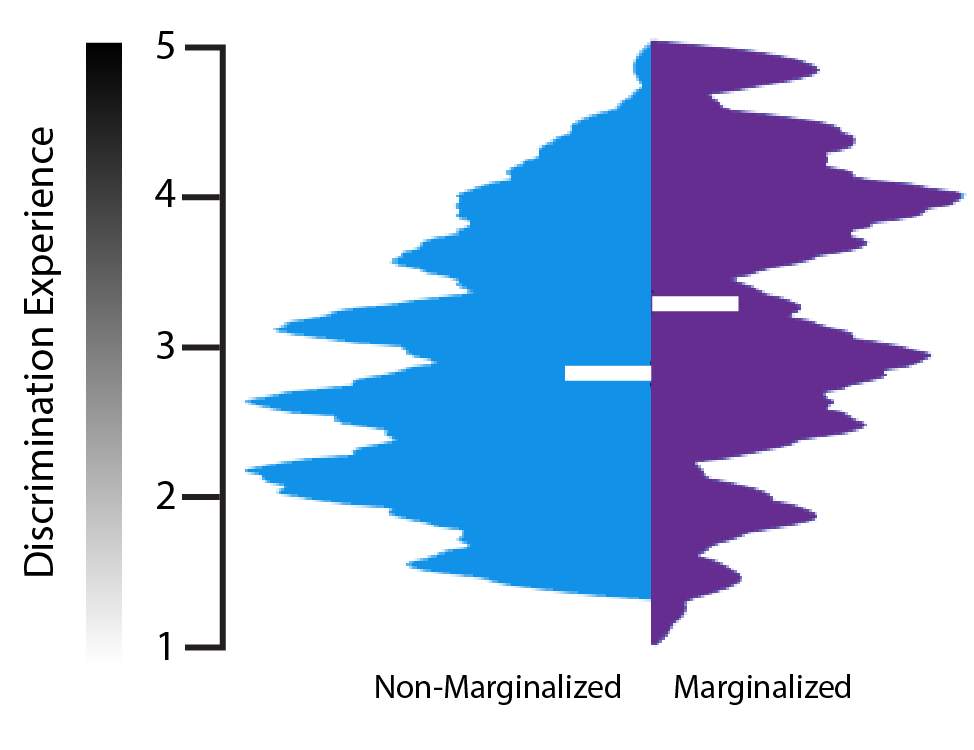
The Global Quantum Needs Assessment indicates significant disparities in the perceived workforce climate based on representation. Specifically, individuals from marginalized groups reported a mean discrimination score of 3.35 on a 1-5 scale, substantially higher than the score of 2.47 reported by non-marginalized individuals. This difference is statistically significant, as demonstrated by a t-test yielding a value of -8.60 with a p-value less than 0.001, suggesting that the observed difference is unlikely due to chance and confirms the presence of systemic challenges impacting experiences within the quantum field.
Interpretation of the Global Quantum Needs Assessment data requires adherence to the ethical principles of Respect for Persons, Beneficence, and Justice, given statistically significant disparities in perceptions reported by marginalized scientists. Specifically, analysis reveals that marginalized scientists rate their career opportunities and working environments as substantially less favorable (M=3.54) compared to their non-marginalized counterparts (M=3.99), a difference supported by a t-test (t = 6.06, p < 0.001). These findings indicate a systemic issue requiring interventions grounded in equitable practices to ensure inclusivity and optimize the quantum workforce climate.
Rewiring the System: Cultivating a Quantum Ecosystem for All
Prioritizing talent retention is critical for organizational success, and proactive mentorship programs are demonstrably effective in supporting the advancement of individuals from underrepresented groups. These programs provide targeted guidance, skill development, and networking opportunities that can address systemic barriers to career progression. By fostering inclusive relationships and providing access to institutional knowledge, mentorship initiatives increase employee engagement, reduce turnover rates among diverse talent, and contribute to a more equitable and representative workforce. Successful programs often incorporate structured frameworks, dedicated resources, and ongoing evaluation to maximize their impact and ensure alignment with broader diversity, equity, and inclusion goals.
Intentional diversity hires represent a proactive strategy to expand the available talent pool beyond traditional recruitment channels and mitigate the effects of historical underrepresentation in specific roles and industries. These initiatives move beyond simply ensuring equal opportunity and actively seek out qualified candidates from groups that have been systematically excluded or disadvantaged. This approach often involves targeted outreach to minority-serving institutions, partnerships with diversity-focused organizations, and the implementation of blind resume screening processes to reduce unconscious bias. The goal is not to lower standards, but to identify and cultivate talent that might otherwise be overlooked, leading to a more innovative and representative workforce.
Robust anti-harassment policies are directly correlated with improvements in workforce climate and increased participation. Data indicates a statistically significant difference in the importance of a positive workplace climate between marginalized respondents (M=4.19) and non-marginalized respondents (M=3.69), as demonstrated by a t-test (t = -4.60, p < 0.001). This suggests that individuals from marginalized groups place a substantially higher value on a safe and supportive work environment, reinforcing the necessity of comprehensive policies and their effective implementation to foster inclusivity and encourage broad participation.
Beyond Innovation: Architecting a Sustainable Quantum Future
The European Quantum Flagship, a significant driver of quantum technology development, currently holds considerable sway over the formation of the forthcoming Quantum Act. This influence presents a crucial opportunity to proactively integrate ethical considerations – encompassing issues like data privacy, algorithmic bias, and responsible innovation – directly into the legislative framework. Beyond ethics, the Flagship can champion policies fostering a positive workforce climate within the burgeoning quantum sector. This includes promoting diversity, equity, and inclusion, as well as investing in education and training programs to cultivate a skilled and engaged workforce. By prioritizing these elements, the Quantum Act can ensure that the benefits of this revolutionary technology are shared broadly, and that its development aligns with societal values, ultimately maximizing its long-term impact and sustainability.
A truly sustainable quantum future hinges not only on technological advancement, but also on the deliberate construction of an equitable and inclusive workforce. Legislative frameworks are essential tools in this endeavor, moving beyond simple non-discrimination policies to actively promote opportunities for underrepresented groups in STEM fields. These frameworks can incentivize quantum education and training programs targeted at diverse communities, support mentorship initiatives, and ensure fair hiring practices within the burgeoning quantum industry. By proactively addressing potential biases and barriers to entry, legislation can cultivate a quantum workforce that reflects the broader population, fostering innovation through a wider range of perspectives and ultimately maximizing the societal benefits of this transformative technology. The absence of such frameworks risks exacerbating existing inequalities and limiting the full potential of quantum science for all.
Strategic investment in equitable and inclusive quantum initiatives transcends ethical considerations, functioning as a catalyst for maximizing the field’s potential. A diverse workforce, fostered through supportive legislative frameworks and dedicated funding, brings a wider range of perspectives to problem-solving, accelerating innovation and mitigating potential biases in algorithm development and application. This broadened approach not only ensures a more just distribution of the benefits derived from quantum technologies – spanning fields like medicine, materials science, and finance – but also enhances the resilience and adaptability of the entire quantum ecosystem. Ultimately, prioritizing inclusivity is not simply about doing what is right; it is a pragmatic step toward unlocking the full transformative power of quantum science for global benefit and establishing a sustainable future for the field.
The study illuminates a stark paradox within the burgeoning field of quantum science. While innovation demands pushing boundaries, the experiences detailed reveal systemic constraints hindering progress for marginalized groups. This echoes Wilhelm Röntgen’s sentiment: “I have made a beginning, and I have a great deal still to do.” The ‘beginning’ of quantum technology cannot truly flourish until the workforce climate, as highlighted by the survey’s findings regarding bias and harassment, undergoes fundamental change. Röntgen’s pursuit of the unseen required dismantling established understandings; similarly, addressing the inequities within the quantum workforce necessitates a willingness to deconstruct and rebuild existing structures to foster genuine inclusion and unlock the full potential of the field.
Uncharted Territory
The data presented here doesn’t so much reveal a problem as expose the inherent fragility of any system claiming meritocracy. A thousand responses detail predictable patterns – the concentration of negative experiences within marginalized groups. It’s almost… elegant. One doesn’t need complex algorithms to predict where the stress fractures will appear in a structure built on unspoken assumptions. The task now isn’t to ‘fix’ quantum science, but to dismantle the comforting illusion that it operates differently.
Future inquiry should bypass documenting the effects of exclusion and instead focus on the mechanisms that perpetuate it. What specific institutional practices, seemingly neutral on the surface, consistently yield inequitable outcomes? How do implicit biases manifest not as isolated incidents, but as systemic pressures? The field requires a willingness to reverse-engineer its own foundations, to trace the pathways of privilege and disadvantage with unflinching honesty.
Ultimately, the true measure of progress won’t be a decrease in reported harassment – a lagging indicator at best. It will be a demonstrable shift in the questions being asked. A move from ‘how do we include everyone?’ to ‘what are we actively excluding, and why?’ Only then can the pursuit of quantum understanding extend to understanding ourselves.
Original article: https://arxiv.org/pdf/2601.14297.pdf
Contact the author: https://www.linkedin.com/in/avetisyan/
See also:
- Gold Rate Forecast
- Dune 3 Gets the Huge Update Fans Have Been Waiting For
- Hazbin Hotel Secretly Suggests Vox Helped Create One of the Most Infamous Cults in History
- 22 actors who were almost James Bond – and why they missed out on playing 007
- Every Creepy Clown in American Horror Story Ranked
- Kingdom Come: Deliverance 2 – Legacy of the Forge DLC Review – Cozy Crafting
- Arknights: Endfield – Everything You Need to Know Before You Jump In
- Jack Osbourne Shares Heartbreaking Tribute to Late Dad Ozzy Osbourne
- Jason Statham’s Hit Creature Feature Is Heading to Streaming for Free
- As Dougal and friends turn 60, Radio Times explores the magic behind The Magic Roundabout
2026-01-22 07:14