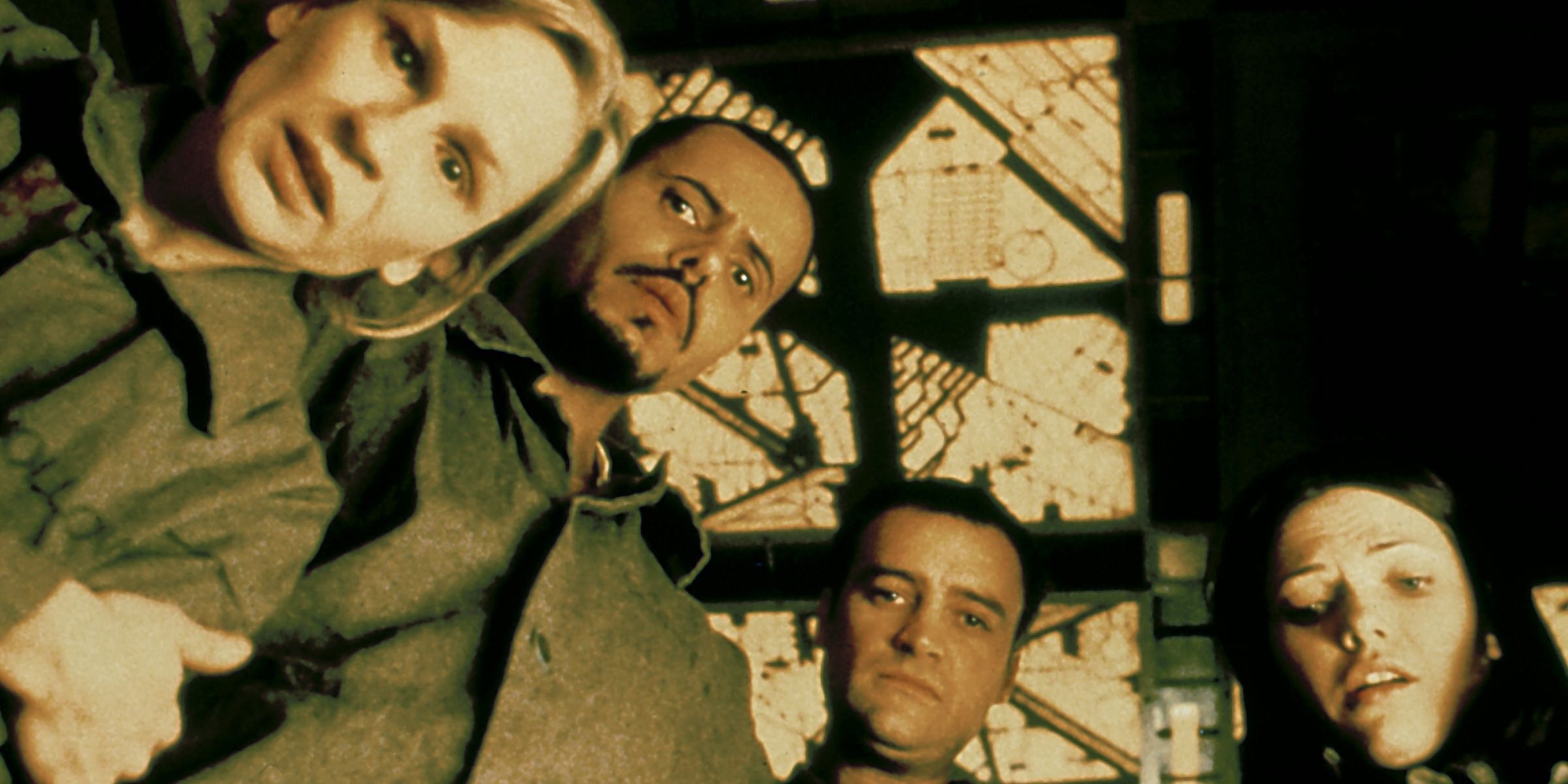
I’ve always been fascinated by those really strange, visually striking horror movies – you know, the ones that started gaining traction after films like Eraserhead and Videodrome. There’s something about the unsettling stories and, let’s be honest, the gore, that just gets under your skin. One movie that I think doesn’t get enough credit is Cube. It really kicked off a whole wave of horror films focused on puzzle-solving, and you can definitely see its influence in movies like Saw and Escape Room.
Though it was groundbreaking, the movie Cube has largely been forgotten. This is likely because its strange story and graphic violence turned off many viewers, particularly those who weren’t used to that type of film. However, those viewers missed the deeper meaning: Cube is a clever and disturbing commentary on capitalism, making it a truly exceptional science fiction film.
Cube’s Entire Premise is a Metaphor for Capitalism
I’m a big fan of the movie Cube, and one thing that really struck me is how it explores capitalism. It’s about six people who wake up trapped inside this massive, dangerous cube structure, and they have to work together to find a way out, navigating all sorts of deadly traps. But beyond the thrills, it feels like a really clever commentary on how our society works – or doesn’t – and the ideas of trust and whether anything really matters are constantly being questioned.
The group consists of a police officer named Quentin (Maurice Dean Wint), a math student Leaven (Nicole de Boer), doctor Helen (Nicky Guadagni), a mathematical genius named Kazan (Andrew Miller), an escape artist Rennes (Wayne Robson), and architect Worth (David Hewlett). They are all trying to figure out the purpose of the Cube.
Helen is convinced the Cube is a government experiment, believing there’s a specific reason she’s trapped inside. Worth, on the other hand, thinks the Cube is completely random and without purpose. The film’s power actually comes from its lack of answers.
The film Cube isn’t about random chaos, but rather a carefully constructed system, much like life under capitalism. The maze of cubes symbolizes a modern company, with people trapped inside its departments. Just like the dangerous traps in the movie, errors within this system can lead to serious problems.
The story follows new employees from many different walks of life joining a company. They have to collaborate in a workplace that values getting things done quickly over personal expression. While each person has their own dreams and what they want to achieve, the rigid structure of the company, symbolized as ‘the Cube,’ gradually diminishes those ambitions as they try to climb the career ladder.
The Cube represents a company focused on its own goals, where people get stuck in repetitive tasks and eventually lose sight of their personal values. They become simply instruments used to achieve those goals, rather than valued individuals.
Even in this difficult situation, there’s still a chance to break free. Surviving means overcoming the challenges of today’s economic system and finding a path forward. The protagonist achieves this by refusing to accept conventional corporate norms, fueled by his skepticism and a sense of meaninglessness. While he does escape, his reluctance highlights his disapproval of the system itself.
Kazan is an outcast, seen as unproductive and a hindrance by conventional standards. This allows him to break free, while characters like Quentin, Leaven, and Holloway – who embody traits valued in the corporate world – remain stuck inside the Cube.
Cube’s Ending is one of the Darkest in Sci-Fi History
At the end of Cube, Leaven figures out the rooms are rearranging in a continuous loop. She believes there’s a special room – a ‘bridge’ – that links to the outside and offers a way out. By using a coordinate system, she maps their position inside the Cube, allowing them to navigate and time their movements for a safe escape.
It’s ironic that the bridge room is actually where the group first woke up. This room briefly offers a way to escape before the Cube starts moving again. They soon realize that if they’d understood this earlier, they could have saved themselves a lot of hardship.
As the group approached the bridge room, Quentin grew increasingly bossy, pushing them to hurry up and escape. The others managed to lock him in a room close by so they could continue towards the exit.
When the group enters the brightly lit final room, Worth hesitates, unwilling to go back to his dissatisfying life. Suddenly, Quentin rushes in and fatally stabs Leaven. He then attacks Worth before turning his attention to Kazan.
Kazan bursts into the light, with Quentin right behind him. Just as the rooms start to change, Worth uses the last of his energy to catch Quentin. But Quentin is pinned between the shifting walls and crushed, leaving only a bloody mark on the outside of the Cube.
Honestly, after everything that went down inside the Cube, it’s kind of unsettling to think it’ll just keep going, endlessly resetting. It’s impossible to fully grasp what happened in there, partly because of all the rotating, but it seems the Cube itself survives. And, sadly, a lot of how it worked – the real secrets – died with Worth. It’s like all that knowledge went with him, leaving the Cube a mystery that will likely continue indefinitely.
The situation with the Cube highlights how easily everyone could have survived (except for Alderson). Each person possessed a useful skill or quality, but instead of working together, those abilities were lost. This is similar to how capitalism functions: everyone has potential, but the system encourages competition instead of cooperation.
Even without the added stress of hunger and thirst, the system is set up for people to fail. As Worth puts it, there’s no intentional evil at play – no one is deliberately causing this. It’s simply a chaotic mess that seems like it’s being controlled. The situation endlessly repeats itself, like a spinning cube, making people pursue a pointless objective over and over.
The struggle to understand the Cube symbolizes our society’s focus on wealth and social standing. It represents everything capitalism tells us we need to be happy, and the endless effort to achieve these things drains our energy, time, and attention – much like the constant desire for more possessions. Within this system, simply surviving isn’t enough, and the cycle continues. Ultimately, an excessive drive for power, control, or pointless achievements can be destructive and leaves most people feeling trapped.
Cube is a Metaphysical Masterpiece
The low-budget film Cube surprisingly became a hit at the box office, earning $9 million despite only costing $350,000 to make. Its success led to a sequel and a prequel, and a Japanese remake came out in 2021. Currently, Lionsgate is working on an American remake, but a release date hasn’t been announced yet.
Like many successful films, Cube sparked a wave of similar movies, including Escape Room. The themes of confinement and how people behave under pressure can also be seen in later films that explore social dynamics, such as Circle and The Platform.
While these movies all built upon the ideas of the subgenre, they didn’t feel as believable as Cube. The film strikes a balance between the tension of escape-room mysteries and the unsettling nature of social horror, and its realistic depiction of fear and paranoia draws the audience into the terrifying experience, making them feel involved in the unfolding events.
The experience is comparable to being immersed in a story, where the realistic details pull the viewer in, even if they don’t want to be. The film’s repetitive imagery and frequent use of complex math mirror the characters’ own confusion and dependence on numbers.
Like the people watching, the group depends on Leaven to understand the complex numbers that help them navigate the Cube. Her understanding of prime numbers and factorials is key to finding their way through the maze. Even viewers who are good at math can feel lost and frustrated, just like Leaven, because the system seems intentionally confusing.
The creators paid close attention to detail, even when naming the characters. Each one is named after an actual prison: Holloway after a U.K. women’s prison, Quentin after San Quentin in California, Rennes after a prison in France, Kazan after a Russian prison, and Leaven and Worth after Leavenworth in the U.S. This subtle detail connects each character to the idea of being imprisoned.
While the film aimed for realism, it didn’t always succeed with Cube, which may explain its mixed reception. The problem with movies like Cube is they can sometimes prioritize cleverness over accessibility. Many viewers missed the deeper meanings and symbolism, simply seeing it as a strange and scary horror film similar to Event Horizon or Videodrome.
I think a lot of people get the wrong idea about how violent Cube actually is, and that’s led to it being labeled as overly graphic. Honestly, it seems to have gotten that reputation early on, probably because of what the movie’s about, some of the first reviews people read, or that pretty intense opening scene. It’s a bit much at the start, sure, but the violence isn’t constant like some might expect.
Despite its reputation, Cube actually has very little on-screen violence – only two brief, intense scenes in the beginning. The rest of the movie explores complex ideas like the meaning of life and the impact of economic systems. Because of this, viewers who can get past the initial shock will find Cube to be a clever, unsettling, and truly thought-provoking sci-fi horror film that deserves the praise it receives.
Read More
- Looks Like SEGA Is Reheating PS5, PS4 Fan Favourite Sonic Frontiers in Definitive Edition
- Gold Rate Forecast
- Dune 3 Gets the Huge Update Fans Have Been Waiting For
- Pluribus Star Rhea Seehorn Weighs In On That First Kiss
- Jack Osbourne Shares Heartbreaking Tribute to Late Dad Ozzy Osbourne
- Action Comics #1096 is Fun Jumping-On Point for Superman Fans (Review)
- Every Upcoming Transformers Movie: Release Dates, Details, & Everything We Know
- 22 actors who were almost James Bond – and why they missed out on playing 007
- Dungeon Stalkers to end service on June 9
- Antiferromagnetic Oscillators: Unlocking Stable Spin Dynamics
2025-12-19 17:14