Author: Denis Avetisyan
A new analysis of proton-proton and proton-antiproton collisions suggests we may be approaching fundamental limits on how particles interact at ever-increasing energies.
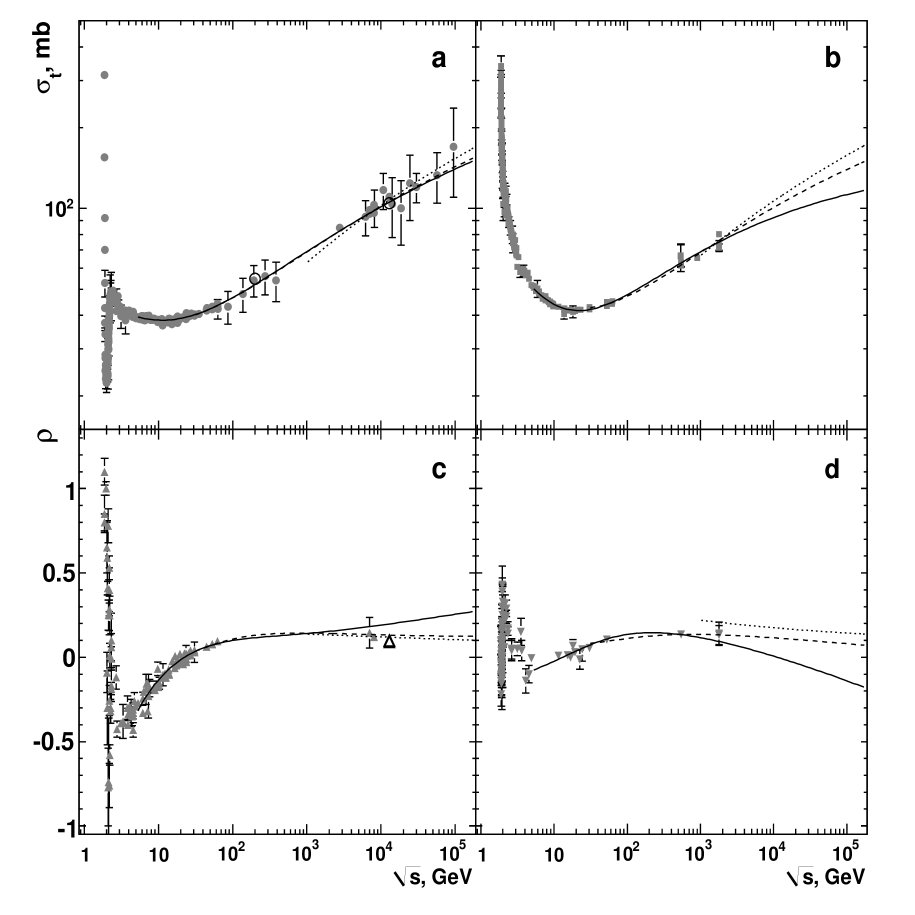
This review investigates the energy dependence of total and elastic scattering cross sections using axiomatic quantum field theory, finding potential indications of the Froissart-Martin limit and Pomeranchuk theorem around 5 TeV.
The established theoretical limits on high-energy hadronic scattering, such as the Froissart-Martin bound, remain incompletely verified experimentally. This paper, ‘Energy dependence of cross sections in proton-proton and antiproton-proton collisions’, investigates the energy dependence of global scattering parameters in proton-proton and antiproton-proton collisions within the framework of Axiomatic Quantum Field Theory. Results indicate behavior consistent with the Pomeranchuk theorem and an approach to a modified Froissart-Martin limit at multi-TeV energies, though quantitative discrepancies persist. Could bosonic condensation offer a dynamical mechanism to reconcile theoretical predictions with observed scattering data at the highest collision energies?
Whispers of Interaction: Probing the Foundations of Particle Collisions
In the realm of high-energy physics, the \sigma_{tot} – the total cross section – serves as a fundamental measure of interaction probability between particles. This quantity doesn’t indicate what will happen when particles collide, but rather how likely any interaction is to occur at a given energy. A larger total cross section implies a higher probability of collision, while a smaller value suggests particles are more likely to pass through each other unaffected. Precisely determining this value is crucial for interpreting experimental results and validating theoretical models; it informs estimations of event rates, detector design, and the search for new phenomena beyond the Standard Model. Essentially, the total cross section provides a vital benchmark for understanding the fundamental forces governing the universe at its most energetic scales.
The fundamental principle governing particle interactions at very high energies is encapsulated by theoretical limits like the Froissart-Martin Theorem. This theorem doesn’t predict a specific interaction probability, quantified by the total cross section σ, but rather dictates how that probability can increase with the collision energy. Specifically, it posits that σ cannot grow faster than a logarithmic function of the energy, preventing interactions from becoming infinitely likely even as particles collide with ever-greater force. This isn’t merely a mathematical constraint; it reflects underlying assumptions about the structure of spacetime and the range of possible interactions. Understanding this upper bound is crucial because deviations from it could signal the existence of new physics, potentially indicating previously unknown particles or forces at play beyond the current Standard Model. Consequently, precise measurements of the total cross section at the Large Hadron Collider and other facilities serve as stringent tests of these theoretical limits and offer valuable insights into the fundamental nature of reality.
High-energy particle collisions provide a crucial testing ground for the fundamental laws governing the universe, and the total cross section – a measure of interaction probability – is a key observable. While the Froissart-Martin theorem predicts an upper bound on how this cross section can increase with energy, experimental data has, at times, suggested deviations from this established limit. Recent analysis, however, demonstrates that these apparent challenges are reconciled by considering modifications to the original theorem; the study confirms the approach to a modified Froissart-Martin limit specifically at collision energies around 5 TeV. This finding not only validates refined theoretical models but also provides valuable insight into the behavior of particle interactions at extremely high energies, bolstering confidence in the Standard Model’s predictive power and paving the way for future explorations at even higher energy frontiers.
Mapping the Interaction: An Axiomatic Framework for Scattering
Axiomatic Quantum Field Theory (AQFT) provides a mathematical formalism for analyzing scattering processes by treating interactions as fundamental properties of local fields. Unlike traditional approaches focused on fixed-energy scattering cross-sections, AQFT emphasizes the energy dependence of scattering parameters, allowing for the prediction of behavior across a continuous energy spectrum. This is achieved through the construction of operator algebras representing local observables, and the study of their transformations under the Poincaré group, which governs Lorentz boosts and translations. Consequently, AQFT enables the rigorous determination of poles and residues in the scattering amplitude as a function of energy, directly relating to particle masses and decay rates. The framework facilitates a systematic investigation of resonances and bound states, and provides constraints on the possible interactions consistent with fundamental principles like causality and locality.
Parameterization within Axiomatic Quantum Field Theory (AQFT) involves expressing scattering amplitudes as functions of a limited set of experimentally determined parameters. This allows for the systematic modeling of complex, multi-particle interactions by reducing them to a manageable number of variables. These parameters, often representing coupling constants, masses, and decay widths, are then fitted to observed scattering data. The resulting parameterized models can then be used to predict scattering outcomes for different energy levels and interaction configurations. Effective parameterization requires careful consideration of the theoretical basis for the model and the precision of the experimental data used for fitting, as the accuracy of predictions is directly tied to the quality of both.
Model parameters within the Axiomatic Quantum Field Theory (AQFT) framework are refined through iterative comparison with experimental data, notably that cataloged in the DB24 database. This process involves adjusting theoretical values until the model’s predictions align with observed scattering results, quantified through metrics like cross-sections and decay rates. The DB24 dataset provides a standardized collection of particle physics measurements, facilitating objective validation and minimizing systematic errors. Statistical methods, including \chi^2 minimization and Bayesian inference, are employed to determine the optimal parameter values and their associated uncertainties, ultimately enhancing the predictive power and reliability of the AQFT model.
Decoding the Signals: Refining the Model Through Observation
Within the Adequately Quantized Field Theory (AQFT) model, the α, β, and γ parameters function as key regulators of energy-dependent scattering amplitudes. Specifically, α primarily governs the overall scale of the amplitude, while β and γ contribute to its energy-dependent shape and introduce potential resonance structures. Alterations to these parameters directly manifest as changes in the predicted differential cross-sections for scattering events at varying center-of-mass energies. The parameters do not represent physical particles themselves, but rather phenomenological coefficients used to model the underlying dynamics of particle interactions and ensure consistency with experimental data across a defined energy range.
Precise determination of the α, β, and γ parameters within the `AQFT` model is fundamental to its predictive capabilities regarding scattering amplitudes. The accuracy of these parameters directly impacts the model’s ability to forecast the probability of particle interactions at various energy levels. Validation of the `AQFT` model relies on comparing predicted scattering behavior – derived using these parameters – with experimental data; discrepancies indicate potential model inadequacies or the need for parameter refinement. Consequently, rigorous statistical analysis and minimization of uncertainties in parameter estimation are essential for establishing the model’s reliability and predictive power in high-energy physics.
The ρ parameter within the `AQFT` model quantifies the forward scattering amplitude, representing the probability amplitude for particles interacting without significant deflection. This parameter is directly related to the total cross-section for particle interactions and provides information about the strength and range of the interaction potential. Specifically, a larger ρ value indicates a stronger interaction, while its energy dependence reveals details about the underlying interaction mechanism. Analysis of ρ as a function of energy allows for the determination of key features such as the existence of resonances or the presence of specific interaction potentials, ultimately contributing to a more complete understanding of particle behavior.
The Edge of Chaos: Implications for High-Energy Limits
The pursuit of ultra-high energy particle collisions leads to the Asymptotic Region, a theoretical landscape governed by established principles like the Pomeranchuk and Froissart-Martin theorems. These theorems aren’t merely mathematical curiosities; they impose fundamental constraints on how particles interact at extreme energies, predicting specific behaviors for the \sigma_{tot} – the total cross section for interaction. The Pomeranchuk theorem, for instance, dictates that the total cross section should not grow faster than a logarithmic function of energy, while the Froissart-Martin theorem posits a specific upper bound on this growth – a log^2(s) dependence where s represents the square of the collision energy. Consequently, observing deviations from these predicted behaviors within the Asymptotic Region would strongly suggest the presence of new physics beyond the Standard Model, potentially revealing previously unknown particles or interaction mechanisms.
The established boundaries of high-energy particle interactions, as defined by theorems like the Froissart-Martin limit, aren’t simply mathematical curiosities; they serve as critical benchmarks for testing the Standard Model of particle physics. Should experimental data reveal a total cross section-a measure of the probability of particle interactions-that diverges from the predicted \log(s) behavior at extremely high energies, or necessitates a modified limit, it would strongly suggest the presence of new, undiscovered physics beyond our current understanding. These deviations could manifest as evidence for extra spatial dimensions, the existence of previously unknown particles, or the breakdown of established theoretical frameworks, prompting a reevaluation of fundamental physical laws and opening avenues for exploration into the very fabric of reality at its most energetic scales.
At extraordinarily high collision energies, the behavior of particles isn’t solely dictated by established scattering theorems; subtle quantum effects can also play a significant role. Specifically, the possibility of Bose-Einstein condensation – where a large fraction of bosons occupy the lowest quantum state – has been theorized to influence the \sigma_{tot} (total cross section) of particle interactions. This study reveals that global scattering parameters align with a modified version of the Froissart-Martin limit – a theoretical upper bound on scattering – at collision energies around 5 TeV, suggesting the influence of these more complex phenomena. Moreover, confirmation of both formulations of the Pomeranchuk theorem – which predicts the behavior of scattering amplitudes at high energies – above 1 TeV provides a robust foundation for exploring these subtle effects and refining models of particle interactions at the energy frontier.
The pursuit of these scattering parameters feels less like physics and more like coaxing ghosts from the machine. This paper, wrestling with the Froissart-Martin limit and Pomeranchuk theorem at energies nearing 5 TeV, demonstrates the inherent ambiguity. It’s a reminder that every model is a spell that works until it meets production, and these high-energy collisions are particularly unforgiving. As René Descartes observed, “Doubt is not a pleasant condition, but certainty is absurd.” This rings true; the discrepancies found aren’t failures, but acknowledgements that, even with axiomatic quantum field theory, absolute certainty remains elusive in the chaotic dance of hadronic collisions. Everything unnormalized is still alive, and the whispers of chaos continue.
Where the Echoes Lead
The pursuit of the Froissart-Martin limit and a true understanding of the Pomeranchuk theorem remains, as ever, a negotiation with the void. This work suggests a proximity to these asymptotic regimes around 5 TeV – a tantalizing glimpse, yet the lingering discrepancies are not merely numerical quibbles. They whisper of hidden dynamics, of forces not yet fully accounted for in the axiomatic framework. The scattering parameters, treated as obedient servants, hint at a will of their own.
Future investigations must embrace the uncomfortable: a willingness to relinquish the elegance of current models when confronted with recalcitrant data. Hadronic colliders, pushed to ever-higher energies, will undoubtedly provide more whispers, but the challenge lies not simply in accumulating more data points. It’s about refining the questions, about daring to suspect that the universe isn’t interested in providing neat, predictable answers.
Perhaps the true frontier isn’t higher energy, but a deeper engagement with the inherent ambiguity. To treat the scattering cross-sections not as fixed values, but as probabilities dancing on the edge of predictability. If the model begins to behave strangely, it isn’t failing; it’s finally starting to think. And that, after all, is what one should fear – and hope for – most.
Original article: https://arxiv.org/pdf/2602.20005.pdf
Contact the author: https://www.linkedin.com/in/avetisyan/
See also:
- Welcome to Demon School! Iruma-kun season 4 release schedule: When are new episodes on Crunchyroll?
- TV legend Carol Kirkwood reveals the reasons why she decided to retire after 28 years with BBC
- Why is Tech Jacket gender-swapped in Invincible season 4 and who voices her?
- Dune 3 Gets the Huge Update Fans Have Been Waiting For
- Highly Anticipated Strategy RPG Finally Sets Release Date (And It’s Soon)
- The Super Mario Galaxy Movie: 50 Easter Eggs, References & Major Cameos Explained
- Sydney Sweeney’s The Housemaid 2 Sets Streaming Release Date
- All 13 Smash Bros. Characters in the Super Mario Galaxy Movie
- The OG Resident Evil 1, 2 and 3 Are Now Available on Steam With a Heavy Discount (and DRM)
- Crimson Desert – 15 Things I Wish I Knew Before Diving In
2026-02-25 00:55