Japan’s 30-year government bond yield rose above 4% in May 2026 for the first time since it was introduced in 1999, hitting around 4.2%. This increase is happening as the Bank of Japan gradually moves away from its long-standing low-interest rate policy, which had previously encouraged investors to borrow yen cheaply and invest in riskier assets like XRP worldwide.
In the first three months of 2026, Japanese investors sold off $29.6 billion in US debt—the biggest sell-off in four years. This contributed to a rise in US 30-year Treasury yields, pushing them above 5%, and also tightened lending conditions for mortgages, corporate loans, and government bonds all at the same time.
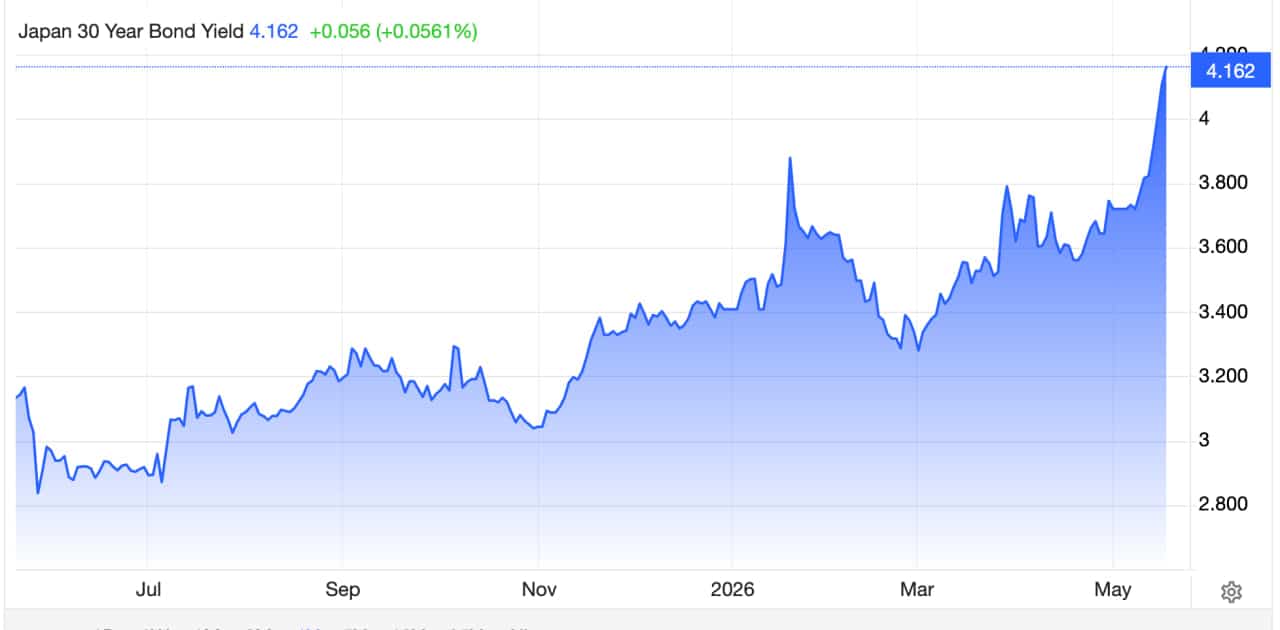
Source: TE
In a recent analysis, Catalina Castro explained a concerning cycle: when Japan sells US bonds, it pushes up interest rates, which leads to higher mortgage payments and makes borrowing money more expensive overall, ultimately creating stress throughout the American financial system.
This isn’t just a typical adjustment in the Japanese bond market. It’s a major disruption in how money flows around the world, highlighting a core problem that Ripple and XRP were originally created to solve.
We believe the issues in the Japanese Government Bond (JGB) market will be a critical test for Ripple’s payment system. It’s not about whether Ripple can handle a massive $9 trillion bond market downturn, but rather that the way rising interest rates cause liquidity problems for institutions is exactly what Ripple’s on-demand settlement feature is designed to fix.
DISCOVER: Best Meme Coins to Buy in 2026
XRP and Ripple Payments: How the On-Demand Liquidity Mechanism Actually Functions
Here’s how it typically works: When a Japanese bank or insurance company needs to pay a bill in dollars, they usually use pre-funded accounts held at foreign banks. These accounts hold dollars that just sit there, earning no interest – which becomes a problem when interest rates are rising and that money could be earning a return elsewhere.
Ripple’s Payments platform, previously known as On-Demand Liquidity and relaunched in late 2024 as part of a larger effort to serve banks and other institutions, removes the need for upfront funding. It works by using XRP as a middle step: the sending bank changes yen into XRP, the XRP transfer settles almost instantly on the XRP Ledger, and then the receiving bank converts the XRP back into the desired currency before the transaction is complete.
⚠️ATENCIÓN⚠️
EL TERCER MERCADO DE BONOS MÁS GRANDE DEL MUNDO SE ESTÁ ROMPIENDO + RELACIÓN CON $XRP
Japan is experiencing economic conditions not seen since the 1990s, and this could have significant repercussions for global markets.
💥El bono japonés a 30 años superó el 4% por…
— Catalina Castro (@techconcatalina) May 18, 2026
Castro explained that the system would work like this: a bank sends money in its local currency, which is instantly exchanged for XRP, stablecoins, or digital currencies issued by central banks. It’s then converted into the receiver’s currency, all without needing intermediaries or pre-funded accounts. This frees up money that can then be used for things like purchasing bonds, providing loans, or making investments, boosting the overall economy.
Ripple’s initial results confirm that using its system can significantly reduce costs – between 40% and 70% less than using SWIFT. Plus, transactions settle in minutes, much faster than the several days it currently takes with traditional banking methods.
The Japan corridor isn’t just a plan for the future. SBI Holdings, working with SBI Ripple Asia, has already been using XRP to settle payments – both for everyday money transfers and larger institutional payments – within Japan for several years. This gives Ripple a real-world network for reaching institutions in the country most impacted by issues with Japanese government bonds.
Read More
- Best Controller Settings for ARC Raiders
- Meet the cast of Good Omens season 3: All the actors and characters
- Mark Zuckerberg & Wife Priscilla Chan Make Surprise Debut at Met Gala
- Review: Final Fantasy Tactics: The Ivalice Chronicles (PS5) – Still the Benchmark for Turn-Based Tactics
- Nippon Sangoku Is The Best New Post-Apocalyptic Anime of Spring 2026
- The Witcher 3 Officially Reveals Stunning New Ciri Figure Coming 2026
- The WONDERfools ending explained: What happened to the Child of Eternity?
- 7 Great Marvel Villains Who Are Currently Dead
- FRONT MISSION 3: Remake coming to PS5, Xbox Series, PS4, Xbox One, and PC on January 30, 2026
- Welcome to Demon School! Iruma-kun season 4 release schedule: When are new episodes on Crunchyroll?
2026-05-19 17:52