Science fiction often lets us glimpse incredible possibilities for the future. But it can also be a somber commentary on where we are now, almost like a warning about the direction we’re heading. While exploring the worst parts of human nature, serious sci-fi films can be deeply unsettling and leave audiences feeling anxious for a sense of hope.
Science fiction films vary widely in tone. Some challenge viewers with complex scientific ideas, while others present grim, hopeless futures that can be deeply unsettling and stay with you long after the credits roll. These powerful stories, whether through their themes or striking visuals, can even change how we see the world. While these films might leave you feeling disturbed for a while, they often remind us to appreciate the good things in our own lives.
Threads is an Under-Recognized Masterpiece
Released in 1984, Threads is a powerful and disturbing anti-war drama directed by Mick Jackson. It realistically portrays the devastating consequences if a war were to break out between the United States and the Soviet Union. The film focuses on two families in Sheffield, England, as they face the terrifying prospect of nuclear winter and societal collapse. Threads was groundbreaking for its depiction of a post-nuclear winter world and is often considered the most realistic and horrifying portrayal of nuclear war and its aftermath.
The story portrays a Britain ravaged by war, where the population struggles in poverty and relies on food for trade due to widespread famine. While technology is scarce, industry slowly returns with limited steam power. The children born after the war speak a unique, non-standard English, a result of radiation exposure during pregnancy, a lack of schools, and the emotional trauma of their parents. Initially considered intensely dark and disturbing, the film is now recognized as a powerful and moving work that realistically depicts the horrors of a post-nuclear Britain.
Primer Did Not Dumb Down the Heavy Scientific Jargon
Shane Carruth’s 2004 film, Primer, is a remarkably well-made and surprising science fiction movie. Carruth wrote, directed, produced, edited, and composed the music for this, his first feature film. He also stars alongside David Sullivan in a story about two men who stumble upon time travel and deal with the unexpected results. Despite being made on a very low budget, Primer is known for its complex, experimental story and thought-provoking themes. Carruth intentionally kept the technical details realistic and challenging, demanding close attention from viewers and making it a rewarding, but difficult, film to fully understand.
As a movie buff who loves a good head-scratcher, I have to say Primer is something special. It won the Grand Jury Prize at Sundance back in 2004 and has really built a dedicated following since then. Now, be warned, it’s packed with scientific terms – quantum physics, chaos theory, the works! It’s definitely one of the more complex films out there. But beyond all the complicated science, it’s a really fascinating look at how obsession can mess with your mind. You really see the characters falling apart as they get caught in this endless loop of trying to fix things with time travel. Honestly, the plot is so twisted and messes with time itself that it leaves you totally disoriented and wondering what just happened – but in a good way, if you’re up for a challenge!
Arrival’s Plot Twist Leaves Viewers Questioning Time Itself
Denis Villeneuve’s film Arrival, released in 2016, was highly acclaimed and drew inspiration from Ted Chiang’s science fiction story, “Story of Your Life.” The movie centers on Louise Banks, a language expert tasked with finding a way to communicate with alien visitors called Heptapods. As she learns their language, Louise begins to perceive time differently, experiencing memories of the future much like the Heptapods do, in an attempt to prevent global conflict.
Beyond its fascinating look at how language shapes thought – particularly through a dramatic take on the Sapir-Whorf hypothesis – this Amy Adams film delves into poignant and ultimately sad ideas about what it means to be human and how we react to difficult situations. It skillfully transforms Louise’s journey into a moving character study, presenting a profound question about choice and destiny. The film’s emotional heart lies in Louise’s difficult decision to accept her future, even knowing it will bring heartbreak.
Children of Men Has Never Felt So Timely
Alfonso Cuarón’s film, A, is a gripping and believable dystopian thriller. The story takes place in 2027, after twenty years of widespread infertility have pushed the world to the edge of breakdown. It centers on Theo, a disillusioned former activist now working as a government employee, who must protect Kee, the world’s only pregnant woman, and get her to The Human Project – a research group that offers a potential safe haven from the increasingly chaotic and oppressive government in Britain.
Unlike most modern action movies, Children of Men feels strikingly realistic, resembling a documentary or news footage with its long, fluid shots of intense action. The film centers on themes of hope and belief even when everything seems lost. While the reason for humanity’s sudden inability to have children isn’t explained, director Cuarón intentionally avoided giving answers. He wanted the infertility itself to represent a loss of hope, and the mysterious ‘Human Project’ to symbolize the enduring power of the human spirit.
The film draws heavily on the story of the Virgin Mary, portraying Theo as a protector of a mother and child fleeing danger, and highlights themes of selflessness and compassion. It subtly touches on issues of reproductive rights and immigration, presenting the mother, Kee, as a symbol caught between opposing forces and ultimately victimized by a controlling government. By depicting the mistreatment of refugees, government control of information, and detention camps presented as necessary for order, the film serves as a chilling commentary on historical and contemporary fascism, making it feel particularly relevant and disturbing.
Solaris Brings Back the Dead — But Not Really
Andrei Tarkovsky’s Solaris is a highly praised Soviet science fiction film, adapted from the 1961 novel by Stanisław Lem. The film delves into the inner lives of its characters and explores complex questions about consciousness. It centers around a sentient ocean on an alien planet that attempts to communicate with human scientists by recreating their memories – specifically, the protagonist is haunted by apparitions of his deceased wife.
I’ve been completely captivated by this film. It’s not your typical sci-fi action movie at all; it’s a deeply moving and thoughtful experience that really makes you think. It slowly unfolds, exploring big questions about life, death, what it means to be human, and how we understand the world around us. It delves into the conflict between what we know logically and what we feel emotionally. The story uses the characters’ inner lives and this amazing idea of an alien ocean to explore how we experience reality, and what it might be like to connect with something completely different – life that doesn’t follow the same rules as us. Honestly, it’s a powerful and sometimes difficult film to watch, but it’s stayed with me long after the credits rolled.
Blade Runner 2049 Doubles Its Predecessor’s Emotional Weight
Blade Runner 2049 is a powerful sequel to the classic sci-fi film, Blade Runner. Directed by Denis Villeneuve, the movie centers on K, a replicant (a type of human-like robot) played by Ryan Gosling. K discovers a shocking secret – evidence of a replicant who had a child – which could cause widespread chaos. He’s tasked with finding this child to prevent a potential war, a mission that leads him to the original Blade Runner, Rick Deckard.
The film delves into big questions about who we are, what makes us human, and whether artificial intelligence can truly have a soul. It asks if being born a person is what matters, or if feelings, selflessness, and free will are enough to make an artificial being equal to a human. The movie also considers the importance of memories in forming our identities, and wonders if fabricated memories can be as meaningful as real ones. Ultimately, it suggests that even if a memory isn’t genuine, the emotions it evokes are real and can define an individual’s identity.
The film explores the feeling of loneliness in a modern world that’s become numb to emotion due to technology, and questions what it truly means to be human when surrounded by artificial things. Unlike the first film, this one uses the character of K to ask whether our purpose in life comes from being unique or destined for greatness, or from building real relationships and making our own choices. Both Blade Runner films are thought-provoking and can be quite intense to watch due to their complex philosophical ideas.
Stalker is a Soviet Psychological & Philosophical Sensation
Andrei Tarkovsky’s film is inspired by the classic 1972 Soviet science fiction novel, Roadside Picnic. The script was even co-written by the novel’s authors, Arkady and Boris Strugatsky. The movie takes the book’s frightening, otherworldly ideas and presents them as a slow-paced, artistic film filled with dreamlike images. It delves into complex psychological and philosophical questions. The story centers on a guide known as the “Stalker” who leads a writer struggling with sadness and a very logical professor into a dangerous, forbidden area called the “Zone.” Within the Zone lies a room rumored to grant a person’s most profound wish.
This celebrated film uses its characters – embodying faith, art, and science – and a strange, rule-bending setting to explore big questions about what it means to be human and our constant search for purpose. The film portrays this setting as a hauntingly beautiful but dangerous place, foreshadowing the Chernobyl disaster, and contrasts it with a hopeful space representing a fresh start. Through symbolic imagery, it delves into our hidden desires, the decline of belief, and the conflict between reason and spirituality, ultimately resisting easy answers and becoming a powerful, personal experience for each viewer.
2001: A Space Odyssey is the Original Heavy Sci-Fi
Stanley Kubrick’s 2001: A Space Odyssey is a visually breathtaking film that revolutionized science fiction. The story centers on a journey to Jupiter by astronauts, scientists, and the intelligent computer HAL 9000. They are investigating a mysterious alien monolith discovered on the Moon – a monolith identical to one that appeared millions of years ago and seemed to spark human evolution. This new monolith is buried and sending a radio signal toward Jupiter.
Okay, so when the protagonist finally gets to Jupiter, things get really weird. He finds another monolith, and then… well, it’s hard to describe. He’s pulled into this incredible, swirling vortex of light and color, like a trip through space and time itself. It’s all very psychedelic! Ultimately, he transforms into this being called the ‘Star Child’ – basically, a being of pure energy. As a film fan, I always took it to mean that humanity needs to move beyond just technology and our physical bodies to reach the next level of evolution, to become something truly cosmic. It’s a powerful, visually stunning way of saying we need to transcend our limitations.
This thought-provoking film delves into big questions about life and what it means to exist. It beautifully blends the stark reality of space travel with a deeply poetic and spiritual quest, almost like a search for the divine. Known for its realistic portrayal of spaceflight and groundbreaking visual effects, the film offers layers of meaning about humanity’s past, present, and future – exploring themes like evolution, technology, artificial intelligence, and the potential for life beyond Earth, especially when viewed again.
The Needs of the Many Outweigh the Few in Interstellar
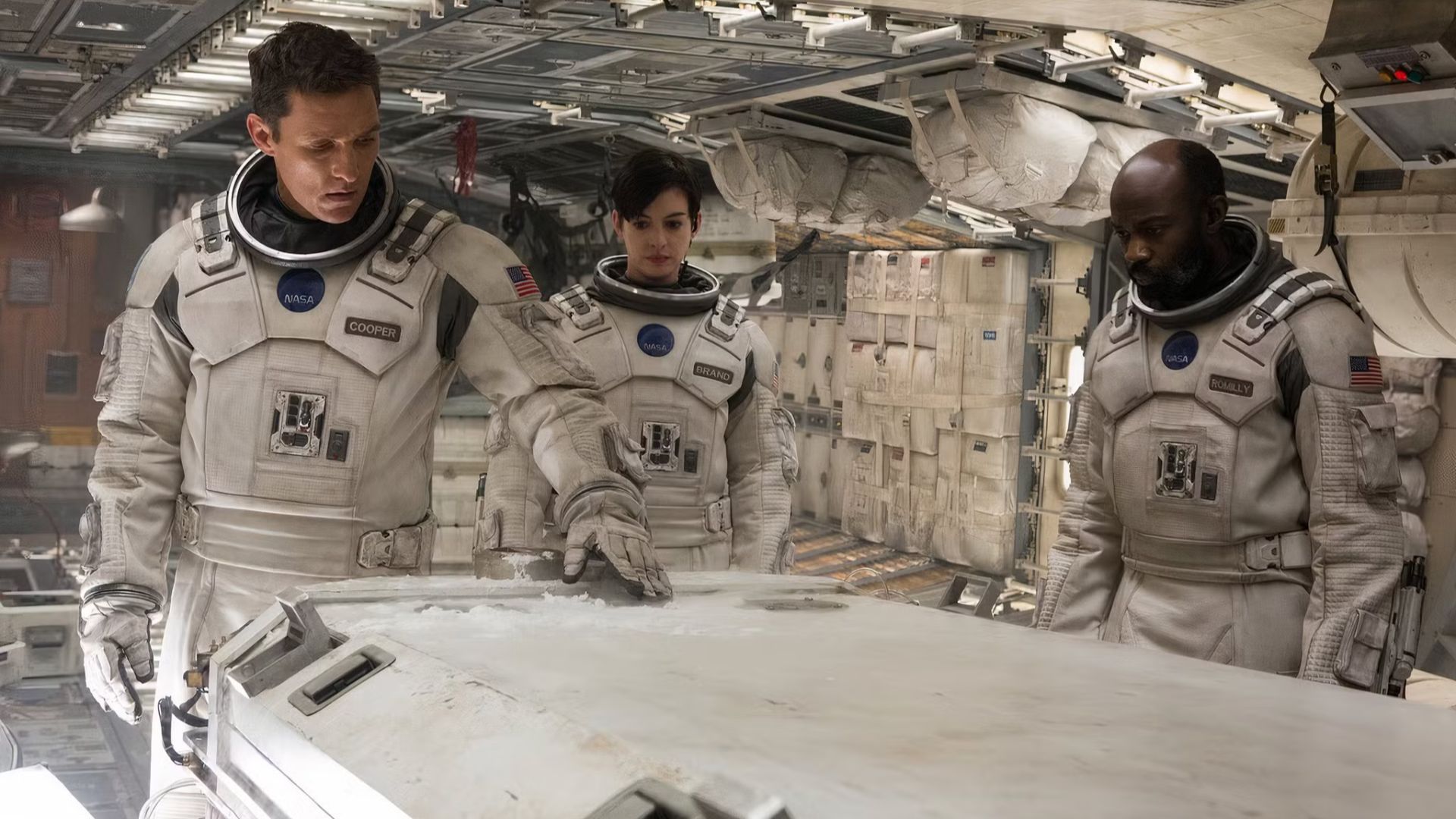
Christopher Nolan’s Interstellar, the 2014 science fiction film that won an Academy Award, tells the story of a team of astronauts who journey through a wormhole. Set in a troubled future where Earth is becoming uninhabitable, they’re searching for a new home for humanity. Starring Matthew McConaughey, Anne Hathaway, Jessica Chastain, and Michael Caine, the film combines complex ideas about space and physics with powerful themes of survival, what we owe to future generations, and the difficult choices people make when facing impossible odds.
At its heart, the film is a powerful story about the unbreakable bonds between people, specifically a father’s relentless journey to find his children, no matter how much time or distance separates them. The ending of Interstellar beautifully showcases the love between Cooper and his daughter Murph, portraying it as a force stronger than the laws of physics and key to saving humankind. While the film concludes on a hopeful note, time itself acts as a silent enemy, taking years from the characters’ lives. Cooper makes the ultimate sacrifice for humanity, but the cost is greater than he anticipates. Ultimately, beneath the complex science fiction, the film is a deeply moving exploration of what it means to be human.
Aniara is Inspired By a Tragic, Epic Sci-Fi Poem
Inspired by a Swedish poem, the film depicts a future where Earth is ruined and humanity is fleeing to Mars. It centers on the passengers of a spaceship making a regular journey when it crashes into space junk. The ship is forced to dump its fuel, sending it off course and leaving thousands of people to grapple with a life adrift in the endless darkness of space.
This story explores difficult ideas like the meaninglessness of life, humanity’s arrogance towards nature, and how easily civilization can fall apart. It’s a dark reflection of Earth, lost in a chaotic universe and suffering from the damage humans have caused. The people onboard come to realize there’s no hope, and their efforts are pointless when faced with the overwhelming scale of space and time.
The film explores how technology serves as a distraction for passengers trapped in a confined space, reflecting our modern dependence on it as a way to avoid reality and its inherently addictive qualities. As time passes, the social order on the ship collapses, and people begin to act on their most primal urges. Aniara ultimately presents a deeply unsettling and sorrowful story, leaving viewers emotionally exhausted and grappling with profound questions about existence.
Read More
- Best Controller Settings for ARC Raiders
- The Boys Season 5 Officially Ends An Era For Jensen Ackles’ Soldier Boy
- Review: Final Fantasy Tactics: The Ivalice Chronicles (PS5) – Still the Benchmark for Turn-Based Tactics
- Nippon Sangoku Is The Best New Post-Apocalyptic Anime of Spring 2026
- Mark Zuckerberg & Wife Priscilla Chan Make Surprise Debut at Met Gala
- Elon Musk’s Mom Maye Musk Shares Her Parenting Philosophy
- 10 Greatest Manga Endings of All Time
- The Witcher 3 Officially Reveals Stunning New Ciri Figure Coming 2026
- The WONDERfools ending explained: What happened to the Child of Eternity?
- 7 Great Marvel Villains Who Are Currently Dead
2026-05-20 02:13