Author: Denis Avetisyan
Researchers are exploring how to harness the unique properties of hexagonal boron nitride to create a new platform for strong light-matter interactions and advanced quantum photonic devices.
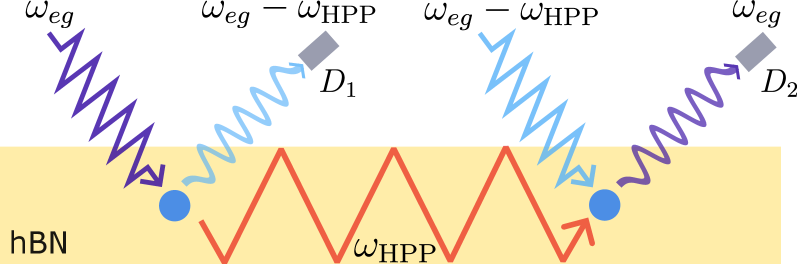
Coupling color centers in hBN with hyperbolic phonon polaritons offers a pathway to realize cavity QED in the mid-infrared spectrum.
Confining and controlling light-matter interactions at the nanoscale remains a significant challenge in quantum photonics. This work, ‘Color Centers and Hyperbolic Phonon Polaritons in Hexagonal Boron Nitride: A New Platform for Quantum Optics’, establishes a novel framework by coupling the unique properties of color centers in hexagonal boron nitride with hyperbolic phonon polaritons. We demonstrate that these emitters can serve as efficient quantum sources of HPPs, enabling both spontaneous and stimulated generation of spatially confined, mid-infrared polaritons with enhanced decay rates and tunable characteristics. Could this approach pave the way for realizing on-chip quantum networks and exploring new regimes of strong light-matter coupling in van der Waals materials?
Confining Light: Overcoming the Diffraction Limit
Traditional photonic structures, designed to manipulate light, face fundamental limitations when attempting to confine electromagnetic waves to dimensions smaller than the wavelength of light itself. This presents a significant obstacle to achieving strong light-matter coupling – the regime where light and matter interact intensely, enabling novel phenomena and technologies. Because light naturally spreads out when encountering features comparable to its wavelength, building nanoscale optical devices requires overcoming this diffraction limit. Consequently, many promising applications, such as highly sensitive sensors and efficient energy harvesting systems, are hampered by weak interactions and signal loss when relying on conventional approaches to light confinement. This challenge drives the exploration of alternative materials and designs capable of squeezing light into volumes far smaller than previously attainable.
Hexagonal Boron Nitride (HBN) emerges as a compelling two-dimensional material for manipulating light at the nanoscale, offering a pathway beyond the limitations of conventional photonics. The material’s unique atomic structure facilitates the creation of hyperbolic phonon polaritons (HPPs), quasiparticles formed from the strong coupling of light and vibrational energy. These HPPs exhibit a highly anisotropic response to electromagnetic radiation, enabling light to be confined to dimensions far smaller than its wavelength – a feat crucial for developing advanced optoelectronic devices. Unlike traditional materials, HBN supports these extreme light confinement capabilities through its intrinsic properties, opening opportunities for novel investigations into light-matter interactions and the realization of subwavelength photonic circuits.
Hyperbolic phonon polaritons (HPPs) represent a fascinating pathway to overcome the diffraction limit in nanophotonics. These quasiparticles emerge from the strong coupling of light with longitudinal optical phonons – collective atomic vibrations – within the layered structure of hexagonal Boron Nitride (HBN). This interaction isn’t merely a resonance; it fundamentally alters the propagation of light, allowing for wavelengths to be compressed far below the conventional diffraction limit. Specifically, the oscillating electric field of light drives these atomic vibrations, and in turn, these vibrations enhance and redirect the light itself. This process effectively ‘shields’ the light from scattering, enabling subwavelength confinement-meaning light can be concentrated into volumes significantly smaller than its wavelength-and opens exciting possibilities for manipulating light at the nanoscale, with potential applications in advanced sensing and high-resolution imaging.
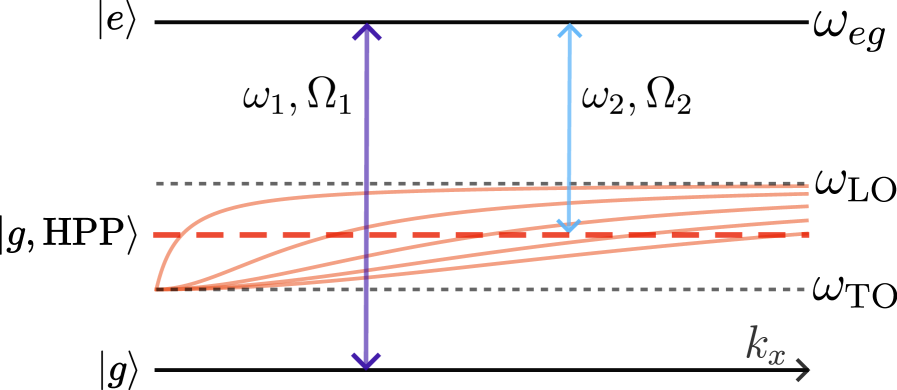
The remarkable ability of hexagonal Boron Nitride (HBN) to confine light at the nanoscale hinges on its behavior within the Reststrahlen band. This spectral region is characterized by a negative dielectric function, a property arising from the collective oscillation of the material’s atoms. When light interacts with HBN in this band, the negative dielectric function effectively ‘pulls’ the light into the material, rather than reflecting it – a phenomenon crucial for creating hyperbolic phonon polaritons. This results in a dramatic reduction of the wavelength of light propagating within the HBN, enabling subwavelength confinement and exceptionally strong light-matter interactions. Consequently, operating within the Reststrahlen band isn’t merely a condition for HBN’s functionality; it’s the fundamental principle underpinning its potential for advanced nanophotonic devices and materials science.
Quantum Emitters and Strong Coupling
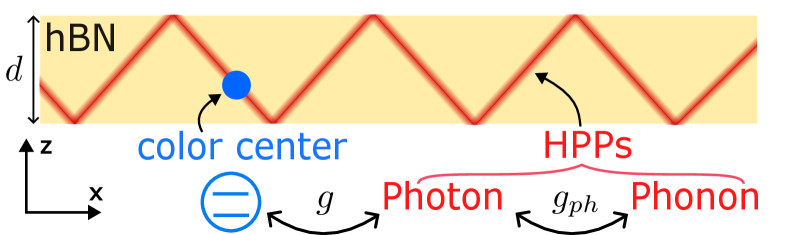
Color centers, point defects within the hexagonal boron nitride (hBN) lattice, function as quantum emitters due to their localized electronic states. These defects, typically nitrogen-vacancy (NV) or boron-vacancy (V_B) centers, possess discrete energy levels that define quantized transitions responsible for photon emission. The energy of these transitions falls within the visible and near-infrared spectrum, making them suitable for integration with photonic devices. Crucially, these discrete quantum states serve as the active elements for interaction with hyperbolic plasmonic photonic (HPP) structures, enabling strong light-matter coupling and the potential for manipulating the emitters’ properties. The concentration of color centers within hBN can be controlled during material growth or post-synthesis processing, allowing for tailoring of emission intensity and spatial distribution.
The strong coupling regime between color centers in hexagonal boron nitride (hBN) and hyperbolic plasmonic photonic (HPP) structures is quantitatively modeled using the principles of Cavity Quantum Electrodynamics (cQED). This framework accounts for the coherent exchange of virtual photons between the localized states of the color center and the strong field confinement provided by the HPP cavity. Specifically, the interaction strength, g, exceeds the decay rates of both the color center and the HPP mode, leading to the anti-resonant behavior characteristic of strong coupling. Spectral analysis reveals the characteristic splitting of the energy levels into upper and lower polariton branches, confirming the formation of hybrid light-matter states and validating the cQED description. The parameters governing this interaction – the color center dipole moment, the HPP mode volume, and the effective dielectric environment – are crucial for determining the magnitude of g and the degree of coupling.
The strong coupling between quantum emitters and HPPs facilitates precise control over emission characteristics, including wavelength, polarization, and temporal properties. This control arises from the modification of the emitters’ spontaneous emission rates and the ability to engineer the density of optical states within the HPP structure. Furthermore, this interaction leads to the formation of hybrid light-matter states, specifically exciton-polaritons, where the quantum emitter’s excitation and the HPP’s photon are no longer distinguishable. These polaritons exhibit unique dispersion relations and lifetimes, differing from those of either constituent component, and can be utilized for novel optoelectronic devices and quantum information processing applications.
The presence of Hexagonal Boron Nitride Photonic Crystal Cavities (HPPs) significantly alters the spontaneous emission characteristics of color centers embedded within the HBN. Specifically, the HPPs enhance the spontaneous emission rate by increasing the density of optical states at the emission wavelength of the color center. This enhancement is not merely a rate increase; the HPPs also modify the angular distribution of emitted photons, directing emission into specific modes of the cavity. Consequently, new emission pathways are created, including those involving coupling to the HPP modes, resulting in the formation of light-matter hybrid states \text{polaritons} and altering the overall radiative decay dynamics of the color center.
Probing and Controlling Hybrid Polaritons
Near-field techniques, such as utilizing focused laser beams or scanning probe microscopy, represent a prevalent methodology for both the excitation and characterization of Hybrid Polariton Propagation (HPP) modes. However, these techniques are fundamentally constrained by their reliance on classical electromagnetic theory. This limitation manifests in an inability to fully capture the quantum mechanical nature of the light-matter coupling that defines polaritons, hindering precise control over polariton coherence and wavevector. Specifically, classical approaches struggle to accurately model the strong coupling regime where the light and matter states are significantly mixed, leading to inaccuracies in predicting HPP dispersion relations and propagation characteristics. Consequently, the spatial resolution and the ability to probe specific polariton modes are inherently limited by diffraction and the classical treatment of the electromagnetic field.
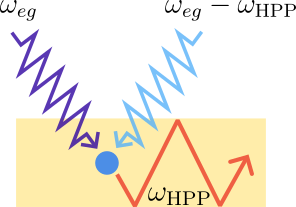
Stimulated Raman Scattering (SRS) provides a coherent pathway for the generation of Hybrid Polariton Particles (HPPs) by leveraging the nonlinear interaction between light and a material. Unlike incoherent excitation methods, SRS allows for precise control over the generated polariton’s characteristics, including its momentum and energy. This coherent generation also results in a significantly narrower emission spectrum compared to techniques relying on spontaneous emission. The narrowband emission, typically achieved with linewidths under 10 GHz, is crucial for maximizing HPP propagation length and maintaining spatial coherence, facilitating more controlled experiments and enabling observation of long-range polariton transport phenomena. The technique commonly employs pump-probe schemes to initiate and characterize the generated HPPs, offering temporal and spatial resolution capabilities.
The propagation distance and spatial coherence of Hybrid Polariton Rays (HPPs) are directly influenced by the spectral bandwidth – or Frequency Width (δ) – of the excitation source. Narrow linewidth excitation, specifically where δ < 10 GHz, demonstrably extends HPP propagation lengths to several micrometers. Increasing spectral bandwidth reduces the coherence of the generated polaritons, leading to shorter propagation distances due to increased scattering and dephasing. This relationship highlights the necessity of utilizing highly monochromatic excitation sources to achieve well-defined and spatially coherent HPPs for applications requiring extended propagation lengths.
The characteristics of Hybrid Polariton Propagation (HPP) are strongly dependent on the excitation source linewidth; maintaining a narrow frequency width is essential for achieving well-defined HPP behavior. Specifically, the spatial extent of the HPP ray is fundamentally limited by the size of the emitter and exhibits an inverse relationship with the momentum cutoff Λ. This means smaller emitters and larger momentum cutoffs result in narrower HPP rays, while larger emitters and smaller cutoffs broaden the ray width. Consequently, precise control over both the emitter dimensions and the excitation source linewidth are critical parameters for manipulating and characterizing HPPs.
Towards Quantum Technologies with HPPs
Hexagonal boron nitride (hBN) polariton platforms facilitate remarkably strong light-matter interactions, presenting a pathway towards the development of advanced quantum technologies. This strong coupling regime allows for the creation of polaritons – quasi-particles resulting from the hybridization of light and matter excitations – with properties tailored for quantum information processing. Specifically, researchers are investigating hBN-based devices as highly efficient single-photon sources, crucial for quantum cryptography and communication, where the precise control over photon emission is paramount. Simultaneously, the sensitivity of these polariton states to external stimuli makes them promising candidates for realizing novel quantum sensors capable of detecting minute changes in electric fields, strain, or temperature, potentially revolutionizing fields ranging from materials science to biomedical diagnostics. These developments leverage the unique ability of hBN to confine light at the nanoscale, enhancing light-matter coupling and paving the way for compact and integrated quantum devices.
The ability to finely tune the dispersion and polarization of hyperbolic plasmon polaritons (HPPs) promises a revolution in subwavelength optics. By manipulating these properties within engineered nanostructures, researchers envision devices that transcend the diffraction limit, enabling functionalities previously unattainable with conventional optics. Precise control over HPP characteristics allows for the creation of optical components – such as lenses, waveguides, and filters – dramatically smaller than the wavelength of light. This opens possibilities for highly integrated photonic circuits, advanced imaging techniques with nanoscale resolution, and novel sensors capable of detecting single molecules. The tailoring of HPP behavior not only shrinks device size but also enhances light-matter interactions, potentially leading to more efficient and sensitive optical technologies.
The continued investigation of hexagonal boron nitride (hBN)-based heterostructures promises significant advancements in manipulating hybrid polariton-plasmon (HPP) characteristics and optimizing device capabilities. By carefully layering and combining hBN with other two-dimensional materials, researchers can engineer the dielectric environment surrounding the plasmonic structure, thereby precisely tuning the strength of light-matter coupling and the resulting HPP dispersion. This approach allows for a greater degree of control over the HPP’s effective mass, lifetime, and propagation length – critical parameters for realizing efficient quantum devices. Furthermore, stacking hBN heterostructures offers a pathway to mitigate decoherence effects and enhance the overall performance of HPP-based technologies, potentially leading to more robust and scalable quantum sensors and single-photon sources.
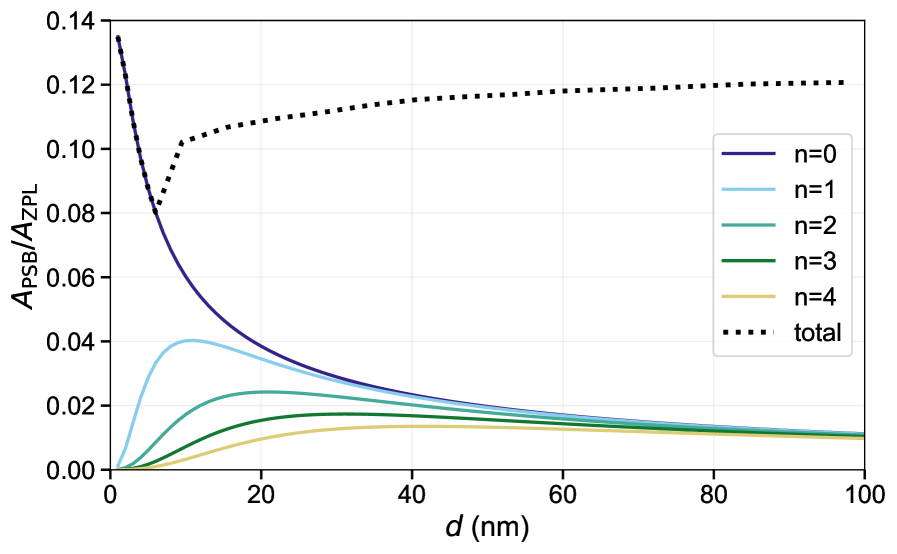
Hexagonal boron nitride (hBN)-based platforms represent a promising route for connecting the quantum world of nanoscale materials to macroscopic systems, due to the strong light-matter interactions they facilitate. The efficiency of this coupling is intrinsically linked to the ratio between phonon sideband (PSB) and zero-phonon line (ZPL) intensities; this ratio isn’t merely a material property, but scales quadratically with the material’s dipole moment μd^2. Crucially, the observed PSB/ZPL intensity is also sensitive to the momentum cutoff, influencing how effectively energy can be transferred between light and matter. This dependence provides a tunable parameter for optimizing quantum interactions and controlling the behavior of nanoscale quantum systems, ultimately offering a pathway toward realizing practical quantum technologies that leverage the unique properties of these two-dimensional materials.
The pursuit detailed within this study-coupling color centers in hexagonal boron nitride with hyperbolic phonon polaritons-demands a ruthless paring away of complexity. It isn’t simply about adding more materials or layers; it’s about achieving strong light-matter interaction through precise control and minimizing extraneous factors. As Galileo Galilei observed, “You cannot teach a man anything; you can only help him discover it himself.” This mirrors the research approach; the scientists aren’t imposing a solution, but rather creating conditions for inherent quantum properties to reveal themselves. The platform’s potential lies not in its intricate design, but in the clarity of the interactions it enables – a testament to the power of lossless compression in scientific inquiry.
Further Refinements
The pursuit of strong coupling, predictably, reveals the limitations of current material fabrication. Defect density in hexagonal boron nitride remains a persistent variable, obscuring the true potential of color centers as quantum emitters. A focus on scalable, high-purity hBN synthesis – not simply characterization – becomes paramount. Clarity is the minimum viable kindness; signal obscured by noise benefits no one.
Beyond material science, the exploration of alternative phonon polariton platforms merits consideration. While hBN offers a convenient starting point, its mid-infrared spectral range constrains potential applications. Expanding this range, perhaps through heterostructure engineering or novel material design, would broaden the scope of this approach. The goal is not proliferation of options, but simplification-a single, robust system.
Ultimately, the true test lies in device integration. Demonstrating coherent control and entanglement of quantum emitters coupled to hyperbolic phonon polaritons is necessary, but insufficient. A practical, scalable architecture-one that transcends the limitations of laboratory demonstration-remains the elusive horizon. The elegance of a concept diminishes with the complexity of its realization.
Original article: https://arxiv.org/pdf/2602.05736.pdf
Contact the author: https://www.linkedin.com/in/avetisyan/
See also:
- The Super Mario Galaxy Movie: 50 Easter Eggs, References & Major Cameos Explained
- 10 Best Free Games on Steam in 2026, Ranked
- Sydney Sweeney’s The Housemaid 2 Sets Streaming Release Date
- Skate 4 – Manny Go Round Goals Guide | All of the Above Sequence
- Why is Tech Jacket gender-swapped in Invincible season 4 and who voices her?
- Welcome to Demon School! Iruma-kun season 4 release schedule: When are new episodes on Crunchyroll?
- 10 Best Supporting Actress Oscar Wins That Are Indisputable
- Highly Anticipated Strategy RPG Finally Sets Release Date (And It’s Soon)
- Preview: Sword Art Online Returns to PS5 as a Darker Open World Action RPG This Summer
- Forza Horizon 6 ‘Prologue’ gameplay
2026-02-07 16:58