Author: Denis Avetisyan
A novel framework connects the microscopic structure of spacetime with the large-scale behavior of the universe through a shared entropic foundation.
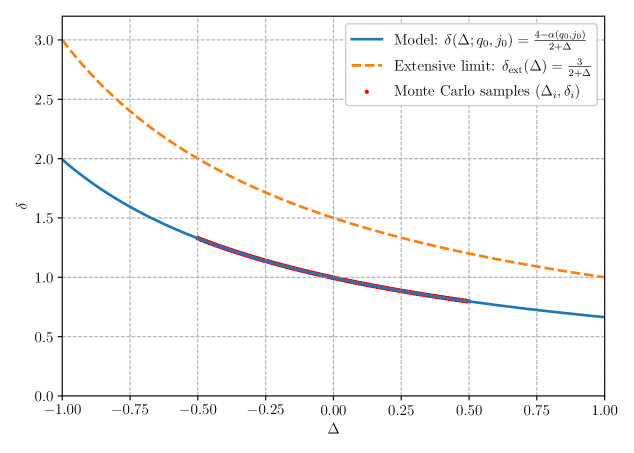
This review establishes a relationship between Barrow and Tsallis entropies, cosmographic parameters, and the holographic dark energy density, demonstrating an implementation of the infrared-ultraviolet correspondence.
Reconciling quantum gravity with cosmological observations remains a fundamental challenge, particularly in understanding how microscopic physics influences the large-scale structure of the Universe. This is addressed in ‘Cosmographic Connection Between Cosmological And Planck Scales: The Barrow-Tsallis Entropy’, which investigates the relationship between the quantum structure of spacetime-described by the Barrow parameter Δ-and macroscopic, non-extensive gravitational effects quantified by the Tsallis parameter δ. The study establishes an exact connection between these parameters through cosmographic parameters, effectively demonstrating an implementation of the infrared-ultraviolet correspondence. Could this framework provide a pathway toward a more complete understanding of the Universe’s evolution and the interplay between its smallest and largest scales?
The Universe’s Illusion: Beyond Standard Cosmology
The prevailing Standard Cosmological Model has accurately predicted many large-scale features of the universe, from the cosmic microwave background to the observed expansion rate. However, its foundations rest upon substantial unknowns: dark matter and dark energy. These enigmatic components collectively constitute approximately 95% of the universe’s total energy density, yet their fundamental nature remains deeply mysterious. Dark matter, inferred through its gravitational effects on visible matter, does not interact with light, making direct detection incredibly challenging. Dark energy, responsible for the accelerating expansion of the universe, is even more perplexing, often described as a cosmological constant or a dynamic field with negative pressure. While these concepts successfully fit current observations, they represent significant gaps in understanding, prompting ongoing research into alternative theories and the search for direct evidence of these elusive cosmic constituents.
The persistent difficulty in uniting quantum mechanics with general relativity poses a significant hurdle for contemporary cosmological models. While general relativity accurately describes gravity on large scales, and quantum mechanics governs the behavior of matter at the subatomic level, attempts to combine them into a consistent theory of quantum gravity consistently yield predictions that clash with cosmological observations. This disconnect suggests that current frameworks, relying on established physics, may be incomplete or fundamentally flawed when applied to the extreme conditions of the early universe or within black holes. Researchers are actively exploring alternative approaches – including string theory, loop quantum gravity, and modified gravity theories – that aim to resolve these inconsistencies and provide a more comprehensive understanding of spacetime and its interaction with matter and energy, potentially revealing new physics beyond the Standard Model.
Reconciling the vastness of the cosmos with the quantum realm presents a formidable challenge to modern physics, demanding a more nuanced understanding of spacetime itself. Current models, while effective at describing large-scale structures like galaxies and galaxy clusters, often break down when applied to the earliest moments of the universe or within the singularities of black holes. This disconnect stems from treating spacetime as a smooth, continuous fabric – an approximation that works well for most observations but likely fails at the Planck scale, where quantum effects dominate. Researchers theorize that spacetime may, in fact, be fundamentally discrete, granular, or even an emergent property of more fundamental entities. Exploring these possibilities – through approaches like loop quantum gravity, string theory, and causal set theory – requires developing new mathematical frameworks and observational tests capable of probing the universe at both its largest and smallest scales, ultimately seeking a unified description of gravity and quantum mechanics.
The Universe’s Inevitable Disorder: Entropic Cosmology
Entropic cosmology posits that the observed expansion of the universe is not driven by hypothetical dark matter or dark energy, but rather by the second law of thermodynamics – specifically, the tendency of systems to maximize entropy. This framework suggests that gravity emerges as an entropic force, arising from the statistical tendency of systems to move from states of lower to higher entropy. The cosmological constant, typically invoked to explain accelerated expansion, is thus reinterpreted as a thermodynamic parameter related to the universe’s overall entropy increase. Consequently, observations currently attributed to dark energy may instead reflect the natural progression towards a state of maximum disorder, removing the need for exotic, undetected components in the standard cosmological model.
Entropic cosmology establishes a direct correspondence between gravitational phenomena and thermodynamic principles, effectively recasting cosmology within the framework of statistical physics. This approach posits that gravity isn’t a fundamental force, but rather an emergent phenomenon arising from the tendency of systems to maximize entropy. Specifically, gravitational attraction is interpreted as a consequence of increasing the number of accessible microstates, driven by entropy maximization. Consequently, cosmological models are constructed not through General Relativity directly, but through statistical mechanical calculations of entropy and probability distributions. This allows for the potential explanation of observed cosmological effects, such as accelerated expansion, without invoking concepts like dark matter or dark energy, instead attributing them to entropy gradients and the statistical behavior of large systems. S = k_B \ln \Omega , where S is entropy, k_B is Boltzmann’s constant, and Ω is the number of microstates, becomes a central equation in defining the evolution of the universe.
The standard Bekenstein-Hawking entropy, S = \frac{kA}{4\ell_p^2}, relates a black hole’s entropy to its event horizon area, A, and the Planck length, \ell_p. Entropic cosmology generalizes this concept to the entire universe, requiring modifications to account for quantum gravitational effects and spacetime deformation. These modifications involve considering non-equilibrium thermodynamics and the contribution of gravitational degrees of freedom to the overall entropy. Specifically, the generalization necessitates incorporating terms that describe the curvature of spacetime and the quantum fluctuations of the gravitational field, leading to an entropy expression that extends beyond the simple area proportionality of the original Bekenstein-Hawking formula and is dependent on the universe’s expansion history and matter content. This expanded entropy definition is then used to derive cosmological dynamics, potentially obviating the need for dark matter and dark energy as explanatory components.
Beyond Simple Counting: Generalized Entropies
Barrow entropy represents a modification of the standard Boltzmann-Gibbs entropy by introducing a deformation parameter, Δ. This parameter quantifies the degree of deviation from the standard event horizon, effectively altering the calculation of entropy based on the number of accessible microstates. Standard entropy assumes a sharply defined event horizon; however, Barrow entropy accounts for scenarios where the horizon may be ‘fuzzy’ or exhibit deviations due to quantum gravity effects or other physical phenomena. The inclusion of Δ allows for the exploration of entropy calculations beyond the traditional framework, potentially providing insights into the behavior of entropy in extreme gravitational environments and modified cosmological models.
Tsallis Entropy modifies the Boltzmann-Gibbs entropy by incorporating a non-extensivity parameter, δ. Standard statistical mechanics assumes additivity of independent subsystems, leading to entropy scaling linearly with the number of particles. However, systems exhibiting long-range interactions or possessing memory effects may violate this assumption. The parameter δ quantifies this deviation from additivity; when δ = 1, Tsallis entropy reduces to the standard Boltzmann-Gibbs entropy. Values of δ differing from unity indicate non-extensive behavior, where the total entropy is not simply the sum of individual entropies, and the parameter effectively describes the strength of these correlations or long-range interactions within the system.
Barrow-Tsallis entropy represents a unification of Barrow and Tsallis entropies, offering a comprehensive framework for analyzing universal entropy across multiple scales. This combined entropy effectively addresses the limitations of standard entropy calculations in scenarios involving long-range interactions and deviations from standard statistical mechanics, as quantified by the non-extensivity parameter δ of Tsallis entropy and the deformation parameter Δ of Barrow entropy. Crucially, the application of Barrow-Tsallis entropy, as demonstrated in the referenced work, reduces the number of free parameters required to model dark energy from two to one, simplifying cosmological models while maintaining descriptive power and potentially improving predictive accuracy.
The Echoes of Scale: IR-UV Correspondence and Cosmological Implications
The interconnectedness of seemingly disparate energy scales, formalized by the Infrared-Ultraviolet (IR-UV) Correspondence, provides a powerful tool for cosmological inquiry. This principle posits a deep relationship between the low-energy, long-wavelength phenomena – the infrared realm – and the high-energy, short-wavelength processes dominating at ultraviolet scales. Crucially, this correspondence isn’t merely a mathematical curiosity; it serves as a fundamental constraint when calculating entropy, a measure of disorder and information content within the universe. By accurately linking these scales, researchers can refine models of the universe’s evolution and explore alternative explanations for observed phenomena, potentially circumventing the need for conventional dark energy paradigms. The ability to relate low and high energy behavior allows for a more complete picture of the universe, facilitating the derivation of key cosmological parameters and offering insights into the universe’s expansion history, all while providing a rigorous framework for entropy calculations.
The late-time evolution of the universe, a period crucial for understanding its ultimate fate, benefits significantly from the application of fractional derivatives within the IR-UV correspondence framework. Traditional cosmological models often rely on integer-order derivatives to describe the rate of change in various parameters; however, these can struggle to accurately capture the complex, non-local dynamics inherent in the universe’s expansion. Fractional calculus, utilizing derivatives of any order, provides a more nuanced approach, allowing for a more precise modeling of the universe’s behavior. This is particularly useful when dealing with phenomena exhibiting memory effects or anomalous diffusion, potentially resolving discrepancies between theoretical predictions and observational data. By incorporating fractional derivatives, researchers can refine calculations of cosmological parameters and explore alternative explanations for observed phenomena, potentially lessening the need for hypothetical components like dark energy and offering a more complete picture of the universe’s expansion history.
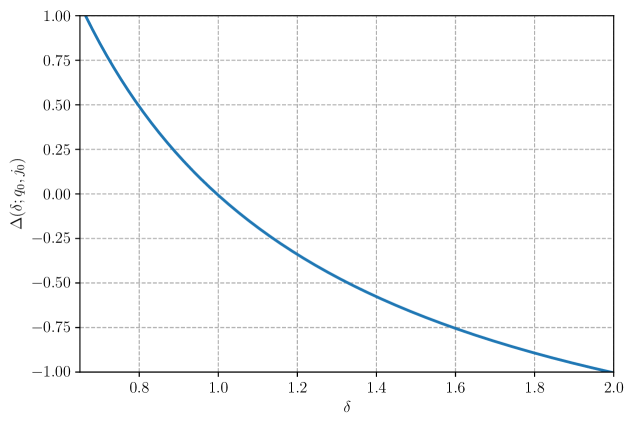
A novel cosmological model demonstrates the potential to determine key parameters like the Hubble constant and trace the universe’s expansion without relying on the concept of dark energy. This framework leverages the interplay between the Length Scale (L) and Ultraviolet Cutoff (Λ) to establish a self-consistent description of cosmic evolution, effectively mapping entropy parameters to established cosmographic quantities. The relationship (1+Δ/2)δ = 2 - (1/2)α(q0, j0) serves as a crucial link, allowing for the derivation of the universe’s expansion history directly from fundamental principles of scale correspondence and entropy, offering a potentially more parsimonious explanation for observed cosmological phenomena and challenging the necessity of invoking currently unexplained energy components.
Beyond the Standard Model: A New Era in Cosmology
A compelling alternative to the Standard Cosmological Model is emerging, rooted in the principles of entropy and its connection to the very fabric of spacetime. This approach doesn’t rely on assumptions about dark matter or dark energy, instead positing that the universe’s evolution is fundamentally driven by maximizing entropy – a measure of disorder. Central to this framework are generalized entropies, mathematical tools that extend the conventional understanding of entropy to encompass gravitational systems, and the Infrared-Ultraviolet (IR-UV) Correspondence, a theoretical link suggesting a deep relationship between long-wavelength and short-wavelength phenomena. By leveraging these interconnected concepts, this entropic cosmology offers a potentially more complete and self-consistent description of the universe, suggesting that its expansion isn’t simply happening, but is a natural consequence of its tendency towards maximum disorder – a perspective that may ultimately resolve several outstanding problems in modern cosmology.
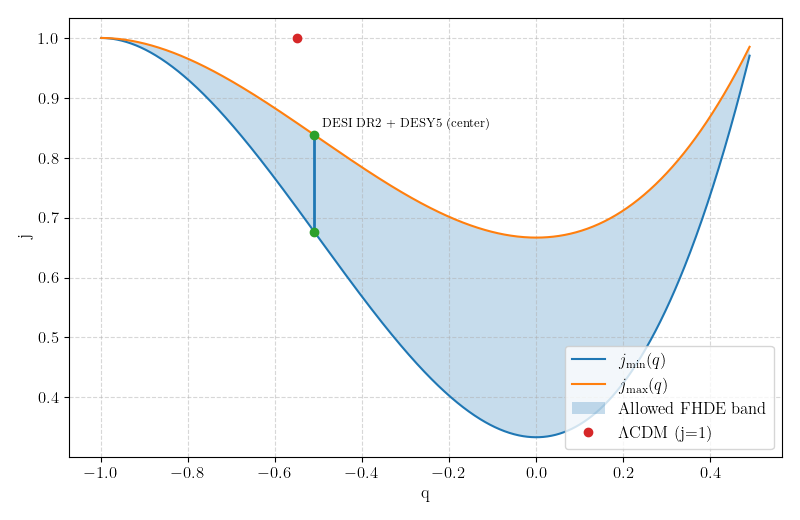
Cosmographic parameters, specifically deceleration q and jerk j, offer a powerful, model-independent method for charting the universe’s expansion history. Unlike many cosmological models that rely on specific assumptions about dark energy or modified gravity, this framework derives these parameters directly from the kinematic properties of spacetime. By analyzing how the Hubble rate changes over time – essentially, how quickly galaxies are moving apart – researchers can determine q and j without needing to posit a particular underlying theory. This allows for a more flexible and robust description of cosmic expansion, enabling cosmologists to test different theoretical models against observational data and potentially reveal deviations from the predictions of the Standard Cosmological Model. The beauty of this approach lies in its simplicity and its ability to provide meaningful constraints on the universe’s evolution, regardless of the complex physics driving it.
Investigations into the interplay between entropy, cosmographic parameters, and the infrared-ultraviolet correspondence suggest a pathway towards resolving fundamental questions about the universe. This research isn’t merely about refining existing cosmological models; it’s about establishing a lower limit on the precision with which length scales can be measured – a boundary dictated by the Planck length. The relationship δL ≥ (L/lp^2)^(1/3) signifies that any attempt to measure distances with infinite precision is fundamentally constrained by the quantum nature of spacetime itself. Consequently, ongoing studies aim to build a framework where observations of the universe’s expansion and the behavior of gravity are consistently aligned with this quantum limit, potentially revealing the true structure of spacetime and offering insights into the universe’s earliest moments and its ultimate fate.
The pursuit of a cosmographic connection, as detailed in this work, reveals a humbling truth about the foundations of physical law. Any attempt to define the universe through parameters – be they microscopic like the Barrow parameter Δ or macroscopic like the Tsallis parameter δ – feels provisional, a construction vulnerable to dissolution at the ultimate boundary of knowledge. As Friedrich Nietzsche observed, “There are no facts, only interpretations.” This echoes the study’s underlying implication: even seemingly fundamental laws, linking quantum foam to gravitational interaction through entropic cosmology, may be merely effective descriptions, subject to revision as understanding approaches the event horizon of complete knowledge. Discovery isn’t a moment of glory, it’s realizing we almost know nothing.
Beyond the Horizon
The presented cosmographic connection between microscopic and macroscopic scales, facilitated through entropic considerations, offers a temporary respite from the persistent unease regarding the ultraviolet-infrared correspondence. However, the reliance on cosmographic parameters as intermediaries introduces a degree of arbitrariness-a refinement of measurement, rather than a fundamental resolution. The Barrow parameter, Δ, remains phenomenological; its true connection to the quantum foam’s underlying structure, if any, is obscured. Modeling requires consideration of potential non-local effects inherent in the quantum foam itself, and the sensitivity of derived cosmological parameters to the specific choice of Barrow and Tsallis formalisms.
Future investigations must address the limitations of relying on effective descriptions. The accretion disk exhibits anisotropic emission with spectral line variations; similarly, this framework presently offers an effective description, not a derivation, of dark energy. A critical examination of the holographic principle’s validity at extreme scales is warranted, alongside exploration of alternative entropic formalisms that might circumvent the need for ad hoc parameters. Any apparent success should be viewed with circumspection; the universe routinely demonstrates a capacity to expose the limits of any imposed order.
Ultimately, the pursuit of a complete theory risks repeating past failures. The elegance of mathematical consistency should not be mistaken for physical reality. The true test lies not in achieving internal coherence, but in confronting the inevitable discrepancies between model and observation-the whispers from beyond the event horizon, reminding one of the inherent fragility of knowledge.
Original article: https://arxiv.org/pdf/2602.12077.pdf
Contact the author: https://www.linkedin.com/in/avetisyan/
See also:
- Adam Levine Looks So Different After Shaving His Beard Off
- Trails in the Sky 2nd Chapter launches September 17
- After AI Controversy, Major Crunchyroll Anime Unveils Exciting Update
- Gold Rate Forecast
- Xbox Game Pass Users “Blown Away” by New Exclusive Game
- Dialoop coming to Switch on June 17
- Japan’s No. 1 Spring 2026 Anime Is the True Successor to an All-Time Great
- Upcoming Movie Based on 10/10 Fantasy Masterpiece Gets a Release Date & Exciting Cast Update
- PS2 Exclusive RPG Series Returning 20 Years Later With New Release
- USD JPY PREDICTION
2026-02-13 14:33