Author: Denis Avetisyan
New research suggests that the chaotic influence of dark matter halos can leave detectable signatures in the gravitational waves emitted by black hole mergers.

This study demonstrates how chaotic dynamics within dark matter environments imprint unique characteristics on extreme mass-ratio inspiral gravitational wave signals.
The quest to probe strong-field gravity and the environments around supermassive black holes is often hampered by simplifying assumptions about orbital dynamics. This paper, ‘Chaotic imprints of dark matter in extreme mass-ratio inspirals’, investigates how the presence of dark matter halos can induce chaotic behavior in the orbits of small bodies spiraling into massive black holes. We demonstrate that this chaos leaves unique, detectable signatures in the emitted gravitational waves, including irregular amplitude modulation and loss of phase coherence, offering a novel pathway to constrain both dark matter distributions and the underlying spacetime geometry. Could the detection of these chaotic signatures unlock new insights into the nature of dark matter and the validity of general relativity in the most extreme gravitational regimes?
The Limits of Prediction: Approaching the Singularity
The Schwarzschild metric, a cornerstone of general relativity, elegantly describes spacetime curvature around non-rotating, spherically symmetric masses. This solution to Einstein’s field equations predicts phenomena like gravitational lensing and the existence of black holes, yet its very strength reveals a critical limitation. As an observer approaches the event horizon, and particularly the central singularity, the metric’s components become mathematically undefined – quantities like density and tidal forces become infinite. R_{\mu\nu} = 0 – the equations themselves cease to provide meaningful predictions. This isn’t merely a technical difficulty; it signals a fundamental breakdown in the theory’s ability to describe reality under such extreme conditions. While remarkably accurate at describing gravitational effects in most scenarios, the Schwarzschild metric, like all classical metrics, ultimately fails to capture the true physics at the heart of a black hole, prompting the need for more complete theoretical frameworks capable of handling these singularities.
The very nature of a singularity-a point of infinite density-signals the breakdown of general relativity’s predictive power. At these extreme scales, quantum effects, normally negligible, become dominant, demanding a theoretical framework that reconciles gravity with quantum mechanics. Classical metrics, like the Schwarzschild metric describing black holes, offer increasingly inaccurate approximations as one approaches the singularity, failing to account for the granular, probabilistic behavior of matter at the Planck scale. Consequently, physicists explore avenues such as string theory and loop quantum gravity, attempting to construct a more complete description of spacetime where the classical notion of a smooth, continuous geometry dissolves into a fundamentally quantum structure. Understanding matter’s behavior under such conditions isn’t merely an academic exercise; it’s crucial for interpreting observational data from black holes and potentially unlocking the secrets of the universe’s earliest moments.
The extreme gravitational forces surrounding black holes present a significant challenge to contemporary theoretical physics. While general relativity provides a remarkably accurate description of gravity in most scenarios, it falters when applied to the conditions near a black hole’s event horizon and especially at the central singularity. Current models, relying on extrapolations of known physics, often produce infinities or unphysical predictions, hindering a complete understanding of spacetime geometry and matter behavior in these regions. This limitation directly impacts the interpretation of observational data from gravitational wave detectors and telescopes, as any conclusions drawn about the properties of black holes – their mass, spin, or even their fundamental nature – are constrained by the reliability of the underlying theoretical framework. Consequently, progress in black hole physics necessitates the development of new theoretical tools, potentially incorporating quantum gravity, to accurately describe these extreme environments and unlock the secrets hidden within.
Regular Black Holes: Restoring Predictability
Regular black hole solutions represent a modification of the standard Schwarzschild metric designed to eliminate the central singularity at r=0 while preserving the asymptotic flatness of spacetime. Unlike classical black holes which predict infinite density at the singularity, these solutions introduce modifications to the metric that allow for a finite, physically plausible interior geometry. This is typically achieved through the introduction of additional parameters or functions that alter the spacetime structure near the origin, effectively “removing” the singularity. Maintaining asymptotic flatness is crucial, ensuring the solution still accurately describes spacetime far from the black hole and remains consistent with general relativity in that regime. These solutions do not violate any established physical principles, but rather offer a mathematically consistent alternative to the classical singularity problem.
HorizonRegularCoordinates represent a specific coordinate system designed to eliminate the coordinate singularity present in the standard Schwarzschild metric at the event horizon r = 2M. This is achieved through a transformation of the radial coordinate, typically expressed as r \rightarrow R(r), where R(r) is a function chosen to ensure the metric components remain finite and well-defined at r = 2M. The resulting coordinate system allows for the calculation of physical quantities, such as tidal forces and geodesic paths, without encountering the artificial divergences associated with the coordinate singularity, facilitating accurate analysis of black hole horizons and interiors. Unlike a true singularity, the coordinate singularity is a limitation of the chosen coordinate system, and HorizonRegularCoordinates bypass this limitation by providing a smooth, finite coordinate representation at the horizon.
Extending the Schwarzschild metric using HorizonRegularCoordinates allows for the mathematical treatment of the black hole interior beyond the event horizon without encountering coordinate singularities or resulting divergences. Traditional Schwarzschild coordinates exhibit a singularity at the event horizon r = 2M, where M represents the black hole mass. HorizonRegularCoordinates provide a new coordinate system that eliminates this singularity, enabling calculations of quantities like the curvature tensor and geodesic paths within the black hole. This approach avoids the physical implausibility of infinite densities or undefined values at the horizon, offering a mathematically consistent framework for exploring the spacetime geometry inside a black hole and potentially modeling more realistic black hole solutions.
Chaos as a Probe: Extreme Mass-Ratio Inspirals
Extreme mass-ratio inspirals (EMRIs) consist of a compact object – typically a stellar-mass black hole, neutron star, or white dwarf – orbiting a supermassive black hole (SMBH) with a mass ratio of 104 to 106. This substantial mass difference allows EMRI signals to be observed from significantly larger distances than binary black hole mergers, and probes the region very close to the SMBH event horizon where gravitational effects are strongest. The inspiral’s trajectory enters the strong-field regime, characterized by velocities approaching the speed of light and intense spacetime curvature, which allows for stringent tests of general relativity not feasible with other observational methods. Furthermore, the high orbital velocities and proximity to the central mass result in a large number of orbits before merger, amplifying the accumulated effects of strong-field gravity and increasing the precision of parameter estimation.
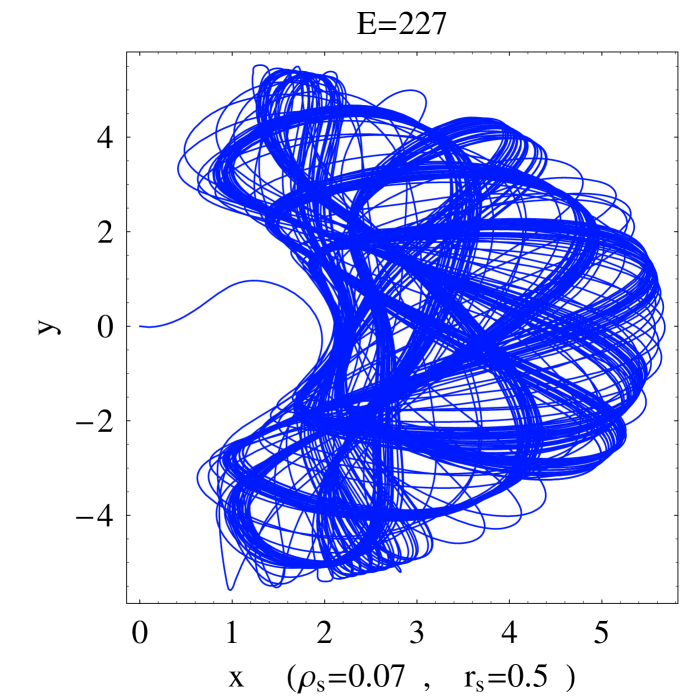
The orbits of Extreme Mass-Ratio Inspirals (EMRIs) exhibit chaotic dynamics due to the significant mass ratio and the strong gravitational field near the central black hole. This chaotic behavior manifests as sensitive dependence on initial conditions and complex orbital trajectories, leading to unpredictable changes in frequency and amplitude over time. Consequently, accurately modeling the gravitational waveforms emitted by these inspirals presents substantial computational challenges; traditional perturbative methods become insufficient, necessitating the use of sophisticated numerical relativity techniques and long integration times to capture the full range of possible orbital evolutions and produce reliable waveform templates for detection and parameter estimation. The Lyapunov exponent, a measure of the rate of separation of initially close trajectories, is demonstrably positive for many EMRI orbits, confirming the presence of chaos.
Gravitational waves emitted from Extreme Mass-Ratio Inspirals (EMRIs) contain detailed information regarding the spacetime geometry surrounding massive objects, allowing for tests of general relativity in the strong-field regime. The frequency and amplitude of these waves are directly modulated by the orbital dynamics of the inspiral, and deviations from predictions based on general relativity can reveal modifications to the theory or the existence of new gravitational fields. Specifically, the chaotic nature of EMRI orbits – characterized by sensitive dependence on initial conditions and complex phase space trajectories – manifests as quantifiable features within the gravitational wave signal, such as broadened spectral lines and unpredictable waveform evolution. Analysis of these chaotic signatures allows for the reconstruction of the spacetime metric and provides constraints on potential deviations from the ΛCDM cosmology.

Dark Matter’s Imprint: Decoding the Signals
Generating accurate gravitational waveforms for Extreme Mass Ratio Inspirals (EMRIs) presents a substantial computational challenge; full numerical relativity simulations are currently impractical for the parameter space relevant to the planned LISA detector. Consequently, researchers have developed NumericalKludge methods – a suite of techniques that offer a pragmatic compromise between accuracy and efficiency. These methods cleverly circumvent the need for solving Einstein’s equations directly across the entire spacetime, instead relying on approximations and simplifications, such as assuming a geodesic orbit perturbed by a static background. While not perfectly capturing all relativistic effects, NumericalKludge methods effectively model the dominant physics governing the inspiral, enabling the rapid production of a vast number of waveforms necessary for data analysis and the subsequent detection of gravitational waves from these systems. The resulting waveforms, though approximate, provide a critical foundation for understanding EMRI signals and extracting meaningful astrophysical information.
The gravitational waves emitted from Extreme Mass Ratio Inspirals (EMRIs) are subtly, yet measurably, altered by the presence of surrounding dark matter. Simulations utilizing the ZhaoDensityProfile – a model describing the density distribution within an EinsteinCluster – reveal that a concentration of dark matter significantly perturbs the spacetime geometry through which these waves propagate. This perturbation manifests as deviations from the waveforms predicted by general relativity alone, including shifts in frequency and amplitude. The extent of these alterations is directly related to the density and distribution of the dark matter cluster, offering a potential pathway to map dark matter halos and constrain models beyond the standard ΛCDM paradigm. Consequently, analyzing EMRI signals with this understanding could transform the Laser Interferometer Space Antenna (LISA) into a powerful instrument for probing the nature of dark matter and testing the limits of gravitational physics.
The forthcoming Laser Interferometer Space Antenna (LISA) presents an unprecedented opportunity to probe the nature of dark matter through observations of Extreme Mass Ratio Inspirals (EMRIs). Accurate waveform modeling, incorporating the influence of a surrounding dark matter EinsteinCluster – specifically modeled using the ZhaoDensityProfile – reveals subtle yet quantifiable changes to the expected gravitational wave signal. Simulations consistently demonstrate that the presence of dark matter induces frequency broadening and irregular amplitude modulation in these signals, indicative of chaotic dynamics within the EMRI system. These deviations from standard general relativistic predictions are not merely noise; they represent a unique fingerprint of dark matter, allowing researchers to constrain its properties – such as density and distribution – and rigorously test the foundations of fundamental physics. The ability to detect and analyze these chaotic signatures offers a novel pathway to unraveling the mysteries surrounding dark matter and expanding our understanding of the universe.

Beyond the Horizon: Towards a Complete Theory
The conventional understanding of black holes posits that all singularities – points where spacetime curvature becomes infinite – are safely tucked away behind event horizons, effectively shielding them from the rest of the universe. However, theoretical work explores the tantalizing, and potentially unsettling, possibility of Naked Singularities – singularities without event horizons. If these exist, they would represent a fundamental breakdown in predictability, as the laws of physics, as currently understood, cease to apply at such points. This challenges the Cosmic Censorship Hypothesis, a conjecture proposing that singularities are always hidden, and forces a re-evaluation of spacetime’s very structure. The existence of Naked Singularities would not only allow observation of the infinite densities at their core but also open doors to potential violations of causality, fundamentally altering our comprehension of time and space.
Classical general relativity rests upon several energy conditions, among which the Weak Energy Condition – which essentially states that the energy density observed by any observer must be non-negative – holds a foundational role. However, theoretical explorations reveal this condition isn’t inviolable; exotic scenarios involving traversable wormholes or the manipulation of negative mass-energy densities propose potential violations. These aren’t merely mathematical curiosities; circumventing the Weak Energy Condition opens doors to possibilities previously deemed impossible within the standard framework, such as faster-than-light travel or time travel. While requiring physics beyond our current understanding – potentially invoking quantum effects or the existence of yet-undiscovered particles – the theoretical permissibility of violating this condition challenges the completeness of general relativity and motivates the search for a more comprehensive theory of gravity.
Progress in gravitational physics hinges on the synergistic interplay between observational astronomy and sophisticated theoretical frameworks. Recent investigations reveal that chaotic signals, unlike those emanating from stable systems, exhibit a finite duration – a crucial characteristic enabling their potential identification within astrophysical data. This temporal constraint offers a pathway to distinguish between predictable gravitational phenomena and those arising from highly dynamic, potentially exotic sources such as those near naked singularities. Future gravitational wave detectors, coupled with advanced signal processing techniques designed to recognize these finite-duration chaotic signatures, promise to probe the extreme limits of spacetime and test the validity of general relativity in previously inaccessible regimes. Such endeavors will not only refine existing models but may also unveil entirely new physics governing the universe’s most enigmatic objects.
The research meticulously strips away extraneous complexity to reveal fundamental truths about gravitational wave signals. It focuses on the distinct signatures arising from chaotic dynamics within extreme mass-ratio inspirals, much like refining a process to its essential components. This pursuit of clarity echoes the sentiment of Thomas Hobbes, who stated, “The greatest error you can make in life is to fear to be disliked.” The study’s focus on isolating detectable imprints from chaos – even amidst the ‘noise’ of dark matter halos – demonstrates a similar principle: a willingness to confront fundamental forces, stripped of unnecessary layers, to achieve a more accurate understanding of the universe. The resulting signals, though complex, become more intelligible through this rigorous reduction.
Where Do We Go From Here?
The demonstration that dark matter halos can introduce detectable chaoticity into extreme mass-ratio inspirals (EMRIs) does not, of course, resolve the deeper question of dark matter’s nature. Rather, it offers a potentially unique observational avenue – a subtle distortion of gravitational wave patterns – to constrain models beyond the purely gravitational. The signal’s fragility, however, is the point. Any claim of detection will demand exceptional data quality and a rigorous accounting of systematic errors-a welcome challenge, perhaps, given the field’s tendency towards optimistic signal-to-noise estimations.
Future work must address the limitations inherent in simplified halo models. The assumption of spherical symmetry, while computationally convenient, is almost certainly unrealistic. The impact of halo substructure, and the range of possible dark matter particle masses, remain largely unexplored territory. A truly comprehensive analysis will require a sustained effort in numerical relativity, pushing the boundaries of current computational resources.
Ultimately, the pursuit of these faint chaotic imprints is a bet on the principle that complexity is not necessarily progress. The most profound insights may not reside in increasingly elaborate models, but in identifying the minimal, irreducible signatures of fundamental physics. The goal is not to map every nuance of the dark matter halo, but to distill its essence – the telltale signs of its existence, etched into the fabric of spacetime.
Original article: https://arxiv.org/pdf/2602.19541.pdf
Contact the author: https://www.linkedin.com/in/avetisyan/
See also:
- Gold Rate Forecast
- 10 Movies That Were Banned in Different Countries For Random Reasons
- Welcome to Demon School! Iruma-kun season 4 release schedule: When are new episodes on Crunchyroll?
- Nintendo Switch 2 Reportedly Getting Remake of One of the Best PS3 and Xbox 360 Games
- Tekken 8 Fans Furious as Tifa Tipped for Street Fighter 6 Instead
- See Kaia Gerber & Lewis Pullman’s Vanity Fair Oscars Party Date Night
- Michael Jackson Biopic’s Record-Breaking Debut Unseats 2026’s Biggest Box Office Hit On U.S. Chart
- 9 Great Supernatural Characters Everyone Forgot About
- The Fairly OddParents’ Creator Reveals Who Timmy Ended Up With
- Did Lauren Sánchez Bezos Hint at Baby Plans With Jeff Bezos? The Truth
2026-02-24 14:50