Author: Denis Avetisyan
A new analysis suggests that the precession of test gyroscopes could distinguish between the event horizons of black holes and the potentially observable surfaces of naked singularities.
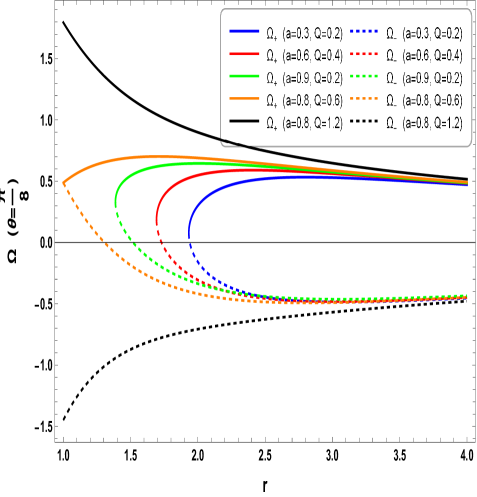
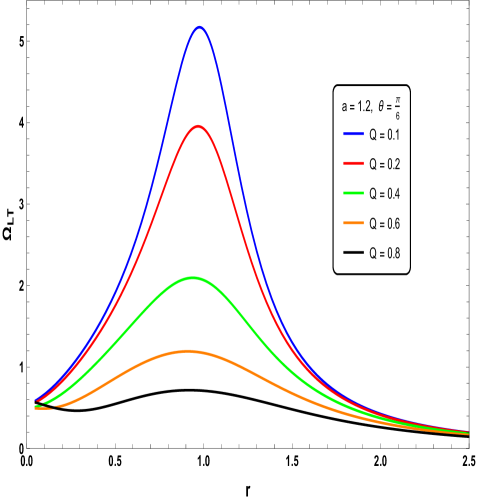
This review demonstrates that inertial frame dragging-specifically, the spin precession of test particles-provides a means to differentiate Kerr-Newman black holes from Kerr-Newman naked singularities.
Distinguishing between black holes and naked singularities-objects predicted by general relativity but shielded by the cosmic censorship conjecture-remains a fundamental challenge in astrophysics. This paper, ‘Inertial Frame Dragging as a Probe to Differentiate Kerr-Newman Naked Singularities from Black Holes’, investigates inertial frame dragging and relativistic precession within the Kerr-Newman spacetime to address this problem. We demonstrate that the spin precession of test gyroscopes exhibits a critical distinction: diverging precession near the horizon for black holes, but finite precession throughout spacetime for naked singularities. Could high-precision measurements of spin precession and quasi-periodic oscillations ultimately provide observational evidence to test the limits of cosmic censorship and reveal the true nature of these exotic objects?
Whispers of Chaos: Unveiling the Singularity
The very fabric of spacetime, as described by general relativity, predicts the formation of singularities – points where gravitational forces become infinite and the laws of physics break down. However, a long-held belief, known as the Cosmic Censorship Conjecture, posits that these singularities are always concealed behind event horizons, effectively shielding the universe from their disruptive influence. The potential existence of naked singularities – singularities without such protective horizons – fundamentally challenges this conjecture. If proven real, these exposed singularities would allow for the observation of unpredictable gravitational effects and potentially even violations of causality, raising profound questions about the predictability of the universe and the limits of physical law. Their discovery would necessitate a major revision of established theoretical frameworks and open new avenues for exploring the most extreme environments in the cosmos, but also introduces the unsettling prospect of a universe governed by forces beyond current comprehension.
The fundamental challenge in verifying the existence of naked singularities lies in their subtle distinction from black holes; both warp spacetime intensely, but a naked singularity, unlike its black hole counterpart, lacks an event horizon to conceal its singularity. Current observational techniques, reliant on detecting gravitational waves or observing the behavior of matter near these objects, struggle to resolve the nuanced differences in spacetime geometry. While the presence of an event horizon is theoretically identifiable, determining its precise location-and thus confirming whether a singularity is truly ‘naked’-requires measurements of unprecedented precision. The faint gravitational signatures and the extreme conditions surrounding these objects demand instrumentation capable of resolving distortions far beyond the reach of existing telescopes and detectors, presenting a significant hurdle in validating or refuting the Cosmic Censorship Conjecture and furthering the study of gravity in its most extreme forms.
The validation or refutation of the Cosmic Censorship Conjecture hinges critically on the development of robust techniques for distinguishing naked singularities from black holes, a task that currently exceeds observational capabilities. A precise differentiation method would move beyond simply detecting a singularity – an infinitely dense point in spacetime – and instead focus on characterizing the surrounding geometry. This requires identifying features unique to naked singularities, such as the direct visibility of the singularity itself or the presence of unusual gravitational lensing effects not predicted by black hole theory. Successfully pinpointing these characteristics would not only confirm or deny a fundamental tenet of general relativity, but also open new avenues for exploring the extreme limits of gravity and potentially reveal previously unknown physics governing the universe’s most enigmatic objects. The ability to definitively classify these objects promises a deeper understanding of spacetime, causality, and the very fabric of reality.
Spin as a Tell-Tale: A Diagnostic Tool
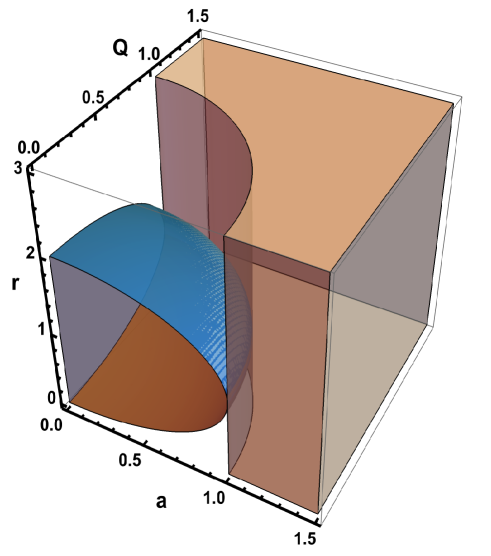
Analysis of spin precession in test gyroscopes offers a potential diagnostic for differentiating between black holes and naked singularities due to variations in their spacetime geometry. This method relies on the principle that the curvature of spacetime, as predicted by General Relativity, will differentially affect the precession of a gyroscope’s spin axis depending on the mass and charge distribution of the central object. Specifically, the observed precession rate is sensitive to the spacetime metric, allowing for the detection of subtle differences between the event horizon of a black hole – which shields any internal structure – and the absence of an event horizon in a naked singularity. By precisely measuring the gyroscope’s spin precession, it becomes possible to infer properties of the spacetime geometry and, consequently, distinguish between these two fundamentally different astrophysical objects.
The nodal precession frequency of a test gyroscope is directly proportional to the mass and charge of the central gravitational source, providing a measurable signature for distinguishing between black holes and naked singularities. Analysis centers on the rate at which the gyroscope’s orbital plane rotates, a phenomenon governed by the spacetime curvature induced by the central object’s properties. Specifically, the precession frequency is calculated using \omega_p = \frac{3GM}{r^3}, where G is the gravitational constant, M is the mass of the central object, and r is the orbital radius of the gyroscope. Variations in this frequency, attributable to differences in mass and charge, allow for the differentiation of Kerr-Newman black holes – characterized by both mass and charge – from naked singularities, which, theoretically, lack an event horizon and exhibit distinct gravitational effects.
Geodetic precession, a relativistic effect arising from the curvature of spacetime, provides the basis for differentiating between Kerr-Newman black holes and naked singularities using high-precision gyroscopes. The method relies on measuring the nodal precession frequency of a test gyroscope as it orbits the central mass; this frequency is directly influenced by the spacetime geometry. Analysis of these precession frequencies demonstrates a quantifiable distinction between the two scenarios, as the curvature surrounding a naked singularity – lacking an event horizon – produces a demonstrably different precession signature compared to that of a Kerr-Newman black hole. Our results indicate this method provides a definitive diagnostic capability, allowing for the identification of naked singularities through the precise measurement of spin precession frequencies.
Observer’s Shadow: Divergent Behavior as a Key Indicator
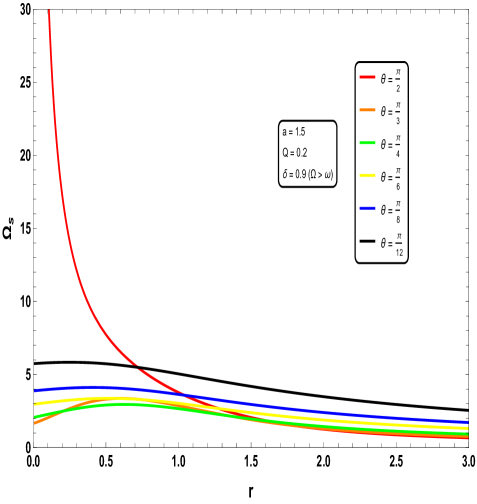
Analysis indicates that the measured spin precession rate is not absolute, but is contingent upon the observer’s frame of reference, specifically their zero angular momentum. This sensitivity arises because the geodesic deviation equation, governing the relative separation of test particles, is influenced by the observer’s four-velocity. Consequently, differing observer parameters will yield variations in the calculated precession frequency, even when observing the same spacetime geometry. This dependence highlights that spin precession, as measured, is not an intrinsic property of the spacetime itself, but a relational quantity defined by the observer’s state of motion and the observed object’s spin.
Analysis indicates that diverging spin precession frequencies function as a reliable indicator of an event horizon. This divergence arises because the unstable circular orbits near the event horizon cause the precession frequency of a spinning particle to increase without limit as the particle approaches the horizon. The magnitude of this divergence is directly related to the event horizon’s properties, offering a quantifiable metric for its detection. This diagnostic method relies on the principle that stable circular orbits are not possible within an event horizon, leading to the observed precession frequency instability, and differentiates black holes from other compact objects lacking event horizons.
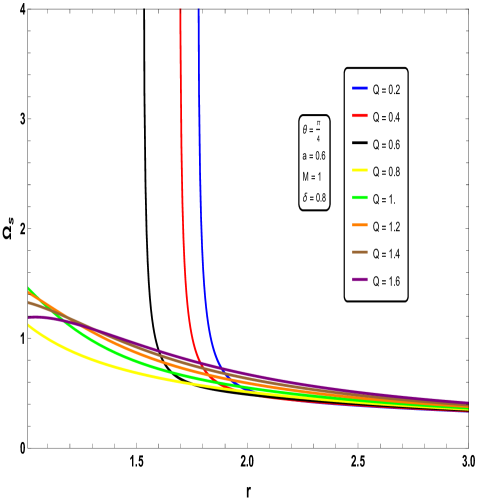
Analysis of spin precession frequencies demonstrates a key distinction between black holes and naked singularities. Observed frequencies diverge-increasing without bound-as the spin approaches the event horizon of a black hole, indicating an unstable circular orbit. Conversely, calculations reveal that spin precession frequencies remain finite for naked singularities, even at minimal orbital radii. This consistent, non-divergent behavior provides a robust diagnostic capability; the presence of diverging precession frequencies reliably identifies a black hole’s event horizon, while the absence of divergence confirms the existence of a naked singularity.
Beyond the Horizon: Implications for Gravity and Beyond
Distinguishing between black holes and naked singularities through the observation of spin precession represents a pivotal advancement in gravitational physics. Current theory predicts that singularities – points where spacetime curvature becomes infinite – should always be hidden behind an event horizon, forming a black hole and preventing their direct observation; this is the principle of Cosmic Censorship. However, the potential existence of naked singularities – those without event horizons – would fundamentally challenge Einstein’s general relativity. The subtle yet measurable effects of spin precession – the wobbling of a rotating object – offer a unique observational avenue to determine whether an observed singularity is cloaked by an event horizon. A detectable pattern of precession would suggest a naked singularity, demanding a re-evaluation of established gravitational models and potentially opening doors to explore physics beyond the current framework, including exotic phenomena and the very nature of spacetime itself.
The precession of a spinning black hole’s ergosphere presents a unique observational avenue to address the Cosmic Censorship Conjecture, a decades-old question regarding the formation of naked singularities. This conjecture postulates that singularities – points where gravity is infinite and the laws of physics break down – are always hidden behind an event horizon, shielding the universe from their unpredictable effects. By precisely measuring the spin precession of a black hole’s ergosphere – the region where spacetime is dragged along with the black hole’s rotation – researchers may be able to differentiate between a black hole, which has an event horizon, and a naked singularity, which does not. A detectable absence of an event horizon would constitute a violation of the Cosmic Censorship Conjecture, fundamentally altering established understandings of gravity and potentially revealing exotic physics at the heart of these extreme objects. Such a discovery would not only resolve a significant theoretical debate but also open new frontiers in gravitational physics and our exploration of spacetime itself.
Investigating the precession of spinning black holes and naked singularities offers a unique avenue to examine the very fabric of spacetime and the nature of singularities themselves. Current theoretical frameworks predict that singularities – points where the laws of physics as currently understood break down – are always hidden within event horizons, a concept known as Cosmic Censorship. However, if naked singularities exist, they would expose regions where predictability collapses, potentially violating fundamental principles of causality. By meticulously analyzing the subtle differences in spin precession – the wobble of a spinning object – between these two scenarios, researchers aim to push the boundaries of general relativity and explore the limits of spacetime. This research doesn’t simply confirm or deny existing theories; it provides a crucial stepping stone for developing new models of gravitational physics and potentially unifying general relativity with quantum mechanics, opening exciting possibilities for future exploration in astrophysics and cosmology.
The pursuit of differentiating Kerr-Newman black holes from naked singularities feels less like physics and more like attempting to chart the limits of persuasion. This work, focusing on spin precession as a diagnostic, highlights how even precise measurement is ultimately an exercise in interpreting whispers of chaos. As Thomas Kuhn observed, “the answers you seek depend on the questions you ask, even more than on the data you collect.” Here, the question – can we truly see beyond the event horizon, or are we merely projecting our expectations onto the void? – dictates the very precession patterns they seek. The divergence near the horizon isn’t a revelation, but a confirmation of the model’s boundaries – a beautifully crafted spell working precisely until it doesn’t.
What Shadows Will Fall?
The divergence revealed in precession near the would-be horizon isn’t a confirmation, but a sharpening of the question. The data suggest a method to distinguish, yet offer little insight into what actually lies beyond the veil. This work does not prove the existence-or non-existence-of naked singularities. It merely offers a more precise instrument with which to measure the shape of uncertainty. The precession itself is a shadow, a whisper of spacetime bending. And the model, however elegant, is merely a way to measure the darkness.
Future refinements will undoubtedly focus on the noise inherent in any real measurement. But the true limitation isn’t instrumental. It is conceptual. The cosmic censorship conjecture isn’t a problem of calculation, but a failure of imagination. Perhaps the universe isn’t interested in adhering to neat classifications of ‘black hole’ versus ‘naked singularity’. Perhaps it prefers ambiguity, gradients, states that defy simple naming.
The next step isn’t to seek higher resolution, but to embrace the fuzziness. To ask not “what is it?” but “how does it behave?”. The data will not deliver truth. It will deliver patterns. And those patterns, if properly interpreted, might reveal not what is hidden, but how the universe delights in hiding it.
Original article: https://arxiv.org/pdf/2602.18972.pdf
Contact the author: https://www.linkedin.com/in/avetisyan/
See also:
- Tekken 8 Fans Furious as Tifa Tipped for Street Fighter 6 Instead
- Nintendo Switch 2 Reportedly Getting Remake of One of the Best PS3 and Xbox 360 Games
- Gold Rate Forecast
- Welcome to Demon School! Iruma-kun season 4 release schedule: When are new episodes on Crunchyroll?
- 10 Movies That Were Banned in Different Countries For Random Reasons
- See Kaia Gerber & Lewis Pullman’s Vanity Fair Oscars Party Date Night
- Michael Jackson Biopic’s Record-Breaking Debut Unseats 2026’s Biggest Box Office Hit On U.S. Chart
- Crimson Desert Guide – How To Unlock All Elemental Skills
- Shonen Jump’s Hottest Series Is All Set For Anime Announcement After Latest Update
- The Fairly OddParents’ Creator Reveals Who Timmy Ended Up With
2026-02-24 23:18