Author: Denis Avetisyan
A new understanding of altermagnetic textures is revealing unexpected links between spin arrangements, emergent electromagnetic fields, and the quantum behavior of electrons.
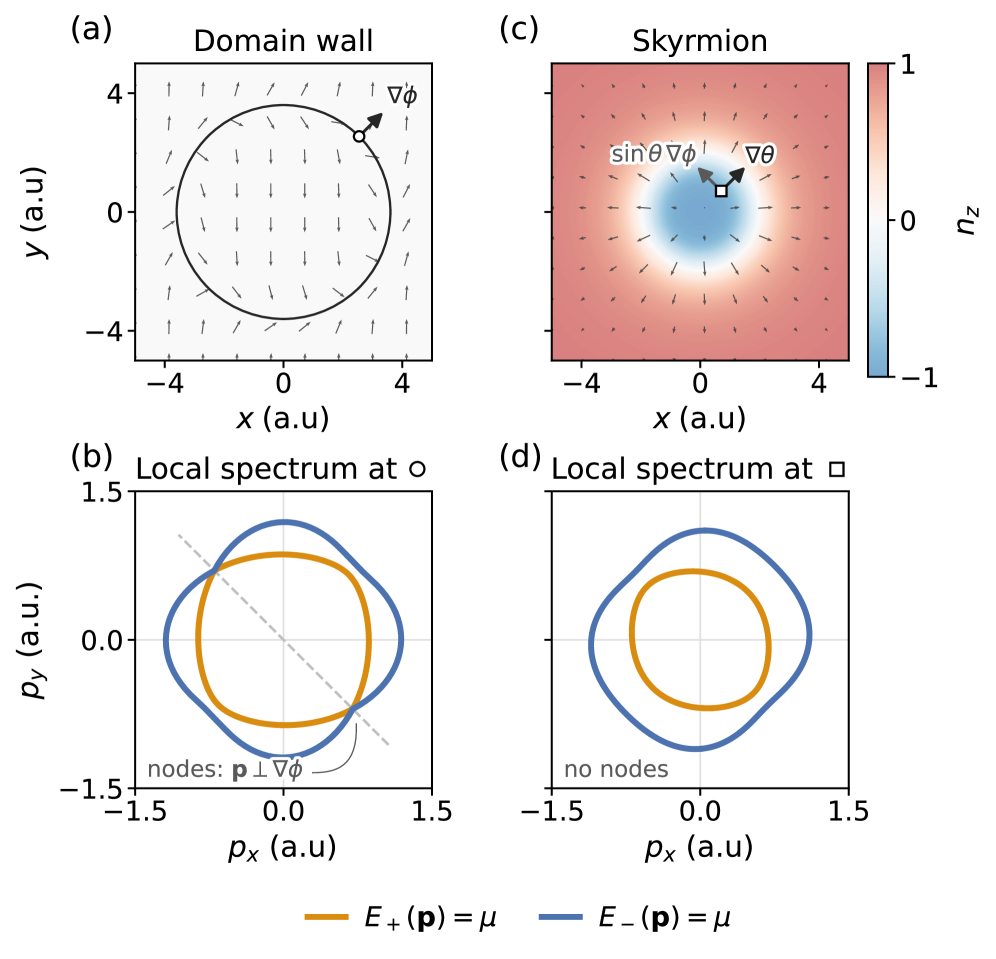
This review explores the fundamental physics of altermagnetism and its potential to engineer novel electronic and spintronic devices.
While conventional spintronic materials rely on ferromagnetic or antiferromagnetic orders, the emergent phenomena arising from more subtle magnetic textures remain largely unexplored. In this work, titled ‘Altermagnetic spin textures: Emergent electrodynamics, quantum geometry, and probes’, we demonstrate that spatially varying altermagnetic spin textures-characterized by vanishing net magnetization but finite spin splitting-give rise to unique emergent electromagnetic fields and geometric effects on electron transport. These effects, including spin-dependent electron lensing and locally encoded Zeeman fields, offer a novel pathway for spin manipulation and the differentiation of distinct altermagnetic orders. Could textured altermagnets thus serve as a versatile platform for advanced spintronic functionalities and a sensitive probe of this intriguing magnetic state?
Beyond Ferromagnetism: Exploring Altermagnetic Textures
Traditional spintronic devices, which harness the spin of electrons for information processing, predominantly utilize ferromagnetic materials. However, continued miniaturization of these devices is increasingly challenging due to the fundamental limitations inherent in maintaining stable magnetic order at the nanoscale. As feature sizes shrink, the energy required to switch magnetic states increases, leading to substantial power dissipation and ultimately hindering further advancements in device efficiency. Moreover, the stray fields generated by closely packed ferromagnetic bits can cause unintended interactions and data corruption, posing a significant obstacle to high-density storage and reliable operation. This necessitates exploration beyond conventional ferromagnetism to unlock new paradigms for low-power, high-density spintronic technologies.
The pursuit of next-generation spintronic devices is increasingly focused on altermagnetic textures as a means to circumvent the limitations inherent in conventional ferromagnetic materials. Unlike ferromagnets which rely on a macroscopic magnetic moment, altermagnetism allows for the manipulation of electron spin via a spatially varying, but globally compensated, magnetic order. This crucial difference drastically reduces energy dissipation, as maintaining a net magnetization requires continuous energy input. Consequently, altermagnetic materials present a pathway to significantly lower power consumption in future devices, potentially enabling more efficient data storage and processing. The ability to control electron states without a net magnetic field also opens doors to novel device functionalities and architectures currently unattainable with traditional spintronics, promising a new era of energy-efficient information technology.
Altermagnetic textures represent a departure from traditional magnetic order, specifically antiferromagnetism, due to their unique symmetry characteristics. Unlike antiferromagnets, which possess a simple Néel or Bloch order, altermagnetic materials exhibit more complex arrangements of spins driven by specific crystal symmetries – including those lacking inversion symmetry. This nuanced order isn’t merely a static arrangement; it gives rise to emergent phenomena like topological spin textures and unconventional magnetoelectric effects. The symmetry dictates how the electron’s spin and momentum are coupled, leading to the possibility of controlling electron transport without relying on a net magnetic moment. Consequently, these textures hold considerable promise for spintronic devices that are both energy-efficient and robust, potentially overcoming limitations inherent in conventional ferromagnetic materials.
Modeling Electronic Structure: A Four-Band Approach
The four-band model utilized in analyzing altermagnetic systems represents a simplification of the electronic structure, focusing on the relevant degrees of freedom. This model considers two sublattices, each possessing two spin states – typically spin-up and spin-down. By restricting the Hilbert space to these four bands, the computational complexity is significantly reduced while retaining the essential physics governing the low-energy electronic behavior. This approach allows for tractable calculations of the band structure, density of states, and other key electronic properties, providing a foundational framework for understanding the unique characteristics of these materials. The bands are defined by the combination of sublattice and spin, forming a basis for describing electron transport and optical properties.
The four-band model utilizes a two-sublattice framework, representing distinct atomic arrangements within the altermagnetic material. Each sublattice incorporates two spin states – spin up and spin down – resulting in four distinct bands when considering electron energy levels. This approach simplifies the analysis of the electronic band structure by focusing on the relevant degrees of freedom and allowing for the calculation of electron dispersion relations and density of states. Consequently, the model enables predictions regarding the material’s electrical conductivity, optical properties, and magnetic behavior as a function of electron energy and momentum.
Simplifying the electronic structure problem through a four-band model allows for the isolation and analysis of key physical phenomena. Full material calculations, incorporating all electronic bands and atomic orbitals, are computationally expensive and often obscure the dominant interactions driving altermagnetic behavior. By focusing on a reduced set of bands – specifically those most relevant to the near-Fermi level – we can efficiently investigate the resulting band dispersions, density of states, and carrier properties. This approach facilitates the identification of topological features and the determination of key parameters influencing electron transport and magnetic ordering without the computational burden of a full band structure calculation. Consequently, emergent physical properties can be more readily understood and predicted.
Emergent Fields and Effective Models: Unveiling the Physics
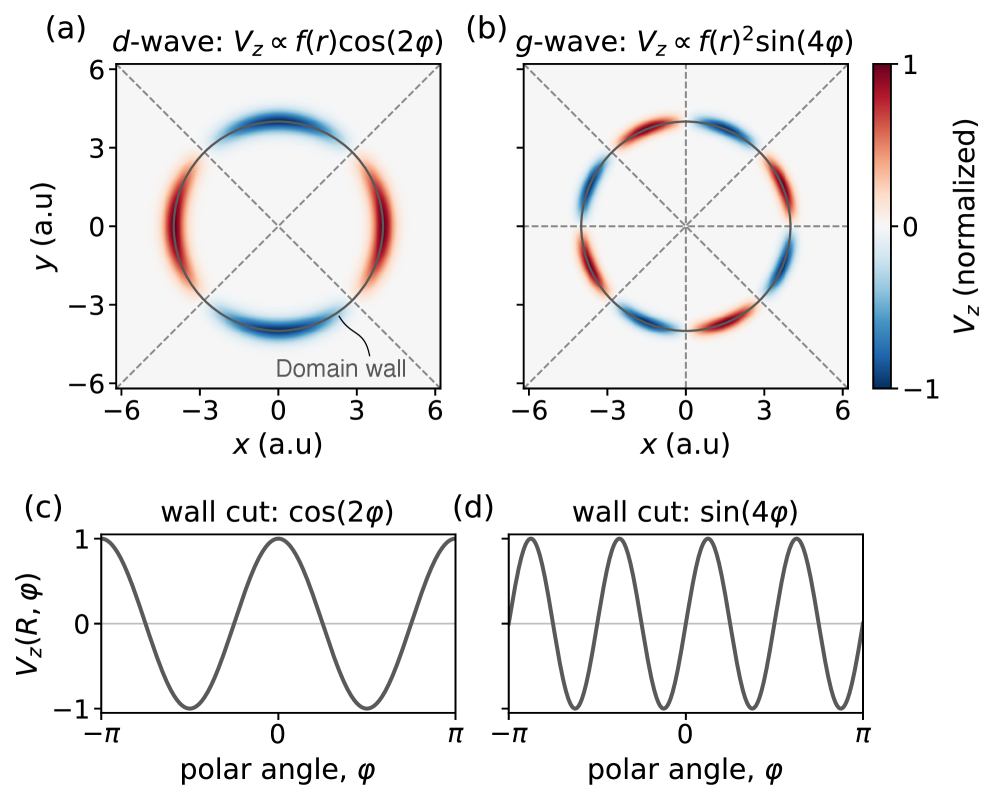
The reduction of a complex four-band electronic structure to a simplified two-band description allows for the identification of emergent electromagnetic fields within the material. This simplification, achieved through appropriate approximations and focusing on low-energy degrees of freedom, reveals that the observed electric and magnetic fields are not externally imposed, but rather intrinsic properties arising from the material’s internal electronic structure. Specifically, these fields are directly linked to the spin texture and the behavior of itinerant electrons, manifesting as effective fields experienced by the charge carriers and influencing their transport properties. This effective two-band model facilitates analysis and prediction of phenomena not observable in the full four-band representation, providing a computationally tractable pathway to understand complex electronic behavior.
The emergence of electric and magnetic fields is directly linked to the interaction between spin textures – arrangements of electron spins – and itinerant electrons, which are electrons capable of free movement within a material. This interplay modifies the electron’s effective Hamiltonian, H_{eff}, introducing terms dependent on both momentum and spin. Consequently, electron behavior deviates from traditional descriptions based solely on band structure; specifically, the velocity of electrons is altered by the spin texture, leading to phenomena like anomalous Hall and Nernst effects. The resulting modification of the electron’s dispersion relation E(k) dictates altered transport properties and novel responses to applied electric and magnetic fields.
The reduced two-band model predicts responses to external stimuli – including electric and magnetic fields, strain, and temperature gradients – that deviate significantly from those observed in conventional materials. Specifically, the model forecasts phenomena such as anisotropic magnetoresistance, tunable topological states, and the emergence of novel magnetoelectric effects. These unique responses stem from the altered electronic band structure and the strong coupling between spin and charge currents, resulting in behavior not captured by traditional models based on independent charge carriers and magnetism. Quantitative predictions derived from the effective model demonstrate the potential for tailoring material properties through external control, opening avenues for advanced device functionalities.
Quantum Metric and Altermagnetic Response: A Deeper Look
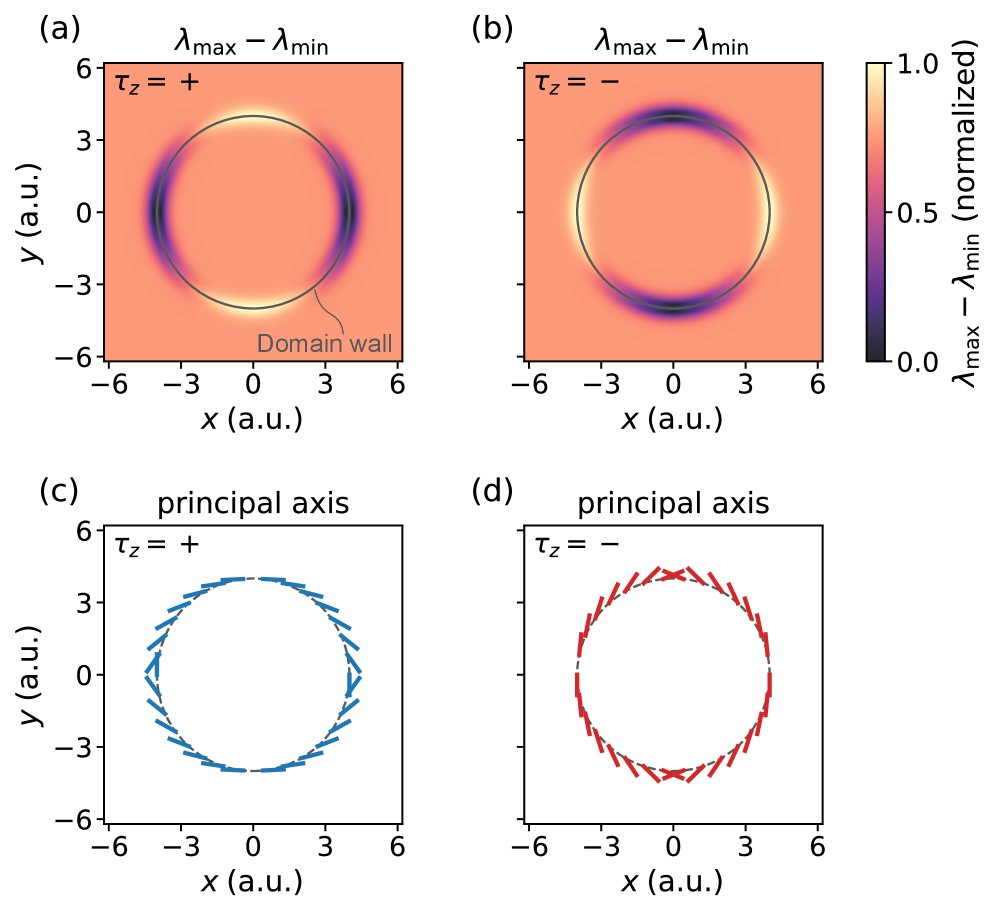
Altermagnetism gives rise to an emergent Zeeman field – an effective magnetic field experienced by electrons – which fundamentally differs from that found in conventional antiferromagnets. This field isn’t simply a consequence of broken time-reversal symmetry, but is intricately linked to both the altermagnetic order parameter – describing the degree of altermagnetic ordering – and the quantum metric. The quantum metric, a measure of how sharply the energy bands of electrons curve in momentum space, dictates the sensitivity of electron states to variations in the spin texture. Consequently, the strength and character of this emergent field are not fixed properties, but are tunable through materials engineering that directly influences the quantum metric and the altermagnetic order, opening avenues for novel spintronic devices and materials with tailored magnetic responses.
The quantum metric, a fundamental property describing the curvature of electronic band structures, dictates how readily electron states respond to alterations in the spin texture of a material. Essentially, this metric quantifies the sensitivity of electrons to changes in the magnetic ordering; a larger metric implies a heightened responsiveness. This isn’t simply about the presence of spin texture, but how dramatically electron behavior shifts with even subtle changes in its arrangement. \text{Quantum Metric} = \sum_{n} \langle \partial_{i} \psi_{n} | \partial_{i} \psi_{n} \rangle Materials exhibiting a pronounced quantum metric therefore offer a pathway to finely tuned magnetic responses, as the behavior of electrons – and thus the material’s magnetic properties – can be sculpted by manipulating the spin texture itself.
The altermagnetic response, a novel magnetic behavior, isn’t rigidly fixed but rather susceptible to deliberate manipulation through careful materials engineering. This tunability stems from the fundamental link between the response and the quantum metric – a property reflecting the curvature of electronic band structures. By strategically altering the composition and crystalline structure of altermagnetic materials, researchers can effectively modify this quantum metric. This modification, in turn, allows for precise control over the emergent Zeeman field and, consequently, the overall altermagnetic behavior. Such design flexibility opens doors for tailoring materials with specific magnetic properties, potentially leading to advancements in spintronic devices and other applications where precise magnetic control is paramount. The ability to engineer the quantum metric represents a significant step beyond traditional magnetic materials, offering a new paradigm for magnetic control through materials design.
Electron Optics and Beyond: Lensing Effects and Future Directions
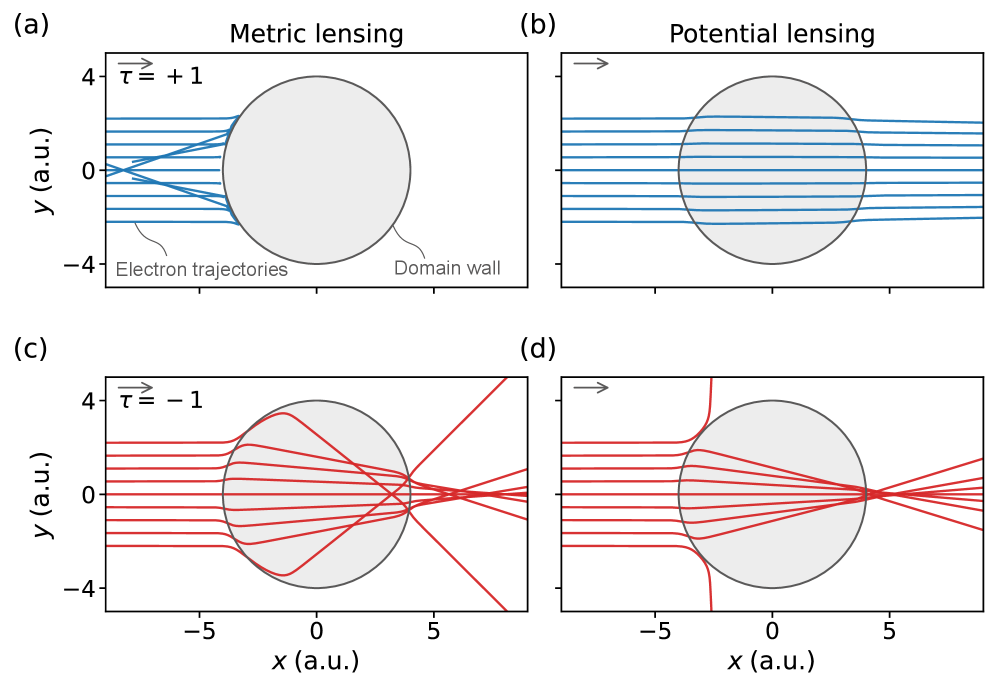
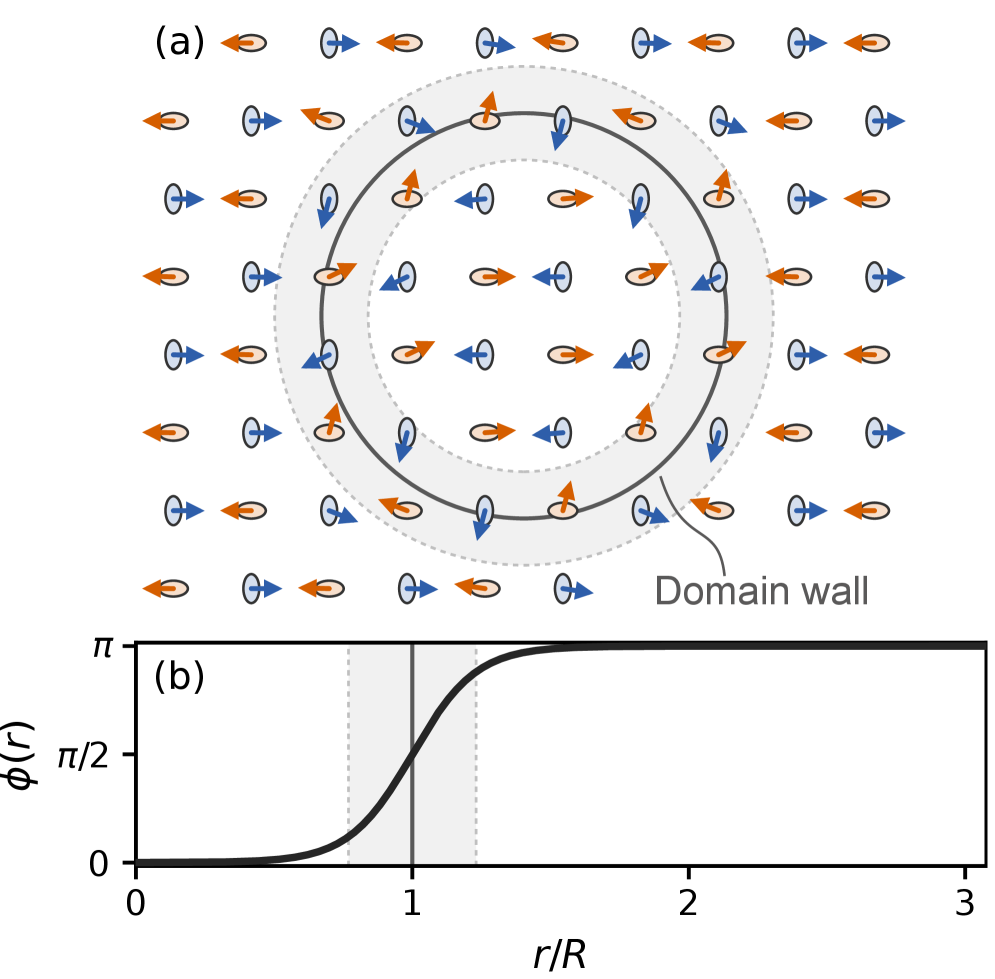
Electron trajectories within altermagnetic materials aren’t necessarily straight lines; subtle variations in the material’s internal magnetic texture can actually bend their path, creating an effect strikingly similar to gravitational lensing observed with light. This deflection isn’t random, however, but predictably linked to the specific arrangement of the altermagnetic order. The degree of bending is quantified by a relationship where the deflection is proportional to \sin(2\phi)/vr, with φ representing the angle of the altermagnetic texture, v the electron velocity, and r a characteristic length scale. This suggests a remarkable level of control over electron beams is possible, potentially enabling the creation of novel electron optics based on manipulating the material’s magnetic structure rather than external electromagnetic fields.
The ability to control electron trajectories through manipulation of the effective mass tensor opens avenues for precise beam steering and focusing without traditional electromagnetic lenses. This tensor, which dictates how electrons respond to external forces within a material, can be engineered to create regions of varying refractive index for electrons – analogous to how glass lenses bend light. By tailoring the material’s structure and composition, researchers can sculpt the effective mass tensor, allowing for customized deflection and shaping of electron beams. This offers possibilities for advanced electron microscopy, novel electron-based devices, and even the development of compact accelerators, potentially revolutionizing fields ranging from materials science to high-energy physics. The dependence of electron deflection on this tensor – quantified by the relationship \propto \sin(2\phi)/vr – allows for fine-tuned control, suggesting a path toward manipulating electron beams with unprecedented precision.
The peculiar bending of electron trajectories within altermagnetic materials isn’t merely a geometric quirk; it strikingly echoes the behavior of light in curved spacetime, as described by general relativity. This analogy isn’t just conceptual; the degree to which electron paths curve is quantifiable, expressed through a transmission factor denoted as Z\tau. Crucially, Z\tau reveals that this ‘electron lensing’ isn’t uniform-it acts as a filter, selectively transmitting electrons based on their spin polarization. Electrons with specific spin orientations experience greater curvature and, consequently, differing transmission probabilities. This suggests a potential for novel spin-based devices where electron beams are manipulated not by conventional electromagnetic fields, but by engineered distortions in the material’s altermagnetic texture, blurring the lines between condensed matter physics and fundamental explorations of gravity and spacetime.
The exploration of altermagnetic textures reveals a landscape where established assumptions regarding electron behavior begin to fracture. This research demonstrates how emergent electromagnetic fields, arising from complex spin configurations, fundamentally alter electron transport. It echoes a sentiment articulated by René Descartes: “Doubt is not a pleasant condition, but it is necessary for a clear understanding.” The paper doesn’t prove a particular outcome; rather, it methodically subjects conventional understandings of spin-orbit coupling and quantum geometry to rigorous scrutiny. The findings aren’t simply about discovering new phenomena, but about refining the models used to interpret them – a process where repeated challenges to existing theories reveal a more nuanced, and ultimately more accurate, picture. Data isn’t the goal – it’s a mirror of human error, constantly reflecting the imperfections in our attempts to model reality.
What Lies Ahead?
The exploration of altermagnetic textures, as this work demonstrates, isn’t simply about discovering novel spin configurations. It’s about acknowledging the limitations of conventional wisdom regarding magnetism and its relation to electronic behavior. A texture isn’t a static picture, but a dynamic interplay of fields, and the emergent electrodynamics revealed here demand a rigorous accounting of relativistic effects-something often glossed over in condensed matter modeling. The significance level of these effects, particularly at interfaces and in heterostructures, remains an open question.
Predicting, and then controlling, the interplay between altermagnetism and topological phases is, predictably, the next hurdle. The paper hints at geometric effects on electron transport, but the extent to which these can be harnessed-or are merely artifacts of specific material parameters-needs careful consideration. One suspects the true potential lies not in replicating known topological phenomena, but in engineering entirely new ones, predicated on the unique symmetry breaking inherent to altermagnetic order.
Ultimately, a model isn’t a mirror of reality-it’s a mirror of its maker. The current frameworks, while offering a starting point, will undoubtedly require substantial refinement. The challenge isn’t merely to describe these textures, but to understand how their fragility-their sensitivity to external perturbations and material imperfections-impacts their practical viability. And, of course, to begin asking what, if anything, would disprove the most optimistic projections.
Original article: https://arxiv.org/pdf/2602.20236.pdf
Contact the author: https://www.linkedin.com/in/avetisyan/
See also:
- Gold Rate Forecast
- 10 Movies That Were Banned in Different Countries For Random Reasons
- Nintendo Switch 2 Reportedly Getting Remake of One of the Best PS3 and Xbox 360 Games
- Welcome to Demon School! Iruma-kun season 4 release schedule: When are new episodes on Crunchyroll?
- Tekken 8 Fans Furious as Tifa Tipped for Street Fighter 6 Instead
- 9 Great Supernatural Characters Everyone Forgot About
- See Kaia Gerber & Lewis Pullman’s Vanity Fair Oscars Party Date Night
- Michael Jackson Biopic’s Record-Breaking Debut Unseats 2026’s Biggest Box Office Hit On U.S. Chart
- PS5 Game Devs Collectively Clown on Nvidia’s Controversial DLSS 5 Tech
- The Fairly OddParents’ Creator Reveals Who Timmy Ended Up With
2026-02-25 09:22