Author: Denis Avetisyan
New, highly precise measurements of hyperon decay are refining our understanding of why the universe is dominated by matter over antimatter.
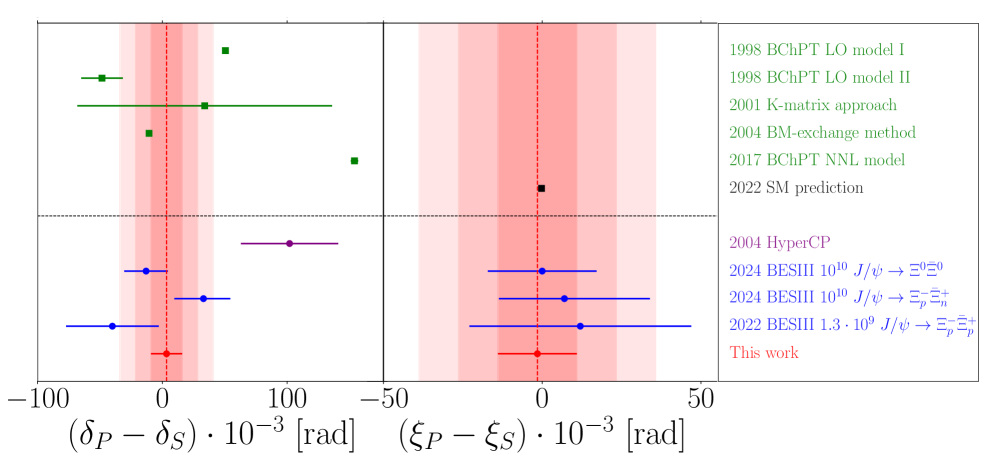
Precise measurements of strong and weak phase differences in Ξ− decays provide further constraints on CP violation and tests of the Standard Model.
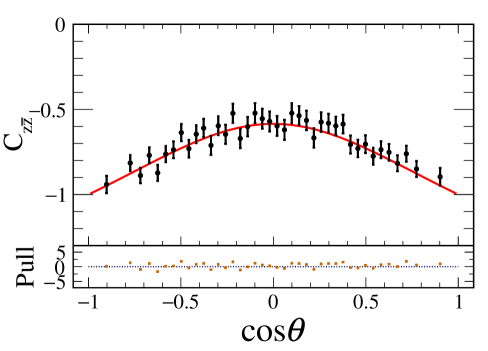
The observed matter-antimatter asymmetry in the universe remains a fundamental puzzle challenging the Standard Model of particle physics. This paper, ‘Precise Measurement of Matter-Antimatter Asymmetry with Entangled Hyperon Antihyperon Pairs’, presents the most precise measurements to date of strong and weak phase differences in \Xi^-\bar{\Xi}^ decays, utilizing a nine-dimensional helicity amplitude analysis of data collected by the BESIII experiment. These refined measurements-including A_{CP}^\Xi and \Delta\phi_{CP}^\Xi-constrain potential CP violation in the hyperon sector and provide stringent tests of the Standard Model. Do these results offer clues towards understanding the origin of baryogenesis, or will new physics be required to fully resolve the matter-antimatter imbalance?
The Matter-Antimatter Asymmetry: A Universe Built on Imbalance
The observable universe presents a profound puzzle: a distinct prevalence of matter over antimatter. Current cosmological models suggest that during the Big Bang, matter and antimatter were created in nearly equal quantities. However, if this were perfectly balanced, these substances would have annihilated each other, resulting in a universe composed almost entirely of energy. The continued existence of galaxies, stars, and ultimately, life, indicates a subtle imbalance – a slight excess of matter. This asymmetry, though seemingly minuscule, is responsible for everything that exists today, and understanding its origin remains one of the most significant challenges in modern physics. The very fabric of reality hinges on explaining why matter ‘won’ over antimatter in the early universe, a question that drives ongoing research into the fundamental laws governing particle interactions.
Andrei Sakharov, in 1967, proposed a set of conditions necessary to explain the observed matter-antimatter asymmetry in the universe – a process known as baryogenesis. His theory posits that for an initial symmetry between matter and antimatter to be broken, leading to the prevalence of matter today, three key criteria must be met. These involve an asymmetry in the decay rates of particles and their antiparticles, violation of baryon number conservation, and, crucially, violation of Charge-Parity (CP) symmetry. CP symmetry suggests that the laws of physics should remain consistent if a particle is simultaneously replaced with its antiparticle (Charge conjugation, C) and its spatial coordinates are inverted (Parity, P). If CP symmetry holds, matter and antimatter would be produced and decay at equal rates, preventing the formation of a matter-dominated universe. Therefore, any deviation from CP symmetry offers a potential pathway for explaining why matter exists at all, making its investigation a central focus in particle physics and cosmology.
The prevalence of matter over antimatter in the observable universe represents a profound cosmological puzzle, and establishing definitive evidence of Charge-Parity (CP) violation is central to resolving it. This symmetry, if perfectly maintained, would predict equal production of both matter and antimatter, leading to mutual annihilation and a universe devoid of structure. However, the existence of galaxies, stars, and ultimately, life, demonstrates a clear imbalance. CP violation offers a potential mechanism to explain this asymmetry, allowing for a slight preference in the creation of matter during the early universe. Identifying and quantifying the extent of CP violation, therefore, isn’t merely a test of fundamental physics; it’s a crucial step towards understanding the very conditions that allowed our universe – and everything within it – to come into being. The search for CP violation extends beyond verifying its existence, focusing on the degree to which it occurs, as the Standard Model’s current predictions fall short of the amount needed to account for the observed matter-antimatter disparity.
The Standard Model of particle physics, while remarkably successful, predicts a level of Charge-Parity (CP) violation insufficient to account for the observed matter-antimatter asymmetry in the universe. CP violation, a subtle difference in the behavior of particles and their antimatter counterparts, is considered a crucial ingredient in explaining why matter prevailed after the Big Bang. However, experimental measurements of CP violation within the Standard Model, particularly in the decays of kaons and B-mesons, fall significantly short of the amount required by cosmological observations. This discrepancy strongly suggests the existence of additional sources of CP violation beyond the currently known particles and interactions. Consequently, physicists are actively pursuing searches for new physics – including hypothetical particles and forces – that could potentially enhance CP violation and resolve this fundamental puzzle about the universe’s composition.
Weak Decays: Probing the Subtle Asymmetries
Two-body weak decays of hyperons and kaons are particularly useful for CP violation studies due to the relatively clean experimental signatures and well-defined decay topologies. These decays, such as K^+\rightarrow \pi^+ \pi^0 or \Lambda^0 \rightarrow p \pi^-, proceed via the weak interaction, which inherently mixes particles and antiparticles. The two-body nature simplifies kinematic reconstruction and reduces background contributions compared to multi-body decays. Furthermore, the final state particles’ momenta and angular distributions provide sensitive probes of CP-violating phases in the decay amplitude, allowing for precise measurements of CP asymmetry parameters. The sensitivity arises because even small differences between the decay rates of a particle and its antiparticle can be magnified in these controlled decay processes.
Two-body weak decays of hyperons and kaons are complicated by the simultaneous presence of both weak and strong interaction dynamics. While the weak interaction is responsible for the decay process and potential CP violation, strong interactions govern the production of intermediate hadronic states. Consequently, observed decay rates and angular distributions are a convolution of both contributions. Isolating the CP-violating effects necessitates a detailed understanding and careful subtraction of the strong interaction contributions, often achieved through theoretical calculations based on Quantum Chromodynamics (QCD) and experimental analyses of control channels where CP violation is not expected. Accurate determination of decay parameters requires precise modeling of these hadronic effects to avoid systematic biases in the measurement of CP-violating asymmetries.
Precise determination of decay parameters α, β, and γ in weak decays of hyperons and kaons provides a rigorous method for testing CP symmetry. These parameters are extracted from the angular distributions of the decay products, specifically analyzing the direction of emitted particles relative to the initial particle’s spin and momentum. Deviations from CP symmetry manifest as differences between decay rates with a particle and its antiparticle, and are quantified by comparing the measured values of α, β, and γ with their CP-conjugated counterparts. Statistical precision in measuring these angular distributions directly impacts the sensitivity of CP violation searches, allowing for increasingly stringent tests of the Standard Model and potential discovery of new physics.
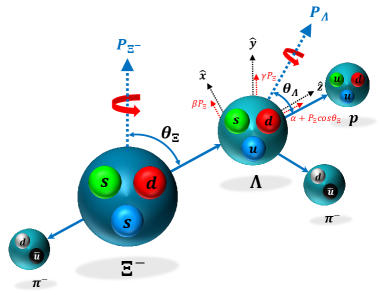
The Helicity Reference System (HRS) is a coordinate system defined by the direction of the decaying particle’s momentum and the direction opposite to its momentum, facilitating the unambiguous determination of particle polarization in weak decays. Unlike other coordinate systems where the polarization direction can vary depending on the decay channel, the HRS provides a consistent and measurable frame, crucial for extracting CP-violating parameters. Polarization is expressed as components along these axes, simplifying the analysis of angular distributions and allowing for precise measurements of parameters like α, β, and γ. Utilizing the HRS minimizes systematic uncertainties introduced by arbitrary coordinate choices and is essential for comparing results across different decay modes and experiments probing CP violation in hyperon and kaon decays.
Hyperon Decays: A New Window into CP Violation
The Ξ– baryon presents a valuable system for investigating Charge-Parity (CP) violation due to its decay dynamics which differ from those of more commonly studied kaon and B meson systems. Specifically, the Ξ– baryon decays weakly into final states involving both strange and charm quarks, allowing for sensitivity to different parameters within the Cabibbo-Kobayashi-Maskawa (CKM) matrix. Unlike systems where mixing dominates the CP violation signal, the Ξ– baryon’s decay proceeds primarily through a tree-dominated process, minimizing theoretical uncertainties related to mixing amplitudes and providing a cleaner probe of the underlying CP-violating phase. This unique decay pathway enables independent constraints on CKM parameters and offers a complementary approach to searches for physics beyond the Standard Model.
Measurements of the weak phase difference in Ξ⁻ baryon decays are critical for precision tests of the Standard Model and searches for physics beyond it. The currently measured value is (-0.2 ± 1.2 ± 0.1) × 10⁻² radians, representing a combination of statistical and systematic uncertainties. This phase difference arises from the interference between different decay pathways involving the weak interaction, and deviations from Standard Model predictions could indicate the presence of new particles or interactions. Precise determination of this parameter requires high-statistics data samples and careful control of experimental systematic effects, as even small discrepancies can have significant implications for understanding fundamental symmetries and the nature of CP violation.
Spin polarization, inherent to the production and decay of Ξ- baryons, introduces asymmetries in the observed angular distributions of the decay products. This polarization arises from the production mechanism – typically involving strong interactions – and affects the relative populations of different spin states. Consequently, the decay rates for different final states are modulated by the spin polarization vector, necessitating a detailed understanding and accurate correction for these effects in the data analysis. Failing to account for spin polarization would introduce systematic biases in the measurement of key parameters, such as the weak phase difference, and could lead to incorrect conclusions regarding CP violation and tests of the Standard Model. The analysis requires a full angular decomposition incorporating the spin density matrix to extract the underlying decay dynamics independent of the initial spin state.
The BESIII detector at the Beijing Electron Positron Collider II (BEPCII) generates Ξ⁻ baryons through the radiative decay of J/ψ mesons, providing a substantial sample for CP violation studies. Analysis of these decays has yielded a measured strong phase difference of (0.3 ± 1.2 ± 0.2) \times 10^{-2} rad. This result demonstrates a statistically significant discrepancy of 11.8σ when compared to current Standard Model predictions, suggesting potential contributions from beyond-Standard-Model physics or inaccuracies in the theoretical framework used to model Ξ⁻ decay dynamics. The high luminosity and efficient particle identification capabilities of BESIII are crucial for obtaining the precision necessary to observe and quantify this deviation.
Constraining Beyond the Standard Model: The Pursuit of Precision
The search for physics beyond the Standard Model heavily relies on quantifying ACp, a parameter directly sensitive to Charge-Parity (CP) violation. This measurement probes whether the laws of physics behave identically when a particle and its antiparticle are swapped, a symmetry subtly broken in nature and necessary to explain the observed matter-antimatter asymmetry in the universe. Experiments meticulously analyze the decay of particles like kaons and hyperons, looking for discrepancies between the decay rates of a particle and its counterpart. The precision with which ACp can be determined acts as a stringent test of theoretical predictions; any significant deviation from the Standard Model’s expectations would strongly suggest the influence of new particles or interactions, opening a window into the fundamental structure of reality and the origins of matter itself.
The pursuit of precision in particle physics demands maximizing the information gleaned from experimental data, and this is powerfully achieved by combining analyses of different decay channels. Investigations into CP violation, for instance, aren’t limited to the well-studied decays of kaons; incorporating data from hyperon decays – involving heavier, more complex particles – significantly boosts the statistical power of the overall measurement. This multi-channel approach doesn’t just increase the number of observed events; crucially, it also helps to mitigate systematic uncertainties. Different decay modes are susceptible to distinct experimental biases, and by carefully combining results, researchers can effectively average out these errors, leading to a more robust and reliable determination of fundamental parameters and a sharper search for physics beyond the Standard Model. This synergistic approach allows for a more complete and nuanced understanding of the weak interactions that govern particle decay.
Current investigations into CP violation reveal a compelling tension between experimental results and established theoretical frameworks. Analyses of decay processes, specifically focusing on the interference patterns between differing particle pathways, have yielded a weak phase difference that aligns with predictions from the Standard Model-though with a statistical significance of only 1.5σ. However, the concurrently measured strong phase difference exhibits a notable departure from expected values, exceeding the level that can be readily explained by known physics. This discrepancy doesn’t immediately invalidate the Standard Model, but it strongly suggests the presence of additional, yet undiscovered, particles or interactions influencing these decays – potentially hinting at new physics beyond our current understanding of fundamental forces and matter.
The pursuit of precision in particle physics, particularly in understanding CP violation, extends far beyond the confines of theoretical exercises. These investigations delve into the very asymmetry that allowed matter to prevail over antimatter in the early universe, ultimately leading to the existence of galaxies, stars, and everything within them. The subtle differences observed in particle decays, while seemingly esoteric, provide crucial clues about potential physics beyond the Standard Model – mechanisms that might explain why there is something rather than nothing. The search isn’t simply about verifying existing theories; it’s about unraveling the fundamental conditions that permitted the universe – and life itself – to emerge, offering insights into the deepest questions regarding our origins and place in the cosmos.
The pursuit of precision in measuring matter-antimatter asymmetry, as demonstrated in this study of Ξ− decays, feels less like objective science and more like a desperate attempt to rationalize an irrational universe. Everyone calls the Standard Model comprehensive until experimental results stubbornly refuse to fit. This paper, with its meticulous accounting of strong and weak phases, is merely another layer of narrative built atop the fundamental human need to impose order on chaos. As John Stuart Mill observed, “It is better to be a dissatisfied Socrates than a satisfied fool.” This research exemplifies that dissatisfaction – a relentless questioning of assumptions, even as the answers remain frustratingly elusive. The quest isn’t about finding the solution, but about refining the model-and admitting when the numbers don’t align with the story.
The Horizon of Imperfection
The relentless refinement of phase measurements in hyperon decays feels less like a march toward understanding, and more like a detailed cartography of ignorance. Each decimal place secured isn’t a victory over the universe, but a precise location marker indicating where the map still tears. The Standard Model, even with these increasingly stringent constraints, remains a remarkably successful accounting trick, not an explanation. It predicts what will happen, rarely why. This work, with its focus on CP violation, chases a ghost – a subtle imbalance that might, just might, account for existence itself. But the deeper one looks, the more the problem resembles collective self-deception.
Future progress will inevitably demand moving beyond the comfortable geometries of particle physics. The limitations aren’t simply instrumental; they’re conceptual. The insistence on treating particles as isolated entities, divorced from the chaotic context of quantum fields, feels increasingly contrived. A more fruitful path likely involves embracing the messiness – accepting that these asymmetries aren’t born of fundamental laws, but emerge from the statistical fluctuations of something far more complex, and perhaps, fundamentally unknowable.
Ultimately, the search for baryogenesis isn’t a quest for truth, but a human attempt to impose order on contingency. It’s a remarkably persistent delusion, this need for a ‘reason’ for being. Each measurement, therefore, is less a step toward solving a cosmic puzzle, and more a poignant reaffirmation of the species’ enduring, and likely futile, hope for meaning.
Original article: https://arxiv.org/pdf/2602.20524.pdf
Contact the author: https://www.linkedin.com/in/avetisyan/
See also:
- Gold Rate Forecast
- 10 Movies That Were Banned in Different Countries For Random Reasons
- Welcome to Demon School! Iruma-kun season 4 release schedule: When are new episodes on Crunchyroll?
- Nintendo Switch 2 Reportedly Getting Remake of One of the Best PS3 and Xbox 360 Games
- Tekken 8 Fans Furious as Tifa Tipped for Street Fighter 6 Instead
- See Kaia Gerber & Lewis Pullman’s Vanity Fair Oscars Party Date Night
- Michael Jackson Biopic’s Record-Breaking Debut Unseats 2026’s Biggest Box Office Hit On U.S. Chart
- 9 Great Supernatural Characters Everyone Forgot About
- The Fairly OddParents’ Creator Reveals Who Timmy Ended Up With
- Did Lauren Sánchez Bezos Hint at Baby Plans With Jeff Bezos? The Truth
2026-02-25 16:05