In a recent interview with Scott Melker on The Wolf of All Streets, Arthur Hayes, co-founder of BitMEX and Chief Investment Officer of Maelstrom, urged lawmakers to reject the CLARITY Act. These comments are gaining attention now, as the bill recently passed the Senate Banking Committee with bipartisan support – 15 votes to 9 – and is gaining momentum.
In a conversation with Melker, Hayes firmly stated his opposition to the CLARITY Act, saying, “It should be vetoed. We don’t need any regulation.” This statement, shared on X by Wu Blockchain (@WuBlockchain), publicly positions him against most major cryptocurrency exchanges, lobbying groups, and company leaders, all of whom have considered the bill a crucial piece of potential legislation for months.
Why Hayes Says The Industry Is Wrong
Hayes isn’t arguing that regulations are simply annoying. He believes they fundamentally clash with the core principles of Bitcoin and other decentralized technologies.
He highlights a key point: the companies pushing for the CLARITY Act – like exchanges, custodians, and platforms used by institutions – are the very ones that benefit from clear rules to function and draw in mainstream investors.
This new bill removes obstacles, but according to Hayes, it doesn’t actually help Bitcoin or truly decentralized systems. These systems are valuable because they operate independently of any rules or regulations. He explained that regulation primarily benefits companies with central control, and it’s understandable why they would want it, as he discussed at Consensus Miami 2026.
According to Hayes, broader economic factors have a much bigger impact on Bitcoin’s price than any new regulations. He believes Bitcoin’s value is tied to the amount of money in circulation and government policies that increase it, not legislative changes like the CLARITY Act. He argues that unless central banks increase the money supply, Bitcoin won’t see a significant boost. Factors like job losses due to AI and global political instability might actually *force* central banks to inject more money into the economy, and *that*, not the CLARITY Act, is what will truly drive Bitcoin’s price, according to a report by Yahoo Finance on his recent statements.
The Bill That Just Got Harder To Stop
Hayes’ remarks come at a tricky time for those who, like him, doubt the current approach. The CLARITY Act recently passed the Senate Banking Committee by a vote of 15 to 9, with two Democrats – Ruben Gallego and Andy Kim – joining Republicans to support it. This outcome was even more decisive than expected, as reported by Scott Melker on Yahoo Finance. The bill will now be combined with a similar version from the Senate Agriculture Committee, then face a full Senate vote needing seven Democratic votes, and finally require the President’s approval to become law.
As an analyst following the crypto space, I’m hearing a lot of concern about the potential for crypto legislation to stall. Ripple’s CEO, Brad Garlinghouse, recently spoke at Consensus Miami and made it clear that if Congress doesn’t act before their summer break, the chances of seeing any meaningful regulation pass this year plummet. He suggests we could be looking at a delay until 2030 or even further down the line. Senator Bernie Moreno seems to agree, stating that this is really Congress’s last good shot before the 2026 midterms make things even more difficult.
The Portfolio Behind The Conviction
Hayes’ investment choices reveal his overall perspective. Besides Bitcoin, he primarily invests in HYPE, the token for Hyperliquid (which he predicts will reach $150 by August 2026), and ZCash, a privacy-focused cryptocurrency he believes will eventually be worth $10,000. He shared these predictions at the Consensus conference, as reported by Stocktwits.
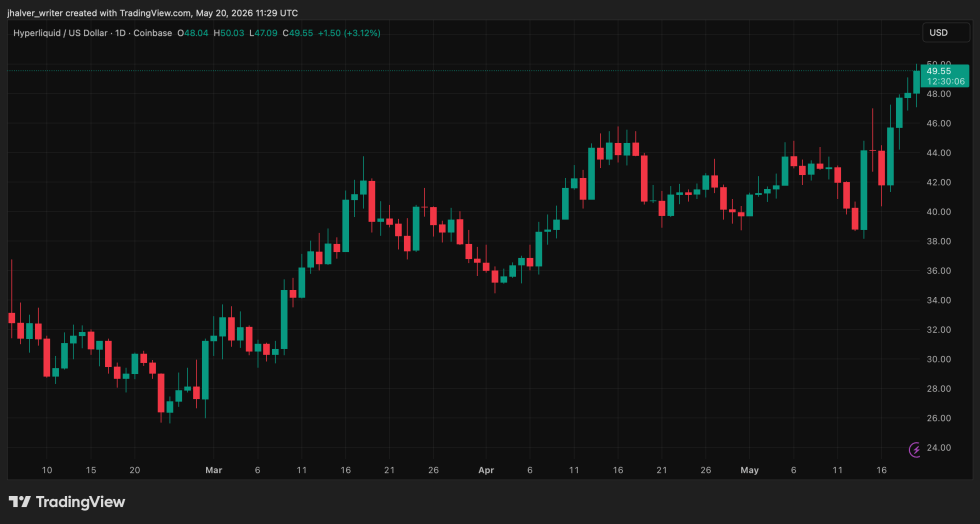
As a researcher, I’ve been looking at these two assets, and what really drives their value isn’t fitting into existing regulations – it’s their decentralized nature and resistance to censorship. Frankly, the CLARITY Act doesn’t offer them much benefit at all. Ultimately, the way this portfolio is constructed *is* the core argument – it’s a statement made through investment.
This is a pivotal and somewhat worrying time for the developing cryptocurrency industry. The U.S. is closer than ever to establishing clear rules for the sector – as demonstrated by the recent activity in the Senate Banking Committee – but a leading Bitcoin advocate has publicly expressed concern that these regulations could actually be detrimental.
Cover image from ChatGPT, HYPEUSD chart from Tradingview
Read More
- Best Controller Settings for ARC Raiders
- Review: Final Fantasy Tactics: The Ivalice Chronicles (PS5) – Still the Benchmark for Turn-Based Tactics
- Mark Zuckerberg & Wife Priscilla Chan Make Surprise Debut at Met Gala
- The Boys Season 5 Officially Ends An Era For Jensen Ackles’ Soldier Boy
- Nippon Sangoku Is The Best New Post-Apocalyptic Anime of Spring 2026
- Elon Musk’s Mom Maye Musk Shares Her Parenting Philosophy
- 10 Greatest Manga Endings of All Time
- The Witcher 3 Officially Reveals Stunning New Ciri Figure Coming 2026
- The WONDERfools ending explained: What happened to the Child of Eternity?
- 7 Great Marvel Villains Who Are Currently Dead
2026-05-20 19:57