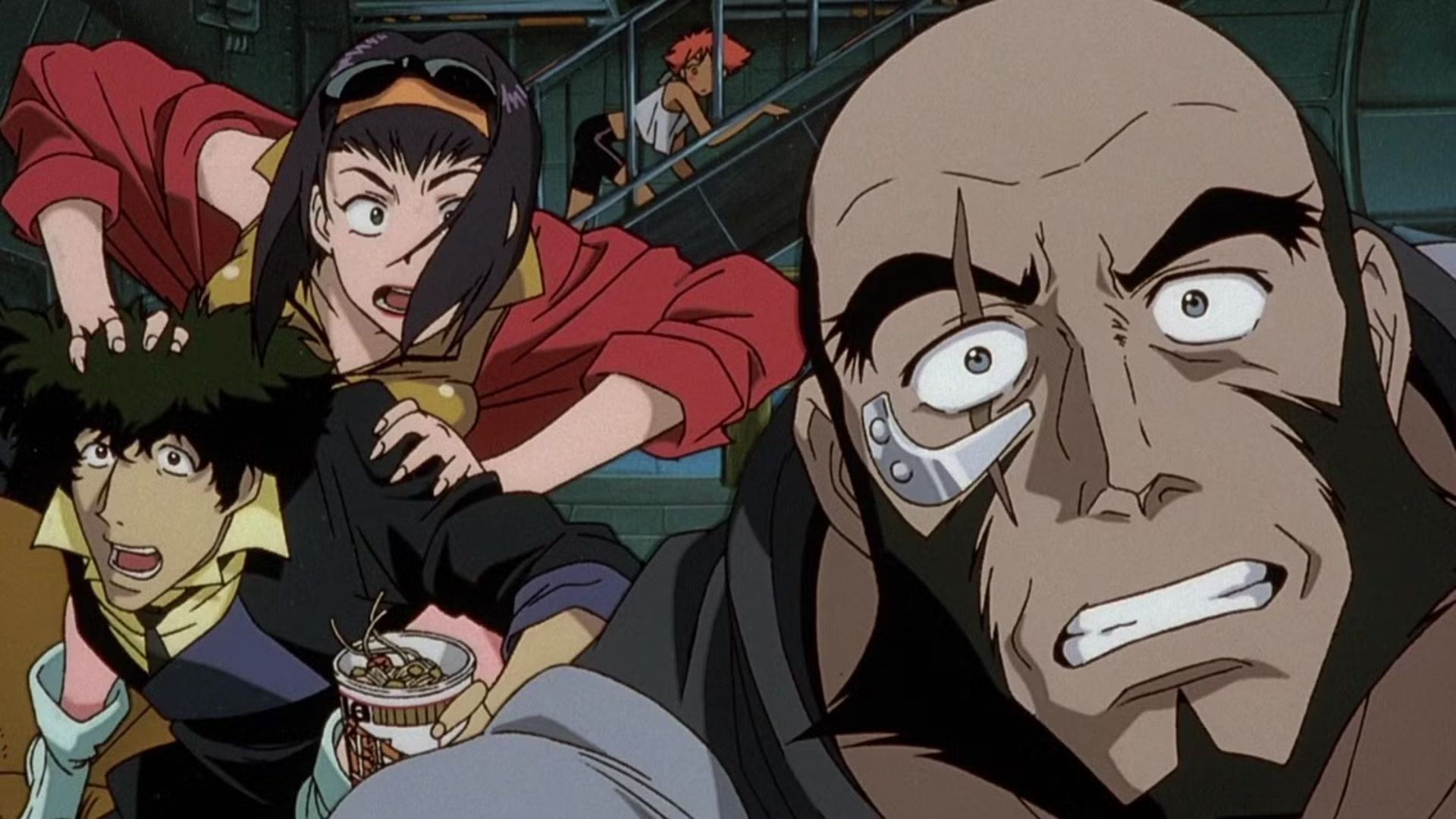
Shinichiro Watanabe’s work is a highly regarded science fiction anime that helped pave the way for the medium during a period of growth in the 1990s. Many anime series have become iconic after their initial release, and continue to gain popularity over time. The ‘90s were a particularly important decade for anime, launching successful franchises like One Piece, Sailor Moon, The Vision of Escaflowne, and Trigun.
While many anime are important and influential, none quite reach the heights of Cowboy Bebop, which boldly took risks, told a compelling story, and created truly memorable characters in a distinctive setting. It’s not surprising so many anime have tried—and failed—to capture that same brilliance. Though Cowboy Bebop was a phenomenal success, a few other essential anime from the 90s actually surpass it in quality and achievement.
Neon Genesis Evangelion Is A Masterpiece That Transcends Its Mecha Package
Though very different in style and story, Cowboy Bebop and Neon Genesis Evangelion are both landmark anime series. They both boldly redefine their genres and are remembered just as much for their incredible endings as for the shows themselves.
Neon Genesis Evangelion appears to be a typical, action-packed mecha show, but it’s actually a deep exploration of what it means to be human. While it includes familiar elements like a hesitant hero piloting a giant robot, the series goes much further, offering a powerful and moving look at depression and the struggle to find oneself.
Neon Genesis Evangelion is a groundbreaking anime that places the responsibility for saving the world on a troubled and isolated teenager. While Cowboy Bebop features well-developed characters who defy typical genre tropes, Evangelion delves into even darker and more emotionally challenging territory. The show is celebrated for its bleak outlook and willingness to explore the depths of its characters’ struggles, ultimately reinventing the mecha genre by taking it apart and rebuilding it in a more complex way.
Initially, Evangelion seems like a typical show with giant robots fighting monsters. However, the series quickly reveals a much deeper and unsettling story about the origins of the robots, how they’re powered, and the pilots who control them – exploring the connection between humans and machines in a surprisingly disturbing way, almost reminiscent of David Cronenberg’s work. This approach brilliantly transforms the often-sterile mecha genre into something much more raw and emotionally impactful. Furthermore, the creatures the robots fight, known as Angels, are bizarre and incomprehensible, far from the standard monster-of-the-week fare.
I absolutely love how Cowboy Bebop is structured – it’s really satisfying with its self-contained episodes, though it doesn’t reach the same depths as Evangelion. And both shows stick the landing with their endings, doing things their own way. But The End of Evangelion? That film is still a huge topic of conversation and, honestly, it’s a masterpiece of unconventional storytelling.
Yu Yu Hakusho’s Adaptive Shonen Storytelling Builds To Superior Character Arcs
While not as widely known as some other classic ’90s action anime like Dragon Ball Z, Yu Yu Hakusho is still considered a timeless masterpiece of the genre. The series centers on Yusuke Urameshi, a rebellious teen who becomes a spirit detective and gets caught up in an epic battle between the human and demon worlds. Yu Yu Hakusho features many familiar elements of action anime, including long tournaments, dramatic character deaths, and powerful transformations.
With just 26 episodes, Cowboy Bebop maintains a consistently high quality, avoiding any weak installments. However, its overall story doesn’t quite reach the same level of depth as Yu Yu Hakusho, which had 112 episodes to develop its plot. Cowboy Bebop tends to be more focused on self-contained episodes, each offering a complete and satisfying story while also revealing pieces of the characters’ backgrounds. Yu Yu Hakusho‘s longer length allows for more extensive character and story development, but it remains engaging without becoming overly drawn out.
I think 112 episodes is the perfect length for this series – it fully explores the story without overstaying its welcome. You could even just watch the Dark Tournament Saga from Yu Yu Hakusho and still have a really complete and satisfying experience, actually it’s longer than Cowboy Bebop. Both shows really benefit from having strong, central characters. Interestingly, in Cowboy Bebop, the crew often splits up into smaller groups or goes their separate ways. This makes their time together feel even more special when they are all together – you really feel that absence.
It’s good to share the focus among characters, even if it means giving Yusuke a break sometimes. The story doesn’t rely solely on him. Plus, both Cowboy Bebop and Yu Yu Hakusho are known for having excellent English dubs, but Yu Yu Hakusho was particularly important for Funimation, now Crunchyroll, as it marked a major improvement in their dubbing work.
Slam Dunk Is A Foundational Sports Anime Rich In Cathartic Growth
It’s amazing how many anime series now feature sports – it feels like almost every hobby has its own anime adaptation. What stands out about Slam Dunk is its simplicity. It doesn’t try to reinvent the genre; instead, it tells a genuinely heartfelt story about Hanamichi Sakuragi, a rebellious high schooler who discovers a passion for basketball and finds a positive outlet for his energy.
Sports anime often feature unlikely heroes, but Slam Dunk stands out because Sakuragi truly falls in love with basketball and his teammates at Shohoku High. The show’s 101 episodes allow for deep character development, a strong sense of teamwork, and a story that builds beautifully to an exciting finale. Watching Sakuragi grow as a player, teammate, and person is incredibly satisfying.
I’m a huge fan of character development, and honestly, Spike Spiegel from Cowboy Bebop is fascinating. While we see him grow over the 26 episodes, it feels like he already has a lifetime of backstory shaping everything he does. It’s like the anime is showing us the result of all that history. Compared to that, Sakuragi’s journey is a bit more chaotic, but I think that ultimately makes it even more impactful and meaningful.
Cowboy Bebop stands out with its unique and thought-provoking structure, mirroring the intricate nature of jazz music. Slam Dunk excels at telling familiar stories in a compelling way, consistently finding fresh and exciting angles. It’s no surprise that Slam Dunk remains a beloved basketball anime even after thirty years, and the 2022 film, The First Slam Dunk, proved a massive hit in theaters.
Serial Experiments Lain’s Prescient Techno-Horror Continues To Impress & Inspire
While many ’90s anime have longer storylines than Cowboy Bebop, allowing them to explore deeper themes, Serial Experiments Lain achieves more with far fewer episodes. Despite being only 13 episodes long – half the length of Cowboy Bebop – it’s a more impactful series. Cowboy Bebop offers an entertaining space western about bounty hunters, but Serial Experiments Lain presents a more thought-provoking future focused on the internet, social media, and the evolving world of digital identity.
Serial Experiments Lain is a deeply unsettling and thought-provoking anime that explores themes of identity and what we leave behind. It tackles surprisingly modern ideas like online avatars, the concept of becoming famous (or infamous) online, and one-sided relationships with public figures. The show’s unique and experimental style is captivating, and it powerfully contrasts the bleakness of everyday life with the vast potential of the digital world, known as The Wired.
While Cowboy Bebop remains a classic and enjoyable anime, Serial Experiments Lain has surprisingly become even more impactful over time – a rare feat for any animated series. Serial Experiments Lain is truly unique, unlike the many other great space westerns and bounty hunter anime, including other works by its creator, Shinichiro Watanabe.
Read More
- GBP CNY PREDICTION
- Elon Musk’s Mom Maye Musk Shares Her Parenting Philosophy
- Elon Musk’s Ex Ashley St. Clair Reveals When Romance Became “Weird”
- 10 Best Free Games on Steam in 2026, Ranked
- Mark Zuckerberg & Wife Priscilla Chan Make Surprise Debut at Met Gala
- Forza Horizon 6 Car List So Far: Confirmed Highlights, Cover Cars, DLC, and Rewards
- 10 Greatest Manga Endings of All Time
- Hollow Knight: Silksong Guide – All 30 Lost Flea Locations
- 38 Years Later, Murder, She Wrote’s Most Overlooked Episode Still Pulls Off TV’s Greatest Crossover
- 20 K-Dramas That Nailed the Perfect Ending
2026-05-26 03:43