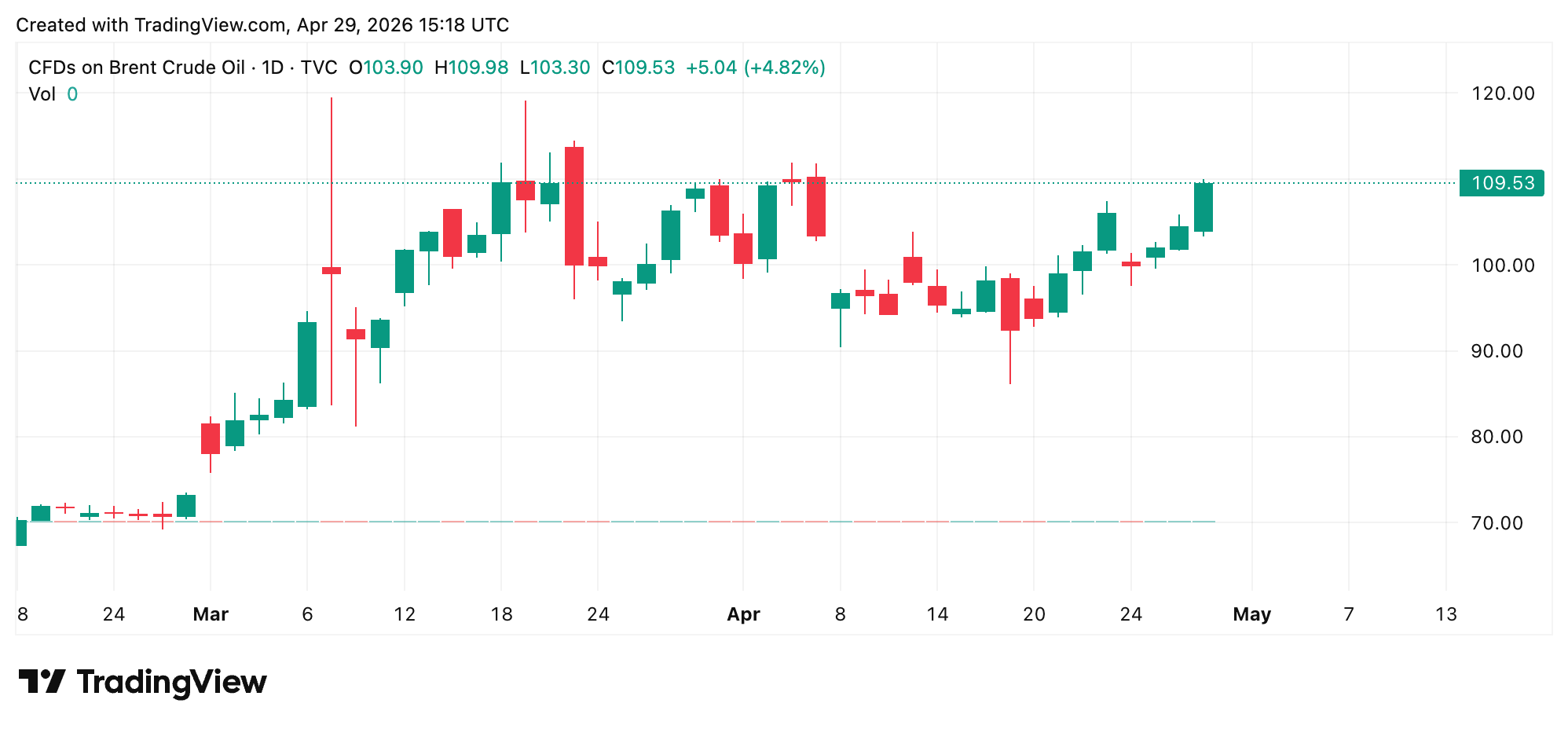
On April 29th, President Trump instructed his staff to plan a long-term naval blockade of Iranian ports. This action caused the price of Brent crude oil to jump above $115 a barrel and significantly worsened a global supply shortage, which the International Energy Agency described as the biggest ever recorded.
Key Takeaways:
- Brent crude climbed above $115 per barrel on April 29 as Trump ordered preparations for an extended Iranian naval blockade.
- The IEA called the Strait of Hormuz shutdown the largest supply shock on record, with 20% of global oil flows halted.
- The Federal Reserve is expected to hold rates steady today, with Chair Jerome Powell’s comments on inflation risks in focus.
Iran Blockade Fears Push Brent Crude Higher, Largest Increase Since June 2022
Brent, the international benchmark, climbed above $115 per barrel on Wednesday, the highest level since June 2022, marking an eighth straight session of gains as concerns over global supply intensified. West Texas Intermediate (WTI) crude, the U.S. benchmark, rose above $102 per barrel as well, gaining for the third straight session, supported by mounting uncertainty around global supply as U.S.-Iran peace talks stalled and the Strait of Hormuz remained effectively closed.
The Strait of Hormuz normally handles roughly 20% of global oil and liquefied natural gas shipments. Since late February, Iran has restricted tanker traffic through the chokepoint to near zero in response to U.S. military pressure. Ongoing U.S.-Iran tensions and the effective closure of the Strait of Hormuz continue to tighten the supply outlook.
Peace negotiations collapsed in Pakistan in mid-April without agreement, and a ceasefire that had been in place since early April remains fragile. President Trump said Iran has called for the U.S. to lift its naval blockade while negotiations continue. Trump, writing on Truth Social, told Iran to “get smart soon” and sign a deal, framing the blockade as a lower-risk alternative to resumed airstrikes.
Iran’s economy is reportedly under severe strain. The country is reporting 53.7% inflation, a record-low rial, and millions of job losses linked to the conflict. The Iranian rial crashed to a record low of approximately 1.8 million (or 1.81 million) per U.S. dollar. Tehran has vowed to keep disrupting Hormuz traffic, claiming it can manage through alternative routes.
Washington is stepping up pressure with potential sanctions targeting Chinese refiners and countries paying transit fees through Hormuz. The UAE announced it will exit OPEC on May 1 to gain production flexibility, though analysts say that move does little to ease the immediate supply crunch while Hormuz remains closed.
Prices have swung sharply since the conflict began. Brent neared $120 per barrel at earlier peaks in 2026 before pulling back on ceasefire hopes. The World Bank has forecast energy prices could rise 24% overall this year under prolonged disruptions, the steepest projected increase since Russia’s invasion of Ukraine in 2022.
The average price for a gallon of regular gas has hit $4.229, the highest since Aug. 2, 2022. Fuel costs are heavily influenced by oil prices, which account for more than half of the price at the pump. With refiners now transitioning to pricier summer-blend gasoline, further pressure at the pump is expected heading into peak driving season.
U.S. Equities and Bonds Remain Rattled
U.S. equity markets edged lower on April 29 as the oil rally compounded existing uncertainty. The S&P 500 edged down 0.20%, the Dow Jones Industrial Average lost 0.27%, and the Nasdaq slipped 0.41%. Hyperscalers Microsoft, Meta, Alphabet, and Amazon, totaling around $11 trillion in market cap, were between 1% and 2% lower ahead of their earnings reports after the bell, set to update their artificial intelligence (AI) capital expenditure.
Visa’s stock price rose by over 5% following a strong quarterly earnings report, while Booking Holdings saw a 4% decrease after its earnings announcement. Despite rising oil prices, stocks considered relatively safe investments managed to maintain their value. European markets generally declined, with the FTSE 100 falling 0.73% and the Stoxx 600 dropping 0.4%.
The 10-year U.S. Treasury yield ticked up to 4.39%, reflecting inflation worries tied to rising energy costs. The Federal Reserve is widely expected to hold rates steady at its meeting today. Chair Jerome Powell is likely to reiterate that policymakers remain data-dependent, with inflation risks elevated while growth remains stable. This is expected to be Powell’s final meeting before his term concludes in May.
A combination of major tech company earnings reports, a Federal Reserve decision, and rising oil prices due to global events has created a very uncertain environment for traders. Markets are changing quickly, and any positive news regarding U.S.-Iran negotiations or the reopening of a key shipping route could cause oil prices to fall, just like previous peace announcements have done. For now, traders are carefully monitoring oil supplies, hints from the Federal Reserve, and developments in global affairs.
Read More
- Best Controller Settings for ARC Raiders
- The Boys Season 5 Officially Ends An Era For Jensen Ackles’ Soldier Boy
- Review: Final Fantasy Tactics: The Ivalice Chronicles (PS5) – Still the Benchmark for Turn-Based Tactics
- Nippon Sangoku Is The Best New Post-Apocalyptic Anime of Spring 2026
- Mark Zuckerberg & Wife Priscilla Chan Make Surprise Debut at Met Gala
- Elon Musk’s Mom Maye Musk Shares Her Parenting Philosophy
- 10 Greatest Manga Endings of All Time
- The Witcher 3 Officially Reveals Stunning New Ciri Figure Coming 2026
- The WONDERfools ending explained: What happened to the Child of Eternity?
- 7 Great Marvel Villains Who Are Currently Dead
2026-04-29 19:30