In the bustling heart of Hong Kong, where the echoes of commerce resound through the narrow alleys and towering skyscrapers, a tempest brews within the sanctum of its securities industry. The guardians of traditional finance, the Hong Kong Securities and Futures Professionals Association, have risen in indignant protest against the proposed regulatory edicts that threaten to shackle their ventures into the realm of cryptocurrency. Oh, the irony! In a land where the fusion of Web3 and traditional finance is proclaimed as the beacon of progress, the very rules intended to foster this union now stand as barriers, as absurd as a carriage driver demanding a license to navigate the stars.
On the twentieth day of January, this august body declared its dissent, bemoaning the eradication of the 10% threshold-a modest allowance that permitted asset managers to dabble in the digital realm without the onerous burden of additional licensing. Imagine, if you will, a portfolio manager, whose only sin is allocating a mere 1% of their fund to Bitcoin-that enigmatic beast of the financial wilderness. Under these draconian proposals, such a manager would be compelled to procure a full virtual asset management license, a task as ludicrous as requiring a fisherman to obtain a pilot’s license for casting his net too far from shore.
The association, with a tone both sardonic and weary, decried this “all or nothing” approach, warning that it would stifle the very innovation it seeks to encourage. “How quaint,” one might muse, “that in our zeal to regulate, we forget the spirit of exploration that once drove us to the moon and beyond.” The government’s lofty goal of integrating Web3 with traditional finance, they argue, is but a mirage if the path is strewn with such bureaucratic thorns.
The Current Framework: A Relic of Simpler Times
Under the existing rules, enshrined in the annals of November 2018, firms holding the Type 9 Asset Management License could venture up to 10% into the crypto realm without additional encumbrances. A simple notification to the Securities and Futures Commission sufficed, a gesture as light as a whisper in the wind. This license, the standard bearer for hedge funds, private equity firms, and asset managers, granted them the privilege to navigate the financial seas on behalf of their clients. But alas, this era of relative freedom now teeters on the brink of extinction.
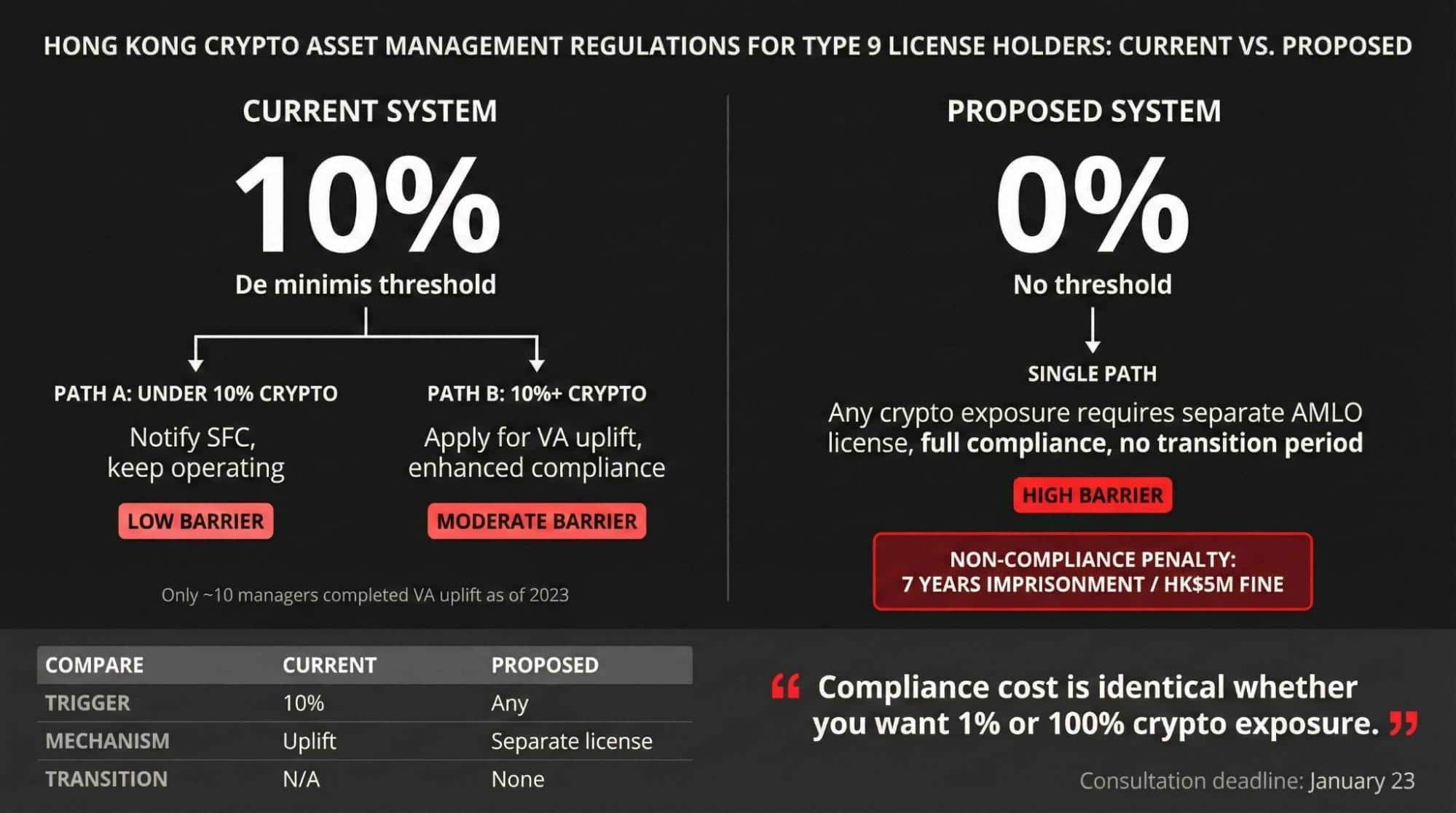
Hong Kong’s proposed crypto licensing changes | Source: FSTB/SFC Consultation Conclusions, December 2025.
The new regime, with its separate licensing under the AML and CTF Ordinance, threatens to replace this simplicity with a labyrinth of compliance. Managers who dare to tread this path without the requisite license face penalties as severe as seven years in the cold embrace of a prison cell and a fine of HK$5 million. One cannot help but wonder if such measures are designed to protect investors or to deter all but the most resolute from venturing into this new frontier.
The SFC, in its December 2025 consultation conclusions, defended this threshold removal with the gravitas of a philosopher justifying the existence of suffering. The need to prevent firms from structuring investments to avoid oversight, they argued, and to maintain consistent investor protection standards, outweighed the burdens imposed on the industry. Yet, one must question whether such rigor is not akin to using a sledgehammer to crack a nut.
The HKSFPA, ever the voice of reason amidst the chaos, also took aim at the proposed custody rules. Mandating that only SFC-licensed firms can hold fund assets, they argued, would be as impractical as requiring a chef to source all ingredients from a single market, regardless of availability or quality. For private equity and venture capital funds, whose very essence lies in investing in early-stage tokens, this rule would be a straitjacket, stifling innovation and growth.
The Broader Regulatory Push: A Grand Vision or a Quixotic Quest?
These proposals, we are told, are part of Hong Kong’s grand strategy to position itself as a global digital asset hub. Christopher Hui, the Secretary for Financial Services and the Treasury, proclaimed these licensing regimes as a significant step in enhancing the legal framework for digital assets. Yet, one cannot help but marvel at the irony of a city accelerating its crypto licensing efforts while simultaneously erecting barriers that may deter the very participants it seeks to attract.
The consultation, which closes on the twenty-third day of January, has already garnered 101 submissions, a testament to the fervor and concern this issue has ignited. Authorities aim to present a legislative bill to the Legislative Council in 2026, yet as of now, no transitional arrangements have been proposed. Managers, it seems, must either obtain the new license before the commencement date or cease all crypto-related activities until they do so. The HKSFPA, ever the advocate for practicality, urges regulators to reinstate the threshold exemption and implement a transitional grace period for existing practitioners. Hong Kong’s broader regulatory roadmap, with its 12 initiatives covering custody services and staking rules, promises much but may deliver little if these concerns are not addressed.
And so, we find ourselves at a crossroads, where the noble pursuit of regulation meets the practical realities of innovation. Will Hong Kong navigate this conundrum with the wisdom of Solomon, or will it succumb to the folly of overreach? Only time will tell, but one thing is certain: the tale of Hong Kong’s crypto licensing saga is far from over, and it promises to be as entertaining as it is enlightening.
Read More
- Gold Rate Forecast
- Dune 3 Gets the Huge Update Fans Have Been Waiting For
- 22 actors who were almost James Bond – and why they missed out on playing 007
- Every Creepy Clown in American Horror Story Ranked
- Jack Osbourne Shares Heartbreaking Tribute to Late Dad Ozzy Osbourne
- Hazbin Hotel Secretly Suggests Vox Helped Create One of the Most Infamous Cults in History
- Arknights: Endfield – Everything You Need to Know Before You Jump In
- Kingdom Come: Deliverance 2 – Legacy of the Forge DLC Review – Cozy Crafting
- Everything We Know About Gen V Season 3 (& Why It’ll Be a Very Different Show)
- As Dougal and friends turn 60, Radio Times explores the magic behind The Magic Roundabout
2026-01-20 15:02