Author: Denis Avetisyan
New research demonstrates the transfer of quantum information across an event horizon-like boundary in a tabletop experiment, shedding light on the long-standing black hole information paradox.
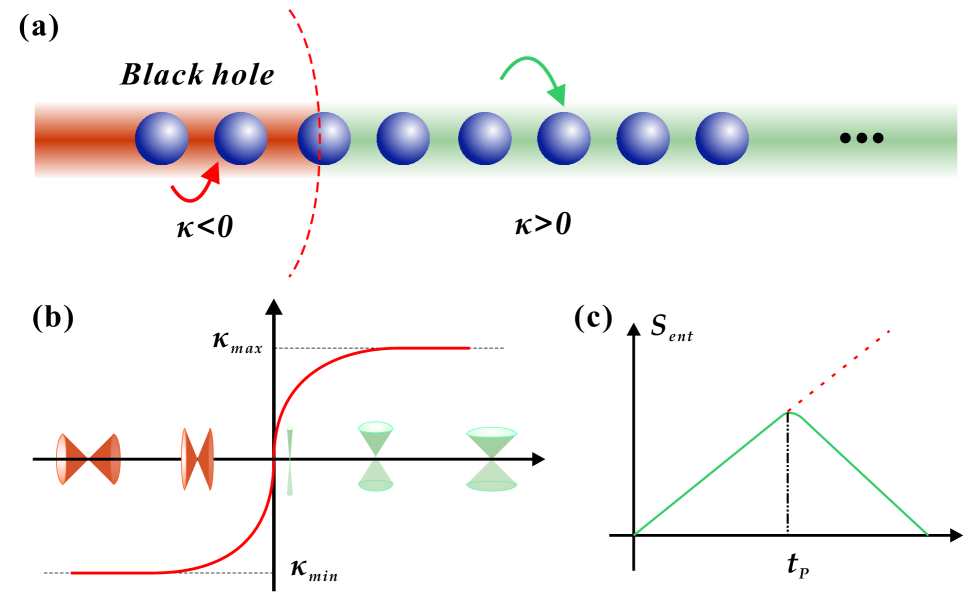
Researchers observe Page curve-like behavior and entanglement transfer in an XY spin chain analogue of an evaporating black hole.
The persistent black hole information paradox challenges fundamental principles of quantum mechanics, positing a conflict between gravity and unitarity. This is explored in ‘Escape of quantum information across an analogue black hole horizon’, which investigates information transfer using a position-dependent coupling in an XY spin chain to simulate an analogue black hole spacetime. The study demonstrates Page curve-like behavior and reveals the successful transmission of quantum resources-entanglement and coherence-across the event horizon via particle radiation. These findings offer a novel perspective on how information might escape black holes, but what further quantum simulations are needed to fully reconcile gravity and quantum information theory?
The Enigmatic Heart of Black Holes: A Paradox of Information
The seemingly simple evaporation of black holes via Hawking radiation presents a profound challenge to the foundations of physics. Stephen Hawking demonstrated that black holes aren’t entirely black, but emit thermal radiation, carrying energy – and crucially, information – away from the black hole. This poses a paradox because quantum mechanics dictates that information cannot be truly destroyed; it must be preserved, even if scrambled. However, if a black hole completely evaporates, taking all the information about what fell into it with it, this fundamental principle is violated. The outgoing Hawking radiation appears to be entirely random, lacking the necessary complexity to encode the information about the infalling matter. This apparent loss of information, if true, necessitates a revision of either quantum mechanics or our understanding of gravity, or potentially, both – suggesting that the universe might not operate under the consistent rules physicists previously believed.
The core of the black hole information paradox lies in a direct confrontation with unitarity, a foundational principle of quantum mechanics. Unitarity dictates that quantum evolution – the way systems change over time – must be information-preserving; in essence, knowing the final state of a system should, theoretically, allow one to reconstruct its initial state. However, Hawking radiation, emitted by black holes, appears to be entirely thermal, carrying no information about what fell into the black hole. This suggests that information is genuinely lost as the black hole evaporates, a direct violation of unitarity and a fundamental challenge to both general relativity – which predicts the black hole’s formation – and quantum mechanics, which governs the behavior of matter at the smallest scales. The apparent incompatibility forces physicists to reconsider long-held assumptions about how gravity and quantum mechanics intertwine, potentially demanding a radical revision of one, or both, of these cornerstones of modern physics.
The resolution to the black hole information paradox may lie within the subtle connections forged through quantum entanglement. Current theoretical frameworks suggest that information isn’t simply destroyed when it falls into a black hole, but rather becomes encoded on the event horizon itself, intricately linked to the outgoing Hawking radiation. This isn’t a physical connection in the traditional sense, but a quantum correlation – a state where the properties of particles inside the black hole are fundamentally intertwined with those escaping as radiation. The degree to which this entanglement can preserve information, essentially creating a ‘copy’ on the exterior, is the subject of intense investigation. Scientists hypothesize that understanding the precise nature of this entanglement – its strength, distribution, and evolution over time – is critical to demonstrating that quantum mechanics remains valid even in the extreme gravitational environment of a black hole, ultimately bridging the gap between general relativity and quantum theory.
The black hole information paradox isn’t merely a theoretical puzzle; its resolution is fundamentally linked to the development of a complete and self-consistent theory of quantum gravity. Current physics operates on two pillars – general relativity, which describes gravity as the curvature of spacetime, and quantum mechanics, governing the behavior of matter at the subatomic level. These frameworks, while remarkably successful individually, clash when attempting to describe the extreme conditions within and around black holes. A satisfactory explanation for what happens to information that falls into a black hole necessitates reconciling these two theories, potentially requiring modifications to either our understanding of spacetime, quantum mechanics, or both. Until the paradox is addressed, the very foundations of physics remain incomplete, hindering the pursuit of a unified framework capable of describing all forces and phenomena in the universe. The quest to solve it drives research into areas like string theory, loop quantum gravity, and holographic principles, all aiming to construct a consistent picture where gravity and quantum mechanics coexist harmoniously.
Entanglement: A Potential Pathway to Information Preservation
Quantum entanglement proposes a mechanism for information preservation during black hole evaporation that avoids complete information loss. Rather than being destroyed, information about infalling matter is theorized to become correlated with the emitted Hawking radiation through entanglement. This means the information isn’t locally accessible in either the black hole or the radiation independently, but remains encoded in the quantum correlations between them. The degree of this correlation is quantifiable, suggesting information isn’t truly lost, but rather scrambled and distributed across the entangled particles, potentially retrievable through complete knowledge of the entangled system’s state.
Entanglement entropy serves as a quantifiable measure of the correlation between a black hole and the Hawking radiation it emits. This entropy, derived from quantum information theory, directly relates to the black hole’s internal state; higher entanglement corresponds to a more complex internal configuration. Calculations of entanglement entropy in the early stages of black hole evaporation demonstrate consistency with theoretical predictions based on quantum gravity models. Specifically, the rate of entanglement growth and its scaling with the black hole’s area align with expectations from the Bekenstein-Hawking formula S = \frac{A c^3}{4G\hbar}, providing empirical support for the preservation of information during the evaporation process.
The Anti-de Sitter/Conformal Field Theory (AdS/CFT) correspondence is a theoretical framework positing an equivalence between quantum gravity in a specific spacetime – Anti-de Sitter space (AdS) – and a quantum field theory (CFT) residing on its boundary. This duality suggests that all physical phenomena occurring within the AdS spacetime, including those within a black hole, have a corresponding description within the CFT, which does not involve gravity. Critically, the CFT is a unitary theory, meaning it preserves information. Therefore, if the AdS/CFT correspondence holds, information seemingly lost within the black hole in the AdS spacetime is actually preserved and encoded in the correlations of the boundary CFT, offering a potential resolution to the black hole information paradox. The correspondence doesn’t explain how information is preserved, but establishes a theoretical setting where information preservation is guaranteed by the properties of the equivalent field theory.
The holographic principle, formalized through the AdS/CFT correspondence, posits a duality where quantum gravity within a volume of spacetime is equivalent to a quantum field theory residing on its boundary. Consequently, all information describing the black hole’s interior, which would otherwise be lost according to classical general relativity, is fully encoded in the quantum entanglement patterns of the boundary field theory. The degree of entanglement between different regions of this boundary field theory directly corresponds to the geometry and state of the black hole’s interior; changes within the black hole manifest as alterations in entanglement on the boundary. This means the information isn’t destroyed, but rather re-expressed as correlations within the boundary field theory’s degrees of freedom, allowing for its potential recovery via analysis of these entanglement structures.
Simulating Black Holes: Insights from Quantum Spin Chains
The XY spin chain, a one-dimensional model in condensed matter physics, is utilized as an analog system to investigate phenomena associated with black hole spacetimes. This chain consists of interacting quantum spins, and its mathematical properties allow for the simulation of curved spacetime geometries. Specifically, the chain’s effective “speed of sound” – the velocity at which excitations propagate – can be manipulated to represent the increasing gravitational forces near a black hole. A region where this speed drops to zero effectively models the event horizon, preventing information from escaping. By studying excitations within this analog spacetime, researchers can explore concepts such as Hawking radiation and information loss in a controlled, laboratory setting, bypassing the complexities of directly observing astrophysical black holes.
The simulation of curved spacetime geometry within the XY spin chain is achieved through the implementation of site-dependent coupling strengths. Specifically, the coupling constant J_{ij} between neighboring spins i and j is varied along the chain’s length to represent the spatially varying gravitational potential near a black hole. A stronger coupling indicates a greater attractive force, analogous to a stronger gravitational pull, while weaker coupling represents a weaker pull. This gradient in coupling effectively creates a ‘potential well’ mimicking the spacetime curvature, with the region of strongest coupling representing the black hole horizon. By precisely controlling these coupling parameters, researchers can map the behavior of particles and quantum information within this analog spacetime, offering insights into the effects of gravity on quantum systems.
Entanglement entropy, a measure of quantum correlation, is calculated within the XY spin chain model to characterize information dynamics analogous to those near a black hole horizon. Specifically, researchers examine how entanglement between spins changes as a virtual horizon is introduced, providing quantifiable data related to information transfer across this boundary. The rate of entanglement loss is directly correlated to the emission of Hawking radiation – the theoretical thermal radiation emitted by black holes – allowing for empirical investigation of this phenomenon in a controlled laboratory setting. By analyzing the scaling of entanglement entropy with system size, researchers aim to determine if information is truly lost during black hole evaporation, or if it is preserved in a subtle, quantum mechanical form, consistent with the holographic principle and unitarity.
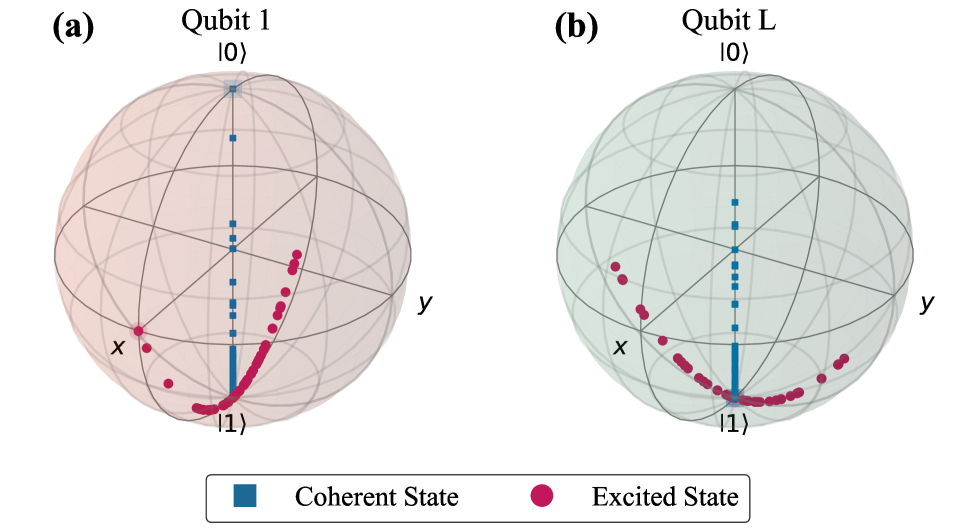
The spin chain model facilitates a controlled examination of quantum coherence during black hole evaporation by providing a platform to observe the evolution of entangled states. Information loss in black holes is a long-standing paradox; however, quantum mechanics dictates information must be conserved. Utilizing the spin chain, researchers can track the entanglement entropy – a measure of quantum correlation – to determine if information is truly lost as the simulated black hole evaporates, or if it is encoded in the Hawking radiation. Specifically, the model allows manipulation of the system to observe how quantum coherence, the superposition of quantum states, affects the preservation of initial information within the outgoing radiation, testing whether coherence mechanisms can prevent complete information loss during the evaporation process. This allows for quantitative analysis of the relationship between quantum coherence and information retrieval in a simplified, experimentally accessible system.
Decoding the Subtle Signals: Measuring Quantum Coherence and Entanglement
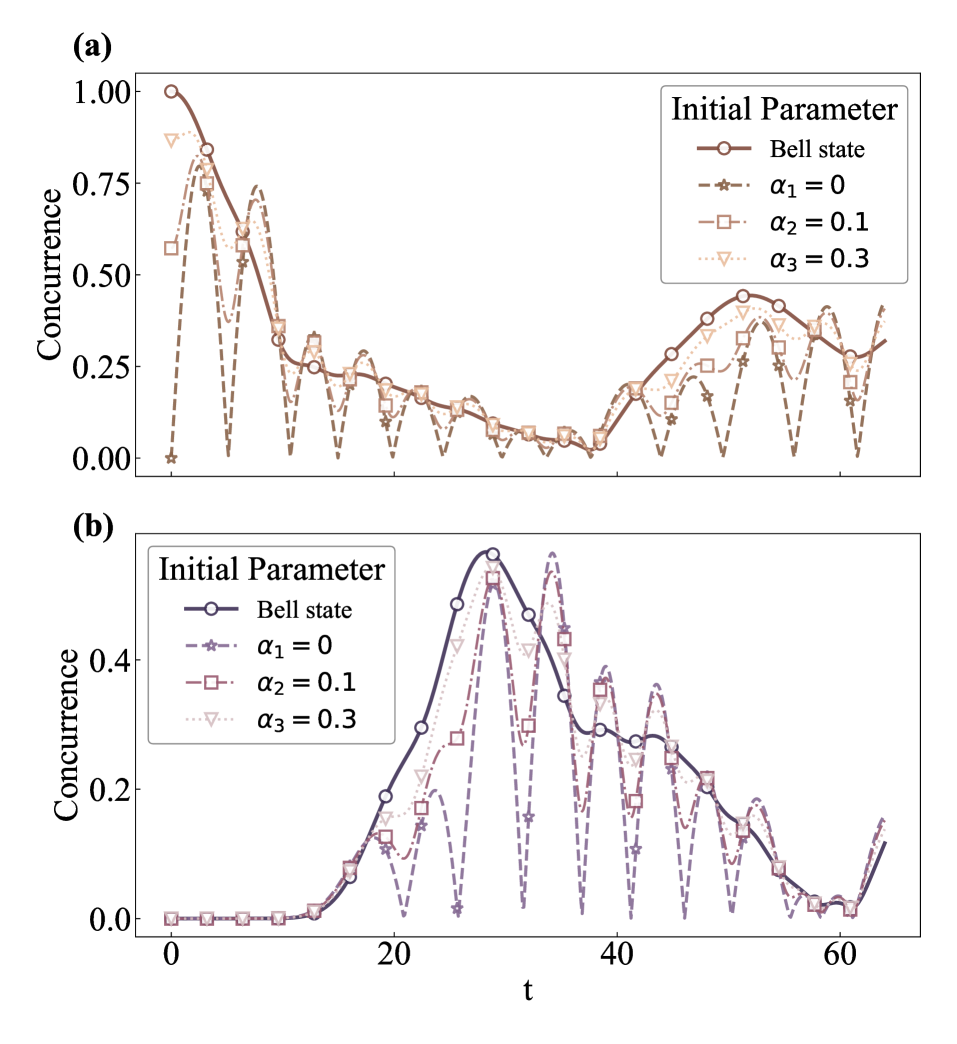
Quantum coherence, the property allowing quantum systems to exist in multiple states simultaneously, is notoriously difficult to measure as it degrades over time. Recent research leverages the l_1-norm to provide a quantifiable metric for this ephemeral phenomenon during simulated black hole evaporation. This mathematical tool assesses the extent to which the phase relationships between quantum states are maintained as the system evolves, effectively gauging the ‘quantumness’ of the emitted radiation. A higher l_1-norm value indicates stronger coherence and a greater capacity to preserve information, while a decreasing value signals the loss of these delicate quantum correlations. By tracking the l_1-norm throughout the evaporation process, scientists gain critical insights into how information is encoded and potentially recovered from Hawking radiation, challenging the long-held belief of information loss in black holes.
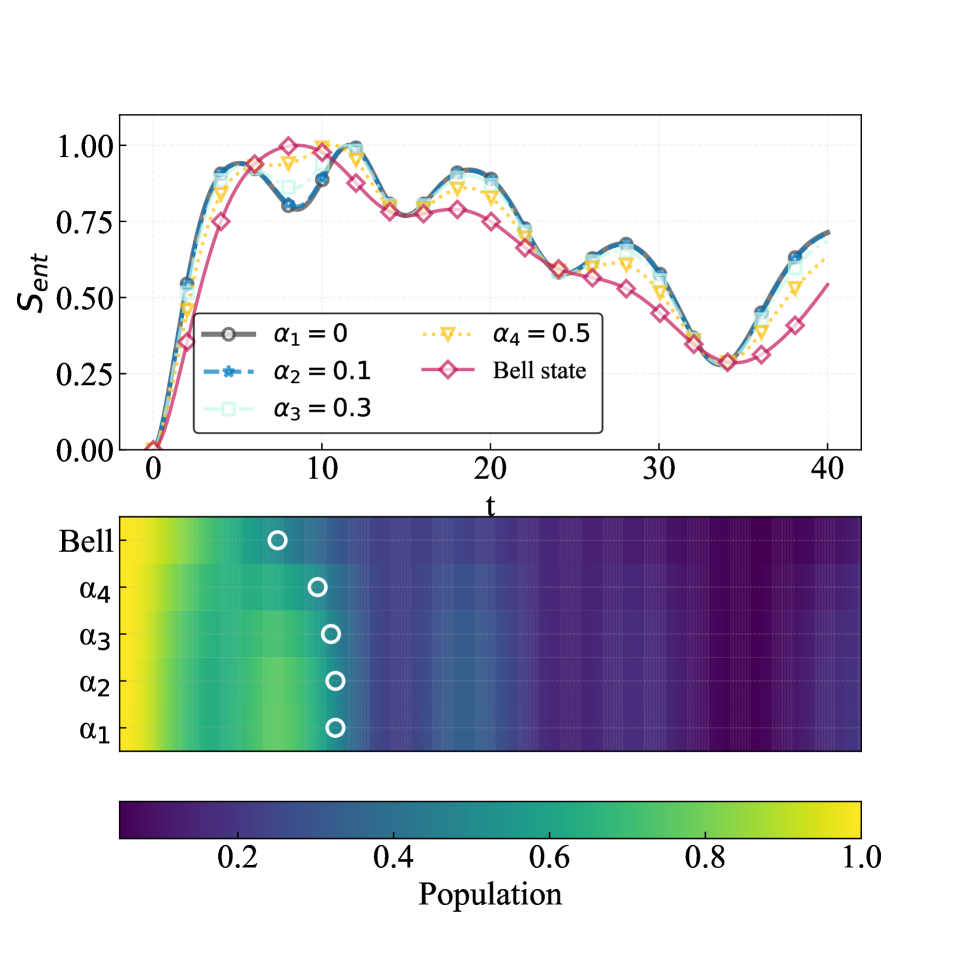
The evolution of entanglement entropy, charted by the Page Curve, provides compelling evidence against information loss in black hole evaporation. This curve depicts how entanglement between the black hole and its emitted Hawking radiation changes over time, and recent analyses demonstrate striking agreement with theoretical predictions. A critical point on this curve, known as the ‘Page time’, marks the moment when roughly half of the initial quantum excitations have escaped the black hole. This isn’t merely a mathematical milestone; it signifies a crucial transition where the black hole’s internal state begins to become increasingly discernible in the Hawking radiation. Before the Page time, entanglement grows, suggesting information is still largely contained within the black hole; afterward, it decreases, implying the beginnings of information recovery through the emitted particles. This behavior strongly supports the idea that information isn’t destroyed but rather subtly encoded in the complex quantum correlations of the Hawking radiation, resolving a long-standing paradox in theoretical physics.
Researchers leverage Von Neumann Entanglement Entropy to dissect the subtle relationships within a simulated black hole’s evaporation. This measure doesn’t simply state that entanglement exists, but precisely quantifies the amount of quantum correlation shared between the Hawking radiation emitted and the remaining interior of the spin chain. By calculating this entropy, scientists gain a detailed understanding of how information, initially contained within the black hole, becomes encoded in the emitted particles. A higher entropy value suggests a greater degree of information transfer, while changes in entropy over time reveal the dynamics of information recovery. The ability to pinpoint and measure this entanglement is crucial for testing the theoretical predictions surrounding black hole information paradox, specifically addressing whether information is truly lost or merely scrambled and retrievable from the Hawking radiation via these quantum correlations.
Current research into black hole evaporation suggests information isn’t simply destroyed, but rather intricately preserved within the emitted Hawking radiation. Utilizing measures like the l1-norm of quantum coherence and Von Neumann entanglement entropy, physicists are beginning to map how information-initially contained within the black hole-becomes encoded in subtle quantum correlations between the escaping particles. This isn’t a straightforward retrieval process; the information isn’t plainly visible, but rather distributed across all emitted radiation in a highly complex manner. The Page curve, detailing the growth of entanglement entropy, provides a crucial timeline, with the ‘Page time’ indicating when sufficient correlations have formed to potentially recover the initial information. These analytical techniques represent a powerful pathway towards resolving the black hole information paradox and demonstrating that quantum mechanics adheres to the principle of information conservation, even in the most extreme gravitational scenarios.
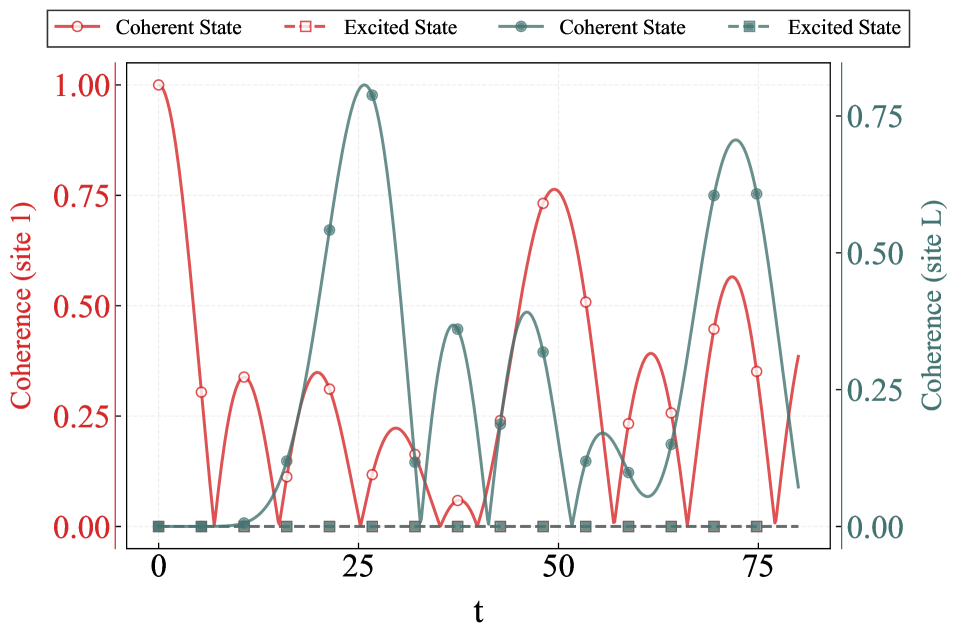
The research detailed in this study offers a compelling analogue for examining the black hole information paradox, specifically through the observation of Page curve-like behavior. This emergent property, demonstrating the eventual release of information seemingly lost behind the event horizon, underscores a fundamental principle of quantum mechanics-unitarity. As Georg Wilhelm Friedrich Hegel observed, “The truth is the whole.” This mirrors the study’s focus; the complete picture of information transfer, revealed through careful observation of entanglement and coherence within the XY spin chain, suggests that information isn’t truly lost, but rather encoded and re-emerges in a different form, echoing the holistic nature of reality and the preservation of quantum states.
Where Do We Go From Here?
The demonstration of Page-like curves in an analog system, while a compelling step, merely shifts the locus of inquiry. The fundamental question regarding information preservation across event horizons isn’t solved by showing information escapes, but by understanding how the underlying quantum gravity encodes this preservation. The XY spin chain serves as a useful model, but it is, ultimately, a simplification. The real universe doesn’t conveniently offer a discrete, easily modeled system. Scalability in these analog experiments risks becoming acceleration toward chaos if not grounded in a deeper theoretical framework.
Future work must confront the limitations of these condensed matter analogs. Exploring different physical realizations – perhaps leveraging other quantum platforms or extending the model to incorporate more complex interactions – could reveal whether the observed phenomena are robust or artifacts of the chosen system. A critical focus should be placed on rigorously quantifying the entanglement structure and coherence properties of the escaping radiation, moving beyond mere curve-fitting to a genuine understanding of the quantum states involved.
It is easy to become enamored with the elegance of a reproduced curve, but every pattern reflects the developer’s ethics. Privacy is not a checkbox, but a design principle, and similarly, unitarity is not merely a mathematical requirement, but a statement about the fundamental nature of reality. The challenge lies not simply in resolving the paradox, but in ensuring that the resolution aligns with a consistent and ethically sound understanding of quantum gravity.
Original article: https://arxiv.org/pdf/2602.07043.pdf
Contact the author: https://www.linkedin.com/in/avetisyan/
See also:
- Gold Rate Forecast
- Arknights: Endfield – Everything You Need to Know Before You Jump In
- Every Creepy Clown in American Horror Story Ranked
- Chill with You: Lo-Fi Story launches November 17
- 10 Best Buffy the Vampire Slayer Characters Ranked
- Best X-Men Movies (September 2025)
- Spider-Man: Brand New Day’s Trailer Release Date Officially Confirmed & The MCU’s Strategy Is Perfect
- Hazbin Hotel Secretly Suggests Vox Helped Create One of the Most Infamous Cults in History
- 22 actors who were almost James Bond – and why they missed out on playing 007
- 40 Inspiring Optimus Prime Quotes
2026-02-10 15:50