The cryptocurrency industry is at a critical turning point. The US Senate Banking Committee will vote on the CLARITY Act this Thursday, May 14th. This vote will decide if the proposed rules for digital assets – potentially the most extensive set of rules in US history – move forward or go back for further discussion. This is happening at a time when activity on blockchain networks is increasing, making the details of this legislation particularly important.
XWIN Research Japan recently highlighted data from CryptoQuant that illustrates the increasing importance of stablecoins. Their analysis of active ERC-20 stablecoin addresses shows a significant jump in usage starting in late 2025, peaking around 600,000 in 2026. This isn’t just about more stablecoins being available; it indicates a real increase in people actually using them for transactions on the blockchain. For the first time, stablecoins are being used as a practical way to send and receive payments at a substantial scale.

The CLARITY Act is adding a new layer to the developing world of digital currencies. The proposed law creates a key difference between two types of stablecoins: those used simply for payments, which the bill seems intended to support and make legal, and those that offer interest or rewards, which would face stricter rules.
Following the GENIUS framework, which already prevents stablecoin issuers from paying interest just for holding their coins, a new proposal called CLARITY expands these rules to include exchanges, custodians, brokers, and wallet providers. This aims to stop the practice of offering high APYs – typically 3% to 5% – simply for holding stablecoins like USDC, a model that has become popular with many users.
The CLARITY Act Is A Boundary. And The Boundary May Actually Help
XWIN Research Japan’s analysis clarifies that the CLARITY Act isn’t a sweeping attempt to regulate all stablecoins. The bill doesn’t outlaw stablecoins or target decentralized finance (DeFi) in general. Instead, it seems focused on a specific goal: officially classifying stablecoins as regulated payment systems and clearly differentiating them from traditional bank deposits that offer interest.
The line isn’t firm. Earning rewards by actively using crypto – like providing liquidity, staking, participating in governance, or lending with collateral – might still be allowed under certain circumstances. The CLARITY Act focuses on differentiating between simply holding a stablecoin and earning from it versus actively participating in financial activities. The Act aims to stop passive earnings from just holding stablecoins, but seems to allow continued opportunities for those who actively use them in financial systems.
This law mainly targets centralized companies like exchanges, custodians, brokers, and wallet providers that offer interest-bearing products similar to banks. Truly decentralized systems and individuals managing their own funds aren’t the main focus of these regulations.
Our analysis suggests a positive outlook that goes beyond just stablecoins. When the rules are clear for payment systems, it encourages growth in related areas like digital representations of US Treasury bonds, products backed by real-world assets, and the overall financial infrastructure built on blockchains. Because stablecoins are essential for dollar-based transactions in the crypto world, increasing their regulated use can lead to more money flowing into Bitcoin over the long term, just as we’ve seen in the past.
As an analyst, I’m watching Thursday’s vote closely. It will decide if this new framework is officially enacted into law, or if it goes back for more discussion. Interestingly, the data we’re seeing on the blockchain indicates the market has already been trending in the same direction this legislation aims to establish.
Stablecoin Dominance Declines As Capital Gradually Returns To Risk Assets
As an analyst, I’ve been tracking stablecoin dominance, and it’s currently around 12.1%. We’ve seen a consistent decline from a peak of over 14% back in February. This shift suggests that capital is moving back into riskier crypto assets after the market correction we experienced in the first quarter. Looking at the data, stablecoin dominance really jumped during February’s sell-off, as investors rushed to the safety of dollar-pegged assets when Bitcoin and other cryptocurrencies faced significant selling pressure.
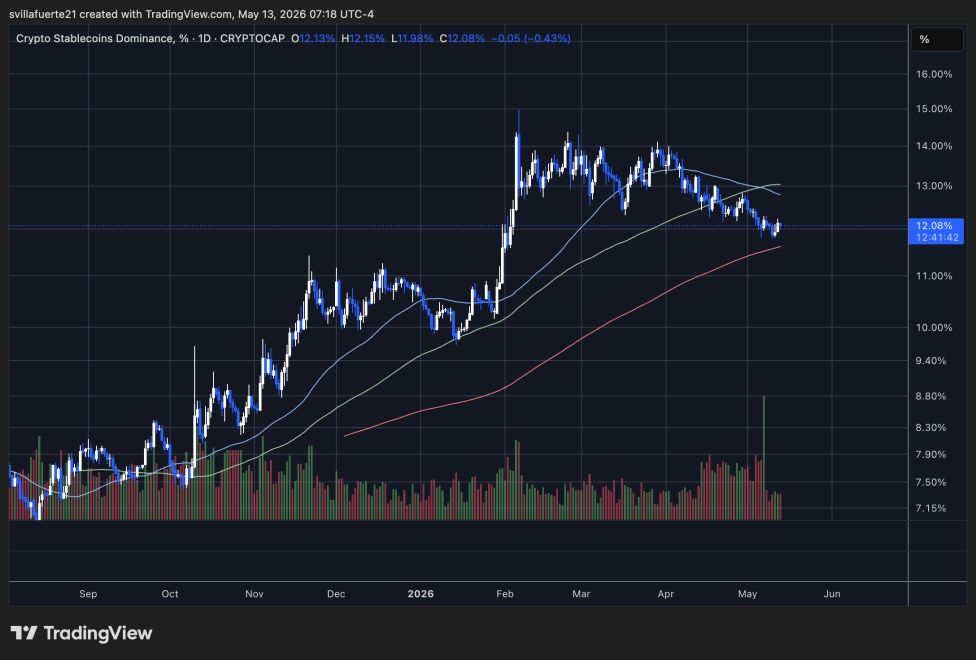
The recent peak of over 14% in stablecoin dominance was one of the highest we’ve seen in this market cycle, and it happened right when fear was at its peak and many people were forced to sell. Generally, when stablecoins become more dominant, it suggests traders are becoming more cautious, moving away from risky investments and holding onto stablecoins until the market becomes more predictable.
As an analyst, I’ve been watching a shift in the market structure since March. We’ve seen stablecoin dominance decline, falling below its 50-day moving average and now approaching the 100-day moving average around 12%. This suggests that some of the capital that sat on the sidelines during the recent correction is slowly starting to move back into the market.
Currently, the strength of the market is still higher than what we typically see during the most hyped parts of past bull markets. This suggests a lot of cash is still held in stablecoins, and people aren’t rushing to invest in riskier assets just yet.
Read More
- FRONT MISSION 3: Remake coming to PS5, Xbox Series, PS4, Xbox One, and PC on January 30, 2026
- Taylor Sheridan’s Gritty 5-Part Crime Show Reveals New Final Season Villain
- The Boys Season 5, Episode 5 Ending Explained: Why Homelander Does THAT
- Mark Zuckerberg & Wife Priscilla Chan Make Surprise Debut at Met Gala
- ‘The Bride!’ Review: Jessie Buckley Breathes Life into a Monstrous Mess
- Invincible Season 4 Episode 4 Post-Credits Unveils a Demonic Return & More
- Welcome to Demon School! Iruma-kun season 4 release schedule: When are new episodes on Crunchyroll?
- From season 4 release schedule: When is episode 2 out on MGM+?
- Why There’s No Ghosts Tonight (Nov 27) & When Season 5, Episode 7 Releases
- Ashley’s Powers in The Boys Season 5 Explained & Why They Don’t Work On [SPOILER]
2026-05-14 06:58