Author: Denis Avetisyan
Researchers have demonstrated the creation of novel light-matter quasiparticles in layered superconductor/ferroelectric materials, paving the way for exploring quantum phenomena at terahertz frequencies.
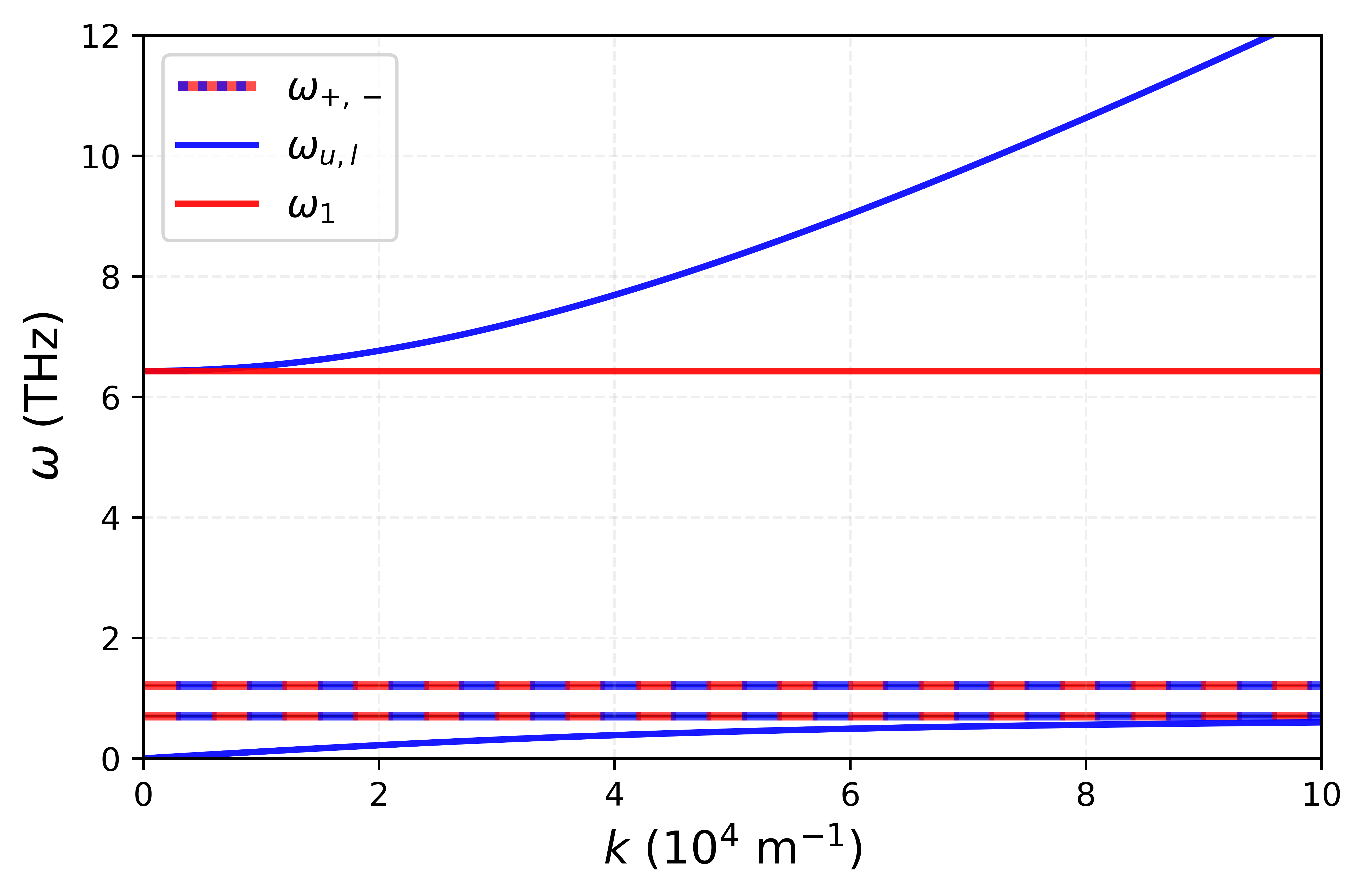
This work details the observation of ferron-polaritons in superconductor/ferroelectric/superconductor heterostructures and their potential for strong light-matter coupling.
Strong light-matter interactions are typically limited by weak electrical dipole strengths, hindering the development of high-speed quantum technologies. This work, ‘Ferron-Polaritons in Superconductor/Ferroelectric/Superconductor Heterostructures’, predicts and demonstrates the formation of ferron-polaritons – hybrid quasiparticles arising from the ultrastrong coupling between ferroelectric excitations (ferrons) and \text{Swihart photons} within a specifically designed heterostructure. The resulting terahertz spectral gap, orders of magnitude larger than magnetic analogues, showcases the superior strength of electric dipole interactions in this system. Could this novel platform pave the way for exploring extreme light-matter coupling and realizing terahertz-frequency ferroelectric quantum devices?
Unveiling Emergent Order: The Ferron as a Fundamental Excitation
The intricate behavior observed in condensed matter systems often arises not from the properties of individual particles, but from their collective interactions. These interactions give rise to collective excitations – emergent phenomena where the system behaves as a unified whole, exhibiting properties not present in its constituents. Consider a seemingly static crystal; its atoms aren’t motionless, but constantly vibrating in coordinated ways, forming waves of motion known as phonons. Similarly, in magnetic materials, spin waves, or magnons, represent collective oscillations of electron spins. These excitations aren’t merely disturbances; they are fundamental modes of the system, dictating its thermal, optical, and electrical characteristics. Understanding these collective behaviors is therefore crucial to unlocking the secrets of materials, allowing scientists to predict and manipulate their properties for advanced technologies, and paving the way for the discovery of entirely new states of matter.
Just as magnons mediate interactions and carry excitations in magnetic materials, ferrons represent a newly understood form of collective behavior within ferroelectrics. These quasiparticles emerge from the coordinated displacement of ions within the material’s structure, effectively acting as vibrational modes of the ferroelectric polarization. Unlike individual atomic movements, ferrons involve the simultaneous and correlated motion of many ions, creating a robust and quantifiable excitation. This concept offers a promising pathway for manipulating and controlling ferroelectric polarization at a fundamental level, potentially leading to the development of novel devices with enhanced performance and functionality – for example, advanced memory storage or highly sensitive sensors – by precisely tuning the material’s response to external stimuli.
The dynamic behavior of ferroelectric materials isn’t simply a chaotic jumble of atomic movements; rather, it arises from the quantization of collective polarization waves, manifested as discrete units called ferrons. These ferrons, akin to quasiparticles, represent a fundamental excitation mode within the ferroelectric lattice, enabling a deeper understanding of how polarization evolves over time. By treating polarization not as a continuous field, but as composed of these distinct ferron units, researchers can model and potentially control the material’s response to external stimuli with unprecedented precision. This quantization allows for the prediction of novel phenomena and opens avenues for designing advanced ferroelectric devices where polarization can be manipulated at the level of these fundamental, discrete excitations – effectively harnessing the building blocks of ferroelectric motion.
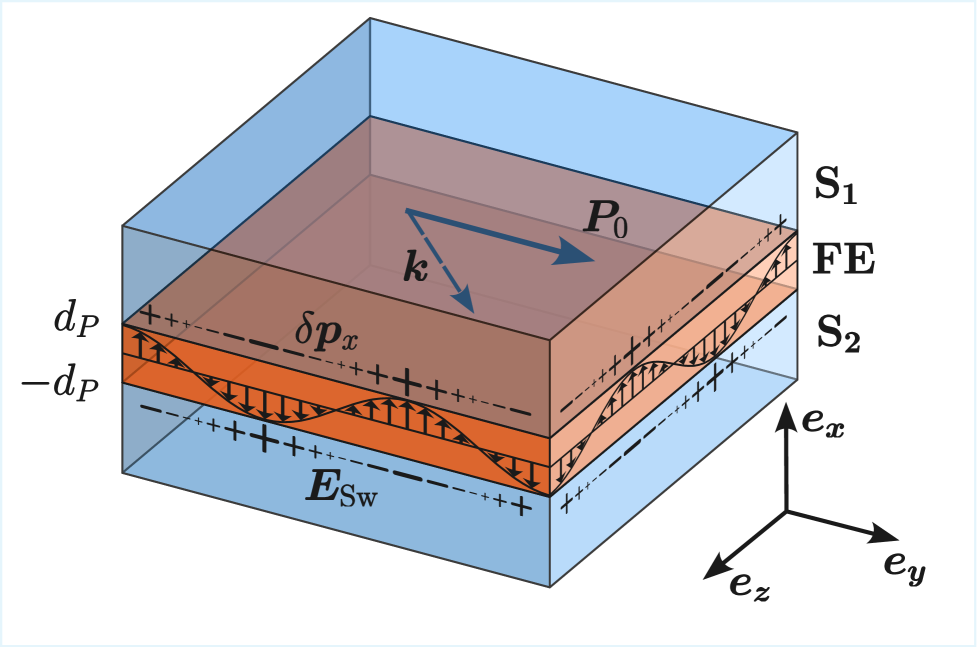
Engineering Control: The S/FE/S Heterostructure as a Platform for Interaction
Superconducting/ferroelectric/superconducting (S/FE/S) heterostructures are engineered by layering a ferroelectric material between two superconducting films. This arrangement is not random; the superconducting layers are chosen to induce proximity effects in the ferroelectric, allowing for external control of its polarization. Common materials include niobium or aluminum as the superconductors, paired with barium titanate or similar perovskite structures for the ferroelectric layer. The thin-film deposition techniques, such as pulsed laser deposition or molecular beam epitaxy, are crucial for creating interfaces with atomic-level precision and controlling the layer thicknesses, typically on the nanometer scale. The resulting heterostructure facilitates the study of interactions between superconductivity and ferroelectricity and provides a platform for novel device concepts.
Superconducting/ferroelectric/superconducting (S/FE/S) heterostructures enable manipulation of ferroelectric order via proximity effects, where the superconducting layers influence the polarization state of the intervening ferroelectric material. This interaction arises from the penetration of the superconducting screening length into the ferroelectric, modifying the electrostatic environment and, consequently, the ferroelectric’s energy landscape. Specifically, the presence of Cooper pairs in the superconductor can induce charge accumulation or depletion at the FE interface, altering the critical field for polarization switching and potentially driving a transition to a new ferroelectric phase. The magnitude of this effect is dependent on the thickness of the layers, the material properties of both the superconductor and the ferroelectric, and the temperature of the system.
The thin film approximation is a critical simplification employed in the analysis of S/FE/S heterostructures due to the systems’ inherent complexity. This approximation assumes that the dimensions of the constituent thin films are significantly smaller than any relevant wavelengths or characteristic lengths, effectively reducing the problem to a two-dimensional analysis. By neglecting variations in properties perpendicular to the film plane, computational demands are substantially lowered, allowing for tractable calculations of parameters such as polarization, screening, and interfacial effects. This simplification is valid when film thicknesses are on the nanometer scale, enabling the use of analytical and numerical methods to model the interplay between superconducting and ferroelectric layers and predict device behavior.
Witnessing Hybridization: The Emergence of the Ferron-Polariton
The ferron-polariton arises from the strong coupling of ferrons – localized, symmetry-broken excitations within the superconducting material – and Swihart photons. Swihart photons are electromagnetic modes specifically confined within the superconductor due to its material properties and geometry. This strong coupling, occurring when the interaction energy between the ferrons and photons exceeds their individual energies, results in the formation of a mixed excitation – the ferron-polariton – possessing characteristics of both constituent elements. The interaction fundamentally alters the behavior of both the ferrons and the photons, leading to the creation of new energy levels and modified dispersion relations.
The ferron-polariton constitutes a novel quantum state of matter arising from the hybridization of ferroelectric excitations – ferrons – and photons. This composite excitation inherits characteristics from both constituent elements; it demonstrates the collective behavior expected of a ferroelectric system, specifically a spontaneous electric polarization, alongside the wave-like properties associated with photons, such as a defined wavelength and energy. Consequently, the ferron-polariton exhibits both electrical and optical responses, differing from traditional ferroelectrics or purely photonic materials and presenting opportunities for manipulating both electric and optical properties within a single system.
The observation of distinct ferron-polariton properties necessitates achieving the ultra-strong coupling regime, a condition where the interaction energy between ferrons and Swihart photons exceeds the energy of either excitation. This strong interaction fundamentally alters the system’s behavior, evidenced by the formation of a coupling gap – a region devoid of excitations – typically on the order of several terahertz (THz). The magnitude of this coupling gap is directly proportional to the strength of the light-matter interaction and serves as a key indicator of the hybrid excitation’s formation and unique characteristics, distinguishing it from weakly coupled systems where such a gap is absent or significantly smaller. \hbar g \gg \hbar \omega_R , where g is the coupling strength and \omega_R is the resonant frequency of the excitation.
Internal Dynamics: The Decisive Role of Depolarization
The intrinsic polarization within ferroelectric materials creates a powerful internal electric field – the depolarization field – that fundamentally governs the behavior of ferrons, nanoscale magnetic domains exhibiting unique properties. This field isn’t merely a passive characteristic; it actively tunes the energy landscape experienced by ferron-polaritons, quasiparticles arising from the strong coupling between ferrons and the ferroelectric polarization waves. Consequently, the depolarization field dictates the ferron’s stability, size, and ultimately, its dynamic response to external stimuli, providing a built-in mechanism for manipulating these magnetic entities at the nanoscale. This interplay between electric polarization and magnetic domains opens avenues for designing novel devices where magnetic properties are directly controlled by an applied electric field, bypassing the need for conventional magnetic control methods.
The ferroelectric material’s internal electric field provides a powerful means of manipulating the ferron-polariton, a quasiparticle arising from the interaction between magnetic textures and light. This tuning occurs through direct modification of the polariton’s energy and lifetime; alterations to the field strength effectively reshape the potential landscape experienced by the polariton, influencing its propagation and stability. Consequently, this dynamic control opens possibilities for engineering novel optomagnetic devices and exploring coherent control schemes at terahertz frequencies, where the ultrastrong coupling regime allows for substantial manipulation of light-matter interactions and the creation of potentially revolutionary technologies.
Recent investigations reveal an unexpectedly potent interaction between light and matter within these ferroelectric systems, manifesting as ultrastrong coupling with energy gaps extending into the terahertz range. This coupling strength dramatically surpasses that observed in comparable systems relying on magnetic interactions – such as superconductor/ferromagnet/superconductor (S/F/S) or superconductor/antiferromagnet/superconductor (S/AF/S) configurations. The observed disparity stems from the fundamentally stronger nature of electric dipole interactions at play; the ratio of electric to magnetic coupling energies exceeds unity, signifying a dominant electric influence. This heightened coupling opens pathways for manipulating quantum states with unprecedented control and suggests potential applications in developing novel optoelectronic devices and exploring fundamental quantum phenomena.
The creation of ferron-polaritons within these heterostructures, as detailed in the study, represents a compelling instance of imposed order upon complex systems. It echoes Jean-Paul Sartre’s assertion that “existence precedes essence,” suggesting that the properties of these polaritons aren’t predetermined, but rather emerge from the specific configuration of materials and electromagnetic excitation. The researchers didn’t discover an inherent property, but created a phenomenon through controlled interaction. This underscores a critical point: correlation, even strong coupling as observed in this work, is suspicion, not proof. Further rigorous testing will be required to fully characterize these quasiparticles and validate the initial findings. The observed Swihart mode, a key indicator of strong light-matter interaction, demands continued scrutiny to ascertain its robustness and potential for practical application.
Where Do We Go From Here?
The demonstration of ferron-polaritons within these heterostructures establishes a new parameter space for manipulating terahertz radiation. However, the sensitivity of these modes to interface quality remains a crucial, and largely unaddressed, consideration. How robust are these couplings against the inevitable imperfections present in layered materials? A thorough investigation into the influence of structural disorder – quantifying the acceptable degree of deviation before coherence is lost – is essential. Simply demonstrating the effect isn’t enough; understanding its limits is paramount.
Furthermore, the current work primarily focuses on linear responses. A natural extension lies in exploring nonlinear phenomena. Can these ferron-polaritons be driven into regimes of strong nonlinearity, potentially enabling applications in all-optical switching or frequency mixing at terahertz frequencies? The theoretical framework needs refinement to accurately predict and interpret such behaviors, particularly given the complex interplay between superconductivity, ferroelectricity, and electromagnetic fields. A predictive model, rather than a descriptive one, remains the goal.
Ultimately, the field must confront the question of scalability. While proof-of-concept devices are valuable, the fabrication of large-scale, integrated systems presents significant challenges. Can these heterostructures be reliably produced with the necessary precision and uniformity? The transition from laboratory curiosity to practical technology will depend not on discovering new effects, but on mastering the art of controlled material growth and device engineering.
Original article: https://arxiv.org/pdf/2602.05473.pdf
Contact the author: https://www.linkedin.com/in/avetisyan/
See also:
- The Super Mario Galaxy Movie: 50 Easter Eggs, References & Major Cameos Explained
- Surprise Isekai Anime Confirms Season 2 With New Crunchyroll Streaming Release
- 10 Best Free Games on Steam in 2026, Ranked
- Sydney Sweeney’s The Housemaid 2 Sets Streaming Release Date
- Welcome to Demon School! Iruma-kun season 4 release schedule: When are new episodes on Crunchyroll?
- Why is Tech Jacket gender-swapped in Invincible season 4 and who voices her?
- Preview: Sword Art Online Returns to PS5 as a Darker Open World Action RPG This Summer
- Skate 4 – Manny Go Round Goals Guide | All of the Above Sequence
- Joel Kinnaman Claims ‘Peacemaker’ Was His Last Time as Rick Flag Jr. in the DCU
- Forza Horizon 6 ‘Prologue’ gameplay
2026-02-07 02:04