
The Borg are arguably the most memorable villains in the history of Star Trek. First appearing in The Next Generation, this group of cyborgs presented a uniquely frightening danger to the Federation through their practice of assimilation. What set the Borg apart from enemies like the Klingons and Romulans wasn’t political ambition or emotional motivations, but a relentless drive to achieve a single, unified perfection. While their beginnings are largely unknown within the official Star Trek storyline, Guinan, as portrayed by Whoopi Goldberg, suggests they’ve been evolving for thousands of years.
A popular fan theory suggests the origins of the Borg can be traced back to the first Star Trek movie. Specifically, Spock’s line, “Any show of resistance would be futile,” is seen as a precursor to the Borg’s famous phrase, “Resistance is futile.” This has led fans to believe the Borg might have been created by, or come from, the same advanced machine civilization responsible for V’Ger (originally Voyager 6). Although this connection isn’t officially confirmed in Star Trek canon, it was embraced by William Shatner, a star of the original series, so much that he included it in one of his Star Trek novels.
The Spock Line That Bridged Two Star Trek Eras and Inspired a Fan-Favorite Theory
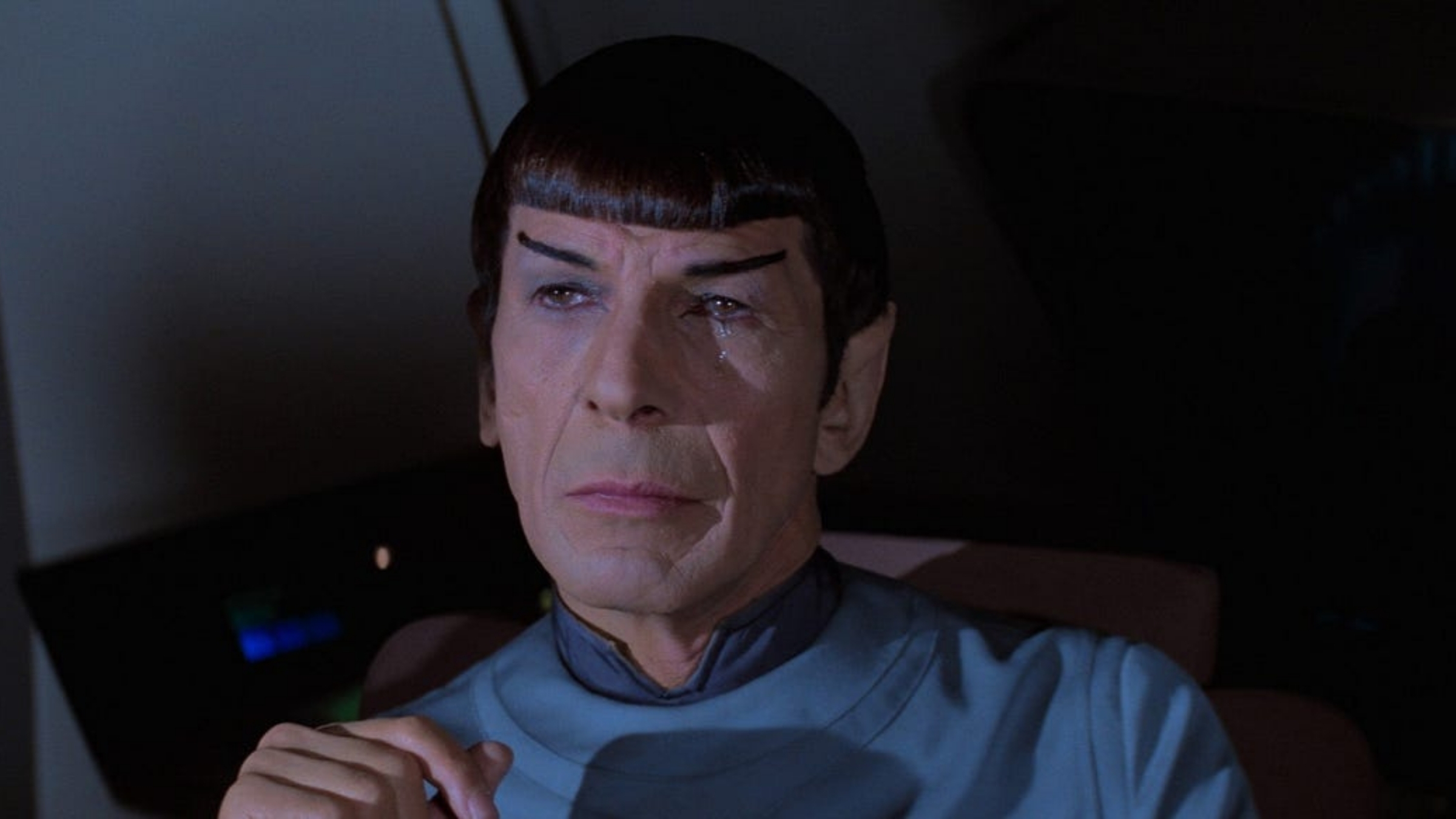
In The Motion Picture, the Enterprise crew encounters a gigantic, living machine that poses a threat to Earth. This entity is revealed to be V’Ger, which originated as Voyager 6 – a NASA space probe launched in the 20th century. After being pulled into a black hole, Voyager 6 was found by a highly advanced race of mechanical beings. They greatly enhanced its power and sent it back to Earth to fulfill its original purpose: to gather all possible knowledge. For fans of The Next Generation watching The Motion Picture later on, the concept of these advanced beings and their relentless quest for knowledge felt strikingly similar to themes explored in TNG.
When Spock mentally connects with V’Ger, he finds a consciousness that is immense, incredibly old, and driven solely by the desire to collect information. However, he discovers that this seemingly all-powerful being is actually lacking something crucial: a human quality needed for further growth. The Borg, who strive for perfection by gathering knowledge and technology and absorb other life forms to fix their own flaws, struggle with a surprisingly similar problem.
The key piece of evidence is an early version of the phrase “resistance is futile,” spoken by Spock. Even this alone hinted at a connection for fans. When the Borg appeared in The Next Generation, the phrase became their defining characteristic. This theory has become more popular over time, as it explains both the origins of the Borg and who upgraded Voyager 6. Many fans still believe that V’Ger and the Borg ultimately came from the same source.
William Shatner Uses the Borg Origin Theory in His Own Star Trek Universe

William Shatner is famous for playing Captain Kirk in the original Star Trek series and seven movies. He also directed Star Trek V: The Final Frontier and continued the story in a series of novels he co-wrote after his character seemingly died in Star Trek Generations. Though not considered official Star Trek storylines, fans affectionately call these novels the “Shatnerverse.”
In his novel The Return, William Shatner establishes a connection between V’Ger and the Borg. He reveals that the advanced civilization behind the upgraded Voyager 6 probe was directly related to the Borg Collective. The story suggests that the “machine planet” V’Ger was searching for was actually the Borg’s home world. This positions V’Ger as an extension of the Borg’s technology and portrays them as explorers, essentially continuing the mission of Voyager 6 on a much grander scale.
William Shatner’s account also sheds light on a strange pattern with the Borg. They sometimes show unexpected mercy when encountering officers from the Federation. As seen in The Return, this hesitation stems from a connection Spock made with V’Ger through a mind meld. That connection left a lasting impression within the Borg collective, making them recognize something familiar in Federation officers.
The story builds on the fan theory by cleverly using the Borg’s origins against them. By merging Picard’s memories of being assimilated with Spock’s connection to V’Ger, the characters pinpoint and shut down the Borg’s main control center. Essentially, the very connection between humans and machines that allowed the Borg to emerge ultimately leads to their defeat.
Shatner’s idea is presented beautifully and feels like it could legitimately be part of the official Star Trek storyline. It actually strengthens the show’s core idea: that even the most powerful artificial intelligence is lacking without human qualities like emotion and individuality. For now, though, this theory about the origins of the Borg and V’Ger remains a popular, but unofficial, fan explanation for the franchise’s most iconic villains.
Do you think Star Trek should officially recognize William Shatner’s portrayal of Captain Kirk? Share your thoughts in the comments and join the discussion in the ComicBook Forum!
https://comicbook.com/tv-shows/list/the-best-episode-from-every-star-trek-tv-series/embed/#
Read More
- The Super Mario Galaxy Movie: 50 Easter Eggs, References & Major Cameos Explained
- 10 Best Free Games on Steam in 2026, Ranked
- Surprise Isekai Anime Confirms Season 2 With New Crunchyroll Streaming Release
- ‘Project Hail Mary’: The Biggest Differences From the Book, Explained
- Why is Tech Jacket gender-swapped in Invincible season 4 and who voices her?
- Preview: Sword Art Online Returns to PS5 as a Darker Open World Action RPG This Summer
- Skate 4 – Manny Go Round Goals Guide | All of the Above Sequence
- Sydney Sweeney’s The Housemaid 2 Sets Streaming Release Date
- Shonen Jump Officially Cancels Yet Another Major Series in 2026 (& Fans Saw It Coming)
- The Punisher: One Last Kill Trailer Review: MCU Special Could Be a Game Changer
2026-02-27 17:10