Author: Denis Avetisyan
A new experiment leverages the planet’s own magnetic field to boost the search for weakly interacting axions, a leading dark matter candidate.
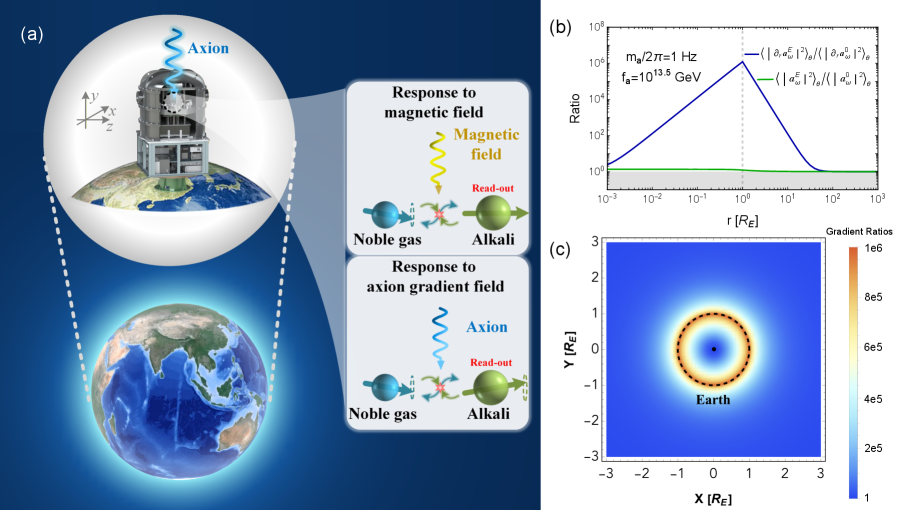
Researchers demonstrate leading constraints on axion-neutron coupling using a self-compensated nuclear spin comagnetometer enhanced by Earth-mediated effects.
Conventional searches for ultralight axion dark matter assume a uniform local density, potentially overlooking crucial environmental effects. This work, titled ‘Earth Matter Enhanced Axion Dark Matter Search’, presents the first dedicated experimental implementation of an environment-aware search, leveraging interactions between axions and terrestrial matter to enhance the local field gradient. Utilizing a highly sensitive K--Rb--^{21}Ne comagnetometer, we report the most stringent limits to date on axion-neutron derivative couplings for masses m_a \in [0.041, ~28.9]~\rm feV, improving upon previous bounds by up to three orders of magnitude-and demonstrating a pathway to detect dark matter in previously inaccessible regions of parameter space. Could precisely mapping geophysical variations unlock even greater sensitivity in future searches for axion dark matter and other elusive particles?
Unveiling the Invisible: The Hunt for Dark Matter
The cosmos reveals a startling discrepancy: visible matter accounts for only a small fraction of the universe’s total mass. Observations of galactic rotation curves, gravitational lensing, and the cosmic microwave background consistently point to the existence of a substantial amount of unseen matter – dubbed dark matter – comprising roughly 85% of the universe’s mass. Despite decades of searching, its fundamental nature remains a profound mystery. This elusive substance doesn’t interact with light, rendering it invisible to conventional telescopes, and its weak interactions with ordinary matter make direct detection extraordinarily challenging. Current research focuses on identifying potential dark matter candidates, ranging from weakly interacting massive particles (WIMPs) to axions and sterile neutrinos, attempting to unravel one of the most significant puzzles in modern cosmology.
The persistent mystery of dark matter has led scientists to theorize the existence of axions – hypothetical particles currently considered among the most promising candidates to comprise this elusive substance. Unlike conventional particles, axions are predicted to interact incredibly weakly with electromagnetic fields, a consequence of their proposed role in resolving a theoretical problem in the strong nuclear force. This interaction, while feeble, offers a potential pathway for detection: in the presence of a strong magnetic field, axions could convert into photons, producing a detectable signal. The expected signal is extraordinarily faint, necessitating the development of highly sensitive detectors capable of discerning these minute energy depositions from background noise. Current experiments leverage resonant cavities and superconducting circuits, precisely tuned to the predicted axion mass range, in a quest to capture these fleeting interactions and finally unveil the nature of dark matter.
The quest to reveal axions hinges on technologies capable of sensing interactions far subtler than anything previously attempted. Because axions are predicted to barely interact with ordinary matter, detection demands instruments shielded from all terrestrial interference – stray radio waves, vibrations, even cosmic rays – and cooled to near absolute zero to minimize noise. Experiments employ resonant cavities, essentially highly tuned microwave ovens, to amplify the faint signal expected from axions converting into photons within a strong magnetic field. These setups aren’t merely sensitive; they represent a frontier of precision measurement, requiring advancements in superconducting materials, quantum amplification techniques, and data analysis algorithms capable of discerning a potential axion signal from the inevitable background fluctuations. The challenges are immense, but overcoming them promises not only a solution to the dark matter mystery, but also breakthroughs in fundamental physics and metrology.
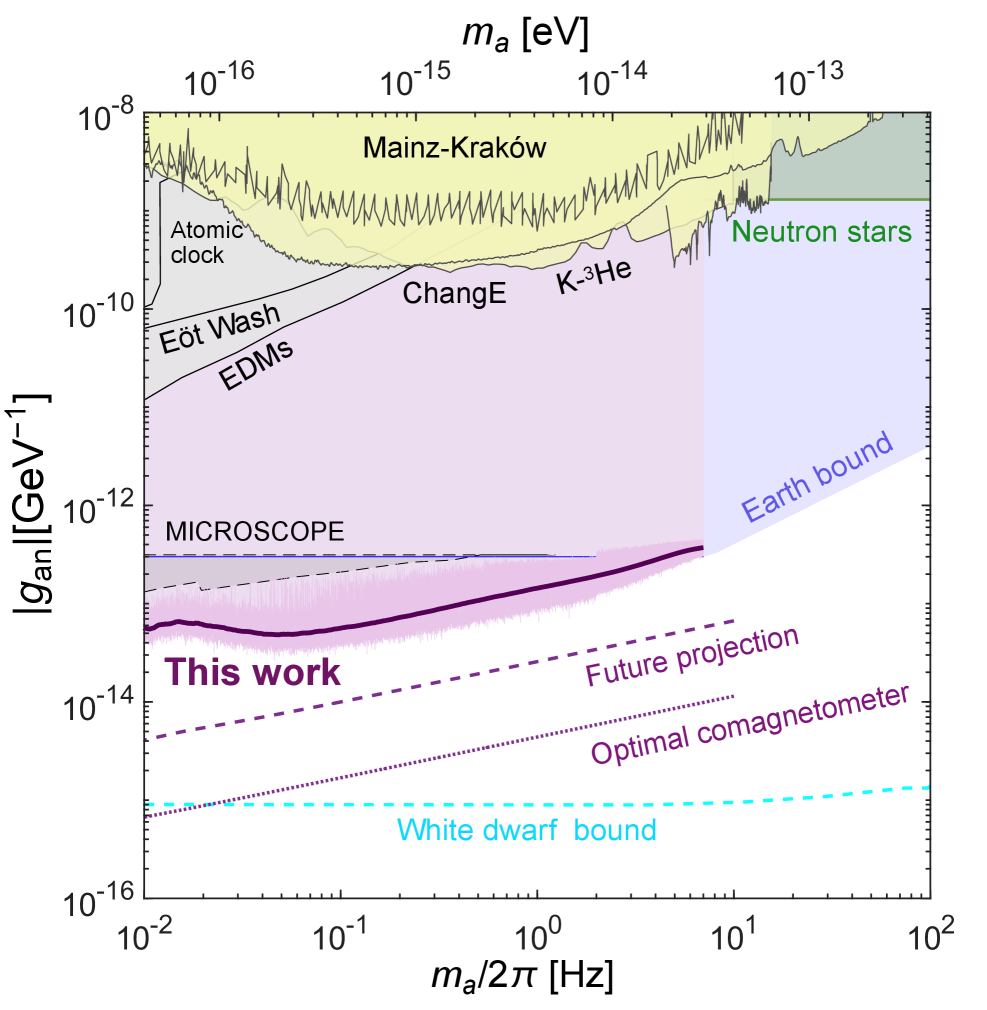
The Comagnetometer: A Precision Instrument for the Unseen
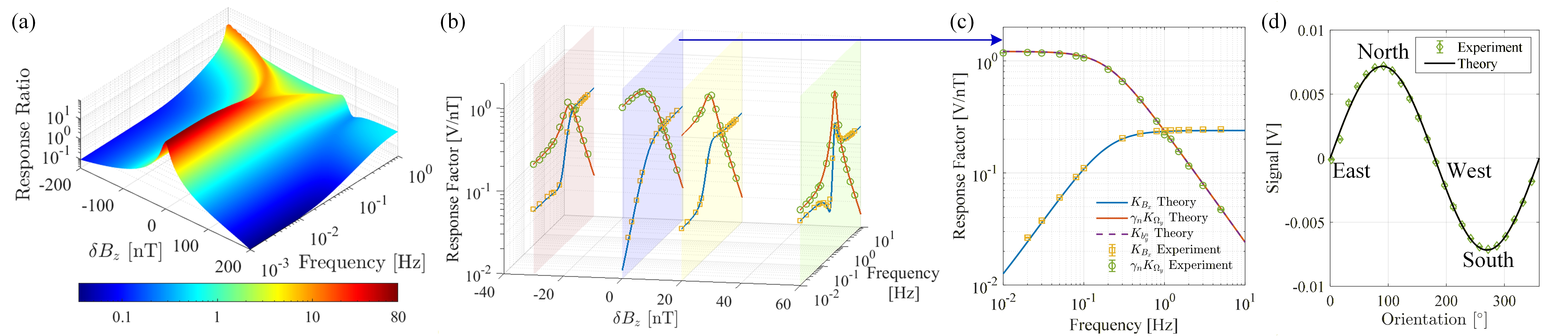
The comagnetometer employed in this experiment operates on the principle of measuring magnetic fields via the distinct responses of alkali and noble gases. Alkali metals, such as rubidium or cesium, exhibit strong magnetic resonance signals due to their unpaired electron spins. Noble gases, specifically ^{129}Xe and ^{131}Xe, possess nuclear magnetic moments which, while weak, can be enhanced through techniques like spin-exchange optical pumping. By simultaneously monitoring the resonance frequencies of both gas types, the comagnetometer effectively nulls common noise sources – including magnetic field gradients and mechanical vibrations – thereby increasing sensitivity to external magnetic fields. This configuration allows for the detection of magnetic fields on the order of femtoteslas (fT), surpassing the capabilities of conventional magnetometers.
Nuclear polarization within the comagnetometer is achieved via spin exchange optical pumping, a process where alkali vapor is optically pumped with circularly polarized light. This excitation transfers polarization to the noble gas nuclei, specifically 3He, through collisional interactions. The resulting net nuclear spin polarization significantly increases the system’s sensitivity to external magnetic fields; the signal is directly proportional to the degree of nuclear polarization. Without this enhancement, the response to weak magnetic fields would be considerably diminished, hindering the detection of subtle variations indicative of the target signal. This technique allows for the measurement of magnetic fields with a sensitivity orders of magnitude greater than would be possible with unpolarized nuclei.
Gradient detection techniques are central to maximizing the signal extracted in this experiment by focusing on the spatial variation of the hypothetical axion field. Rather than measuring an absolute magnetic field, the comagnetometer configuration detects the difference in magnetic field strength between two closely spaced sensors. This approach inherently suppresses common-mode noise and enhances sensitivity to localized magnetic gradients. Specifically, the implemented system achieves a sensitivity of 2.7 fT/Hz at a frequency of 0.1 Hz, representing the minimum detectable change in magnetic field gradient per unit frequency.
Isolating the Signal: Shielding and Data Acquisition
Effective vibration isolation and magnetic shielding are paramount in axion detection experiments due to the exceedingly weak interaction strength of axions. Mechanical vibrations from environmental sources, such as seismic activity or nearby equipment, introduce noise that can obscure the faint signals expected from axion-photon conversions; multi-stage vibration isolation systems, including active and passive damping, are therefore employed. Similarly, magnetic interference from terrestrial sources and electromagnetic noise can mimic or mask the expected signal; therefore, experiments are typically housed within magnetically shielded rooms constructed from μ-metal or similar high-permeability materials to reduce external magnetic field fluctuations to levels below a few picotesla. The combined effect of these mitigation strategies is to lower the noise floor and enable the detection of extremely subtle signals.
Data acquisition employs lock-in amplification to improve the signal-to-noise ratio by selectively measuring signals at a specific, known frequency. This technique involves mixing the input signal with a reference signal at the frequency of interest; the resulting output is then low-pass filtered to remove high-frequency noise and components unrelated to the reference. The process effectively isolates the signal component, enabling the detection of extremely weak signals that would otherwise be obscured by noise. Signal demodulation, integral to lock-in amplification, provides both the amplitude and phase of the signal at the reference frequency, allowing for precise characterization and discrimination against spurious signals.
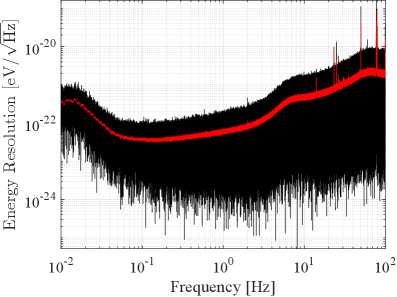
Frequency domain analysis is a crucial component of signal processing in axion detection experiments, enabling the discrimination of weak signals from substantial background noise. This technique transforms time-series data into its constituent frequencies, allowing researchers to identify specific frequency components potentially indicative of axion interactions. The resulting power spectrum reveals signal characteristics and facilitates the application of filters to reduce noise. In these experiments, frequency domain analysis yields an energy resolution of 3.8 \times 10^{-{23}} \text{ eV} at a frequency of 0.1 Hz, representing the minimum detectable energy difference and establishing a critical performance benchmark for the detector system.
Taming the Noise: Control and Calibration
The pursuit of precise measurements in axion research demands meticulous control over environmental magnetic fields, as even minute fluctuations can masquerade as genuine signals. To combat this, sophisticated self-compensation techniques are employed, utilizing a network of strategically positioned magnetic sensors and feedback loops. These systems actively monitor and counteract internally generated magnetic fields stemming from the experiment itself – including those arising from power supplies, structural components, and even the shielding materials. By minimizing these disturbances, the experiment significantly improves data accuracy and substantially reduces systematic errors, allowing researchers to discern faint axion interactions with greater confidence and ultimately establish more stringent limits on potential axion properties.
The Earth’s rotation presents a significant challenge in the search for subtle interactions like those predicted between axions and neutrons. As the experiment operates, the rotating Earth induces time-varying magnetic fields that can mimic the faint signals expected from axions, creating substantial background noise. Researchers meticulously account for these rotational effects through sophisticated modeling and data analysis techniques. By precisely characterizing and subtracting the terrestrial interference caused by the Earth’s spin, the experiment effectively isolates potential axion signals, enabling a more definitive determination of whether these elusive particles truly interact with neutrons as predicted by certain theoretical models. This careful consideration of terrestrial dynamics is crucial for establishing the validity of any observed results and achieving the highest possible sensitivity in the search.
Precise measurements within the experiment rely heavily on a thorough understanding of the light shift effect, a phenomenon where the frequency of atomic resonances is altered by the interaction with the laser light used to probe them. Researchers meticulously characterized and corrected for these shifts, ensuring the accuracy of the resonant signal and minimizing systematic errors. This careful approach enabled a refined analysis of the data, ultimately leading to the establishment of the most stringent laboratory constraints yet on the coupling between axions and neutrons. The achieved sensitivity surpasses previous limitations by a factor of two to three orders of magnitude, representing a significant advancement in the search for these elusive particles and opening new avenues for exploration within the field of axion physics.

Expanding the Horizon: Towards Deeper Detection
The quest to detect axions, hypothetical particles proposed as a component of dark matter, is fundamentally limited by the sensitivity of detection methods; therefore, ongoing advancements in sensitivity optimization are crucial for expanding the search beyond currently explored parameters. Each refinement in detector technology – from superconducting qubit designs to low-noise amplifiers – effectively widens the ‘net’ cast for these elusive particles. This isn’t simply about detecting a stronger signal, but about accessing previously inaccessible regions of the axion parameter space – specifically, exploring lower mass ranges and weaker interaction strengths. By meticulously reducing systematic errors and improving signal-to-noise ratios, researchers are steadily increasing the probability of encountering an axion signal, potentially revolutionizing our understanding of the universe’s missing mass and the fundamental laws governing particle physics. This process is iterative; each improvement informs the next, driving the field closer to either a definitive detection or a more precise constraint on axion properties.
The quest to detect axions, a leading dark matter candidate, hinges on the ability to discern extraordinarily weak signals from pervasive noise. Current experiments are increasingly focused on sophisticated noise reduction techniques, moving beyond simple shielding to employ advanced algorithms and materials science. These refinements aren’t merely about minimizing background interference; they are about fundamentally enhancing the signal-to-noise ratio, allowing detectors to probe deeper into the theoretical parameter space where axions may reside. By meticulously identifying and mitigating noise sources – from terrestrial vibrations and radiofrequency interference to quantum fluctuations within the detector itself – researchers are steadily unlocking the potential to observe the incredibly faint interactions predicted by axion models. This pursuit of signal clarity is paramount, as even a marginal improvement in noise reduction can dramatically expand the search volume and increase the likelihood of finally unveiling the nature of dark matter.
The quest to understand dark matter and the universe’s fundamental properties hinges on the ability to perform increasingly precise measurements. Current cosmological models suggest dark matter comprises a substantial portion of the universe, yet its nature remains elusive. Pushing the boundaries of measurement precision – in experiments searching for axions, for example, or in mapping the cosmic microwave background – allows scientists to test these models with greater stringency. Subtle discrepancies between theoretical predictions and experimental results, revealed only through highly precise data, can then illuminate the true composition of dark matter and unveil previously unknown physics governing the universe’s evolution. This pursuit isn’t simply about confirming existing theories; it’s about opening pathways to new discoveries and a more complete understanding of the cosmos, potentially revolutionizing fields from particle physics to astrophysics.
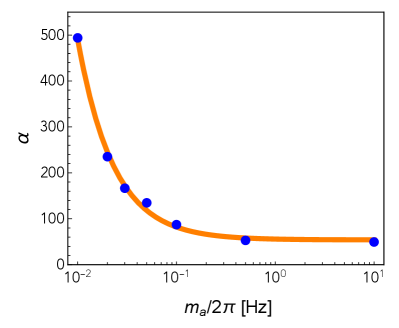
The pursuit detailed within this research exemplifies a rigorous dismantling of established search parameters for axion dark matter. By cleverly leveraging Earth-mediated effects to enhance gradient sensitivity, the study doesn’t simply accept existing limitations; it actively challenges them. This approach echoes Immanuel Kant’s assertion: “All our knowledge begins with the senses.” The experiment doesn’t rely on theoretical assumptions alone but grounds its search in observable phenomena – a direct consequence of applying meticulous methodology to unravel the universe’s hidden components. The self-compensated nuclear spin comagnetometry isn’t merely a tool; it’s a controlled deconstruction of conventional detection techniques, probing the boundaries of what’s known and, crucially, what remains to be discovered.
Beyond the Spin: What’s Next?
The pursuit of axion dark matter has always been a game of amplifying the infinitesimally small. This work, by leveraging the Earth itself as a mediator, represents a shift – not toward easier detection, but toward more elegant exploitation of existing resources. The self-compensated comagnetometer is a necessary, if complicated, step; the real challenge lies in disentangling the signal from the noise inherent in probing fields predicted only by their absence. Future iterations must confront this directly-can the comagnetometer be refined to the point where systematic errors become the limiting factor, rather than fundamental sensitivity?
The assumption of a simple axion-neutron coupling, while pragmatic, feels increasingly like a convenient fiction. The universe rarely adheres to the simplest model. Exploring alternative couplings – perhaps those mediated by more exotic interactions – will demand a reimagining of the experimental apparatus. It’s a deliberate breaking of the established framework, a systematic introduction of complexity to see what breaks-and what unexpectedly holds firm.
Ultimately, this search isn’t about finding dark matter, but about refining the tools to interrogate the unknown. Each negative result isn’t a dead end, but a constraint, a boundary on the possible. The true reward lies not in illumination, but in the increasingly precise definition of the darkness itself.
Original article: https://arxiv.org/pdf/2602.20260.pdf
Contact the author: https://www.linkedin.com/in/avetisyan/
See also:
- Marvel Officially Confirms Deadpool’s Most Brutal Redesign
- Nintendo Switch 2 Reportedly Getting Remake of One of the Best PS3 and Xbox 360 Games
- Welcome to Demon School! Iruma-kun season 4 release schedule: When are new episodes on Crunchyroll?
- Michael Jackson Biopic’s Record-Breaking Debut Unseats 2026’s Biggest Box Office Hit On U.S. Chart
- Crunchyroll Confirms New Isekai Anime Releases for 2026 and Beyond (With Major Returns)
- 10 Movies That Were Banned in Different Countries For Random Reasons
- Gold Rate Forecast
- The Boys Season 5, Episode 2’s Soldier Boy Ending Twist Changes Everything for Homelander & Butcher
- The Fairly OddParents’ Creator Reveals Who Timmy Ended Up With
- Did Lauren Sánchez Bezos Hint at Baby Plans With Jeff Bezos? The Truth
2026-02-25 12:47