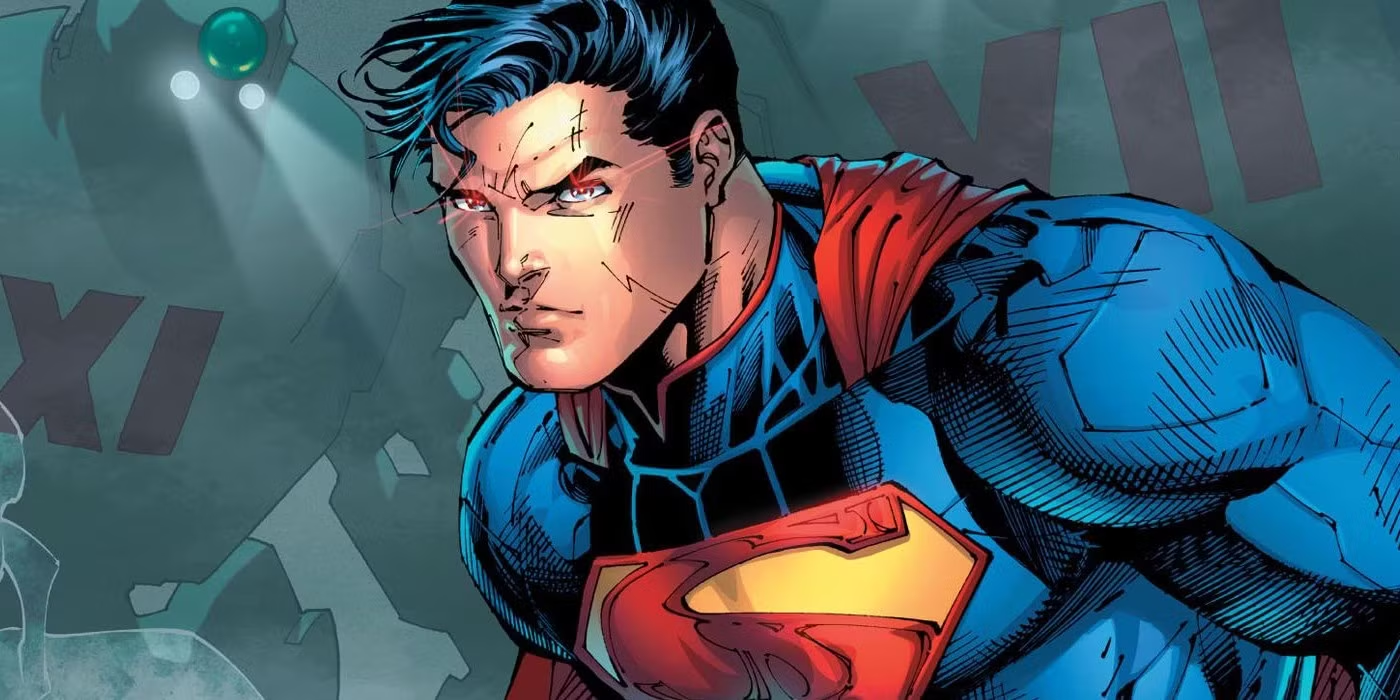
Superman has been reimagined by many writers and artists over the decades. However, fans often remember him best through particular periods and stories. This could be John Byrne’s fresh take with Man of Steel, or more recent adventures like Philip K. Johnson’s The Warworld Saga. People tend to concentrate on the most famous versions of the character.
Over the years, Superman has drawn many skilled writers and artists to the character. While he was most popular during the Bronze Age, and there were periods like the Triangle Era that focused on expanding Superman’s world, some comic book runs haven’t received the appreciation they deserve. However, revisiting these stories often reveals just how compelling Superman can be.
So, a little before the big Crisis on Infinite Earths event, DC tried to shake things up with both Action Comics and Superman. With Action Comics, they brought in Marv Wolfman and let him revamp Brainiac. This new Brainiac was seriously scary – he’d completely lost his humanity, obsessed with gaining knowledge and power at any cost. It was a much darker take on the character.
Wolfman’s version of Superman was a promising attempt to update the character for a modern audience. Unfortunately, his work on the series ended too soon to have a significant, lasting impact. Later, when John Byrne revamped Superman in 1986, Wolfman’s contributions were largely overlooked by newer fans.
Many fans associate DC Rebirth with Peter Tomasi’s Superman comic, but Dan Jurgens’ Action Comics was equally strong, particularly for longtime Superman readers. The series successfully reintroduced classic villains like Doomsday and also added compelling new characters and ideas, such as Superman’s father, Mister Oz.
Dan Jurgens’ run on Action Comics successfully captured the spirit of the often-overlooked ’90s Superman era he helped create. Despite the many changes made to the Superman mythos since the New 52 reboot, his stories managed to blend the classic with the modern. While this era of Action Comics didn’t receive as much attention as other Superman titles, it’s definitely worth revisiting for fans.
Following the “Death of Superman” storyline, Karl Kesel contributed to the Adventures of Superman comic. He began his work during the “Reign of the Supermen” event, where he first introduced Superboy, initially known as “The Metropolis Kid,” in his own series. Even after Superboy launched his own comic, Kesel continued to work on Adventures of Superman through the period known as the Triangle Era.
Similar to his work on Superboy, Kesel loved revisiting classic Silver Age concepts and incorporating characters created by Jack Kirby, such as the Challengers of the Fantastic. He also wrote a period where Superman’s powers grew so immense he struggled to control them. Though often overlooked within the Triangle Era, Kesel’s run is worth revisiting for the excellent artwork by Tom Grummett and Stuart Immonen.
Roger Stern contributed to many Superman comics in the 1980s and 90s, but his work on Action Comics doesn’t get enough recognition. He took over the title, working with George Perez and Brett Breeding, just before DC launched the ‘Triangle Era’ and changed the direction of the book, following a brief period where Action Comics featured different stories each issue.
Working with writers like Dan Jurgens and Jerry Ordway, Roger Stern helped define Superman after the Crisis on Infinite Earths. He had a knack for making even minor Superman villains feel like real threats, and he also enjoyed bringing fun, unexpected characters like Plastic Man into the mix. Stern’s reliable storytelling consistently made Action Comics a standout title for DC each month.
DC initially asked John Byrne to revamp Superman, but they disagreed on creative direction, and he ultimately left the project. Jerry Ordway, who had been involved in updating Superman from the start with the Adventures of Superman team, took over the main Superman title. He led the creative process, with Dennis Janke handling the inking and Glenn Whitmore assisting with the artwork.
During his time on Superman, Ordway explored how discovering a Kryptonian artifact called the Eradicator caused Superman to lose touch with his human side, a storyline stemming from the ‘Superman: Exile’ saga. He also depicted Superman struggling with the loss of his powers due to schemes by Lex Luthor and Mr. Mxyzptlk in ‘Krisis of the Krimson Kryptonite.’ Beyond his writing, Ordway’s artwork established a definitive and influential visual standard for both Clark Kent and Superman.
Geoff Johns is best known for his early work on Superman, particularly his writing of Action Comics. However, many have forgotten that he later revisited the character during the New 52 comics relaunch, writing the main Superman title with art by John Romita Jr. Though a shorter run, it still showcased Johns’ distinctive style and offered a fresh take on Superman at a time when the character was facing challenges within the New 52 universe.
Geoff Johns’ storyline introduced Ulysses, a new character and incredibly powerful scientist comparable to Superman. Johns created Ulysses to give Clark a true equal and potential friend, but their relationship ultimately ended sadly. Despite its short length, this story is considered a highlight of the New 52 Superman series.
Elliot S. Maggin and artist Curt Swan are uniquely known for their work on Superman during the pre-Crisis years. Swan had already established Superman’s iconic appearance starting in the late 1940s and played a huge role in shaping the character’s history. However, his collaboration with Maggin allowed them to create even more memorable stories.
Maggin and Swan were once considered one of Superman’s greatest creative partnerships. They delivered the fun, science-fiction stories fans loved from the Silver Age, but with more developed characters. While many fans may not focus on the stories before Crisis on Infinite Earths today, they still hold up as excellent comics.
The twelve-issue comic series Superman: World of New Krypton followed Superman after he rescued the bottled city of Kandor and helped its citizens find a new home planet. Discovering that not all of the newly settled Kryptonians were trustworthy, Superman went undercover within their society to protect both Earth and New Krypton.
Okay, so the World of New Krypton series, written by James Robinson and Greg Rucka, was actually a highlight for me during that whole New Krypton storyline – even though a lot of it didn’t really hit the mark. What I loved was how it threw all this political stuff in, with Kryptonian society being divided into different guilds. It really made things interesting for Superman, forcing him to figure out how to deal with a culture that was totally foreign, even to him! Honestly, a lot of people skip over this series and just focus on the main Superman: New Krypton story, and they’re seriously missing out on some really great writing, in my opinion. You should definitely check it out if you haven’t!
Although Dan Jurgens began working on Superman after the character was already well-established, many fans consider his run to be the best. He contributed to both Action Comics and Adventures of Superman, but he’s most celebrated for his 90-issue run on Superman itself, which spanned the entire decade of the 1990s.
Dan Jurgens played a key role in exploring Superman’s emotional side, particularly the challenges of finding love while bearing such immense responsibility. He was also the primary artist for much of his work on the character, making him hugely influential in defining Superman’s visual style throughout the 1990s. Without the many acclaimed ‘Elseworlds’ stories and limited series, Jurgens would likely be considered one of the most highly-regarded Superman writers.
Kurt Busiek’s work on Superman is often overlooked, but it’s one of the best modern takes on the character. His run began with the well-received “Up, Up, and Away” story, co-written with Geoff Johns, and continued for several years, producing some of the most memorable Superman comics of the 2000s. It immediately followed the events of Infinite Crisis.
Superman felt more like his older self, the one from before the Crisis on Infinite Earths, but he never lost his compassion. The story also showed him becoming a father as he and Lois Lane raised Zod’s son, Chris Kent, as their own. While many remember Kurt Busiek’s run for the ‘Camelot Falls’ storyline, the entire series is worth revisiting, particularly for Carlos Pacheco’s beautiful artwork.
Found an error? Send it so it can be corrected.
Read More
- 10 Greatest Manga Endings of All Time
- Review: Final Fantasy Tactics: The Ivalice Chronicles (PS5) – Still the Benchmark for Turn-Based Tactics
- Mark Zuckerberg & Wife Priscilla Chan Make Surprise Debut at Met Gala
- GBP CNY PREDICTION
- Elon Musk’s Mom Maye Musk Shares Her Parenting Philosophy
- Forza Horizon 6 Car List So Far: Confirmed Highlights, Cover Cars, DLC, and Rewards
- Miranda Kerr Shares “Quick” Procedure She Got Before Met Gala 2026
- The WONDERfools ending explained: What happened to the Child of Eternity?
- Ranking the 5 Best Spring 2026 Anime So Far (Mid-Season Update)
- Sony Plans to Start Shooting Horizon Movie in 2026, with 2027 Release Planned
2026-03-20 21:11