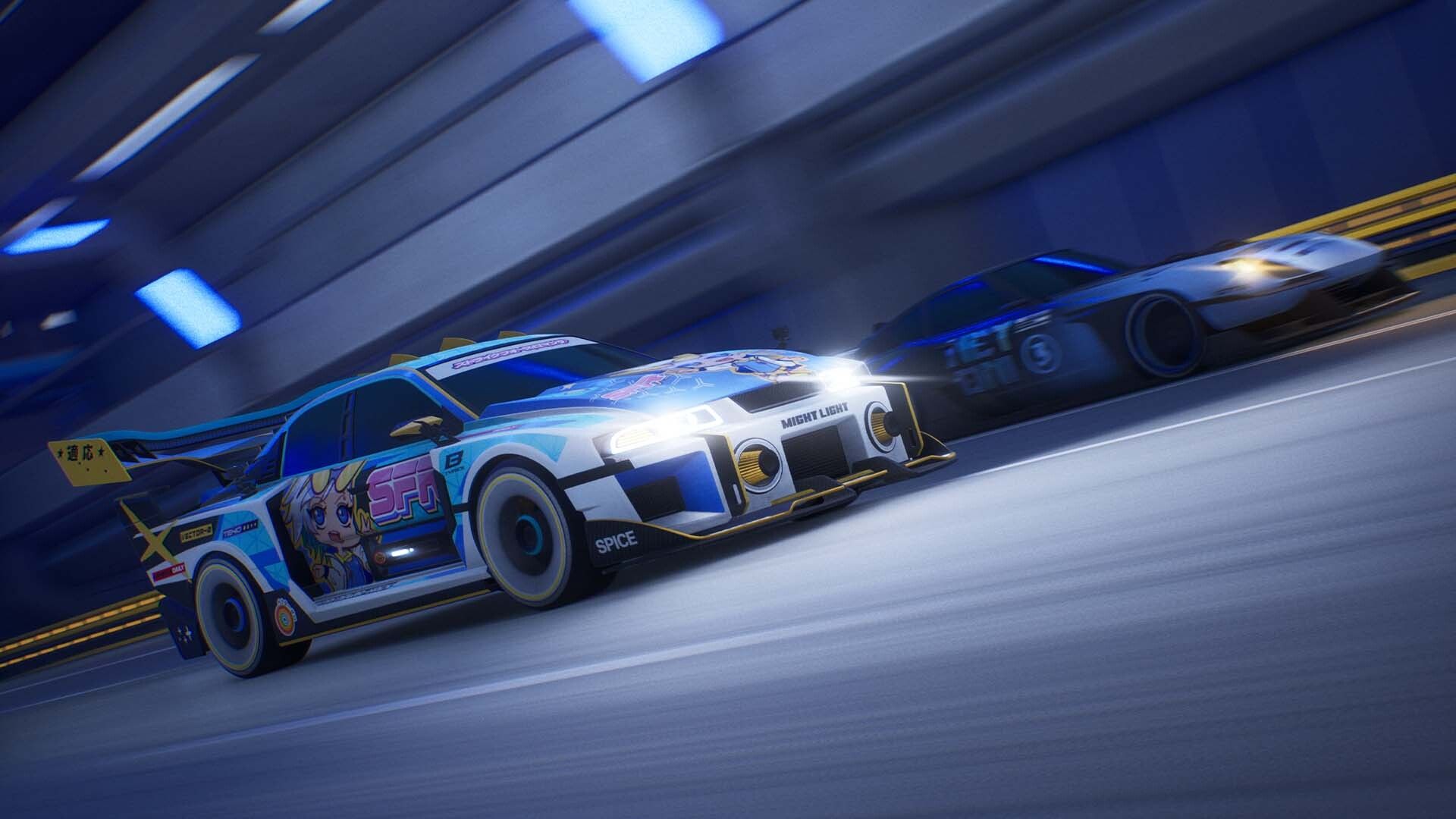
Screamer is a fast-paced arcade racing game that challenges your driving instincts. Initially, I found the controls difficult to master. It uses a twin-stick system where one stick steers and the other controls drifting, which felt very different from what I was used to.
I’m aware other arcade racing games have tried similar control setups – Inertial Drift from 2020, for example – but I hadn’t played it, so I wasn’t prepared. I’ve played plenty of twin-stick shooters, but that experience didn’t translate here. Screamer feels fundamentally different. The best way to describe how strange it is, is to imagine writing with your weaker hand. You understand how pens work and can probably manage to write something, but it won’t look like your normal handwriting.
The brakes are incredibly responsive. Even a gentle touch slows the vehicle enough to navigate nearly any corner, and drifting is effortless, requiring only a light touch on the thumbstick.
With practice, Screamer‘s racing becomes surprisingly precise (though I doubt I’ll ever master it with just a pen and paper!). Despite its unusual controls, Screamer actually has a lot in common with typical arcade racers. Once you get used to how your car handles, you’ll find yourself focusing on familiar techniques like positioning before turns, timing, and maintaining speed. Add in boosts, perfect gear changes, special attacks, and unique character abilities, and the initially awkward controls quickly evolve into a deeply engaging racing experience – one of the most intricate I’ve played in a long time.
Initially, the vehicles in Screamer feel substantial and strong, more like powerful sci-fi cars than finely-tuned racers. This weight actually made it tricky to control at first – it felt like a struggle between me and the machine, with neither of us gaining an advantage. However, after spending a lot of time playing Screamer’s various arcade modes, I realized these vehicles respond better to delicate handling, not raw power.
The brakes are incredibly responsive – even a gentle touch slows the car enough to navigate almost any turn. Drifting is equally delicate, requiring only a slight movement of the controller. Because of this sensitivity, braking is often most effective after reaching the peak of a corner, depending on your speed, angle, and the curve of the road. Initially, the controls felt awkward and I constantly oversteered, but as I practiced with Time Attacks and Checkpoint Challenges, I began to find a natural rhythm. Soon, drifts flowed seamlessly from one corner to the next, creating a smooth and rewarding driving experience.
“Using Sync generates Entropy, which is your car’s fighting aggression and defence.”
In Screamer, racing isn’t just about taking the fastest route. Successfully shifting gears feels rhythmic and rewarding – hitting the button at the perfect moment gives your engine a quick boost. The game makes it easy to time your shifts with helpful visual cues, forgiving timing windows, and controller vibrations that keep you focused on the race.
The game smartly avoids severely penalizing small errors. Shifting up too early won’t completely ruin your speed, just prevent you from getting a quick boost. It’s a subtle but welcome design choice. While maintaining a smooth, fast pace is possible on simpler tracks, the unpredictable nature of races with multiple opponents makes striving for absolute perfection unrealistic.
This isn’t a bad thing – I actually enjoyed the fast pace. However, the intense, close-quarters combat in Screamer means focusing on precise racing techniques like getting the perfect corner entry or drift isn’t as important as simply staying alive. I found myself mostly just focusing on shifting gears, as that was the one thing I could reliably do.
Luckily, each of Screamer’s vehicles has an Echo device installed. This advanced system collects energy that powers two key abilities: Sync and Entropy. You’ll gain energy simply by driving smoothly and shifting gears at the right time. Sync allows you to perform Boosts and Perfect Boosts – the latter is a bit harder to pull off, requiring you to activate the command at just the right moment.
Sync builds up your car’s power, letting you aggressively attack and defend. The Strike system forcefully rams into enemies, destroying their vehicles in fiery explosions. And Overdrive turns your car into a super-fast rocket, allowing you to destroy opponents while briefly becoming invulnerable.
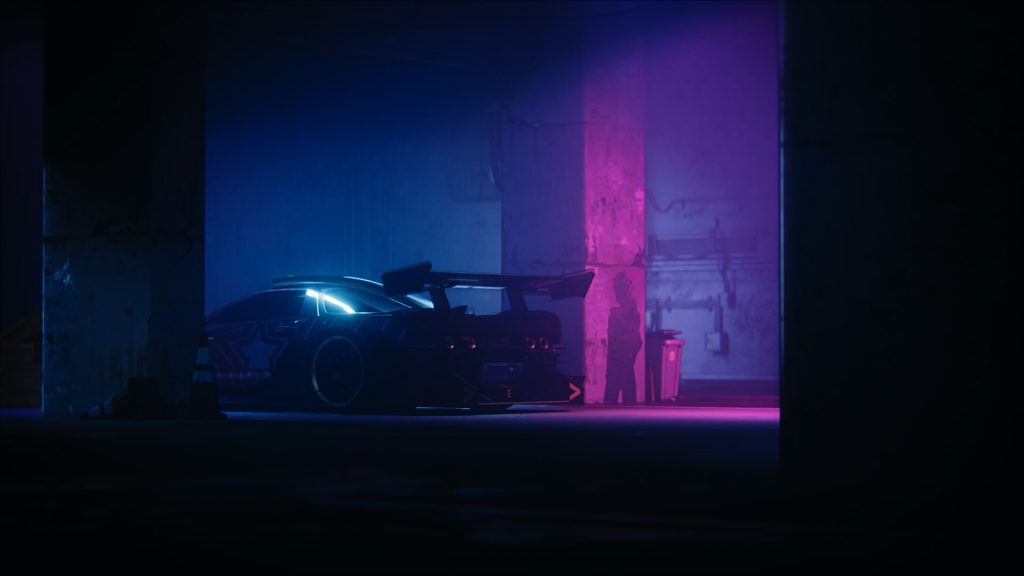
The story mode in Screamer’s really highlights the game’s anime influences. It features fast-paced battles in a high-stakes tournament, all wrapped up in a plot about getting revenge, dealing with rivals, and uncovering secrets within a powerful company.
It’s really satisfying when you’re skillfully managing these systems, and landing a well-timed attack can completely shift the advantage to your side. However, that feeling of control doesn’t always last. It can be hard to predict what your opponent will do, and their attacks often come too quickly to properly defend against, turning what should be strategic battles into frustrating, unavoidable hits.
Because the game doesn’t help players catch up when they fall behind, it can be tough to recover. While getting further back does increase the chance of getting boosts, it’s hard to tell if those boosts actually help during a race (especially on the normal difficulty setting). Ultimately, Screamer’s combat is thrilling and keeps you on your toes, but sometimes it feels unfair to be stuck at the back of the pack when you haven’t made any major mistakes.
Besides the usual Arcade modes, Score Challenge and Team Races reveal some issues with balance in the game. Score Challenge unlocks customization options, but it creates an unfair advantage for “leader” cars over “member” cars, as the leaders are significantly faster and perform better. Playing with the member cars in this mode can be frustratingly difficult unless you reduce the game’s difficulty, creating a repetitive and unnecessarily harsh progression system.
Team Races promise complex strategy, where teammates could work together to be both aggressive and maintain good track position. However, these races usually end up chaotic and unpredictable. It’s hard to coordinate effectively when so much is happening, so players mostly just try to disrupt opponents and finish near the front. Ultimately, Team Races don’t feel much different from regular Free For All races – they just require more preparation for the same results.
The story mode in Screamer’s really showcases the game’s anime influences. It features fast-paced battles in a high-stakes tournament, all wrapped up in a plot about revenge, competition, and shadowy corporate dealings. The story is broken into short, self-contained chapters that introduce the different teams, explaining what drives them and hinting at internal conflicts. The game does a good job of creating a connected world, and the main story moves forward logically, with mysteries unfolding as the teams’ histories intertwine.
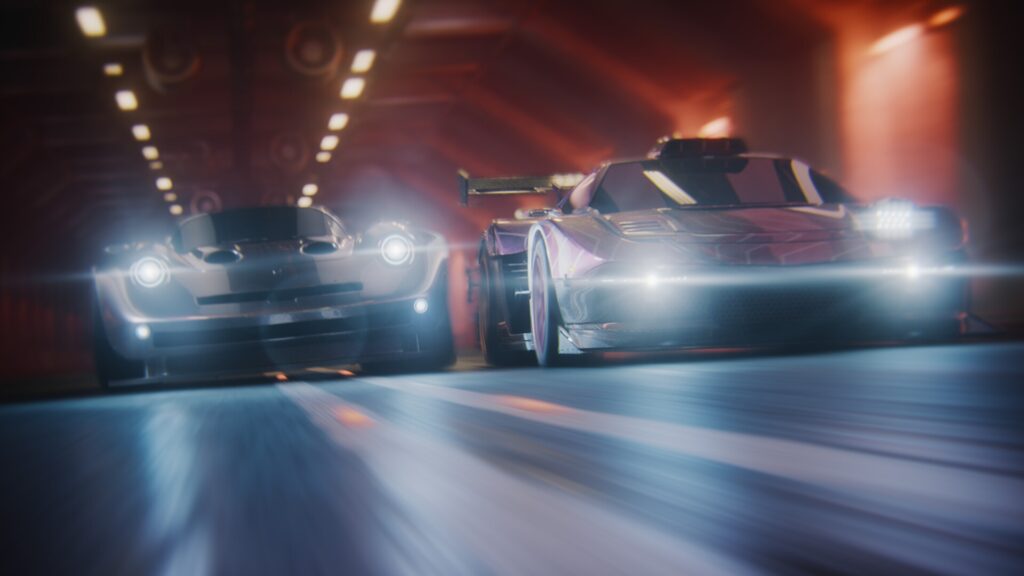
The game runs very well on the standard PlayStation 5, delivering a smooth and consistent experience even during fast-paced, visually demanding races.
Honestly, my biggest problem with this story is how it’s paced. The beginning felt really rushed and clunky, throwing a lot of information at you with only brief moments of actual excitement. And while I loved Róisín – she was fantastic and really stood out with some great voice acting – I didn’t really connect with any of the other characters. You get little glimpses of potential, like with Gabriel and his family issues, but most of them just felt a bit flat. It’s clear the creators were aiming high, but the story just felt slow-moving considering all the action happening around it.
I was more impressed with how Screamer looked than I expected. The game’s cities are beautifully lit with neon, featuring shiny surfaces and strong color contrasts that really create a sense of atmosphere during races. The cars are diverse too, ranging from sleek, futuristic models to classic, worn-in vehicles, giving each one a unique look and feel.
The game runs well on the standard PlayStation 5, maintaining a smooth and consistent experience even with fast-paced, visually intense racing. This level of performance is typical of Milestone, who are known for optimizing their games. While the studio usually delivers excellent sound design, it’s a bit underwhelming here. The engine sounds don’t quite match the powerful look of the cars, creating a slight disconnect between the visuals and audio.
At its core, Screamer is a fast-paced arcade racer that encourages bold driving. The twin-stick controls can feel clumsy at first and may cause hand fatigue during extended play, but they become satisfying once you get the hang of them. The game features a lot of interesting systems that add depth, and while they aren’t always perfectly strategic, they make racing more than just a simple dash to the finish. Some imbalances, a slow progression system, and a weak story do hold it back, but the game’s exciting racing ultimately makes it enjoyable.
There’s a definite appeal to Screamer. It’s a racing game that doesn’t necessarily break new ground, but it’s interesting because it’s willing to take risks.
This game was reviewed on the PlayStation 5.
Read More
- FRONT MISSION 3: Remake coming to PS5, Xbox Series, PS4, Xbox One, and PC on January 30, 2026
- The Boys Season 5, Episode 5 Ending Explained: Why Homelander Does THAT
- Taylor Sheridan’s Gritty 5-Part Crime Show Reveals New Final Season Villain
- ‘The Bride!’ Review: Jessie Buckley Breathes Life into a Monstrous Mess
- From season 4 release schedule: When is episode 2 out on MGM+?
- Welcome to Demon School! Iruma-kun season 4 release schedule: When are new episodes on Crunchyroll?
- Mark Zuckerberg & Wife Priscilla Chan Make Surprise Debut at Met Gala
- How to Build Water Elevators and Fountains in Enshrouded
- Anna Wintour Reacts to Rumors She Approves All Met Gala Looks
- Invincible Season 4 Episode 4 Post-Credits Unveils a Demonic Return & More
2026-03-24 17:44