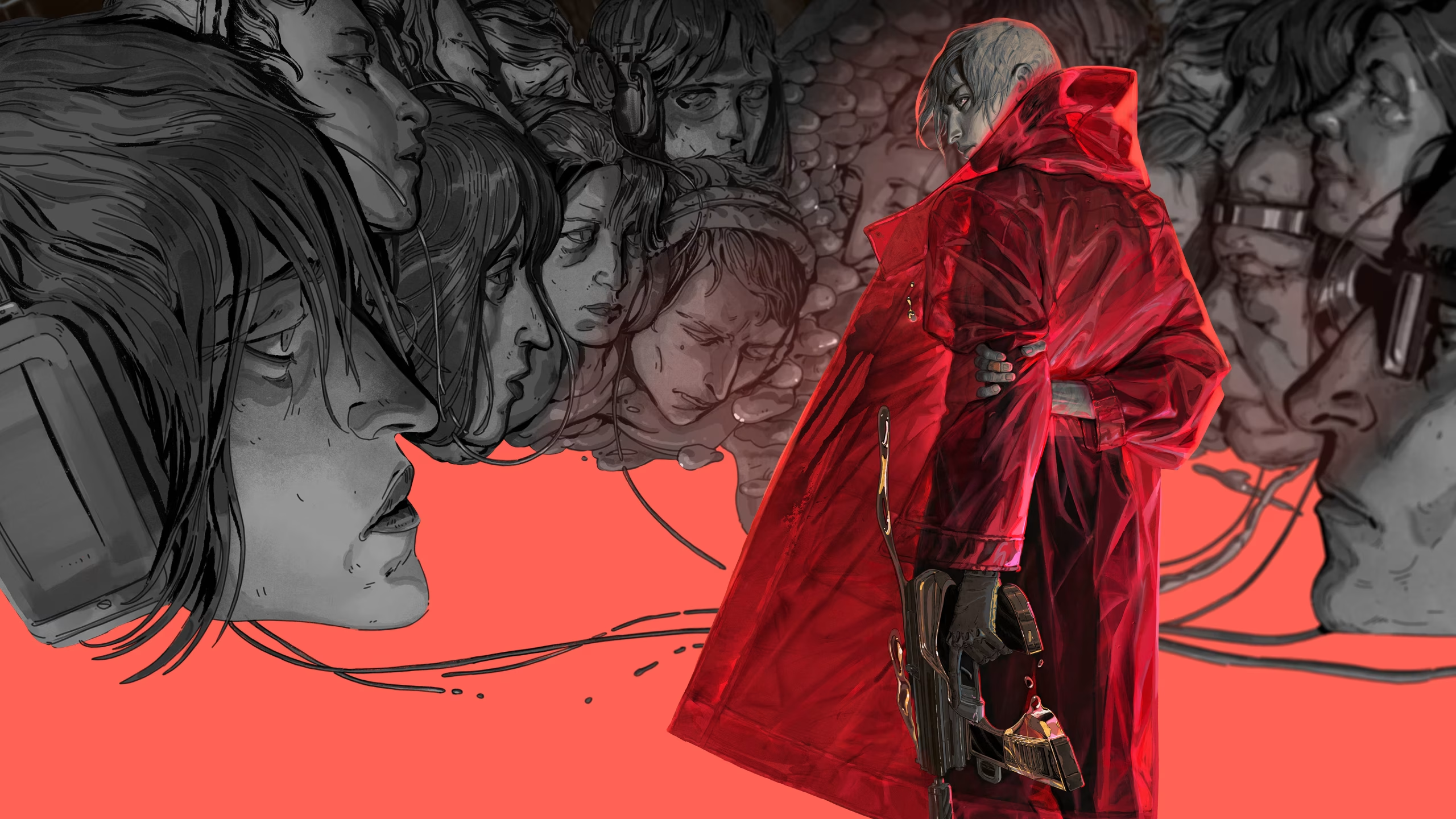
Spy novels often come across as carefully built stories, emphasizing the psychological stress a spy experiences. While there might be exciting action scenes – like a daring escape from an explosion after a job well done – the focus is usually more on building suspense than constant thrills.
Honestly, most games in this style feel pretty similar, and it’s rare to see one where the characters really think about what they’re doing, or who they’re working with. But with ZERO PARADES: For Dead Spies, the team at ZA/UM – the folks who made Disco Elysium – are doing something different. They’re building on what they learned before to tell a story that’s more about looking inward, but it’s not all serious. They’re still keeping the weird, interesting world, crazy politics, and strange situations that made their last game so great.
It’s impossible to talk about ZERO PARADES: For Dead Spies without drawing comparisons to Disco Elysium. The games look remarkably similar – you could easily mistake screenshots from one for the other. Beyond the art style, they also share a lot of gameplay features, including how skills are used for checks and how those skills essentially function as companions to your character.
Beyond being more content from the creators of Disco Elysium, ZERO PARADES offers a completely new experience. It features an original story, a fresh setting, and a diverse set of characters. There have also been some updates to the gameplay itself. But the biggest difference lies in the main character – it’s a brand new protagonist unlike anything seen in Disco Elysium.
You play as Hershel Wilk, a seasoned spy with a long and impressive career. She was sidelined after a mysterious incident, but now the agency needs her skills again. The game begins with a truly unusual conversation, and it immediately grabbed my attention. You’re contacted by another agent known as PSEUDOPOD – your “Double” – who reactivates you as CASCADE. Despite past setbacks, PSEUDOPOD insists you’re still vital, hinting at a significant role to come, and leaves you with the cryptic message, “what will happen has already happened.”
You wake up to find Pseudopod in a strange, almost comatose state. He’s still alive, with a pulse, but doesn’t respond to anything you try. Despite your best efforts, you can only get grunts and a little drool from him. This really highlights what I love about ZERO PARADES: For Dead Spies – its unique stat system.
I loved the idea of RPG stats feeling like actual characters you can talk to – it felt brilliant when I first encountered it in Disco Elysium, and ZERO PARADES: For Dead Spies has only reinforced that feeling. Unlike many RPGs that use basic stats like strength or intelligence, ZERO PARADES presents these as more complex concepts. For instance, “Statehood” represents your sense of national identity and constantly pushes you to be loyal and dedicated. If you need to recall past events, you’ll actually have conversations with your “Records” stat to access your memories.
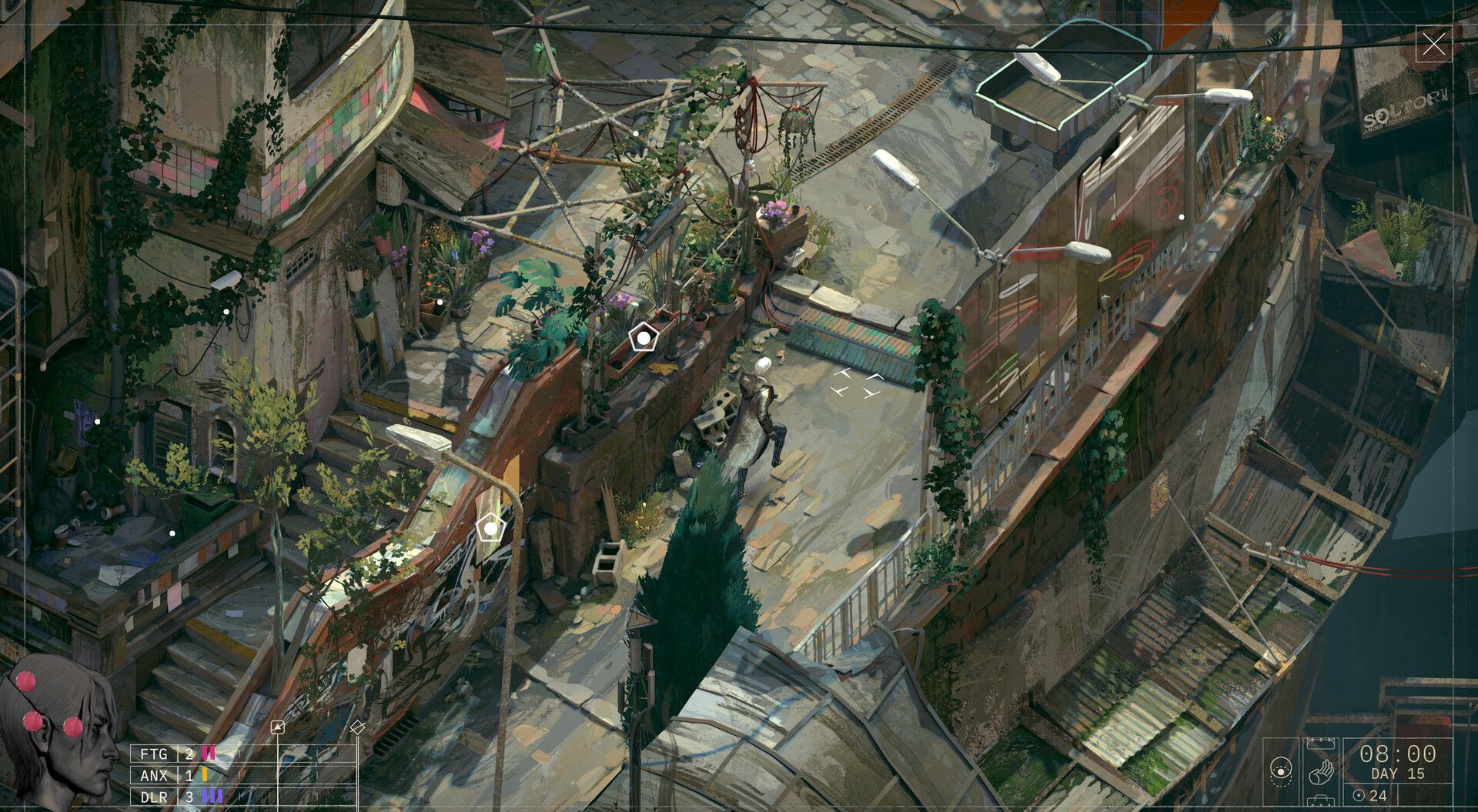
It’s almost certain that people will compare the game ZERO PARADES: For Dead Spies to Disco Elysium in pretty much every way.
The game features 15 different stats divided into three main areas – Action, Relation, and Intellect. Action covers physical abilities, like stealth (Shadowplay) and strength (Doppelgäng). Relation reflects your character’s personality and understanding of the world, including mental fortitude (Nerve) and knowledge of the city (Blueprints). Finally, Intellect encompasses intelligence-based skills, such as technological proficiency (Technoflex) and deductive reasoning (Grey Matter).
Each of the 15 stats feels unique, with writing that’s clever and clearly differentiates them. You won’t mistake one for another – Personalism, for instance, focuses on individual humanity, while Statehood views you as part of a larger national system. These stats manifest as internal voices, which not only develops Hershel’s character but also gives the player ways to influence her perspective and potentially change the story’s outcome.
Okay, so ZERO PARADES isn’t about fighting, not really. Instead, you’re constantly trying to do things, and whether you succeed depends on skill checks. It’s a pretty straightforward system. Like, early on, I had to fix a broken fax machine. The game gives you a number you need to roll, based on how hard the task is, and things like your ‘Technoflex’ skill or whether you bothered to read the manual can change that number. Basically, the game figures out the target number, and then you roll to see if you pull it off! It’s all about seeing if you can actually do stuff, not just battling enemies.
I’ve been playing, and it’s cool how even failing can be really engaging! Depending on what you’re trying to do, you can actually take ‘damage’ in three different ways: physically, with your stamina going down (that’s Fatigue); mentally, with how stressed you get (Anxiety); and even your sanity if things get really intense (Delirium). The thing is, if any of those ‘damage’ meters fill up to 20, you actually lose a level in one of your skills! It adds a lot of pressure, but it’s a neat mechanic.
Fortunately, many options exist to improve your health. These range from simple self-care, like resting to ease anxiety, to seeking professional medical help for issues like fatigue, or using medication to manage confusion.
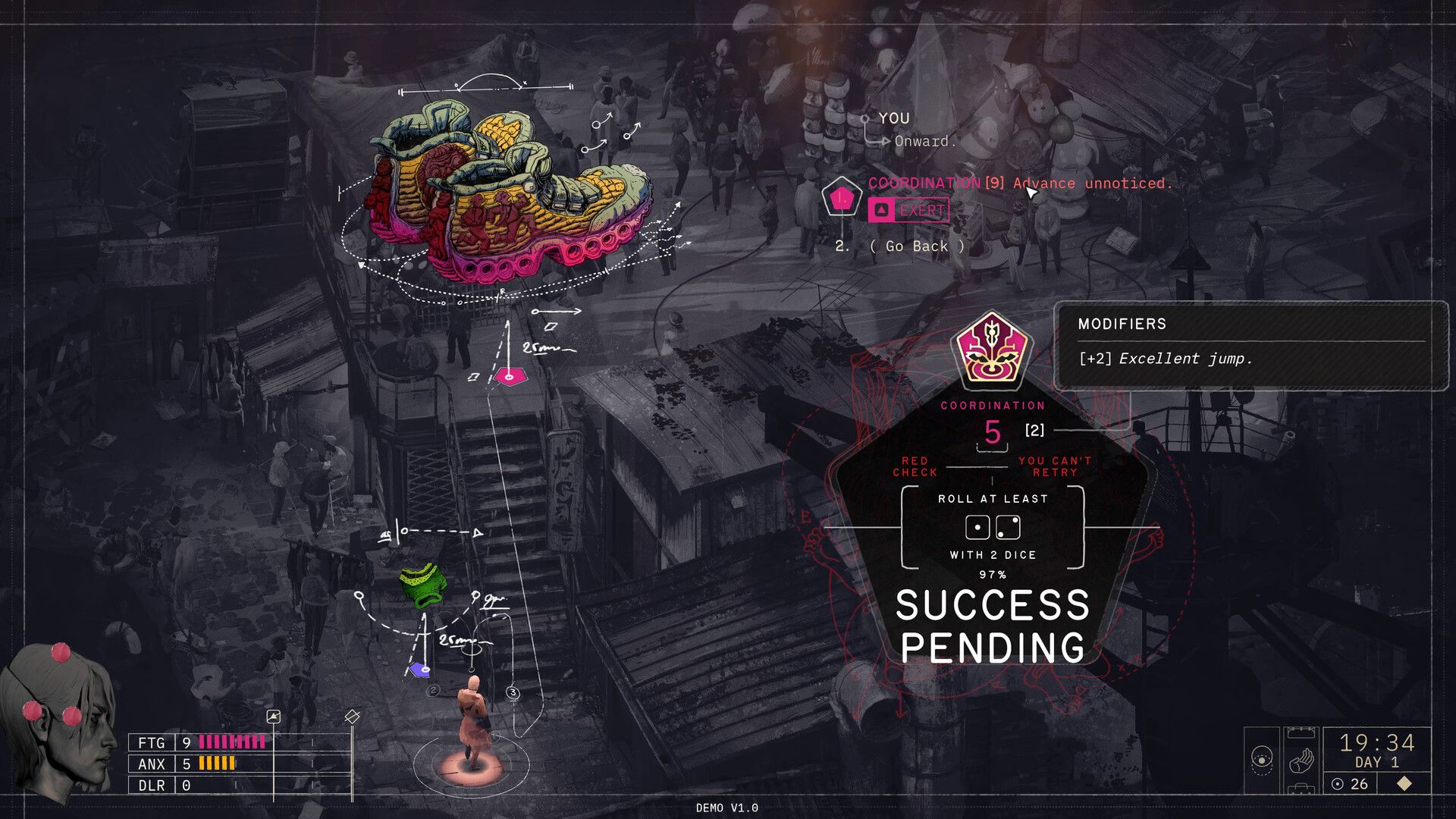
Although achieving success in these cases is usually good, even failing can be valuable and offer its own lessons.
As you improve Hershel’s skills in ZERO PARADES by earning experience, she not only becomes more capable, but her personality also changes. Focusing on the Statehood skill, for instance, will lead Hershel to question her own humanity, and this theme will appear frequently in conversations. If you maximize the Records skill to gain a perfect memory, Hershel will become paranoid, constantly suspecting people from her past are out to get her, and finding faces in crowds disturbingly familiar.
Giving players a lot of freedom is a key feature, but it also has drawbacks. The game keeps a record of your quests, but it doesn’t offer much guidance. You’re responsible for discovering clues and figuring out what to do next. Some players will enjoy this open-ended exploration, while others might feel confused or directionless while navigating the city of Portofiro.
ZERO PARADES: For Dead Spies is a captivating RPG that prompts players to think deeply about its story and the world around us. It’s a spy drama that focuses more on character interactions and emotional weight than stealth, and it’s a remarkable game for the RPG genre. While it builds upon the innovations of games like Disco Elysium, ZERO PARADES stands on its own as a truly excellent experience. It’s a highly recommended game for anyone who enjoys story-driven adventures with meaningful choices and a complex, branching narrative.
This game was reviewed on PC.
Read More
- Best Controller Settings for ARC Raiders
- Review: Final Fantasy Tactics: The Ivalice Chronicles (PS5) – Still the Benchmark for Turn-Based Tactics
- Mark Zuckerberg & Wife Priscilla Chan Make Surprise Debut at Met Gala
- The Boys Season 5 Officially Ends An Era For Jensen Ackles’ Soldier Boy
- Nippon Sangoku Is The Best New Post-Apocalyptic Anime of Spring 2026
- Elon Musk’s Mom Maye Musk Shares Her Parenting Philosophy
- 10 Greatest Manga Endings of All Time
- The Witcher 3 Officially Reveals Stunning New Ciri Figure Coming 2026
- The WONDERfools ending explained: What happened to the Child of Eternity?
- 7 Great Marvel Villains Who Are Currently Dead
2026-05-20 20:12