Bitcoin’s market situation is currently uncertain. While the amount of Bitcoin held on exchanges is unusually low, short-term price signals and how profitable Bitcoin holders are remain concerning.
Summary
- Bitcoin exchange reserves fell to 2.66 million BTC, matching levels last seen in August 2019.
- Long-term holder SOPR near 0.87 shows some investors are moving Bitcoin at a loss now.
- Bearish MACD and RSI readings keep short-term Bitcoin momentum weak near the $73,000 price area.
Data from CryptoQuant, shared by thechessONCHAIN, shows that Bitcoin held in exchange reserves has dropped to 2,666,753 BTC. This is similar to levels seen on August 31, 2019, when Bitcoin was trading around $9,430. Interestingly, despite the same amount of Bitcoin being held by exchanges now, the price is significantly higher.
The decrease in available Bitcoin means there are fewer coins readily available for purchase on exchanges. While this lowers the supply, it doesn’t automatically mean the price will go up. For Bitcoin’s price to increase, there needs to be enough buyer interest to use up the existing supply and restore confidence in the market.
Things are different now compared to the 2019 Bitcoin cycle. The recent launch of spot Bitcoin ETFs in January 2024 has created new buying pressure, something that wasn’t present before. We’ve also seen Bitcoin held on exchanges continue to decrease since these ETFs became available.
This change affects how much of a product is available, but it doesn’t make the future price any clearer. The key now is whether enough people buying through ETFs and directly will balance out weak market trends and hesitant sellers.
Cycle data keeps Bitcoin bulls cautious
CryptoQuant’s Bull-Bear Market Cycle Indicator presents a contrast to the conditions seen in 2019. As of August 31, 2019, the indicator was at +0.83, indicating a bullish market for Bitcoin. The 30-day average was +1.045, and the longer-term 365-day average was -0.206.
Recent data suggests a downward trend. As of May 2026, the indicator was at -0.379, with short-term (30-day) and long-term (365-day) averages at -0.375 and -0.323 respectively. This indicates Bitcoin is currently in a less favorable cycle, despite the fact that the amount of Bitcoin held on exchanges is decreasing.
Just because exchange reserves are decreasing doesn’t necessarily mean the market is turning upward. While there’s less Bitcoin available on exchanges, the indicators that usually signal a strong upward trend aren’t as strong as they were in 2019.
Crypto analyst K A L E O believes the timing of past market cycles suggests caution, even if a short-term price increase is possible. He’s hoping for a rally around $70,000, but is prepared for the current price range to continue for a while longer.
Thinking about potential downsides for Bitcoin (BTC), I realized one major factor I hadn’t fully considered is how it performs over time in relation to its cycles. Historically, the past three major bull market peaks have happened roughly 536 days after each Bitcoin halving event, and this pattern could be relevant.
— K A L E O (@CryptoKaleo) May 27, 2026
Long-term holder SOPR shows weaker profitability
Long-term Bitcoin holders are also seeing their profits decline. According to Arab Chain, the SOPR (Spent Output Profit Ratio) for these holders has dropped to around 0.87, even as Bitcoin’s price stays around $75,000. SOPR is a metric that indicates whether coins held for a long time are being sold at a profit or a loss.
If the reading falls below 1, it suggests that some long-term Bitcoin owners are selling their coins for less than what they originally paid. While this doesn’t necessarily signal the end of a price trend, it indicates these larger, older holders aren’t selling at a significant profit.
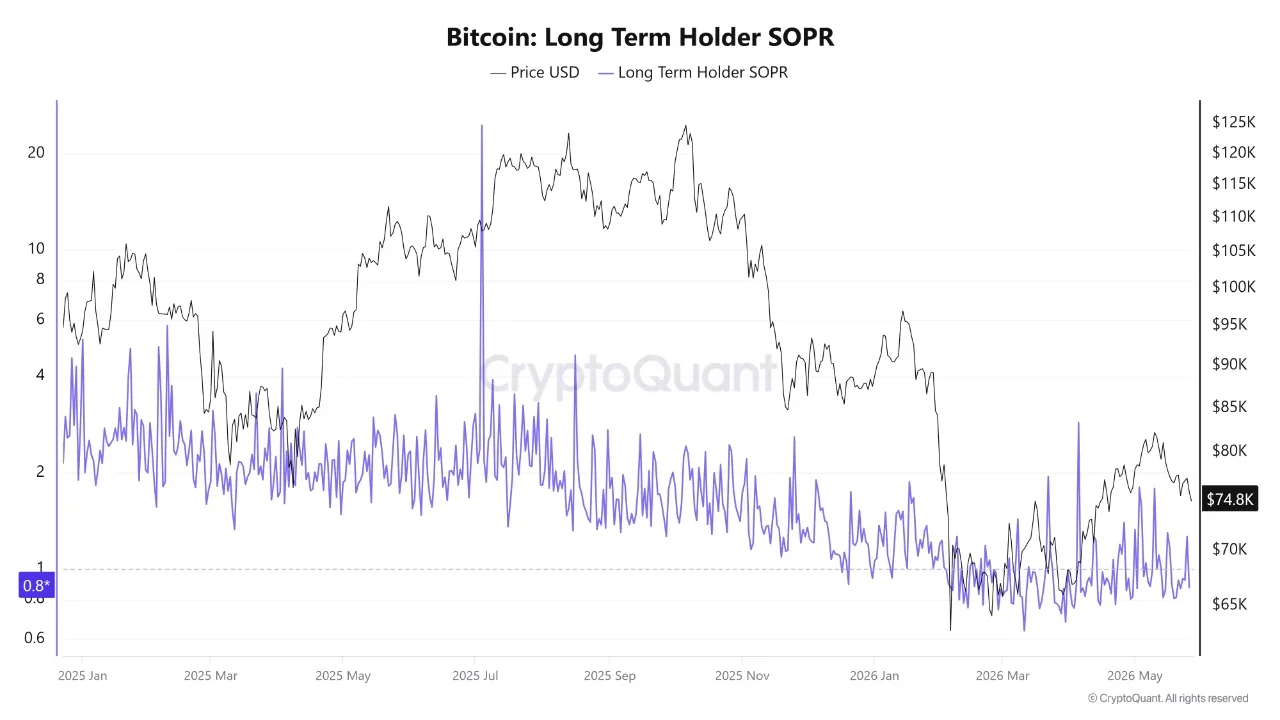
Recently, the number of people reading this has decreased after being higher when the market was doing well. This suggests that long-term investors are becoming more cautious following recent market swings and the decline from previous peak levels.
Some traders see dips in the SOPR (Spent Output Profit Ratio) as simply a temporary adjustment in the market. Historically, periods of low profit-taking by weaker holders have often occurred before prices start to rise again. However, current data suggests the market is still facing downward pressure, and a recovery isn’t yet clear.
Bitcoin price analysis: MACD and RSI stay bearish
At the time of this report, Bitcoin was trading around $73,257. Today, it reached a high of $75,944 and a low of $72,678. To see a significant price increase in the near future, Bitcoin needs to break through and stay above the $70,000 to $75,000 range.
The MACD indicator is currently signaling a downward trend. The MACD line is under the signal line, and the histogram is still negative, around -145, indicating continued downward momentum. However, the strength of this downward movement isn’t extreme.
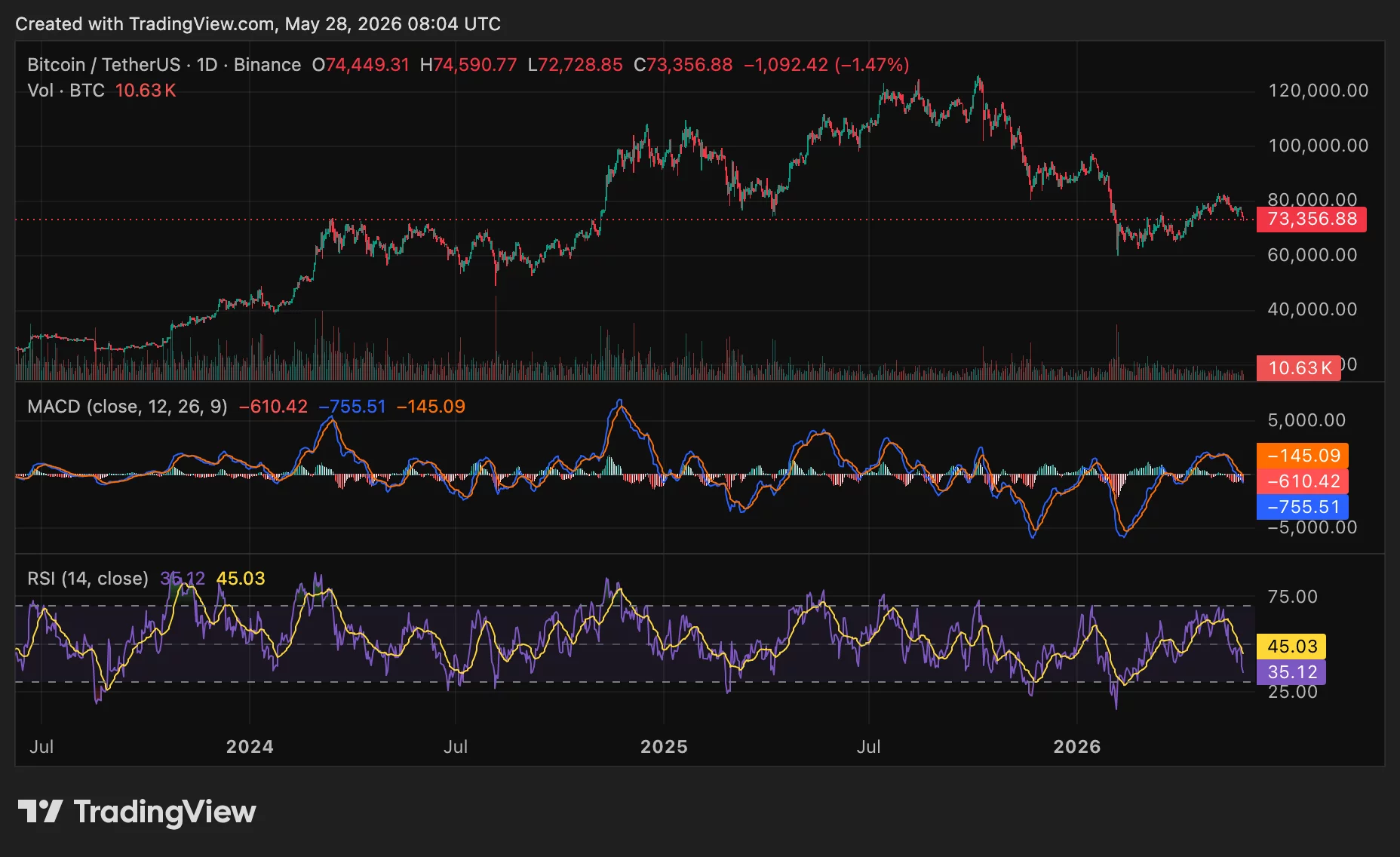
The Relative Strength Index (RSI) is currently at 35.12, which is below its average of 45.03. This indicates that selling pressure is still dominant in the short term. While the RSI is approaching levels that suggest the market may be oversold, it hasn’t reached a point where a significant price reversal is confirmed.
Traders are keeping a close eye on the moves of large Bitcoin holders, often called ‘whales.’ CryptoWatch reported that these whales have recently been opening more long positions, but cautioned that it’s important to see if this pattern continues.
Large Bitcoin investors (often called ‘whales’) are now betting that the price will go up. It’s important to see if they continue to hold this position.
If these investors are changing their outlook after the recent price drop, it could signal that the downward trend is ending. But if they start betting on a price decrease again, we could see further losses.
It’s crucial to monitor their activity to understand what might happen next.
— CW (@CW8900) May 28, 2026
We’re staying cautious in the short term as Bitcoin is currently trading below key resistance levels. If Bitcoin can break back above $70,000-$72,000 with strong trading activity, that would be a positive sign. However, if prices fall from here, we’ll be watching for support around $70,000 and then $68,000.
Read More
- Gold Rate Forecast
- 10 Most Powerful Versions of Superman, Ranked
- Forza Horizon 6 Car List So Far: Confirmed Highlights, Cover Cars, DLC, and Rewards
- 10 Greatest Manga Endings of All Time
- 38 Years Later, Murder, She Wrote’s Most Overlooked Episode Still Pulls Off TV’s Greatest Crossover
- Mark Zuckerberg & Wife Priscilla Chan Make Surprise Debut at Met Gala
- Elon Musk’s Ex Ashley St. Clair Reveals When Romance Became “Weird”
- Forza Horizon 6 PC Issues: Fix Crashes, Stuttering, Steam Errors, and Game Pass Problems
- Why There’s No New Episode Of From S4 This Weekend (May 24) & When The Show Returns
- GBP CNY PREDICTION
2026-05-28 11:28