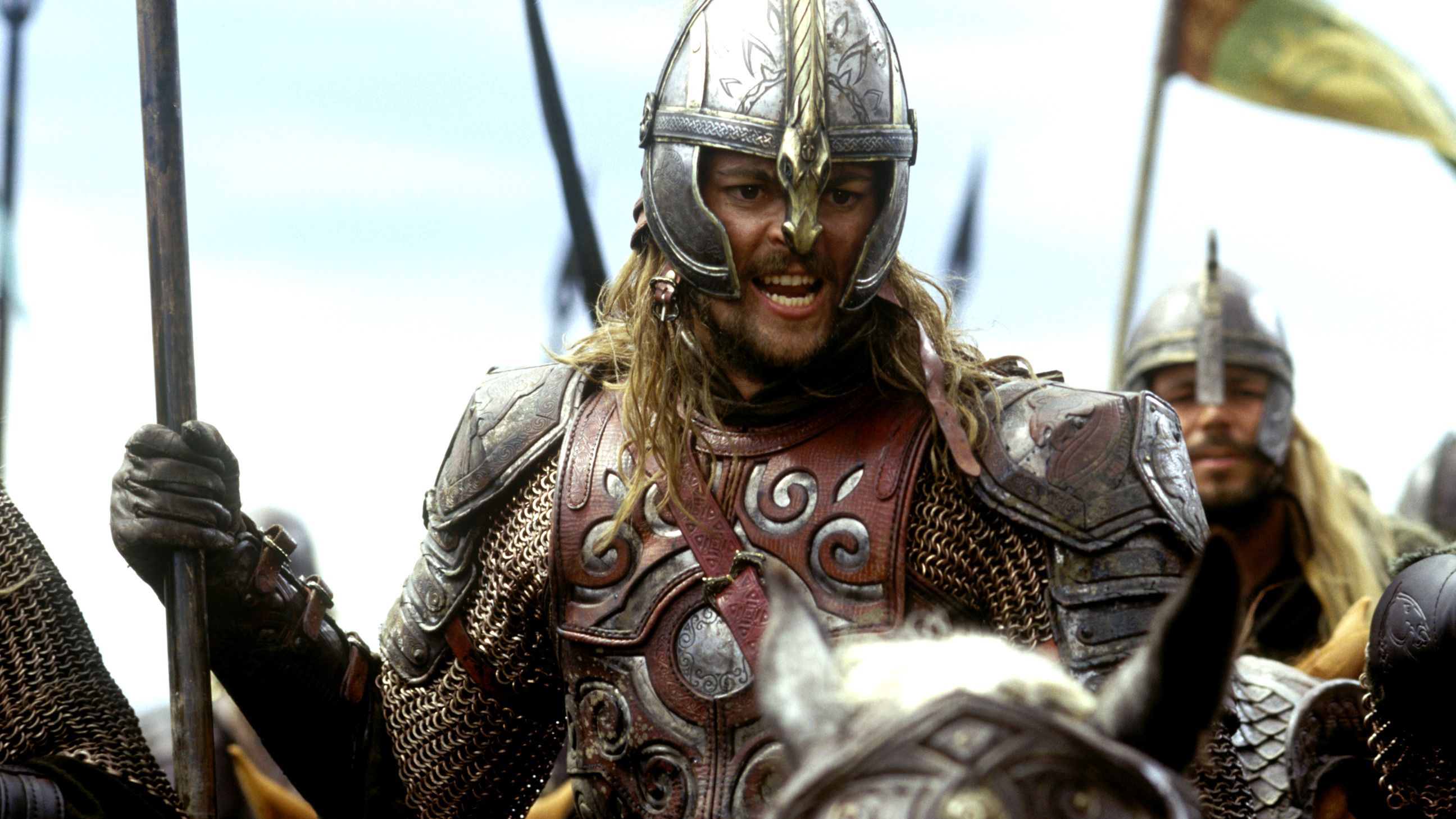
Karl Urban has been a popular topic recently, from his role in Mortal Kombat II to the ending of The Boys. However, many fantasy fans remember him fondly as Éomer from Peter Jackson’s Lord of the Rings films. First appearing in The Two Towers, Éomer was crucial in the Battle of Helm’s Deep, arriving with reinforcements when things looked dire. He continued to fight in major battles, including the Battle of the Pelennor Fields and at the Black Gate, and in J.R.R. Tolkien’s books, he eventually became King of Rohan after his uncle Théoden.
Théoden is generally considered a good king. While Rohan was failing by the time of The Lord of the Rings, it wasn’t entirely his fault. He’d been manipulated by his treacherous advisor, Gríma Wormtongue, who poisoned his mind and effectively controlled him as a puppet of Saruman. However, Tolkien’s Unfinished Tales reveals that Théoden made a significant error well before Saruman’s influence took hold, and it was Éomer who ultimately resolved the issue after the War of the Ring.
Théoden Was More Than Rohan’s King in The Lord of the Rings
In J.R.R. Tolkien’s Unfinished Tales, the chapter detailing the Battles of the Fords of Isen provides a thorough look at how the Rohirrim army was organized. It was commanded by three officers called the Marshals of the Riddermark, and their rank wasn’t determined by number—the First Marshal held the highest position. The First Marshal oversaw the central region of the Riddermark, while the Second and Third Marshals moved around as needed, generally following the First Marshal’s instructions.
When the Rohirrim needed to gather their forces, they always met in Edoras, which was the easiest place for everyone to reach, and were led by the First Marshal. During the War of the Ring, Éomer served as the Third Marshal, and Théoden’s son, Prince Théodred, was the Second Marshal. However, instead of appointing a First Marshal, King Théoden personally took on those responsibilities.
Tolkien described the new king as a strong, skilled warrior who took the throne at just thirty-two years old. He was an excellent horseman and planned to personally lead his troops into battle if war broke out. His people would have seen this as courageous and admirable, preferring a leader who fought alongside them rather than staying safely behind the lines.
In both Peter Jackson’s The Lord of the Rings: The Return of the King film and the book’s ‘The Battle of the Pelennor Fields’ chapter, Théoden sought to die bravely in battle, ensuring he wouldn’t bring shame upon his ancestors. However, his decision to charge into the fight left Rohan’s army vulnerable, and Wormtongue was able to take advantage of this weakness.
Gríma Wormtongue Took Advantage of Rohan’s Military Structure
Normally, if the King of Rohan couldn’t command his army, the First Marshal would step in and lead the Rohirrim to Edoras. But because Théoden was both king and First Marshal, when he became weakened and controlled by Wormtongue, it left the entire army unable to act.
I was so worried watching Théodred and Éomer try to hold back Saruman’s attacks. They fought bravely, but without the support of Rohan’s main army, they were really struggling, especially during that terrible first battle at the Fords of Isen. It wasn’t until Gandalf healed Théoden and got rid of that awful Wormtongue in Edoras that Rohan could finally come together and ride to Gondor’s aid. It was a huge relief to see them finally able to help!
Éomer, having witnessed the weaknesses in Rohan’s army, made important changes when he became king. He replaced the previous system of three ranked Marshals with just two, giving them equal authority. These Marshals – the Marshal of the West-mark and the Marshal of the East-mark – were each responsible for protecting half of the kingdom.
I’ve been studying Jackson’s changes, and it’s fascinating how he populated the new roles with characters he’d previously cut from the movies. It really makes sense, too, because he made the Rohirrim army more modular – so if one leader fell, it wouldn’t cripple everything. And Éomer was smart to create a backup for himself – this ‘Underking’ position meant Edoras would always have someone in charge, even if Éomer was unwell, hurt, or simply traveling. It adds a lot of depth to their leadership structure, honestly.
Éomer’s Reign Started a New Era For Rohan’s Military
Details from Unfinished Tales showcase how richly imagined Middle-earth truly is. While The Lord of the Rings features heroic characters, it wasn’t a story where one warrior could win battles alone. The story realistically considered things like military supplies and planning, which made Sauron’s attempt to conquer Middle-earth feel like a genuine and believable war.
Éomer’s deeds demonstrated that The Lord of the Rings didn’t offer a typical happily-ever-after. While Sauron’s defeat was a huge win for the good people of Middle-earth, it didn’t magically fix everything. Éomer and his companions still had a lot of work to do to rebuild and ensure such a threat never returned.
Tolkien didn’t detail much about Rohan’s fate after the events of The Lord of the Rings. He mentioned the kingdom flourished under King Éomer, who collaborated with Aragorn. However, it’s likely Rohan faced new challenges during and after Éomer’s time, and his changes to the army probably helped them handle those issues.
The new movie, The Lord of the Rings: Shadows of the Past, might connect to existing films by exploring a part of Tolkien’s story that takes place after the War of the Ring. According to the appendices in The Lord of the Rings, the hobbits Merry Brandybuck and Pippin Took traveled to Rohan after the war, and the film could show what they experienced there.
Read More
- Elon Musk’s Mom Maye Musk Shares Her Parenting Philosophy
- GBP CNY PREDICTION
- Mark Zuckerberg & Wife Priscilla Chan Make Surprise Debut at Met Gala
- Forza Horizon 6 Car List So Far: Confirmed Highlights, Cover Cars, DLC, and Rewards
- 10 Greatest Manga Endings of All Time
- Elon Musk’s Ex Ashley St. Clair Reveals When Romance Became “Weird”
- 38 Years Later, Murder, She Wrote’s Most Overlooked Episode Still Pulls Off TV’s Greatest Crossover
- 10 Best Free Games on Steam in 2026, Ranked
- Hollow Knight: Silksong Guide – All 30 Lost Flea Locations
- 20 K-Dramas That Nailed the Perfect Ending
2026-05-26 20:42