Author: Denis Avetisyan
New research reveals that the geometry of self-gravitating systems isn’t fixed, but emerges from the relationships between the particles themselves.
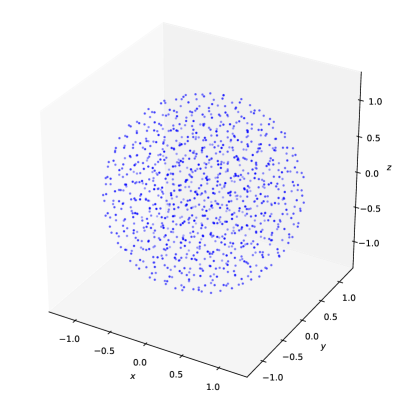
Measured geometry in Newtonian gravity arises from scale-invariant relational physics and depends on local particle separations, challenging the notion of absolute space.
The assumption of absolute spatial geometry clashes with the physical reality of interacting systems, prompting a re-evaluation of how space itself is defined. In ‘The Emergence of Measured Geometry in Self-Gravitating Systems’, we investigate the geometrical properties of gravitationally bound $N$-body systems, revealing that measured distances are not fixed but vary systematically with position. Our analysis of central configurations demonstrates an emergent, context-dependent geometry shaped by particle interactions and scale invariance, suggesting that space is defined by relational physics rather than as a pre-existing framework. Does this framework imply that gravity fundamentally alters our understanding of geometry, and can these insights extend to more complex astrophysical systems?
The Elegant Complexity of Many-Body Systems
The Newtonian N-body problem, at its core, concerns the seemingly simple task of predicting the future positions and velocities of a collection of bodies interacting solely through gravity. While Newton’s law of universal gravitation – F = G \frac{m_1 m_2}{r^2} – accurately describes the force between two bodies, extending this to N bodies creates a system where analytical, closed-form solutions are almost never possible. Each body’s trajectory is influenced by the gravitational pull of every other body, leading to a complex web of interconnected motion. This isn’t merely a mathematical curiosity; it’s a foundational challenge in physics with implications for understanding the stability of solar systems, the evolution of galaxies, and even the formation of planetary systems, forcing scientists to rely on numerical simulations and approximations to explore the behavior of these dynamically complex systems.
The pursuit of predicting the movements of multiple gravitationally bound objects – the N-body problem – quickly encounters limitations when seeking precise, closed-form solutions. While elegantly solvable for just two bodies, or for specific symmetrical configurations, the complexity escalates dramatically with each additional particle. Consequently, physicists and mathematicians often turn to numerical approximations – computational methods that step through time, calculating gravitational forces and updating positions incrementally. However, this reliance on computation introduces inherent uncertainties and raises fundamental questions about the long-term stability of these systems; even minuscule errors in initial conditions or calculations can lead to drastically different outcomes, challenging the very notion of predictable trajectories and prompting investigations into chaotic behavior and the sensitivity of N-body systems to perturbations.
The ability to accurately model the long-term evolution of N-body systems extends far beyond a purely theoretical exercise; it serves as a cornerstone for understanding the cosmos. From the majestic swirling of galaxies, where billions of stars interact gravitationally over immense timescales, to the delicate dance of planetesimals coalescing into planets within protoplanetary disks, the principles governing these systems are fundamentally the same. Researchers utilize sophisticated numerical simulations, built upon the foundations of Newtonian gravity, to explore scenarios ranging from the stability of planetary orbits to the formation of galactic structures. These investigations not only illuminate the past – how celestial bodies came to be – but also provide crucial insights into predicting their future behavior, offering a glimpse into the ultimate fate of stars, galaxies, and even our own solar system. The predictive power derived from these models is essential for interpreting astronomical observations and testing fundamental theories of astrophysics.
Mapping the Landscape of Configuration Space
The analysis of `Central Configurations`-specifically, arrangements of particles in stable equilibrium-provides a method for defining and mapping `Shape Space`. These configurations are not merely spatial coordinates, but rather represent distinct points within a multi-dimensional space where each dimension corresponds to a degree of freedom in the particle arrangement. By identifying and characterizing these stable configurations, researchers can establish a framework for understanding the range of possible particle arrangements and the transitions between them. This approach allows for the systematic exploration of the potential structural states of a system, moving beyond simple observation of individual particle positions to a quantifiable representation of the overall configuration’s topology.
Characterizing particle configurations relies heavily on quantifying spatial relationships between particles. The Nearest-Neighbor Distance, specifically the average distance to the closest neighboring particle, serves as a primary metric for assessing local density and identifying potential clustering. Complementary methods include radial distribution functions, which map the probability of finding a particle at a given distance from a reference particle, and pair correlation functions, quantifying the statistical likelihood of two particles being found at a specific separation. These analyses, alongside calculations of cluster size and distribution, allow for the identification of statistically significant patterns indicative of organizational principles within the configuration, moving beyond simple positional data to reveal emergent structures.
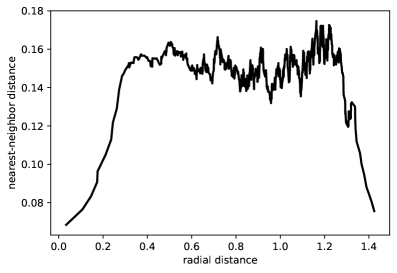
Analysis of particle configurations reveals an average nearest-neighbor distance of 0.16 units for radial distances between 0.3 and 1.3 units. This value, however, is not constant across the configuration; observed fluctuations in this distance indicate variations in particle packing density. These deviations suggest that particles do not maintain a strictly uniform separation, and that local clustering or rarefaction occurs within the overall configuration. The magnitude and frequency of these fluctuations are currently under investigation to quantify the degree of packing heterogeneity and to determine if these variations correlate with the emergence of larger-scale structures.
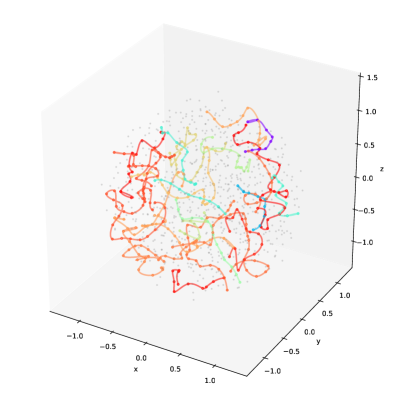
Analysis of particle configurations reveals the frequent emergence of filamentary structures. In a 1000-particle configuration, approximately 37.50% of particles participate in these filaments. These structures are not isolated occurrences but consistently appear across multiple simulations, suggesting an inherent organizational principle governing particle arrangement beyond random distribution. The prevalence of filaments indicates a tendency for particles to align and form extended, linear arrangements within the overall configuration, impacting the observed clustering and spatial distribution patterns.
The arrangement of particles within a given configuration is not merely a spatial distribution, but rather a single point within a multi-dimensional ‘Shape Space’. This space is defined by the intrinsic geometric properties of the configuration, such as the relative distances between particles and the overall topology of the arrangement. Each unique configuration, therefore, corresponds to a specific coordinate within this high-dimensional space, allowing for a mathematical characterization of the system’s structural possibilities. The dimensionality of this space increases with the number of particles, as each particle’s position contributes additional degrees of freedom defining the overall shape. Consequently, analyzing these configurations requires tools from differential geometry and topology to understand the relationships between different shapes and the pathways between them within this abstract space.
Geometry as Emergent Property, Not Precondition
Emergent Geometry posits that geometric properties are not fundamental attributes of the universe, but rather arise as collective phenomena from the interactions of a system’s constituent parts. This challenges the traditional view of a pre-defined, absolute space and instead suggests that spatial relationships are defined by the relationships between physical entities. Geometry, therefore, is not a container within which physics occurs, but is itself a product of physical processes. This perspective indicates that the observed geometry of a system is dependent on the specific configurations and interactions of its components, implying that different arrangements could, in principle, result in different effective geometries.
Newton-Cartan Theory and Poincaré’s Operational Geometry both provide frameworks that move away from the classical Newtonian concept of absolute space. Newton-Cartan Theory extends General Relativity by incorporating torsion and non-metricity, allowing for a geometric description of spacetime where the traditional metric is not the sole determinant of spatial relationships. Poincaré’s Operational Geometry, developed in the late 19th century, posits that space is defined by the procedures used to measure it, rather than being a pre-existing entity; this emphasizes the role of observation and measurement in defining spatial properties. Both theories therefore demonstrate that geometric properties are not inherent to space itself, but are relational and dependent on the physical system within it, challenging the notion of a fixed, absolute spatial background.
The Variety, denoted as V, functions as a quantifiable metric correlating the arrangement of particles with the resulting effective geometry. This scale-invariant measure of shape is calculated from particle configurations, providing a numerical value representing the geometric properties inherent in the system. Recent simulations have demonstrated that the observed value of V is 1.5% greater than the theoretical absolute minimum, indicating a non-trivial geometric structure emerges from the particle interactions and suggesting that the system deviates from a state of minimal geometric complexity. This deviation provides empirical data supporting the concept that geometry is not a pre-defined property but rather an emergent phenomenon dependent on the system’s configuration.
Einstein’s theory of General Relativity establishes a direct relationship between the geometry of spacetime and the distribution of mass and energy within it. Specifically, the Einstein field equations G_{\mu\nu} = \frac{8\pi G}{c^4}T_{\mu\nu} describe how the spacetime curvature, represented by the Einstein tensor G_{\mu\nu}, is directly proportional to the stress-energy tensor T_{\mu\nu}, which characterizes the density and flux of energy and momentum. This means that the presence of mass and energy warps the surrounding spacetime, and this warping is gravity. Consequently, geometry is not a fixed background but a dynamic property determined by the material content of the universe, aligning with the emergent geometry concept where geometry arises from the system’s constituents rather than being a pre-existing framework.
Universal Patterns: Scale Invariance and Clustering
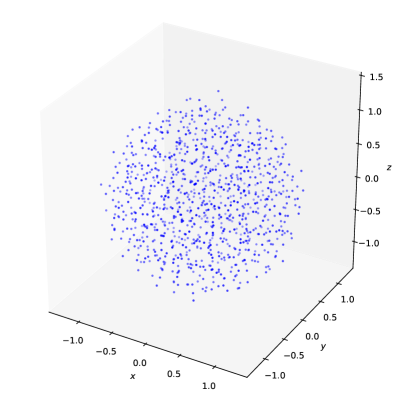
The concept of Variety, a measure of dispersion within a system, exhibits a remarkable property: scale invariance. This means that whether examining a small subsection or the entirety of a complex system-be it a galaxy, a fluid, or a biological tissue-the calculated Variety remains consistent. This isn’t simply a mathematical quirk; it suggests a fundamental organizational principle at play, indicating that the patterns governing particle arrangements are independent of the observational scale. Essentially, the same underlying structure is present regardless of how closely, or broadly, one examines the system, implying a level of universality in how complexity arises and is maintained. Variety therefore provides a powerful tool for understanding systems across vastly different scales, offering insights into the fundamental laws governing pattern formation.
The remarkable consistency of Variety across different scales indicates that the underlying principles structuring particle arrangements are not dictated by system size. This scale invariance suggests a fundamental universality in how matter organizes itself, implying that similar patterns and relationships emerge regardless of whether examining galactic structures or microscopic particle distributions. This isn’t merely a statistical coincidence; the organizational logic appears intrinsic to the system, operating independently of the observational resolution. Consequently, understanding the mechanisms driving this scale invariance offers a powerful lens through which to investigate pattern formation – potentially revealing shared organizational blueprints across seemingly disparate physical and biological phenomena. The implication is that the same mathematical or dynamical rules may govern structures across a vast range of scales, from the cosmos to cellular biology.
Quantifying the degree of clustering within a system requires tools that move beyond simple density measurements. Researchers employ metrics like Root-Mean-Square Length and Mean-Harmonic Length to calculate a value termed ‘Variety’, which effectively assesses how uniformly particles are distributed. Root-Mean-Square Length calculates the average distance between particles, providing a measure of overall spread, while Mean-Harmonic Length is more sensitive to closely packed clusters, giving greater weight to shorter distances. By comparing these values, scientists can determine if a system exhibits a tendency towards uniform dispersal or pronounced aggregation. A higher Variety suggests a more heterogeneous distribution with significant clustering, while a lower value indicates greater uniformity. These calculations offer a powerful means of characterizing structural organization and identifying patterns of clustering across diverse systems, from galactic distributions to biological structures.
The principles revealed by scale invariance and the analysis of clustering extend far beyond the realm of astrophysics. Researchers are discovering that the same mathematical framework used to describe the distribution of galaxies can also model pattern formation in seemingly disparate systems, from the branching of neurons and the growth of fungal networks to the arrangement of atoms in materials and even the spread of epidemics. This suggests a unifying principle at play – a fundamental tendency for systems to self-organize in ways that exhibit similar statistical properties regardless of scale. By applying tools like Variety calculations – which quantify the uniformity or clustering within a system – scientists gain valuable insight into the underlying mechanisms driving these patterns, potentially unlocking new approaches to materials science, biology, and the understanding of complex networks in general.
The study rigorously establishes that geometry, far from being a pre-existing framework, arises from the relationships between bodies-a principle echoing Thomas Kuhn’s observation: “The world does not speak to us directly, but through the filters of our paradigms.” This emergent geometry, demonstrated through the analysis of central configurations, isn’t absolute but relational, intimately tied to the scale-invariant separations of particles. The observed inhomogeneities reveal that measured distances are not inherent properties of space itself, but rather consequences of the system’s internal organization-a compelling illustration of how observed phenomena are shaped by the very frameworks used to observe them. The focus on shape space further reinforces this perspective, emphasizing the primacy of relationships over absolute positions.
Further Lines of Inquiry
The insistence on relational geometry necessitates a re-evaluation of conventional analytical tools. Current methods, predicated on absolute spatial reference, prove cumbersome when applied to systems defining their own measure. The search for invariants beyond scale invariance – those characterizing stability or bifurcations in configuration space – appears paramount. A fully operational geometry demands such descriptors, moving beyond mere kinematic mapping.
Limitations remain stark. Newtonian gravity, while serving as a useful initial framework, obscures the subtleties anticipated in general relativistic settings. Extending these findings to encompass relativistic effects, particularly those concerning the emergence of spacetime itself, presents a formidable, though logical, progression. Such work may require abandoning the notion of particles as fundamental entities, favoring instead a description based on fields or more abstract relational structures.
Ultimately, the value of this work resides not in providing answers, but in clarifying the proper questions. The pursuit of absolute properties yields diminishing returns. The focus should shift toward understanding how constraints, arising from particle interactions, dictate the observable geometry. A parsimonious description, devoid of extraneous assumptions, remains the ideal – though perhaps an asymptotic one.
Original article: https://arxiv.org/pdf/2602.18115.pdf
Contact the author: https://www.linkedin.com/in/avetisyan/
See also:
- Marvel Officially Confirms Deadpool’s Most Brutal Redesign
- 10 Movies That Were Banned in Different Countries For Random Reasons
- Welcome to Demon School! Iruma-kun season 4 release schedule: When are new episodes on Crunchyroll?
- Nintendo Switch 2 Reportedly Getting Remake of One of the Best PS3 and Xbox 360 Games
- Crunchyroll Confirms New Isekai Anime Releases for 2026 and Beyond (With Major Returns)
- Michael Jackson Biopic’s Record-Breaking Debut Unseats 2026’s Biggest Box Office Hit On U.S. Chart
- 9 Great Supernatural Characters Everyone Forgot About
- Gold Rate Forecast
- ‘The Bride!’ Review: Jessie Buckley Breathes Life into a Monstrous Mess
- Taylor Sheridan’s Gritty 5-Part Crime Show Reveals New Final Season Villain
2026-02-23 13:33